
On this page
A DDoS protected VPS combines virtual private server hosting with measures designed to keep websites and applications available during distributed denial-of-service attacks. The most effective protection usually starts at the hosting provider’s network, then adds server hardening, traffic filtering, and application-level defenses.
If you host websites, APIs, online stores, or client projects on a VPS, understanding these layers can help you reduce downtime and choose the right hosting environment. This guide explains how DDoS protection works, how to protect a VPS from DDoS attacks, and which security features to look for in a hosting provider.
What Is a DDoS Protected VPS?
A DDoS-protected VPS is a virtual private server hosted on infrastructure that includes protection against distributed denial-of-service attacks. These attacks send large amounts of unwanted traffic toward a server or service, potentially exhausting its bandwidth, network resources, or application capacity.
Unlike a basic VPS, a DDoS-protected VPS hosting plan includes some form of attack detection and mitigation. The exact protection depends on the provider, network architecture, and service plan.
For example, a provider might filter malicious traffic before it reaches the physical server. You can then strengthen the VPS itself by configuring firewall rules, securing exposed services, and limiting abusive application requests.
A protected VPS does not guarantee that every attack will be stopped. Its effectiveness depends on the types of attacks covered, mitigation capacity, filtering methods, and the provider’s response process.
How Does VPS DDoS Protection Work?
VPS DDoS protection works by identifying suspicious traffic and filtering or absorbing it before it overwhelms the targeted service. Depending on the attack, mitigation can happen at the network, transport, or application layer.
The main protection layers include:
| Protection layer | What it does | Where it helps |
|---|---|---|
| Network level | Filters or absorbs large traffic floods | Attacks that consume bandwidth or network capacity |
| Transport level | Detects and mitigates abusive protocol traffic | TCP and other network protocol attacks |
| Application level | Filters excessive or suspicious requests | HTTP floods and attacks targeting websites or APIs |
| Server level | Restricts unnecessary connections and services | Reducing the server’s attack surface |
These layers work together, but they are not interchangeable.
For example, a Linux firewall can block unwanted connections that reach your VPS. However, it cannot restore bandwidth if an attack has already saturated the network connection upstream. That is why provider level mitigation is essential for serious volumetric attacks.
What Types of DDoS Attacks Can Target a VPS?
Understanding the attack type helps you choose the right protection.
1. Volumetric attacks
Volumetric attacks attempt to consume the available network bandwidth by flooding the target with traffic. The result can be slow connections or complete network unavailability.
These attacks require mitigation that can absorb or filter traffic before it overwhelms the hosting provider’s network or the VPS connection.
2. Protocol attacks
Protocol attacks exploit or overwhelm the resources used to handle network connections. They can affect network devices, connection tracking, or other infrastructure responsible for processing traffic.
Protection may include upstream filtering and appropriate network level controls.
3. Application layer attacks
Application layer attacks target services such as websites and APIs. Attackers may send large numbers of requests that appear similar to legitimate visitor traffic but consume excessive application resources.
A web application firewall, request rate limiting, caching, and upstream HTTP filtering can help mitigate these attacks.
A single protection method may not cover every attack type. Before choosing DDoS protected VPS hosting, confirm which layers the provider actually protects.
How to Protect a VPS From DDoS Attacks
You cannot eliminate every DDoS risk through local configuration, but the following seven steps can strengthen your defenses.
1. Choose a VPS Provider With Upstream DDoS Protection
Start with the hosting provider because network-level protection must operate before malicious traffic overwhelms your server’s connection.
Ask whether DDoS mitigation is always active or activated manually during an attack. Confirm which attack types are covered and whether protection applies to your VPS IP address and the services you run.
Check these details before purchasing:
- Whether network and transport layer attacks are covered
- Whether HTTP and HTTPS attacks receive application-level protection
- How attack detection and mitigation are triggered
- Whether mitigation is included in the plan or billed separately
- What happens if the attack exceeds the provider’s mitigation capacity
- Whether the provider may temporarily null route your IP address
- Whether there are traffic limits, fair use conditions, or additional charges
Do not select a provider based only on a large advertised mitigation figure. Ask what that figure means for your specific plan and what happens when an attack occurs.
2. Configure a Firewall on Your VPS
A firewall helps control which connections can reach your server. It reduces unnecessary exposure and can block traffic that should never reach a service.
On Ubuntu systems using UFW, first check the existing rules:
sudo ufw status verboseIf UFW is not configured, identify your actual SSH port and required application ports before changing anything. For a basic web server using SSH on port 22, a starting configuration may look like this:
sudo ufw allow 22/tcp
sudo ufw allow 80/tcp
sudo ufw allow 443/tcp
sudo ufw enable
sudo ufw status numberedImportant: These are example rules, not a universal configuration. Hosting control panels, mail servers, DNS services, VPNs, and other applications may need additional ports. Confirm the requirements of your installation before enabling the firewall, or you could lose remote access or disrupt services.
For a broader walkthrough, see CyberPanel’s guide to the VPS security checklist.
A firewall is useful against unwanted connections, but it is not a substitute for upstream DDoS mitigation. If the incoming traffic saturates your network link, local firewall rules may not prevent the outage.
3. Close Unnecessary Ports and Services
Every publicly exposed service creates another potential entry point or target.
Review listening services with:
sudo ss -tulpnThis command lists listening TCP and UDP sockets and associated processes where available.
Check which services need public access. A database used only by a local application, for example, generally should not accept unrestricted connections from the public internet.
Review your firewall rules and disable services you no longer need. Do not stop an unfamiliar service without checking its purpose and dependencies.
For hosting environments, verify the required ports for the control panel, web server, DNS, mail, and other enabled services before making changes.
4. Harden SSH and Administrative Access
Attack traffic is not limited to websites. Exposed administrative services can also receive unwanted connection attempts.
Use SSH keys where appropriate, restrict access to trusted networks when practical, remove unused accounts, and disable direct root login if your administration workflow supports it.
Before changing SSH settings, confirm that your replacement access method works and keep an existing session open until you have tested the new connection.
You can review recent authentication activity on many Linux distributions using:
sudo journalctl -u ssh --since "1 hour ago"Some distributions use a different service name, such as sshd, and log locations vary. If the command returns no relevant entries, check the service name and your system’s logging configuration.
SSH hardening does not stop a large bandwidth flood. It helps secure the management interface and reduces other risks while your provider handles network-level attacks.
5. Use a WAF and Rate Limiting for Web Traffic
A web application firewall (WAF) can filter HTTP requests based on configured rules. Rate limiting can restrict how frequently a client or other defined key makes requests to a particular endpoint.
These controls are particularly useful when a website or API is being overwhelmed by expensive requests rather than raw network traffic.
Consider applying suitable limits to:
- Login and authentication endpoints
- Search functions that perform expensive queries
- Public APIs with predictable usage patterns
- Resource-intensive dynamic pages
- Other endpoints that attract automated abuse
Avoid applying one aggressive limit to every visitor. Legitimate users, shared IP addresses, search engine crawlers, and mobile networks can all generate traffic patterns that resemble abuse.
Test WAF rules and rate limits carefully. Overly restrictive settings can block real customers without resolving an attack that is consuming bandwidth upstream.
6. Use a Reverse Proxy or CDN Where Appropriate
A reverse proxy or content delivery network can provide another layer of traffic filtering, caching, and application protection.
For eligible websites, routing traffic through a proxy service can help absorb or filter certain attacks before requests reach the origin server.
However, setup matters. If attackers can still connect directly to the origin IP address, they may bypass the proxy’s application-level protections.
To reduce that risk:
- Configure the website to use the proxy service correctly.
- Restrict direct origin access where possible.
- Allow only the proxy’s published source IP ranges at the origin when your architecture supports it.
- Keep those source ranges updated.
- Confirm that DNS records and other exposed services do not unintentionally reveal alternate routes to the origin.
A website proxy does not automatically protect every service on a VPS. SSH, mail, game servers, and other non-proxied services may need separate network protection.
7. Monitor Traffic and Prepare an Incident Response Plan
Monitoring helps you distinguish an attack from normal traffic growth, an application bug, or a resource bottleneck.
Useful indicators include:
- Sudden increases in incoming traffic
- Unusual request rates or repeated requests to one endpoint
- High network throughput
- Unexpected CPU or memory consumption
- Connection or service errors
- Increased response times and failed requests
You can inspect basic interface statistics with:
ip -s linkAnd review CPU and process usage with:
topThese commands provide useful local information, but they do not independently identify every DDoS attack. Combine server metrics with hosting provider traffic graphs, firewall logs, web server logs, and any available mitigation dashboard.
Prepare a response plan before an incident occurs. Know how to contact your hosting provider, where to check mitigation status, which application endpoints are critical, and how to preserve relevant logs.
If a serious attack is underway, contact the provider’s network or abuse team promptly. They can investigate traffic that never reaches your VPS and apply upstream mitigation when available.
Does a Firewall Provide Enough DDoS Protection?
No. A firewall is an important security layer, but it cannot guarantee protection against every DDoS attack.
The main limitation is where the traffic gets filtered.
If unwanted traffic reaches your VPS connection, host-level rules may help block it. If a flood saturates the provider’s network or the connection to your server before the firewall can process it, the VPS can become unreachable despite having correct local rules.
Compare the different defenses:
| Defense | Main benefit | Important limitation |
|---|---|---|
| Linux firewall | Controls allowed network connections | Cannot recover upstream bandwidth |
| WAF | Filters application requests | Does not cover every network attack |
| Rate limiting | Restricts excessive request rates | Must be tuned to avoid blocking legitimate users |
| CDN or reverse proxy | Distributes and filters eligible web traffic | Direct origin access may bypass protection |
| Hosting provider mitigation | Filters attacks upstream | Coverage and capacity depend on the provider |
For reliable DDoS protection, combine provider-level mitigation with suitable server and application controls. Cloudflare’s DDoS mitigation guide explains why mitigation capacity and filtering before the target network are important.
What Should You Look for in DDoS Protected VPS Hosting?
Not all plans marketed as DDoS protected provide the same level of protection. Compare the actual features and limitations rather than relying on the label.
| Feature | What to verify |
|---|---|
| Network protection | Which network and transport attacks are covered? |
| Application protection | Are HTTP and HTTPS attacks covered, or is a separate WAF required? |
| Always-on mitigation | Is protection active continuously or only after an attack is detected? |
| Mitigation capacity | What are the provider’s limits and escalation procedures? |
| Null routing policy | Can your IP be temporarily disconnected during an attack? |
| Traffic policy | Are there fair use limits or additional fees? |
| Response support | Can the provider investigate an active attack? |
| IP protection | Does protection cover your actual server IP and all relevant services? |
| Monitoring | Are traffic graphs, attack reports, or mitigation events available? |
Choose a plan based on your workload and exposure. A small business website, a public API, and an online game server may have very different traffic patterns and protection requirements.
Do not assume that a VPS with high bandwidth or powerful CPU resources is automatically DDoS protected. Server resources and attack mitigation solve different problems.
DDoS Protected VPS vs. Standard VPS Hosting
The main difference is the availability of attack mitigation, not the virtualization technology itself.
| Factor | Standard VPS | DDoS protected VPS |
|---|---|---|
| Virtualized resources | Yes | Yes |
| Upstream attack filtering | May be limited or unavailable | Included according to the plan |
| Network flood handling | Depends on provider infrastructure | Depends on mitigation coverage and capacity |
| Server hardening | Usually your responsibility | Still your responsibility |
| Application level defense | May require separate tools | May require separate tools |
| Cost | Depends on resources and provider | May cost more depending on protection |
A protected VPS is not necessarily more secure against every threat. DDoS mitigation focuses on availability during traffic attacks, while malware prevention, access control, patching, and backups address other security risks.
Read the service terms carefully and ask the provider to explain any protection limitations that matter to your workload.
What Should You Do During a DDoS Attack?
If your website becomes unavailable or unusually slow, do not assume that every traffic spike is a DDoS attack. Check your monitoring and contact your hosting provider to confirm whether malicious traffic is involved.
Follow this response process:
- Check the provider dashboard. Review traffic graphs, network alerts, and any reported mitigation events.
- Contact support. Share the affected IP address, time of onset, symptoms, and relevant logs through the provider’s official support channel.
- Check server health. Review network interface statistics, CPU and memory usage, connection counts, and web server logs.
- Identify the affected service. Determine whether the issue involves bandwidth, a specific port, a website, an API, or the server itself.
- Apply suitable application controls. If HTTP requests are responsible, review WAF rules, rate limits, caching, and expensive endpoints.
- Avoid random firewall changes. Blocking traffic without understanding the attack can disrupt legitimate users and may not address the underlying bottleneck.
- Review the incident afterward. Record what happened, which controls worked, and whether the provider’s protection met your needs.
If the server is unreachable because the upstream connection is saturated, local commands may be impossible to run over SSH. In that case, provider-level mitigation and out-of-band management options become especially important.
How Does CyberPanel Fit Into VPS DDoS Protection?
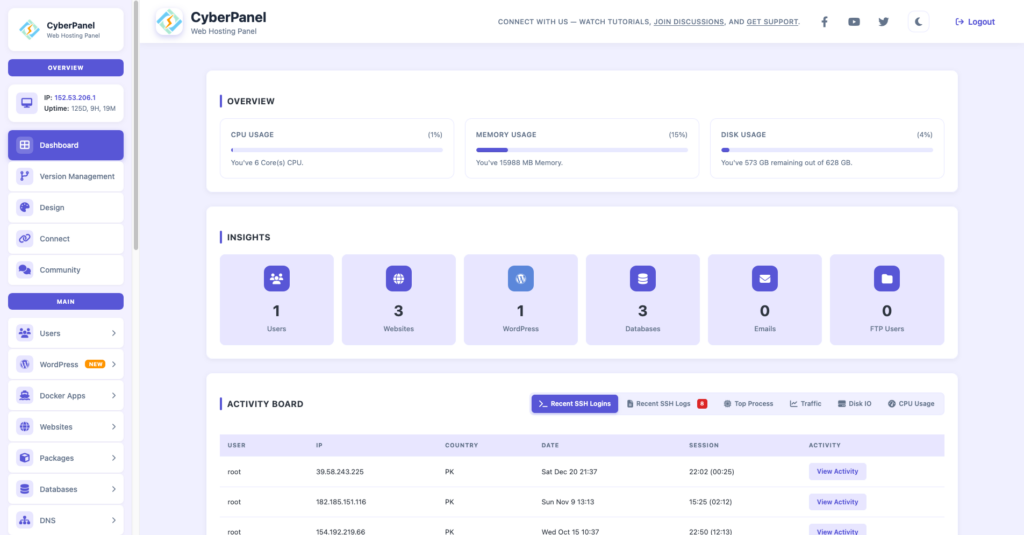
CyberPanel is a free and open-source web hosting control panel powered by OpenLiteSpeed. It helps administrators manage websites and server services, but it should not be treated as a replacement for a hosting provider’s network-level DDoS mitigation.
For a CyberPanel server, use a layered approach:
- Choose hosting with appropriate upstream DDoS protection.
- Configure the CyberPanel firewall to expose only the ports required by your installation.
- Secure panel access with strong authentication and two-factor authentication where available.
- Keep the operating system, panel, web server, and applications updated.
- Use supported web application security controls, including ModSecurity where appropriate.
- Monitor server resources and website traffic.
- Maintain tested backups in a separate location.
For additional server hardening steps, read CyberPanel’s VPS security checklist.
If you are managing a CyberPanel installation, check its current documentation before applying firewall rules or changing service ports. A rule that works for a minimal web server may disrupt a hosting server that also runs DNS, email, FTP, or other services.
The objective is to make the server harder to abuse while ensuring that legitimate traffic and essential administrative access continue to work.
Frequently Asked Questions
What is a DDoS protected VPS?
A DDoS protected VPS is a virtual private server hosted with protection designed to detect and mitigate distributed denial of service attacks. Protection varies by provider and may cover network, transport, and application layer attacks.
Can I protect a VPS from DDoS attacks myself?
You can reduce risk with firewall rules, secure configuration, application rate limiting, monitoring, and a suitable proxy or CDN. However, large attacks that saturate the upstream network generally require mitigation from your hosting provider or a specialist network protection service.
Does DDoS protection slow down a VPS?
It does not necessarily slow down a VPS. Filtering and routing can introduce some overhead or latency, depending on the provider’s architecture and where traffic is processed. A properly designed protection service aims to mitigate attacks while keeping legitimate traffic available.
Final Thoughts
A DDoS protected VPS is a strong starting point for hosting services that need to remain available during traffic attacks. However, the protection is only as useful as its coverage, mitigation capacity, and response process.
Start by choosing a provider with clear upstream DDoS mitigation policies. Then secure your Linux server, reduce exposed services, protect web applications, and monitor traffic so you can respond quickly when something goes wrong.
For CyberPanel administrators, the best approach is to combine provider-level protection with careful server configuration and ongoing maintenance. No single firewall, proxy, or control panel can replace a layered security strategy.