
On this page
Sponsored guest contribution.
Our first eighteen-market read split along language lines. We showed up across the English-language markets and were absent in France, where the answers cited French trade press our PR team had never briefed. PR sat in corporate affairs, and nobody owned a French source list. The pattern isn’t ours alone: 89.34% of sources cited in AI Overviews in France are in French.
That split changed what I ask of AEO software. The first question is the unit of measurement: does the platform treat each market as its own read, with local prompts and a local owner, while the board gets one comparable number? I tiered eight AEO platforms by that answer: per-market tracking, enterprise localization, and market context next to visibility.
What Should AEO Software Do For A Program That Spans Many Markets?
AEO software for a multi-market program has four jobs: track each market in its own language, measure every market the same way, let each local owner work their market, and roll it into one board read. Miss one and the program splits.
Since October 2025, AI Mode launched in more than 35 new languages and over 40 new countries and territories, reaching over 200 countries and territories, so nearly every market now has an answer layer to measure.
What I check in an AEO platform:
- Market unit: country, city or region, prompt language.
- Comparability: same definitions and competitors per market.
- Owner access: users, roles, brands.
- Roll-up: exports, BI connectors, API.
Method: I read each vendor’s own pages in October 2026 and scored them on those four checks.
Which Market Unit Does Each AEO Platform Use?
Here’s the top answer engine optimization software for a multi-market program: four Tier 1 trackers, three Tier 2 enterprise platforms, one Tier 3 context platform. Read the market unit column first: it decides who can own each market.
| # | Platform | Tier | Engines | Market unit | Starting price |
|---|---|---|---|---|---|
| 1 | SE Visible by SE Ranking | 1: Per-market tracking | ChatGPT, Gemini, AI Mode, AI Overviews | Country, or city or region, per project | Free trial available |
| 2 | Peec AI | 1: Per-market tracking | Choose 3; more on Enterprise | 1-3 countries by plan; Enterprise unlimited | Starter $95/mo |
| 3 | Promptwatch | 1: Per-market tracking | 4 models per plan | Country on all plans; city on Business | Essential listed at $95/month |
| 4 | ZipTie | 1: Per-market tracking | 7 engines | Country and language per project | Usage-based, from $42.75/mo |
| 5 | AthenaHQ | 2: Enterprise localization | 11 on paid plans | Single region on Starter; multiple on Enterprise | Starter listed at $295/month |
| 6 | Goodie | 2: Enterprise localization | 5 to 13 by tier | 2, 5, or 8+ countries by tier | Core listed at $399/month |
| 7 | Scrunch AI | 2: Enterprise localization | 4 on Core, 9 on Enterprise | 1 country on Core; Enterprise unlimited | Core listed at $250/mo |
| 8 | Similarweb AI Brand Visibility | 3: Market context | ChatGPT, AI Mode, Gemini, Perplexity | One region and language per campaign | AEO Intelligence listed at $99 |
Tier 1: Which Platforms Track Each Market As Its Own Unit?
Tier 1 AEO platforms treat a market as its own unit of measurement: prompts written in the local language, a competitor set chosen for that country or city, and visibility read market by market. Local leads write the prompts; one central analyst guards the definitions.
1. SE Visible
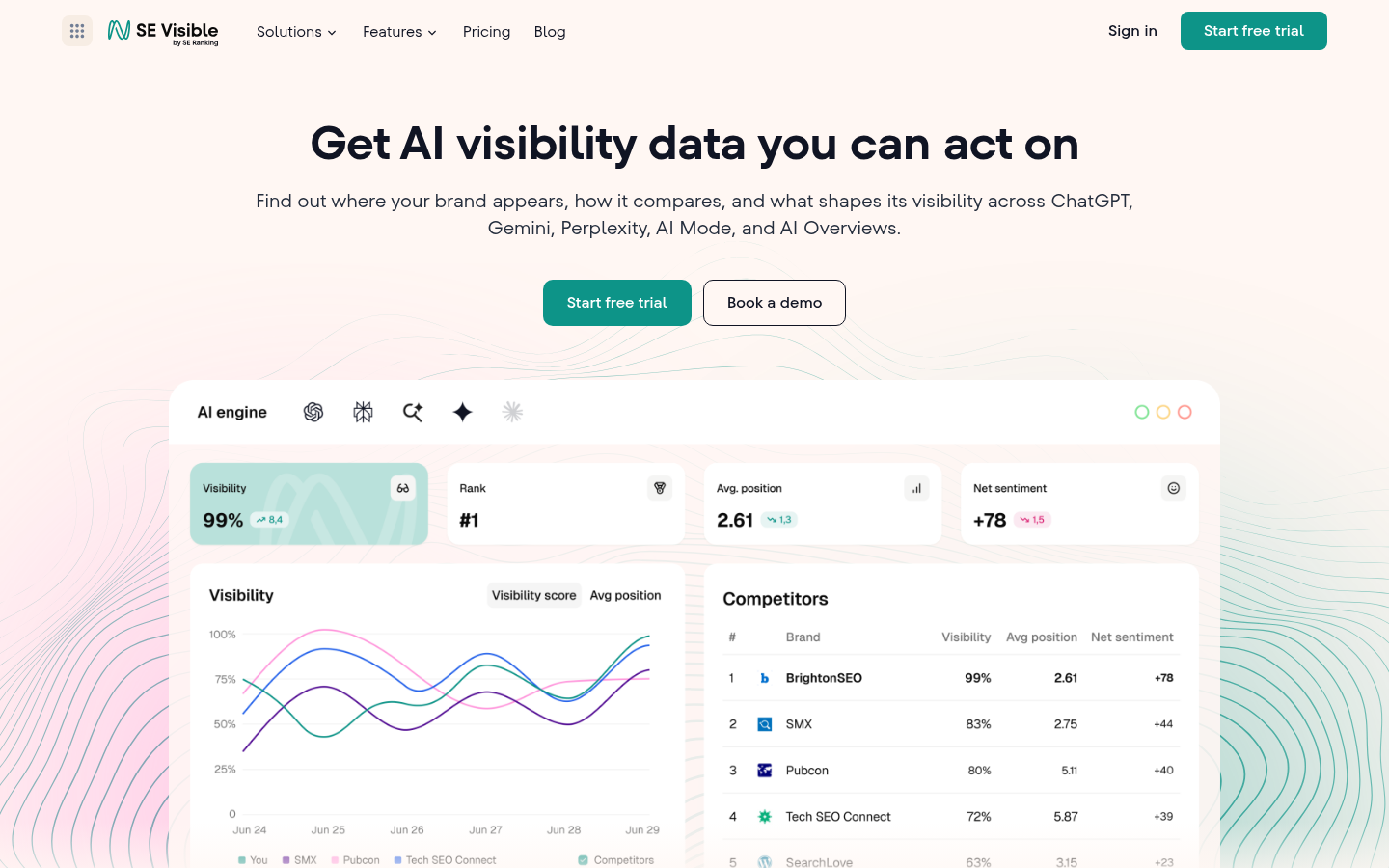
Create one project per market, down to a single city, and no answer from one market leaks into another’s numbers. SE Visible by SE Ranking is an AI visibility platform that stores each engine’s unedited answers per brand and market: a country or a specific city or region.
Best for: in-house AI search leads running several country or city markets who need each market’s evidence kept apart but still comparable at the roll-up.
Standout: SE Visible sets the market per project, down to a city or region, and each prompt carries its language and assigned location. Branded and non-branded prompts report separately. The topic-by-topic competitor comparison shows who leads each topic locally, and any metric opens the stored answer with its engine, market, and date.
Pros:
- Several brands in one platform, with unlimited users, so each local owner opens their market’s answers
- ChatGPT, Gemini, Google AI Mode, Google AI Overviews on all plans, with no engine add-ons; Claude support is planned
- For the cross-market roll-up: a Looker Studio connector, plus API access on all plans
Cons:
- AI visibility only: SEO work such as rank tracking, keyword research, and site audits happens in SE Ranking.
- Tracking several countries inside one project is planned as the platform grows. For now, each market runs as its own project, joined at the roll-up.
Pricing: See visible.seranking.com for current plans; a free trial is available.
Across the markets: Our Tier 1 test was a split of work. The local lead in France opens the French answers and owns the fix, while the central analyst reads every project on the same four metric definitions. Each market keeps its own evidence, and the board slide stays comparable.
2. Peec AI
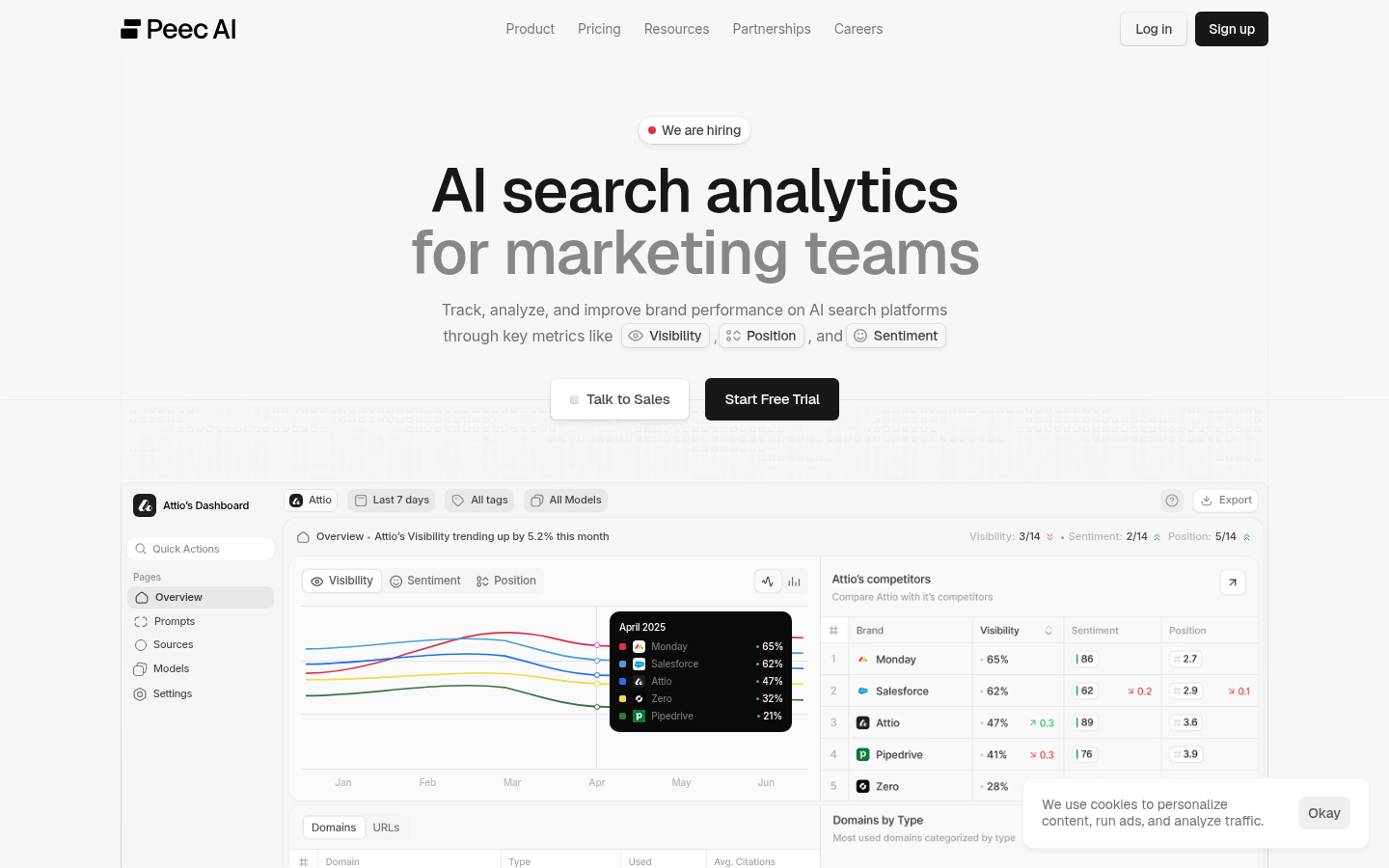
Peec AI tracks brand visibility in AI search, priced by prompt.
Best for: in-house teams adding markets one by one.
Standout: Peec AI’s FAQ says you can track any supported country or language at no additional cost. Starter covers one country, Pro and Advanced three, Enterprise unlimited. Languages are unlimited on every plan, so prompts can follow how each market asks.
Pros:
- Sub-brand tracking in one account
- Full or read-only access per project
- Looker Studio from Advanced, API on Enterprise
Cons:
- Three countries maximum below Enterprise
- Three models per plan until Enterprise
Pricing: Starter $95/mo billed monthly; 15% off annually; free trial.
Across the markets: Each country lead owns a prompt set, and per-project permissions mirror that split. The country cap shapes the plan: three countries carry a pilot wave, while a full rollout lands on Enterprise, so write that into the business case.
3. Promptwatch
Promptwatch follows a brand through AI answers, country by country.
Best for: programs that need city-level reads inside priority countries.
Standout: Promptwatch runs country tracking on Essential, Professional and Business; state and city tracking is listed on Business only. Each plan tracks four models, with Claude and Grok among the options. Promptwatch says it scrapes each answer from the engines’ live interfaces.
Pros:
- MCP and API on every plan
- DeepSeek and Meta Llama available
- Audit logs on Business, for shared projects
Cons:
- State and city tracking only on Business
- Reporting connector listed as coming soon
Pricing: Essential at $95/month; 7-day free trial.
Across the markets: When a capital city answers differently from the rest of its country, Promptwatch can read that gap. The local lead picks the cities. Plans hold 1, 2 or 5 projects, so map markets to projects before the trial.
4. ZipTie
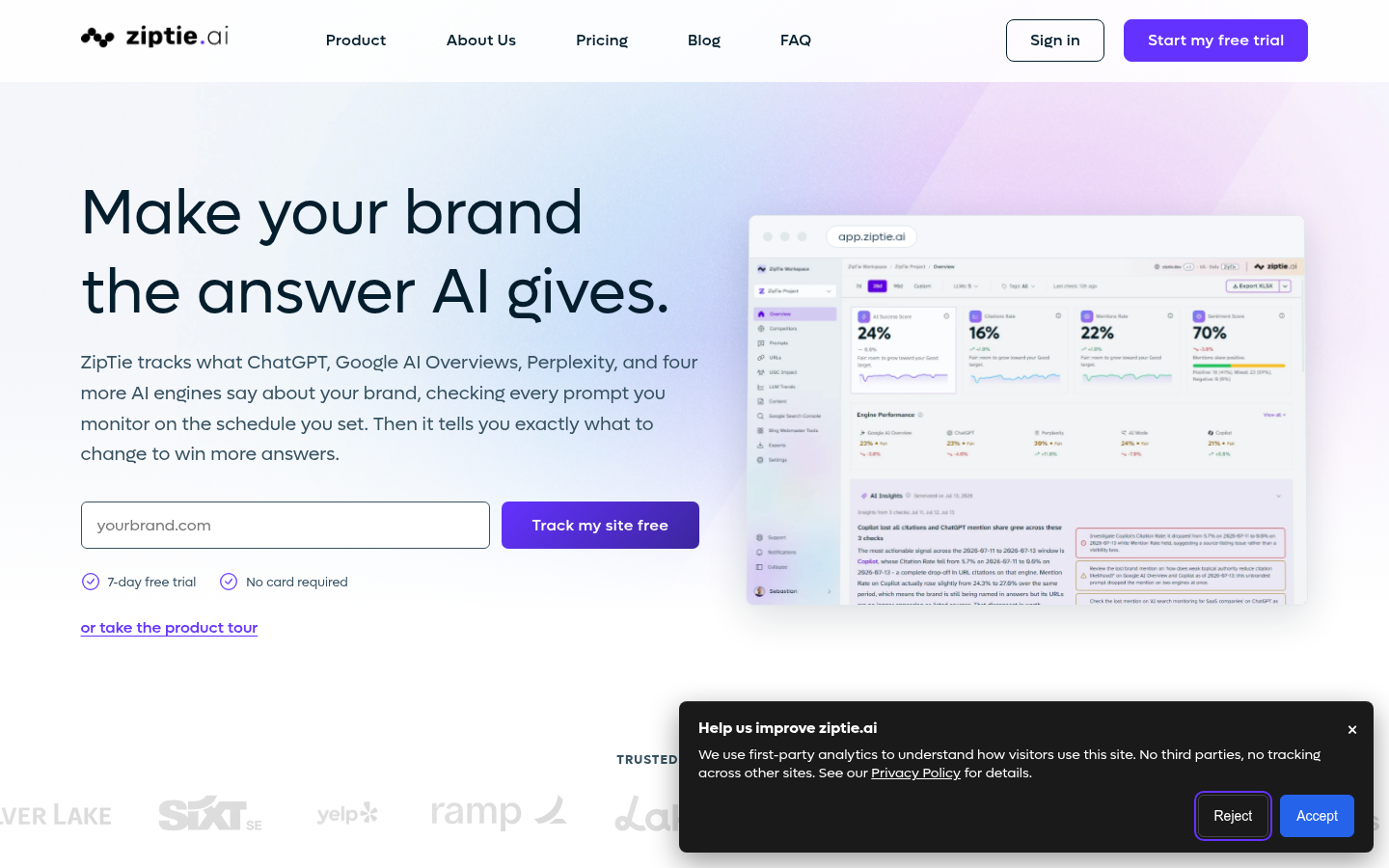
ZipTie captures answers from seven live AI products.
Best for: teams running many small market projects, each configured separately.
Standout: Every ZipTie project carries its own prompts, competitors, country and language, and the vendor claims coverage in nearly every country. Projects, seats and competitors are unlimited, so each market can be its own project. Check cadence is set per project, too.
Pros:
- Copilot and Bing AI Overview included
- Guest, User, Admin and Owner roles
- PDF snapshots shared by no-login link
Cons:
- No cross-project roll-up, per the vendor
- API and MCP cost an extra $10/mo
Pricing: Usage-based, from $42.75/mo billed monthly; 7-day free trial.
Across the markets: There’s no roll-up view, so the central analyst owns a monthly export joining every market project into one comparable read, scheduled before the monthly review. An export without a named owner slips first, and the board slide slips with it.
Tier 2: Which Enterprise Platforms Build Localization In?
Even inside one country and one language, the answer moves with the user: across five US locations, AI Overviews cited identical domains for 47.05% of queries, and 6.34% shared none. Across countries, that drift compounds. Tier 2 AEO platforms answer it with localization and governance written into the enterprise contract.
5. AthenaHQ
AthenaHQ pairs AI visibility tracking with content agents.
Best for: global teams standardizing many regions on one contract.
Standout: AthenaHQ Enterprise lists multi-region and multi-language support, 60+ countries and languages per the FAQ. Configurable multi-views cut dashboards by region, team or persona, so each country lead works a regional view while executive dashboards connect to Tableau, Power BI or Looker.
Pros:
- Eleven engines on paid plans
- Unlimited seats, role-based access
- SAML and OIDC SSO on Enterprise
Cons:
- Starter is “Single” for region and language
- BI support is Enterprise-only; Starter API is an add-on
Pricing: Free Essential; Starter from $295/month; Enterprise custom.
Across the markets: Regional views work when each has a named lead. I’d map them to our country owners before signing and point the BI feed at the dataset behind the board slide. The contract closes in a month; the owner list takes a quarter.
6. Goodie
Goodie runs end-to-end AEO, from tracking to content agents.
Best for: multi-brand groups scaling market coverage by tier.
Standout: Goodie scales countries and languages together: two on Core, five on Pro, eight or more on Enterprise. Enterprise adds centralized multi-brand performance, and Reports include Country/Location Analytics, so a brand group can read each market and each brand in one place.
Pros:
- Every tier gets MCP server access
- Pulls in GA4, Search Console and Bing Webmaster Tools
- Engines grow by plan: five, eight, up to 13
Cons:
- One tracked brand below Enterprise
- Export and API access are Enterprise-only
Pricing: Core listed at $399/month; 7-day free trial.
Across the markets: Five markets on Pro covers a pilot region, not a portfolio. For a full portfolio and several brands, Enterprise is the working tier, and exports decide it: if the analysts can’t pull data out, the monthly cross-functional review runs on screenshots.
7. Scrunch AI
Scrunch AI tracks visibility by country, language and persona.
Best for: global brands adding Agent Pages, Scrunch’s AI-agent site layer, to regional domains.
Standout: Scrunch AI keeps localization on Enterprise: unlimited countries, custom languages and custom personas. The vendor describes multi-brand, multi-domain and multi-region deployments with full language localization, and brand workspaces are custom too, so each brand in a group keeps its own space.
Pros:
- Persona-level tracking
- Nine LLMs on Enterprise, Gemini included
- SOC 2 Type II and role-based access
Cons:
- Core is one country, one language, one persona
- Localization, Looker Studio, API: Enterprise only
Pricing: Core is $250/mo; 7-day free trial.
Across the markets: Monitoring is the easy half. Agent Pages go live on regional domains owned by local web teams, not my analysts. Before an Enterprise deal, I’d agree which market leads approve agent-facing pages, and on what cadence, or localization stays on the slide.
Tier 3: Which Platform Adds Market Context?
Tier 3 sets AI visibility beside market data, because the engine that matters is a market fact: ChatGPT’s share of AI referral traffic is 71.33% in the US, 75.59% in the EU and 85.28% in the UK. Each country then weights its engines on evidence.
8. Similarweb AI Brand Visibility
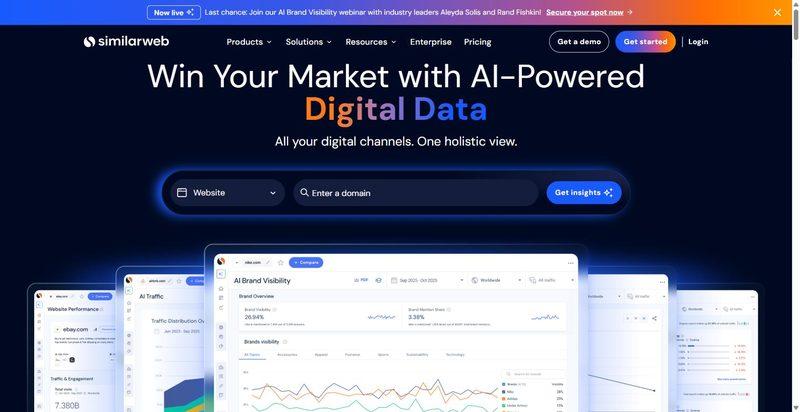
Similarweb’s AI visibility tracker for ChatGPT, Google AI Mode, Gemini and Perplexity.
Best for: teams already using Similarweb market data.
Standout: Every campaign starts with a region and a language, so one market’s read stays clean. Similarweb shows the top 30 brands per tracked topic, telling a local owner which rivals the engines name in their country, beside market data they already use.
Pros:
- Several brands in one dashboard
- Sits beside Similarweb traffic data
- Per-campaign market scope
Cons:
- Region and language fixed after creation, per its Help Center
- Covers four engines
Pricing: AEO Intelligence listed at $99 (1 user, 150 prompts); billing period not shown.
Across the markets: The country lead signs off region and language before a campaign exists, because that choice sticks. Across the program, this belongs in the monthly review as context: which engines carry weight in each country, beside traffic.
Which AEO Platform Tier Should A Multi-Market Team Start With?
If your local owners need their own market’s evidence and the board needs comparable definitions, start your AEO software shortlist in Tier 1 with SE Visible. Add Tier 2 when many regions’ governance must sit in one contract; Tier 3 is context. The best AEO tool matches your market unit.
See how SE Visible fits your program, starting with one market. For SEO, SE Ranking covers Google and traditional search engines; together, the two platforms give a fuller picture of each market across search.
Skip if
- ZipTie as the board’s single source: no cross-project roll-up, per the vendor.
- Similarweb for markets you’ll redefine: region and language stay fixed per campaign.
In our eighteen markets, visibility held in twelve; the six misses had no local prompt owner.
FAQ: AEO Software Across Countries And Languages
Can one AEO platform track several countries and languages?
Yes, but check the market unit first. Some platforms set the market per project, others per prompt or per campaign, and country limits can rise with the plan tier. Confirm each market stays separate under shared definitions.
Should prompts be translated or written per market?
Write prompts per market, by the local owner. A 2026 preprint auditing health queries found that non-English queries surfaced fewer citations, and ChatGPT returned no sources for 23% of Japanese responses. A translated English set doesn’t behave like the original, so our local leads write their own.
What is the best answer engine optimization setup for a large, multi-market business?
Organization comes first. Who owns it: one local owner per market for prompts, one central analyst for definitions, the same competitor set everywhere. The best AEO software for that shape is a Tier 1 platform, adding Tier 2 when cross-region governance requires it.