On this page
Trying to manage a network without thorough documentation is like going to a new town and trying to find your way with no map. The truth is that IP addresses will get reused, VLANs will overlap, and devices will just disappear. What starts as a small confusion ends up being downtime.
This is where NetBox Docker really flips the script.
NetBox is a robust infrastructure resource modeling software that network engineers use to keep track of IP addresses, racks, devices, and connections. If you deploy it with Docker, the installation process is not only quicker but also cleaner and easier to keep up with.
Suppose you want a contemporary, well-organized method of managing your network inventory; then this is the place to begin.
What Is NetBox?
NetBox is an open-source web application for network documentation and IP address management (IPAM).
It helps you keep track of:
- IP addresses
- VLANs
- Racks
- Devices
- Cables
- Data centers
- Virtual machines
Instead of spreadsheets and guesswork, NetBox offers well-structured visibility.
What Is NetBox Docker?
NetBox Docker is a way to run NetBox inside containers rather than installing it on a server directly.
This method leverages the official:
NetBox Docker project, which makes deployment easier. Some of the advantages are:
- Quick start
- Standalone environment
- Effortless upgrades
- Neat backups
- Improved scalability
Nowadays, the majority of production deployments use Docker.
Why Use NetBox Docker Compose?
Technically, you could run each container for NetBox manually, but NetBox Docker Compose is highly advised.
With Docker Compose, you can define:
- NetBox application
- PostgreSQL database
- Redis cache
NetBox Docker Compose Example
| Service | Purpose |
|---|---|
| NetBox App | Web interface and API |
| PostgreSQL | Database storage |
| Redis | Background tasks and caching |
| Worker | Handles background jobs |
NetBox Docker Image Explained
It contains:
- Preconfigured NetBox application
- Required Python dependencies
- Gunicorn web server
- API support
- Plugin compatibility
Using official images ensures:
- Security updates
- Compatibility with latest versions
- Community-tested stability
Always use stable release tags for production environments.
Installing a NetBox Docker Plugin Guide
Besides other things, NetBox is truly powerful when it comes to its plugins.
- To do a NetBox Docker plugin install, you generally:
- Update your requirements file with the new plugin
- Rebuild the Docker image
- Configure the plugin through the settings
- Restart the services
Plugins are basically like new feature adds, which, among other things:
- circuit management
- advanced reporting
- automation-tools
- custom dashboards
With Docker, the whole process becomes cleaner and more streamlined as it basically recreates the whole environment in a controlled manner.
What is NetBox Used For?
Growing IT Teams
When your network expands beyond basic tracking.
Data Center Environments
Keep a close track of racks, power feeds, cable paths, etc.
MSPs and Hosting Providers
Running multiple clients and infrastructures.
DevOps Teams
Track virtual infrastructure and IP planning.
How Does CyberPanel Support?
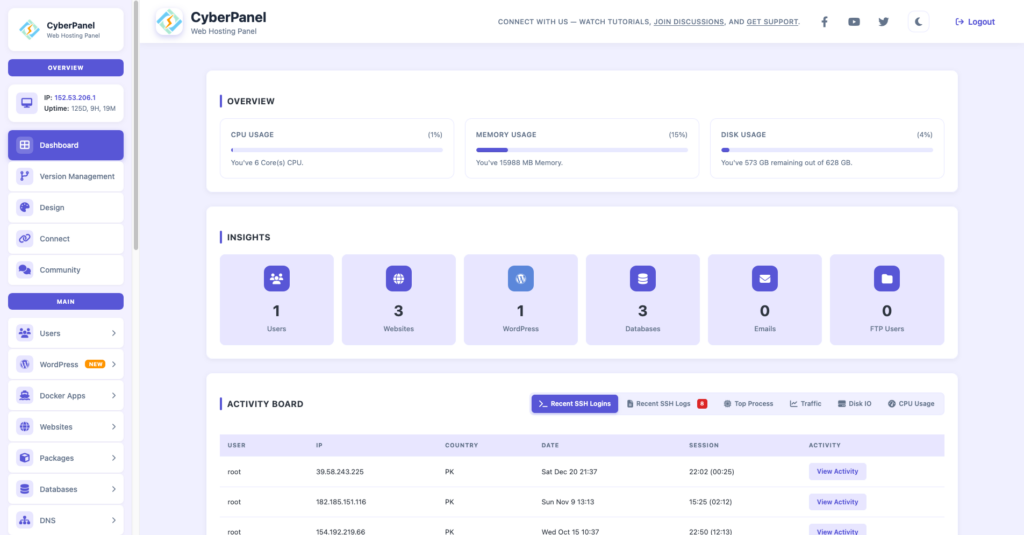
CyberPanel is your free and open-source web hosting control panel. CyberPanel can be of assistance in managing the environment if you install NetBox on a VPS or cloud server.
CyberPanel enables you to:
- Set up a reverse proxy with SSL
- Lock down NetBox dashboard access
- Handle firewall rules
- Keep an eye on server performance
- Provide domain names
Rather than opening raw container ports, you can safely direct traffic via CyberPanel with HTTPS turned on.
For publicly accessible NetBox dashboards, this is a vital security measure.
Security Best Practices
- Use strong passwords for admin accounts
- Use CyberPanel to enable HTTPS
- Limit access to the database
- Make backups regularly
- Update Docker images
Infrastructure data is very sensitive and needs to be secured correctly.
Common Mistakes to Avoid
- Running NetBox with no persistent volumes
- Neglecting database backups
- Opening ports directly to the internet
- Installing unstable plugin versions
- Not testing updates
By avoiding these mistakes, you will ensure that operations are running smoothly.
Key Advantages of NetBox Docker
| Feature | Traditional Install | NetBox Docker |
|---|---|---|
| Setup Time | Long | Faster |
| Dependency Management | Manual | Containerized |
| Updates | Risky | Controlled |
| Rollbacks | Difficult | Easy |
| Portability | Limited | High |
Conclusion
NetBox Docker provides a methodical and easily scalable path to deploy a highly capable open-source network documentation tool. By using Netbox Docker Compose, you get neat service management. The official NetBox Docker image guarantees stability. And with the right Netbox Docker plugin installation habits, you can safely extend the functionality.
Integrating CyberPanel for secure hosting and SSL handling, NetBox turns into a fully-fledged production infrastructure management tool.
First, set up NetBox Docker using Docker Compose in a staging environment. Verify the main functions, set up SSL using CyberPanel, and then move it to production with the necessary backups.
People Also Ask
Does NetBox Docker support API integrations?
Yes. NetBox provides a powerful REST API that works fully within Docker deployments, allowing automation and external system integration.
How often should NetBox Docker be updated?
Updates should be tested in staging before production deployment. Many organizations review updates quarterly unless urgent security patches are released.
Can NetBox Docker run in Kubernetes instead of Docker Compose?
Yes. Some organizations deploy NetBox in Kubernetes clusters for higher scalability and orchestration control.