On this page
Komodo Docker is a practical way to deploy and manage Komodo in a containerized environment. Docker keeps the application isolated from the host system, while Docker Compose makes it easier to define, start, stop, and maintain the services required by a Komodo deployment.
Let’s learn Komodo Docker together!
What Is Komodo Docker?
Komodo Docker means running Komodo using Docker containers rather than installing all of its components directly on the host.
A containerized setup can look like this:
Linux Server
↓
Docker
↓
Komodo Container
↓
Application Services
Docker provides an isolated environment where Komodo can run with its required dependencies and configuration.
This can make deployments easier to reproduce and maintain.
Why Run Komodo in Docker?
Docker is useful when you want to keep applications separated from the host operating system.
A Komodo Docker setup can provide:
- Easier deployment
- Application isolation
- Reproducible environments
- Simple upgrades
- Easier cleanup
- Container-based resource management
- Docker Compose support
- Convenient backup and migration workflows
It also allows you to keep Komodo separate from other applications running on the same server.
What Do You Need Before Installing Komodo?
Before deploying Komodo with Docker, make sure the server has enough resources for the application and any services it needs.
You generally need:
| Requirement | Purpose |
| Linux server | Docker host |
| Docker Engine | Runs containers |
| Docker Compose | Manages multiple services |
| Persistent storage | Keeps application data |
| Network access | Allows required services to communicate |
| Firewall configuration | Protects exposed services |
You should also decide which ports need to be exposed before making the service publicly accessible.
How Does Komodo Docker Compose Work?
Docker Compose allows you to define a multi-container environment in a YAML file.
Instead of manually starting each container, Compose can manage the entire stack.
The basic workflow is:
compose.yaml
↓
Docker Compose
↓
Komodo Services
↓
Networks + Volumes
A Compose project can define the image, ports, environment variables, volumes, networks, and restart behavior required by the deployment.
You can then start the stack with:
docker compose up -dCheck the running services with:
docker compose psAnd stop them with:
docker compose downThe exact Compose configuration should always follow the current Komodo deployment documentation and image requirements.
Why Use Docker Compose for Komodo?
Running a single container manually is manageable.
Managing several connected services becomes much easier with Compose.
For example, a deployment may contain:
Komodo
├── Application
├── Database
├── Persistent Storage
└── Network
Compose allows these components to be defined together.
It also makes the deployment easier to reproduce on another compatible server.
How Do You Update Komodo Docker?
One advantage of a containerized application is that updating it does not normally require manually replacing files throughout the host operating system.
A typical Compose workflow is:
docker compose pullThen recreate the services:
docker compose up -dHowever, do not blindly update production containers.
Before upgrading, check the release notes and make sure important persistent data is backed up.
If the new version changes configuration or database requirements, you may need additional migration steps.
How Do You Keep Komodo Data Persistent?
Containers should not be treated as permanent storage.
Important application data should be stored using Docker volumes or suitable host-mounted directories.
The general structure is:
Komodo Container
↓
Persistent Volume
↓
Server Storage
This means removing and recreating a container does not necessarily remove the data stored outside its temporary writable layer.
Always identify exactly which directories contain important Komodo data before creating a backup strategy.
Is Komodo Docker Secure?
Docker provides isolation, but it does not automatically make an application secure.
Pay attention to:
- Exposed ports
- Container permissions
- Environment variables
- Authentication
- File mounts
- Docker socket access
- Firewall rules
- Image sources
- Software updates
Avoid exposing internal services directly to the Internet when they do not need public access.
If Komodo is being deployed on a production server, place security controls around the application rather than assuming the container itself is sufficient protection.
Komodo Docker vs Direct Installation
| Factor | Docker | Direct Installation |
| Isolation | High | Lower |
| Deployment | Reproducible | Host dependent |
| Cleanup | Simple | More manual |
| Updates | Image based | Installation based |
| Portability | High | Moderate |
| Resource overhead | Some | Lower |
Docker is often attractive for administrators who already manage containerized applications.
A direct installation can make sense when the environment is very simple and container management would add unnecessary complexity.
Can Komodo Docker Run on a VPS?
Yes, a Docker-based Komodo deployment can be hosted on a VPS that has sufficient resources and supports the required Docker environment.
A typical setup could look like:
VPS
|
+– Docker Engine
|
+– Komodo
|
+– Other Containers
Before deploying, check CPU, memory, storage, network requirements, and the number of other workloads sharing the VPS.
A small VPS running several demanding containers can quickly become resource-constrained.
Can CyberPanel Work With Komodo Docker?
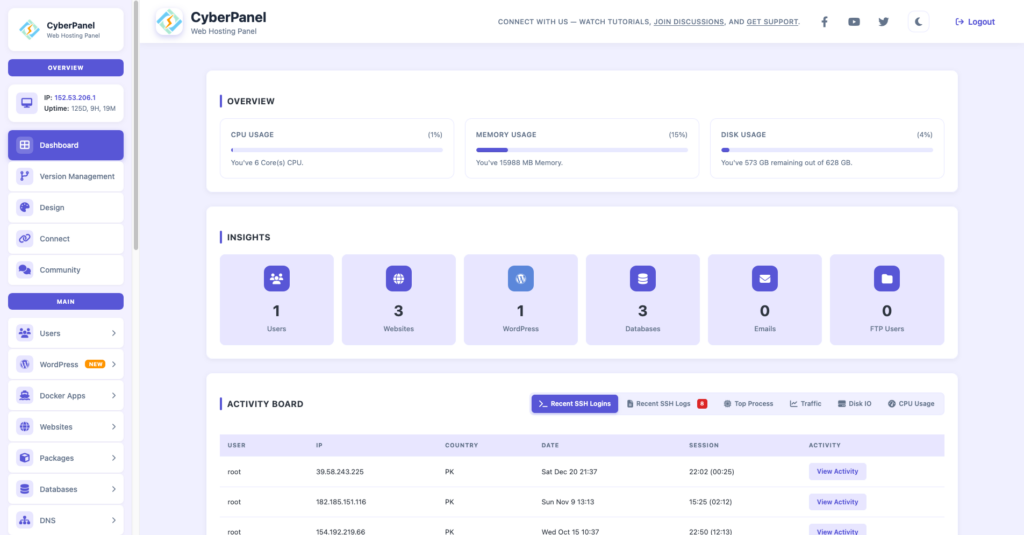
CyberPanel is a web hosting control panel. Komodo can be deployed as a containerized application.
A server might use:
Production Server
|
+– CyberPanel
| └── Websites
|
+– Docker
└── Komodo
Whether you should combine them on the same server depends on the server’s resources and the requirements of each application.
For production environments, keep workloads separated when isolation, performance, or security requires it.
Frequently Asked Questions
Can Komodo be deployed with Docker Compose?
Yes. Docker Compose is useful for defining and managing a Komodo deployment when multiple services, networks, or persistent storage components are involved.
Does deleting a Komodo container delete its data?
Not necessarily. Data stored in persistent Docker volumes or properly configured host directories can survive container removal. Always verify your volume configuration before deleting containers.
Is Docker Compose required for Komodo?
Not necessarily for every possible deployment method. However, Compose can make multi-service deployments considerably easier to configure and maintain.
Conclusion
Komodo Docker provides a clean way to deploy Komodo in an isolated, reproducible environment. Docker handles the containers, while Docker Compose can organize the services, networks, storage, and configuration into a manageable project.
For a basic workflow, the important commands are:
docker compose pull

docker compose up -d

docker compose psDo not treat deployment as simply installing a container. Configure persistent storage, restrict network exposure, protect credentials, and back up important data before making major changes.
If you already work with containers, Komodo Docker Compose can provide a familiar and manageable deployment model.
Start with a documented Compose configuration, test the deployment on a non-critical server, verify persistence and backups, and only then move your Komodo setup into production.