On this page
What if you could create your own cloud storage service like Google Drive or Dropbox, but you controlled everything about it?
Nextcloud Docker lets you create your own private cloud. You can do this without using any third-party services to store your files. You can run Nextcloud from a Docker container in minutes! Developers, businesses, and anyone concerned about data privacy are choosing to run Nextcloud Docker containers to keep their data safe and accessible.
One of the easiest ways to deploy Nextcloud is by using the Nextcloud Docker Compose option. With a single configuration file, you can deploy an entire cloud storage service that supports file sharing, collaboration, calendar management, contact management, and more.
This guide describes how to use the Nextcloud Docker image, how to set up your Nextcloud Docker-Compose file, and how to leverage the newer Nextcloud AIO Docker-Compose deployment methods to make your deployment easier than ever before.
After this guide, anyone can build and deploy their own version of Nextcloud with confidence.
What is Nextcloud?
Nextcloud is a cloud storage platform that is open-source, allowing you to create your own personal Cloud Storage system. Nextcloud has features that are similar to:
- Google Drive
- Dropbox
- OneDrive
The only difference is that you own your own server and don’t share it with others. Here are some of the key features of Nextcloud.
- File Storage & Sharing
- Team Collaboration
- Calendar and Contact
- Video Calling and Chatting
- Document Editing
Benefits of Running Nextcloud with Docker
Many organizations are now using Nextcloud with Docker to deploy Nextcloud to their own servers because it offers several benefits:
- Fast Setup
- You can quickly deploy a Cloud Platform in just a few minutes.
- Isolate from Host
- Docker containers separate services from the operating system.
- Easy Upgrades
- To upgrade Nextcloud, all you have to do is update Nextcloud’s image file.
- Flexible Scaling
- With Docker Compose, you can expand services as needed.
- This is why Nextcloud is so popular to deploy using Docker Compose.
Nextcloud Docker Compose Example
version: "3.8"

services:
  db:
    image: mariadb:10.6
    container_name: nextcloud-db
    restart: always
    environment:
      MYSQL_ROOT_PASSWORD: strongpassword
      MYSQL_DATABASE: nextcloud
      MYSQL_USER: nextcloud
      MYSQL_PASSWORD: nextcloudpass
    volumes:
      - db:/var/lib/mysql

  app:
    image: nextcloud:latest
    container_name: nextcloud-app
    restart: always
    ports:
      - "8080:80"
    environment:
      MYSQL_HOST: db
      MYSQL_DATABASE: nextcloud
      MYSQL_USER: nextcloud
      MYSQL_PASSWORD: nextcloudpass
    volumes:
      - nextcloud:/var/www/html

volumes:
  db:
  nextcloud:
Now run the deployment using:
docker compose up -dOnce the containers start, access your cloud at:
http://your-server-ip:8080Nextcloud Docker Image Overview
The Nextcloud Docker image is a complete installation of Nextcloud running in a container.
Features Included With The Nextcloud Docker Image:
- Apache web server
- PHP runtime environment
- Core Nextcloud files
However, you still need a database in addition to this installation. Some examples of databases supported by Nextcloud include:
- MariaDB
- PostgreSQL
By keeping the database separate from the rest of the installation, you can achieve better scalability and performance.
Nextcloud AIO With Docker Compose
With the Nextcloud AIO (All-in-One) method for deploying the Nextcloud tool, we can further eliminate deployment complexities.
Nextcloud AIO automatically handles the following services:
- database
- Redis caching
- reverse proxy
- backups
You can start all of these services with one simple command.
docker run \
--name nextcloud-aio-mastercontainer \
-p 8080:8080 \
-v nextcloud_aio_mastercontainer:/mnt/docker-aio-config \
nextcloud/all-in-one:latest
Comparing Deployment Methods
Here is a helpful comparison for you:
| Deployment Method | Difficulty | Flexibility | Best Use Case |
|---|---|---|---|
| Basic Docker Image | Easy | Medium | Small deployments |
| Docker Compose | Medium | High | Production setups |
| Nextcloud AIO | Very Easy | Medium | Quick deployments |
Best Storage Procedures
Adhere to these best storage procedures for smooth operations.
- Utilize persistent volumes to ensure your data persists through container reboots.
- Store items on: SSD or NVMe storage and off-site backup drives
- Turn on automatic backups of any critical data.
- Don’t forget to protect your cloud storage against hardware failure.
Security Guidelines
Running your cloud means that security is important.
Key Security Recommendations are:
- Enable HTTPS
- Use strong administrator passwords
- Configure containers to have up-to-date versions
- Limit the number of open ports
A reverse proxy will be beneficial (Nginx or Traefik) to protect the application.
CyberPanel’s Role in Nextcloud Docker Hosting
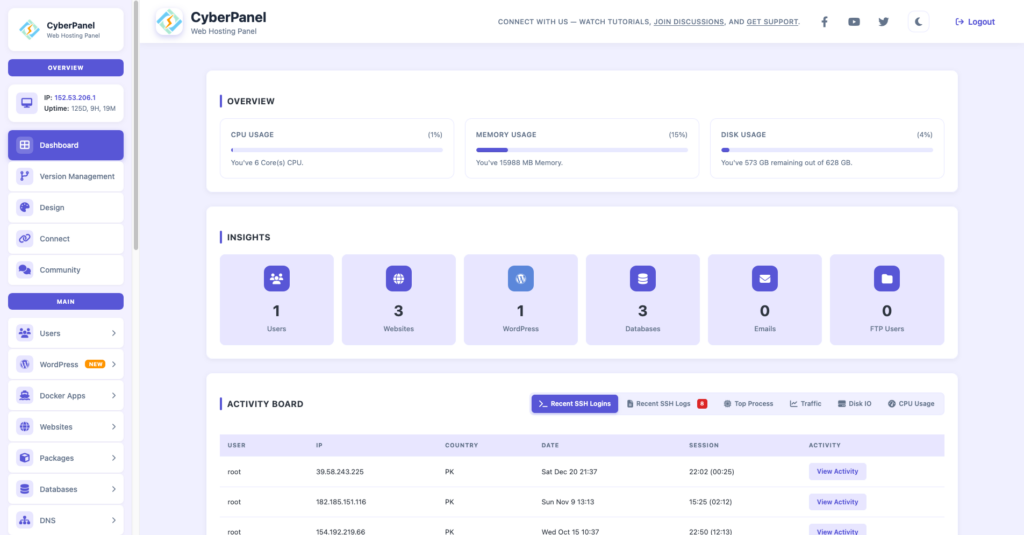
CyberPanel is a free and open-source web hosting control panel. When running Nextcloud Docker Compose on a VPS, CyberPanel will help simplify managing the VPS.
CyberPanel can assist with:
- Configuring your domain
- Generating your SSL certificates automatically
- Managing your DNS
- Monitoring your server
- Managing your firewall
Nextcloud will be running within a container, and CyberPanel manages the web server that supports it. This keeps the system organized and secure.
Frequent Pitfalls of Deploying Nextcloud Docker
Avoid making these mistakes when deploying NextCloud Docker.
- Using weak passwords for the database
- Not providing for persistent storage
- Not using HTTPS
- Deploying old/unmaintained versions of your containers
- Opening the database port to the public
These mistakes are likely to lead to security vulnerabilities and the loss of your data!
Final Thoughts!
In conclusion, the use of Docker to run NextCloud as a Private Cloud platform is an effective way to establish a cloud-based service. By choosing between either a standard (full) setup with NextCloud Docker Compose or a simplified (minimal) setup using the Advanced Install with NextCloud AIO Docker Compose, you will be able to install NextCloud quickly and easily using Docker technology.
If you have the right version of Nextcloud, persistent storage, and the appropriate security measures in place, you can build an effective Private Cloud system that will allow you to have complete control over all aspects of your data.
Start setting up your NextCloud Docker system by creating secure storage volumes, enabling HTTPS, and using your very own Private Cloud Service, rather than relying on third-party providers.
FAQs
1. Is it possible to deploy a Docker Nextcloud instance behind a reverse proxy?
It is possible to deploy a Nextcloud Docker instance behind reverse proxies, such as Nginx and Traefik, to allow for HTTPs connections and domain-based routing.
2. What are the Nextcloud requirements regarding disk space?
The Nextcloud application configuration is fairly small. However, the total amount of disk space needed depends on what you want to store in Nextcloud.
3. Does Nextcloud support integration with third-party external storage providers?
Nextcloud has the capability to integrate with external storage solutions such as Amazon S3 or SMB shares and many other cloud providers.