On this page
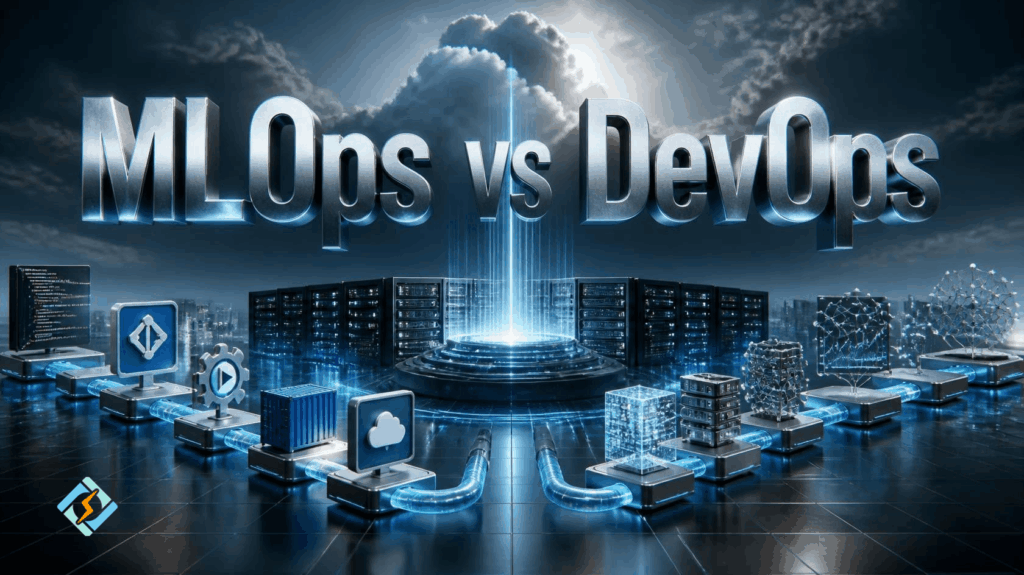
MLOps vs DevOps is an important consideration for teams that need to develop and manage modern software and machine learning systems. Both of these practices assist teams with developing, deploying, managing, and improving applications, but they provide solutions to slightly different problems.
DevOps primarily focuses on a software development and delivery process. MLOps extends many of the same concepts to machine learning, where teams also need to address the management of data, models, experiments, training, and model performance. Simply put, DevOps assists software teams in delivering reliable applications, while MLOps helps machine learning teams build, deploy, monitor, and maintain reliable ML systems.
Additionally, Google Cloud points out that MLOps is a practice for managing the machine learning lifecycle, from development to deployment and monitoring.
The purpose of this guide is to explain MLOps vs DevOps, the differences and similarities, tools and workflows, use cases, and how a web hosting control panel such as CyberPanel fits into the picture.
What Is DevOps?
DevOps is a collaboration of development and operations practices meant to help teams build, test, release, and maintain software more efficiently. The traditional way of building software often creates a divide between developers focused on writing code and operations teams focused on deploying and running that code in production.
DevOps helps bridge that gap by providing collaboration, automation, continuous integration, continuous delivery, infrastructure management, testing, and monitoring practices. One common DevOps workflow is:
Plan → Code → Build → Test → Release → Deploy → Monitor → Improve
CI/CD, or Continuous Integration/Continuous Delivery, is one of the most important concepts in DevOps. It focuses on automating the processes of building, testing, and deployment to allow for quicker and more reliable releases with less manual intervention. Other key goals typically associated with DevOps include:
- Faster releases
- Reliable deployments
- Automated testing
- Continuous integration
- Continuous delivery
- Infrastructure automation
- Application monitoring
- Improved teamwork
- Faster resolution of problems
- More consistent production environments
DevOps can be used for websites, mobile applications, APIs, cloud applications, enterprise applications, and many other software-related use cases.
What Is MLOps?
MLOps is short for Machine Learning Operations.
It is a practice that incorporates many of the concepts found in DevOps, extended to address additional challenges specific to machine learning.
A traditional software application is largely defined by its source code. A machine learning application, however, has more variables to consider.
It often consists of:
- training data
- data pipelines
- features
- algorithms
- model versions
- parameters
- training environments
- infrastructure, predictions
- model performance
This requires additional considerations beyond regular software development.
MLOps provides a framework for developing, deploying, monitoring, and maintaining machine learning models. One simplified MLOps workflow could be:
Collect data → Prepare data → Train model → Test model → Register model → Deploy → Monitor → Retrain → Improve
As Google Cloud notes, ML systems add additional challenges to traditional CI/CD, because teams need to validate not only code but data and schemas. MLOps can include additional aspects such as continuous training and monitoring of model performance.
MLOps vs DevOps: Quick Comparison
The easiest way to differentiate between MLOps vs DevOps is to look at the factors each practice covers.
| Factor | DevOps | MLOps |
| Main focus | Software development and operations | Machine learning development and operations |
| Main output | Software application or service | ML model and ML system |
| Data management | Important but usually not central | Core requirement |
| Model management | Usually not required | Essential |
| Model training | Not applicable | Essential |
| CI/CD | Central | CI/CD plus ML-specific processes |
| Continuous training | Not required | Often required |
| Monitoring | Application and infrastructure | Application, infrastructure, data, and model |
| Main teams | Developers and operations teams | Data scientists, ML engineers, developers, and operations teams |
| Version control | Mainly source code | Code, data, models, configurations, and experiments |
| Main challenge | Reliable software delivery | Reliable software and reliable ML behavior |
The main difference between MLOps and DevOps is the scope of the project. DevOps focuses on the software delivery lifecycle, and MLOps is concerned with additional aspects that arise due to the nature of machine learning systems.
DevOps vs MLOps: Main Differences Explained
1. Software vs Machine Learning Lifecycle
DevOps primarily focuses on the software lifecycle. For example, a developer could make a change to an application’s code, and the CI/CD pipeline would verify the changes and deploy the code to production.
MLOps deals with a larger lifecycle because the model itself can change. A ML team may need to perform these actions:
- Collect new data
- Clean the data
- Train a model
- Test the model
- Compare it with an existing model
- Deploy the better model
- Monitor predictions
- Retrain the model (if needed)
This is one of the more significant differences between DevOps vs MLOps.
2. Data Is Central to MLOps
Software can often be tested and validated primarily through code.
Machine learning, on the other hand, requires additional considerations, such as data. Model quality is highly dependent on the characteristics of the training data. For example, a fraud detection model might work well in one set of conditions, but start behaving poorly when customer habits change. As the real world evolves, models need to be retrained and updated accordingly. Monitoring can help recognize these trends and provide the foundation for a process that regularly updates models. Therefore, MLOps requires additional practices specifically related to data.
3. Model Versioning
DevOps teams often use version control systems to track changes to the application code. Similarly, MLOps teams can use model versioning to track different iterations of ML models. For example:
Model v1 → Model v2 → Model v3
Each model may have different characteristics, such as:
- Training data
- Features
- Algorithms
- Parameters
- Accuracy
- Evaluation results
Without proper version tracking, it could be unclear which model is in production, or why one model performed better than another.
4. Continuous Training
Continuous Training (CT) is similar to Continuous Integration/Continuous Delivery (CI/CD) used in many DevOps practices. The process enables teams to retrain their ML models periodically, in order to ensure their accuracy and performance. The concept could be summarized in this workflow:
New data → Train model → Evaluate model → Approve model → Deploy model
It doesn’t mean that every ML system must be retrained every day – the frequency depends on the application, data, risk tolerance, and other factors.
5. Monitoring Is Different
DevOps monitoring could be focused on:
- Server health
- CPU usage
- Memory usage
- Application errors
- Response time
- Network traffic
- Availability
MLOps needs to address these considerations as well, but also have additional checks for the ML systems. These checks could include:
- Prediction quality
- Model accuracy
- Data quality
- Data drift
- Model drift
- Prediction distribution
- Business performance
The reason why simply deploying an ML model is not enough is because it is possible for a model to be in production but perform poorly.
MLOps and DevOps: What Do They Have In Common?
While this article focuses on the differences between MLOps vs DevOps, it is also important to highlight the similarities. Both MLOps and DevOps focus on:
- Automation
- Collaboration
- Testing
- Continuous improvement
- Monitoring
- Version control
- Reproducible processes
- Faster and safer deployments
- Infrastructure management
- Reliable production systems
In fact, MLOps vs DevOps is really not a competition, because MLOps builds upon many of the practices offered by DevOps, and extends them to address additional considerations introduced by machine learning. Google Cloud points out that organizations which apply DevOps practices can often benefit from implementing MLOps.
MLOps vs DevOps Tools
Both DevOps and MLOps employ a wide variety of tools. While the specific technologies could be different for each team, a general comparison could be made.
| Category | DevOps Examples | MLOps Examples |
| Source control | Git, GitHub, GitLab | Git, GitHub, GitLab |
| CI/CD | Jenkins, GitHub Actions, GitLab CI/CD | GitHub Actions, GitLab CI/CD, Jenkins |
| Containers | Docker | Docker |
| Container orchestration | Kubernetes | Kubernetes |
| Cloud | AWS, Azure, Google Cloud | AWS, Azure, Google Cloud |
| Infrastructure | Terraform, Ansible | Terraform, Ansible |
| Monitoring | Prometheus, Grafana | Prometheus, Grafana plus ML monitoring |
| Model tracking | Not usually required | MLflow and similar platforms |
| Data pipelines | Limited depending on project | Airflow and other data pipeline tools |
| Experiment tracking | Usually not central | ML experiment tracking tools |
The specific tools are less important than the concept of an effective process. Good MLOps should focus on enabling reproducible experiments, reliable model deployment, performance monitoring, and safe production system upgrades.
Where Does CyberPanel Fit Into MLOps And DevOps?
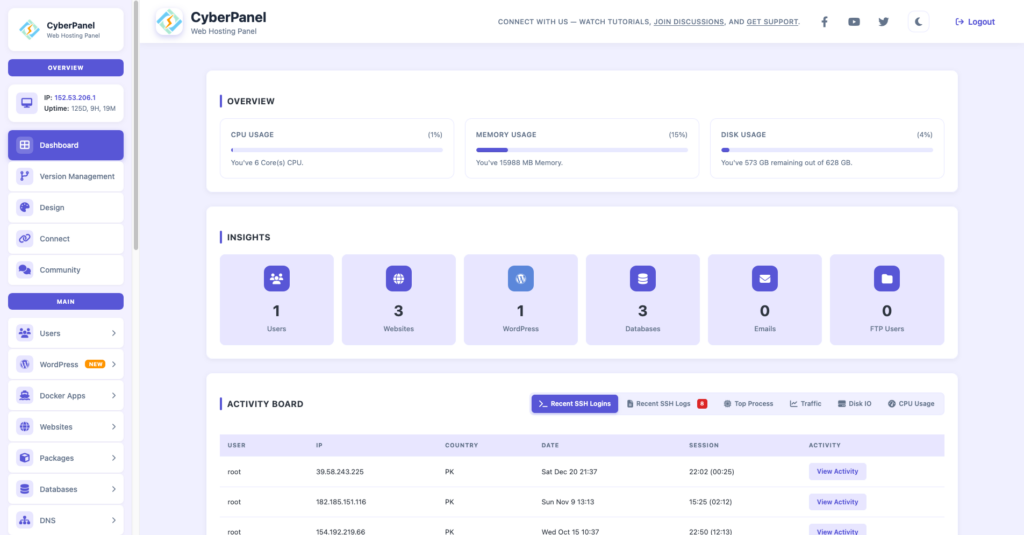
This is where CyberPanel can be useful, but be aware that it is a web hosting control panel, not an MLOps platform, and not a DevOps replacement. It is a solution that is meant to provide a graphical interface for users who want to manage their websites and servers. CyberPanel supports OpenLiteSpeed and offers features such as website management, SSL management, databases, FTP, Docker management, backups, and firewall management.
How does it fit with MLOps vs DevOps? Think about the technology stack in layers:
Application layer
This is where your website, API, dashboard, or ML-powered application runs.
Deployment and operations layer
This is where DevOps or MLOps practices automate testing, deployment, monitoring, and infrastructure.
Server management layer
This is where a web hosting control panel such as CyberPanel could help with managing servers.
Let’s look at an example. An organization could have an ML-powered web application which uses an API to communicate with a deployed model. The application could be hosted on a Linux server managed through CyberPanel, while Git based workflows and CI/CD tools handle automated deployment. CyberPanel’s current feature set also includes Docker management, resource monitoring, SSL management, backups, and website management, which can be useful for the infrastructure supporting a web application.
However, CyberPanel does not replace important MLOps capabilities such as:
- Model experiment tracking
- Model registry
- Model evaluation
- Data validation
- Model drift detection
- Continuous model training
- ML-specific monitoring
The best way to describe its relationship is that CyberPanel can support the hosting and server management side of a DevOps or MLOps environment, but it is not itself a DevOps/MLOps platform. This should be considered an important distinction for people who are researching DevOps vs MLOps tools.
When Should You Use DevOps?
DevOps is the primary approach for software development, and it helps achieve faster releases, reliable production deployments, infrastructure automation, testing, collaboration, and production monitoring. DevOps is typically used when the main focus is on traditional software.
Use cases:
- Business websites
- E-commerce applications
- Mobile backends
- SaaS platforms
- REST APIs
- Enterprise applications
- Web applications
If your main concern is software development and deployment, DevOps is probably the right choice.
When Should You Use MLOps?
MLOps comes into play when machine learning is a critical aspect of your production system. You may need MLOps if your organization:
- Trains machine learning models
- Deploys models to production
- Retrains models regularly
- Handles large datasets
- Runs many ML experiments
- Needs model versioning
- Monitors model performance
- Needs repeatable ML workflows
- Uses AI or ML for important business decisions
For a small experiment, you may not need a full MLOps platform, but for a large production ML system, these manual steps can become error-prone and time-consuming.
Can DevOps and MLOps Work Together?
Yes, because they often address different aspects of a similar technology environment. A modern AI application may use both, such as these concepts:
Developer writes application code
↓
DevOps pipeline builds and tests the application
↓
Data scientist trains a machine learning model
↓
MLOps pipeline evaluates the model
↓
Approved model is deployed
↓
Application communicates with the model API
↓
DevOps monitors infrastructure
↓
MLOps monitors model and data performance
↓
Model is retrained (when necessary)
This combination creates an effective production environment because DevOps handles the broader aspects of the software and infrastructure lifecycle, while MLOps addresses the specific aspects of the machine learning lifecycle.
MLOps vs DevOps: Which Is Better?
There is no definitive answer, because it largely depends on what you are trying to build. If you are working on traditional software, DevOps is typically the right choice. If you are working on production machine learning systems, MLOps is typically a better fit. If you are working on an AI-powered application, you may need both – DevOps for the general application, and MLOps for the machine learning components. This is a case of an effective question:
MLOps vs DevOps Career Differences
DevOps and MLOps also offer slightly different career opportunities.
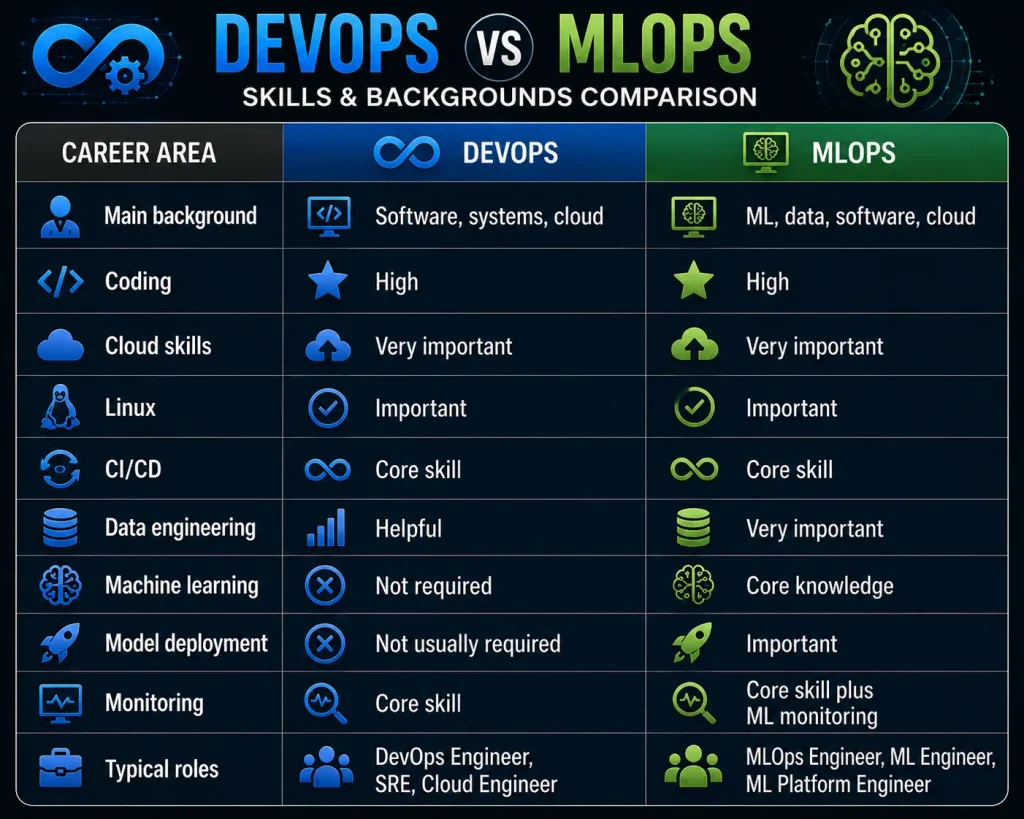
MLOps can be more challenging because it combines software engineering, infrastructure, data, and machine learning concepts.
Common Mistakes When Comparing MLOps And DevOps
Mistake 1: Thinking that MLOps replaces DevOps
MLOps is not a newer name for DevOps – it builds on many existing DevOps practices but also addresses additional considerations specific to ML development and operations.
Mistake 2: Focusing only on deployment
Deploying an ML model is only one part of MLOps – teams also need to manage data, models, experiments, testing, monitoring, and retraining.
Mistake 3: Treating an ML model like normal application code
An ML model can change because the underlying data changes, making model lifecycle management important.
Mistake 4: Confusing CyberPanel with an MLOps platform
CyberPanel can help manage web hosting and server-related tasks, but it does not provide the complete ML lifecycle management needed for MLOps.
Frequently Asked Questions
Is MLOps harder than DevOps?
MLOps can be more complex because it combines software engineering and operations with machine learning and data management. The exact difficulty depends on the project’s size and requirements.
Can a DevOps engineer become an MLOps engineer?
Yes. DevOps skills such as Linux, cloud infrastructure, containers, CI/CD, automation, and monitoring provide a strong foundation. The engineer would then need to learn machine learning concepts, data pipelines, model deployment, and ML monitoring.
Do small businesses need MLOps?
Not always. A small company running one simple ML model may use a lightweight workflow. Full MLOps becomes more valuable as the number of models, data sources, deployments, and business requirements increases.
Is MLOps only for large AI companies?
No. Any organization running machine learning in production can benefit from MLOps practices. The level of automation should match the size and complexity of the project.
Can CyberPanel host an ML application?
CyberPanel can help manage the web hosting and server environment for applications, and its current feature set includes Docker management. However, hosting an ML application is different from managing the complete MLOps lifecycle.
FINAL THOUGHTS
The difference between MLOps vs DevOps becomes clear when we look at what is supported and managed.
DevOps is software delivery and operations. MLOps supports similar practices that are applicable to machine learning, plus additional considerations for data, model, experiment, training, and ML monitoring needs.
DevOps is a great practice for traditional software systems, whereas MLOps is aimed at supporting production machine learning systems. Modern AI products could require both: an ML application is still software, but it has additional machine learning-specific challenges that need to be addressed.
CyberPanel can be a part of this environment as a web hosting control panel that supports management of websites, servers, SSL, databases, Docker, backups, and other infrastructure-related tasks. It is better to consider it as an additional server management layer rather than an MLOps replacement.
Ready to choose the right approach? Start with a current application inventory to understand your needs. Determine what requires software delivery and operations (DevOps), what requires infrastructure automation, and what requires machine learning model lifecycle management (MLOps). If you are going to build a traditional application, start with DevOps basics. If you are going to use ML models in production, add MLOps-specific practices for data, model, training, deployment, and monitoring. And if your project requires a reliable and lightweight solution for the web hosting layer, consider a web hosting control panel such as CyberPanel as part of your infrastructure stack.
The point is not to chase the most popular technologies: the point is to build a system that is reliable, repeatable, secure, and easy to evolve.