On this page
Every enterprise IT leader has run into the same wall this year: the AI initiatives everyone's excited about keep stalling on infrastructure nobody wants to touch. You can't bolt an autonomous agent onto a fifteen-year-old monolith and expect it to behave. That uncomfortable realization is driving a fresh wave of application modernization spending in 2026, not because modernization is trendy, but because it's become the price of admission for everything else on the IT roadmap.
The result is a crowded, fast-moving market for modernization partners, and picking the wrong one is expensive in ways that go beyond the invoice: missed deadlines, half-migrated systems, and technical debt that just moves somewhere new. Below, we break down what's actually changed this year, how to evaluate a shortlist, and seven companies worth putting on yours, starting with a provider handling some of the largest and most complex modernization estates in the world.
Why this market has gotten so urgent
DXC Technology has quietly become one of the most-cited names in this space, and its applications modernization practice is worth a look – https://dxc.com/solutions/application-services/applications-modernization – partly because of the scale it operates at, which we'll get into shortly. But first, it helps to understand why this market has gotten so much more urgent.
Gartner expects roughly 40% of business applications to carry task-specific AI agents by the end of 2026, up from under 5% a year earlier, a jump that simply isn't achievable on brittle legacy architecture. That shift is pushing enterprises to treat modernization less like routine maintenance and more like a prerequisite for everything else on the AI roadmap. Gartner also estimates that by 2028, 90% of enterprise software engineers will use AI-augmented development tools, up from under 14% in 2024.
The pressure isn't only about staying current, either. Organizations that modernize proactively cut technical debt costs by an average of 40% and reach AI-readiness 40 to 50 percent faster than those still patching legacy systems, according to McKinsey research. Pair that with a shrinking pool of engineers who can still read COBOL, and it's easy to see why modernization has stopped being an optional line item on most CIO budgets.
How we picked this list
Not every modernization vendor is built for the same job, so we weighted a handful of things when narrowing the field down to seven:
- Range of modernization paths offered: rehosting, refactoring, replatforming, rearchitecting, and full replacement
- Depth with mainframe and legacy languages like COBOL, PL/I, and JCL
- Maturity of AI and agentic tooling, and whether it's built in-house or licensed
- Hyperscaler partnerships across AWS, Azure, and Google Cloud
- Independent analyst recognition from firms like Everest Group and Gartner
- Track record in regulated industries such as banking, insurance, and the public sector
None of the companies below is the automatic right answer for every business. A regional insurer and a global bank need very different things from a modernization partner, and that's exactly why this list leans toward variety instead of crowning one universal winner.
The Top IT Companies for Enterprise Application Modernization in 2026
1. DXC Technology
Source: DXC Technology
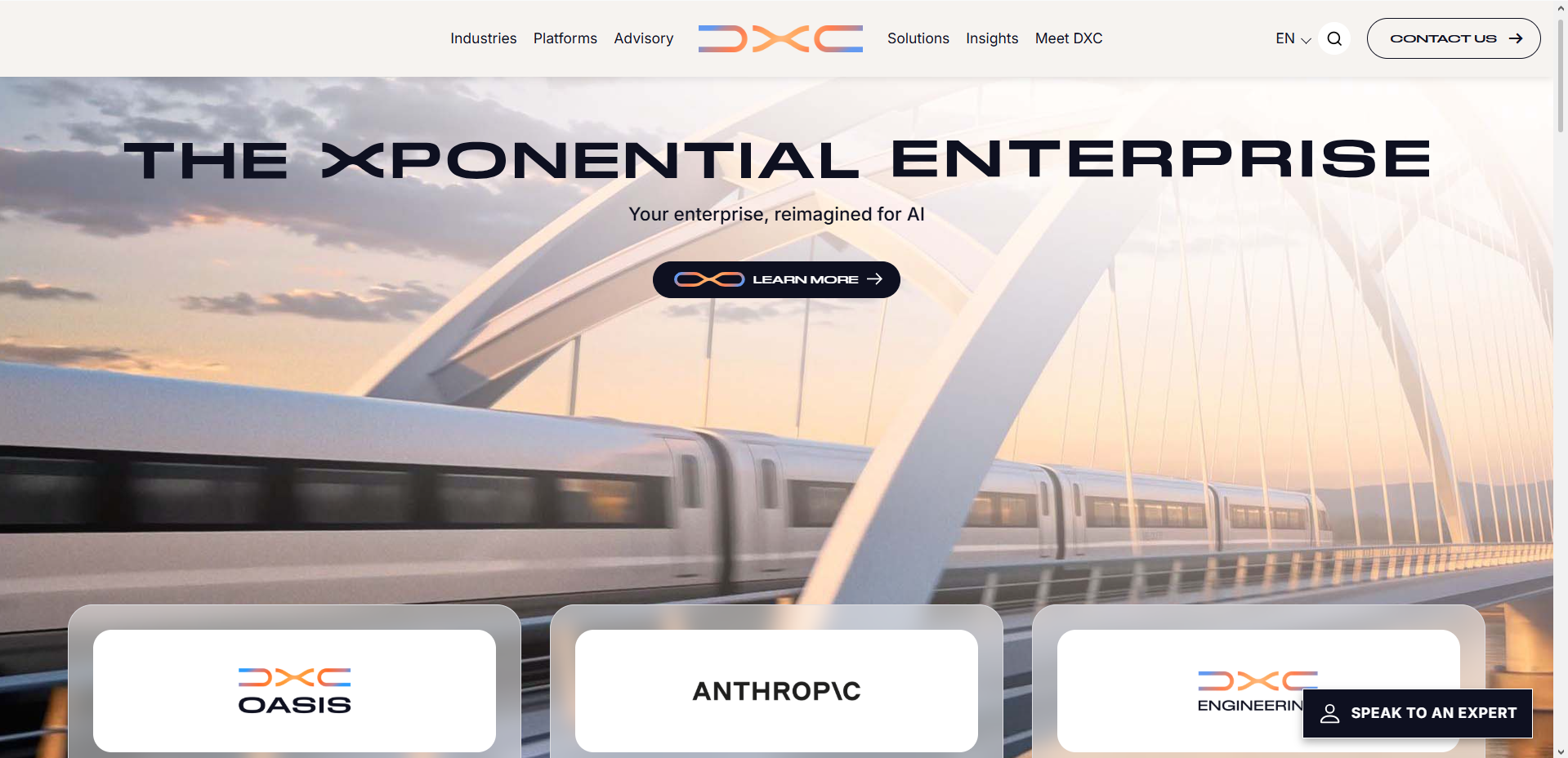
DXC anchors this list for good reason. Its application modernization services cover the full range – advisory, mainframe and legacy migration, modernization factory delivery, and ongoing optimization – built to keep the disruption to a minimum while moving customers onto modern, scalable technology.
The scale backs up the pitch: DXC transforms roughly 65,000 workloads a year, manages more than 20,000 applications globally, and reports a 99.84% migration success rate, with partnerships spanning AWS, Microsoft, Google Cloud, SAP, Salesforce, and Oracle. The company holds leadership positions specifically in application modernization and mainframe services, and its 2026 push has centered on Xponential, an AI orchestration approach paired with what DXC calls its "Human+" philosophy — pairing AI systems with human oversight rather than replacing it outright.
Its work with UK-based defense and aerospace firm Leonardo, modernizing core applications while reducing technical debt as part of a broader digital transformation program, is a solid example of what the practice looks like in the field.
2. Accenture
Source: Accenture
Accenture shows up near the top of nearly every 2026 modernization comparison, and one recent buyer's guide even ranked it the top overall pick among enterprise app modernization providers. Much of that reputation comes down to scale and governance rather than any single flashy feature.
Accenture deploys GenAI accelerators, including tooling built on Google's Gemini Enterprise, across large, multi-system portfolios spanning Java and COBOL environments, and its structured approach to portfolio planning, security controls, and lifecycle management makes it a natural fit for organizations juggling dozens of interdependent applications at once. It also leans heavily on its own hyperscaler partnerships – AWS, Microsoft, and Google Cloud among them – to keep migration paths flexible rather than locking clients into a single cloud provider.
Where Accenture tends to win deals isn't a single killer tool; it's disciplined program management across genuinely massive, multi-year engagements, the kind where a missed dependency can cascade into months of delay. That makes it a common pick for regulated industries like banking and insurance, where the cost of a botched rollout is measured in more than just money.
3. IBM Consulting
Source: IBM Consulting
IBM's edge is mainframe depth, full stop. It offers first-party AI tooling purpose-built for IBM Z environments, targeting COBOL, JCL, PL/I, and Db2, the languages most other providers treat as a specialty rather than a core competency. If your estate still leans heavily on IBM Z infrastructure, IBM Consulting is usually the first call, since its Watsonx Code Assistant for Z has the most documented outcomes in that specific niche, particularly for organizations trying to preserve decades of business logic rather than rebuild it from scratch. IBM also picked up formal third-party validation in 2026, landing as both a Leader and a Star Performer in Everest Group's Oracle Cloud Applications Services PEAK Matrix Assessment, a signal that its modernization chops extend well past mainframe work into broader enterprise application ecosystems.
Beyond the tooling itself, IBM ties modernization into wider AI operating-model consulting, connecting strategy, governance, and delivery under one roof so clients aren't managing separate vendors for the migration and the AI layer sitting on top of it. That combination tends to appeal most to large, heavily regulated enterprises that need both technical depth and a credible governance story to show auditors.
4. Capgemini
Source: Capgemini
Capgemini's specialty is extracting decades of buried business logic out of COBOL and mainframe systems using generative and agentic AI, rather than simply rewriting code line by line. That rule-extraction approach, wrapped in a fairly structured delivery methodology, tends to appeal to organizations that are nervous about losing institutional knowledge baked into old systems nobody currently working there actually understands – the kind of tribal knowledge that walked out the door when the original developers retired.
Capgemini was named a Leader in The Forrester Wave: Application Modernization and Multicloud Managed Services, Q1 2025, and it brings solid DevOps and platform engineering chops to replatforming and refactoring work more broadly, not just mainframe extraction. Its phased roadmapping style, which breaks large transformations into smaller, more manageable releases, suits long, governance-heavy programs where stakeholders want visible progress every few months rather than a single high-stakes cutover.
Capgemini also maintains deep partnerships across the major hyperscalers, which helps when a modernization program needs to land on a specific cloud for compliance or existing-infrastructure reasons.
5. Cognizant
Source: Cognizant
Cognizant earned a notable stamp of approval in early 2026, when Everest Group named it a Leader in its Digital Transformation Consulting Services PEAK Matrix Assessment, an evaluation covering eighteen major consulting providers based on vision, capability, and actual market impact rather than marketing claims.
The analyst commentary pointed specifically to Cognizant's investments in AI, platforms, innovation labs, and a handful of well-targeted acquisitions, along with its ability to blend advisory work with hands-on technology delivery across functions like supply chain, finance, and HR. It's also developed a strong reputation in banking and financial services mainframe modernization specifically, which is worth knowing if your industry sits in that lane – Cognizant's teams tend to understand the regulatory quirks of core banking systems in a way generalist providers sometimes miss.
On top of the domain expertise, clients have pointed to strong product knowledge in areas like Oracle HCM and specialized public-sector work, suggesting the firm's strength isn't purely technical; it extends into understanding how a modernized system actually needs to function once it's live.
6. Tata Consultancy Services (TCS)
Source: Tata Consultancy Services
TCS keeps showing up in 2026 comparisons for a fairly specific reason: DevOps-driven delivery cadence. Its modernization programs tend to emphasize phased architecture and delivery orchestration, aimed at keeping migration risk contained even as multiple application "waves" move through the pipeline simultaneously rather than betting everything on one massive cutover weekend. As part of the broader Tata Group, TCS brings a genuinely enormous global delivery footprint to the table, which matters for enterprises running modernization programs across several regions or business units at once and needing consistent execution in each one.
For enterprises already working with large Indian IT services partners on other engagements and wanting that same relationship extended into modernization work, TCS is a natural, low-friction choice; there's rarely a steep learning curve on either side. It also tends to pair modernization work with broader DevOps operating-model design, so clients come out the other end with a repeatable release process rather than just a one-time migration.
7. Infosys
Source: Infosys
Infosys rounds out the list as another global-scale option with real breadth across legacy stacks. It's typically grouped with the other large multi-system players, where geographic reach and delivery scale matter as much as depth on any single codebase. Infosys pairs migration planning with ongoing managed transition services, which makes it a reasonable fit for enterprises that want one partner to handle both the move and the operational hand-holding afterward, rather than splitting that work across two vendors.
| Company | Known For | Notable Strength |
|---|---|---|
| DXC Technology | Mainframe and legacy migration at enterprise scale | 99.84% migration success rate across 20,000+ managed apps |
| Accenture | Large, multi-system portfolio modernization | modernization Everest Group Leader, Google Cloud Services PEAK Matrix 2026 |
| IBM Consulting | Mainframe-native AI tooling | watsonx Code Assistant for Z |
| Capgemini | COBOL business-rule extraction | Forrester Wave Leader, Application Modernization Q1 2025 |
| Cognizant | Digital transformation consulting | Everest Group Leader, 2025 PEAK Matrix |
| Tata Consultancy Services | DevOps-driven delivery cadence | Phased architecture and release orchestration |
| Infosys | Multi-system legacy portfolios | Combined migration and managed transition services |
Choosing the right partner for your organization
Before signing anything, it's worth pushing every vendor on your shortlist through a few blunt questions:
- How much of your AI tooling is proprietary, and how much is a third-party license wrapped in your branding?
- What's your actual track record with our specific legacy stack – mainframe, .NET, or something more obscure?
- Can you point to measurable outcomes, like migration success rates or timeline reductions, instead of a glossy case study?
- How do you test and govern AI-generated code changes before they touch production?
- What happens to our systems if the engagement ends early or gets rescoped?
None of these questions are meant to be gotchas. They're the kind of thing a serious vendor should be able to answer in under two minutes, and the ones who fumble them are telling you something useful before you've spent a dollar.
Application modernization in 2026 isn't a side project anymore; it's the foundation everything else in the enterprise AI roadmap gets built on. The seven companies above aren't the only credible options out there, but they represent a solid cross-section of what's actually working right now: deep mainframe specialists, AI-forward generalists, and everything in between. Match the partner to your stack, your regulatory exposure, and your appetite for risk, and the rest of the roadmap gets a lot less complicated.