
On this page
A LiteSpeed 503 error means your web server cannot currently complete the request. On WordPress and OpenLiteSpeed servers, the cause can range from an overloaded server or exhausted PHP workers to an lsphp problem, resource limits, or a temporary backend failure.
The fastest way to fix a 503 Service Unavailable error is to identify what is failing first. Check the LiteSpeed or OpenLiteSpeed error logs, inspect PHP/lsphp processes, check server resources, and then restart the affected service if necessary.
What Is a LiteSpeed 503 Error?
A LiteSpeed 503 error is an HTTP 503 Service Unavailable response generated when the server cannot currently process a request.
The important word is currently.
A 503 does not necessarily mean your website files are permanently broken. The server may simply be temporarily unable to handle additional requests.
Common causes include:
- Too many PHP processes
- Exhausted PHP worker limits
- High CPU usage
- Insufficient RAM
lsphpprocess problems- A crashed or overloaded backend
- WordPress plugin or theme activity
- Database overload
- Server resource limits
- Configuration problems
- Sudden traffic spikes
The exact cause needs to be confirmed from the server logs rather than guessed.
Why Does LiteSpeed Return a 503 Error?
LiteSpeed can return a 503 when it cannot obtain the resources needed to process a request.
For a WordPress website, a simplified request can look like:
Visitor → LiteSpeed → PHP/lsphp → WordPress → Database
If PHP workers are unavailable or the server is overloaded, the request may fail before WordPress can generate the page.
This is why a 503 can sometimes appear even when WordPress itself has not been permanently damaged.
What Causes a LiteSpeed 503 Error on WordPress?
Several issues can produce the same HTTP status.
Too Many lsphp Processes
WordPress requests are often handled through LiteSpeed’s PHP implementation, commonly referred to as lsphp.
If too many PHP processes are running at the same time, the server can reach its configured process limits.
High CPU Usage
A plugin, theme, cron job, database query, or traffic spike can consume excessive CPU resources.
When the server becomes overloaded, requests may begin returning 503 responses.
Insufficient RAM
If available memory becomes very low, PHP processes may fail or be terminated.
This can result in intermittent or persistent 503 errors.
PHP Process Failure
An lsphp process can become stuck, crash, or fail to respond correctly.
Restarting the affected PHP service can sometimes restore normal operation.
WordPress Plugin Problems
A poorly optimized or incompatible plugin can create excessive PHP execution, memory usage, database queries, or fatal errors.
If the 503 started immediately after installing or updating a plugin, investigate that change first.
Hosting Resource Limits
On shared or managed hosting, your account may have limits on CPU, RAM, PHP workers, processes, or other resources.
The website can return 503 errors when those limits are reached.
How Do You Fix a LiteSpeed 503 Error?
Start with the least destructive troubleshooting steps.
Do not immediately reinstall WordPress or delete plugins.
Follow this order:
- Check whether the problem affects one website or the entire server.
- Check CPU and RAM usage.
- Check the LiteSpeed/OpenLiteSpeed error log.
- Check
lsphpprocesses. - Restart the PHP process if necessary.
- Check WordPress plugins and themes.
- Check PHP worker and process limits.
- Check database activity.
- Review recent server or website changes.
- Retest the website.
This approach helps you identify the actual cause instead of repeatedly restarting services without knowing why the error occurred.
How Do You Find the OpenLiteSpeed Error Log Location?
Finding the correct log is one of the most important steps when troubleshooting a 503.
For a standard OpenLiteSpeed installation, the main server error log is commonly located at:
/usr/local/lsws/logs/error.logYou can inspect recent entries with:
tail -n 100 /usr/local/lsws/logs/error.logTo monitor new errors while reproducing the problem:
tail -f /usr/local/lsws/logs/error.logThe exact log location can differ depending on your configuration, virtual host settings, and hosting environment.
For a website-specific problem, check the virtual host logs as well.
Do not assume that every 503 will appear in the same log file.
How Do You Check lsphp Processes?
If PHP is the bottleneck, checking running lsphp processes can help identify the problem.
Use:
ps aux | grep lsphpYou can also inspect the process count:
pgrep -c lsphpA large number of PHP processes does not automatically mean something is wrong.
The important question is whether the number is unusually high for your server and whether CPU or memory usage is also elevated.
Use:
topor:
htopto inspect resource consumption.
How Do You Make the lsphp Process Restart?
If an lsphp process is stuck or the PHP service is behaving incorrectly, restarting the relevant PHP service can restore normal operation.
The exact restart command depends on your operating system and PHP version.
For example, on systems using a versioned LiteSpeed PHP service, the service may be managed through a command such as:
systemctl restart lsphp83However, do not blindly run this exact command.
Your server may use PHP 8.1, 8.2, 8.3, 8.4, or another configured version.
First identify the installed PHP version and service name.
On a CyberPanel server, you can also inspect the installed PHP versions and service configuration through the panel.
When Should You Restart lsphp?
Restarting PHP can make sense when:
- PHP processes are stuck
- PHP workers are not responding
- A PHP configuration change requires a restart
- The PHP service has stopped
- Logs indicate a PHP process failure
A restart is not a permanent fix for a server that is consistently running out of resources.
If the 503 returns repeatedly, find out why the PHP workers are being exhausted.
How Do You Restart OpenLiteSpeed?
If the problem is related to the web server itself, restarting OpenLiteSpeed may help.
A common systemd command is:
systemctl restart lswsThen check the service:
systemctl status lswsIf the service starts successfully but the 503 returns shortly afterward, restarting it has only treated the symptom.
Check the logs and resource usage to identify the underlying problem.
How Do You Fix 503 Service Unavailable Caused by High CPU?
If CPU usage is near 100%, identify which process is consuming the resources.
Run:
topor:
htopLook for:
lsphp- MySQL/MariaDB
- OpenLiteSpeed
- WordPress related processes
- Backup processes
- Cron jobs
- Other server applications
If several lsphp processes are consuming most of the CPU, investigate which website or PHP task is generating the load.
Do not simply increase PHP workers.
More workers can create even more CPU contention if the server does not have enough processing capacity.
How Do You Fix 503 Service Unavailable Caused by Low Memory?
Check memory usage:
free -hLook at:
- Total memory
- Used memory
- Available memory
- Swap usage
If the server is consistently running out of memory, determine what is consuming it.
Possible causes include:
- Too many PHP workers
- Large database operations
- Memory-heavy WordPress plugins
- Multiple websites
- Background processes
- Insufficient server resources
Reducing unnecessary PHP processes can sometimes help, but the correct solution depends on the workload.
How Do You Fix a LiteSpeed 503 Error Caused by WordPress?
If the server is healthy but one WordPress website returns 503, investigate the WordPress application.
Think about what changed immediately before the error appeared.
Check Recent Plugin Changes
If the error started after installing or updating a plugin, temporarily disable that plugin.
If you cannot access wp-admin, you can disable a plugin by renaming its directory through SSH or your file manager.
For example:
wp-content/plugins/plugin-namecan temporarily become:
wp-content/plugins/plugin-name-disabledIf the website starts working again, investigate that plugin.
Check the Theme
A theme can also trigger PHP errors or excessive resource usage.
Temporarily switch to a default WordPress theme if you can access the WordPress dashboard.
Check WordPress Debug Logs
If WordPress itself is generating PHP errors, its debug log can provide additional information.
In wp-config.php, WordPress debugging can be configured for troubleshooting.
Avoid leaving verbose debugging enabled indefinitely on a production website.
How Do You Fix a LiteSpeed 503 Error in CyberPanel?
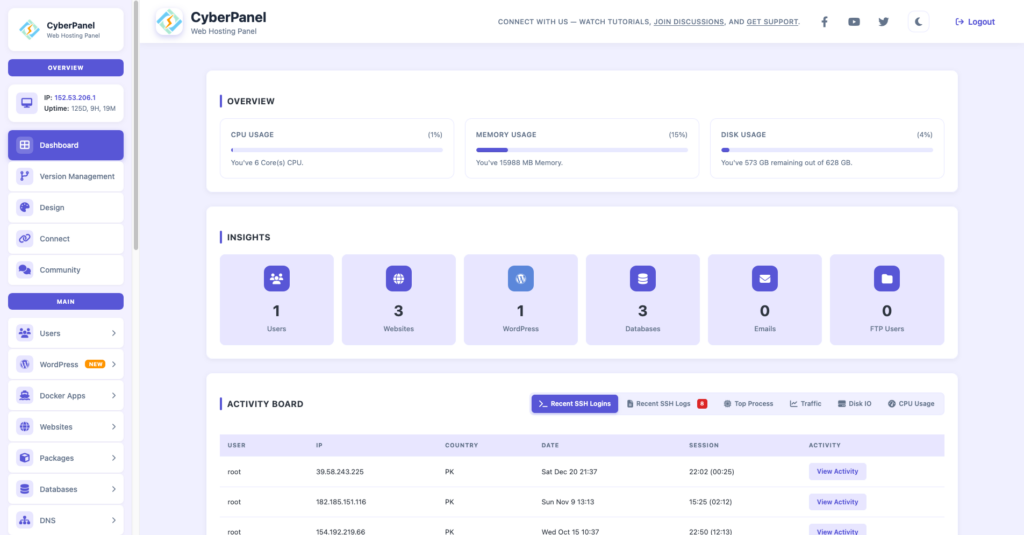
If your website is hosted through CyberPanel with OpenLiteSpeed, start by checking whether the problem is limited to one website or affects multiple sites.
If several websites are returning 503 errors at the same time, investigate the server, PHP services, and available resources first.
If only one website is affected, investigate its virtual host, PHP configuration, WordPress installation, plugins, and database.
A practical CyberPanel troubleshooting sequence is:
CyberPanel → Website → OpenLiteSpeed/PHP status → Server resources → Logs → WordPress
The exact options visible in CyberPanel can vary with the installed version and configuration.
Check Server Resources in CyberPanel
Look at CPU and memory usage.
If resources are consistently exhausted, the 503 may be a symptom of server capacity rather than a LiteSpeed configuration problem.
Check Website Logs
Use the relevant website or OpenLiteSpeed logs to find the error occurring at the time of the 503.
This is more useful than repeatedly restarting the server.
Check PHP Version
A website running an incompatible PHP version or problematic PHP configuration can produce application-level failures.
Confirm the PHP version assigned to the affected website.
Can LiteSpeed Cache Cause a 503 Error?
LiteSpeed Cache itself does not automatically mean a 503 will occur.
However, cache configuration can interact with server resources, PHP requests, crawlers, and WordPress functionality.
If the 503 started immediately after changing LiteSpeed Cache settings, temporarily revert the relevant change and purge the cache.
Do not assume that the cache plugin is the cause without checking the server logs.
How Do You Check LiteSpeed Logs for a 503?
When troubleshooting a litespeed 503 error, reproduce the problem and immediately check the relevant logs.
For the main OpenLiteSpeed error log:
tail -n 100 /usr/local/lsws/logs/error.logFor live monitoring:
tail -f /usr/local/lsws/logs/error.logSearch for terms related to:
503
PHP
lsphp
worker
process
memory
connection
timeoutThe exact error message matters more than the HTTP status code itself.
A 503 only tells you that the service was unavailable. The log can tell you why.
What If the LiteSpeed 503 Error Keeps Coming Back?
If restarting OpenLiteSpeed or lsphp temporarily fixes the website but the 503 returns, investigate the recurring cause.
Look for patterns such as:
- The same time every day
- Traffic spikes
- WordPress cron jobs
- Backups
- Security scans
- Plugin tasks
- Database operations
- PHP worker exhaustion
- Memory exhaustion
For example, if the error appears every few hours and the server reaches its PHP process limit shortly beforehand, increasing resources or fixing the process-heavy workload may be more appropriate than repeatedly restarting PHP.
How Do You Prevent Future LiteSpeed 503 Errors?
Once the website is working again, focus on prevention.
Monitor CPU and RAM
Know the normal resource usage of your server.
Review PHP Worker Limits
Configure PHP workers according to the server’s actual CPU and memory capacity.
Remove Unnecessary Plugins
Every active plugin can add PHP execution, database queries, scheduled tasks, or external requests.
Optimize Heavy WordPress Tasks
Look at backups, cron jobs, imports, image processing, and other resource-heavy tasks.
Keep OpenLiteSpeed Updated
Use a supported OpenLiteSpeed version and keep the server maintained.
Monitor Logs
Repeated warnings often appear before a complete service failure.
Use Caching Correctly
Caching can reduce PHP workload, but it should be configured correctly for the website.
LiteSpeed 503 Error Troubleshooting Checklist
| Check | What to look for |
|---|---|
| Website scope | One site or all websites? |
| CPU | Is the server overloaded? |
| RAM | Is available memory very low? |
| lsphp | Are PHP processes excessive or stuck? |
| Error logs | What happens at the exact time of the 503? |
| PHP version | Is the configured version supported? |
| Plugins | Did a recent change trigger the problem? |
| Database | Are queries or database resources overloaded? |
| Firewall | Are requests being blocked? |
| Cache | Did the error begin after a cache change? |
| Server limits | Are PHP workers or processes exhausted? |
Frequently Asked Questions
Can a traffic spike cause a LiteSpeed 503 error?
Yes. A sudden traffic spike can use more CPU, RAM, PHP workers, or server connections than the website can handle. This can temporarily trigger a 503 response even when the server is otherwise working normally.
Is a LiteSpeed 503 error the same as a 500 error?
No. A 503 error usually means the server is temporarily unable to handle the request, often because of overloaded resources or unavailable services. A 500 error generally indicates an internal server-side problem with the application or server configuration.
Can a CDN cause a 503 error even when the origin server is working?
Yes. A CDN or reverse proxy can return a 503 when it cannot properly connect to the origin server or when its own service encounters a temporary problem. Checking the response from the origin directly can help determine whether the problem is at the server or CDN layer.
Final Thoughts
A LiteSpeed 503 error is a symptom, not a diagnosis.
The fastest reliable way to fix it is to determine what the server was doing when the error occurred. Check the OpenLiteSpeed error log, inspect CPU and memory usage, review lsphp processes, and determine whether the problem affects one website or the entire server.
If restarting lsphp or OpenLiteSpeed temporarily restores the website, keep investigating. A recurring 503 usually means the underlying resource, PHP, WordPress, database, or configuration problem still exists.
For CyberPanel users running OpenLiteSpeed, the same principle applies: use the panel to inspect the server and website environment, then use the relevant logs and system tools to identify the actual bottleneck.
Fix the cause, not just the 503 response.