On this page
In the first week of August, we rebuilt the reporting stack for three of our eleven retainers. We were paying twice for one monthly client report: once for the platform that collects the rankings, backlinks, and AI data, once for the dashboard that charts it. That split runs through almost every ranked list of SEO reporting tools: some products hold the SEO data themselves, and others are SEO reporting software that only displays data it doesn't hold. It matters commercially: 74% of SEO professionals measure SEO by organic traffic while only 60% measure it by qualified leads or sales. The reporting layer now carries more of the client conversation than it used to. Buyers who miss it buy one layer, then find in month three they need both.
What we checked before ranking anything:
- Whether the tool collects its own rankings, backlinks and audit data, or only renders numbers from elsewhere.
- What white-label, client-facing delivery costs once the roster reaches 20 clients, add-ons included.
- Seat and client-access economics: who needs a paid seat, and whether view-only client access is free.
- Whether AI-answer visibility is reportable, and which engines the vendor actually names.
- How the data gets out: scheduled export, connector, API or MCP.
Method: we read every vendor's own pricing page, verified prices on 16 September 2026, assessed each reporting layer against a 20-client agency roster, and checked each AI-visibility claim against the engines it names.
The 8 SEO Reporting Tools at a Glance
SEO reporting tools collect search performance data (rankings, traffic, backlinks, technical issues, AI visibility) and turn it into dashboards or scheduled client reports. The category splits in two: some tools hold the SEO data they report on, while others only display data you buy elsewhere. That split decides what an SEO reporting tool really costs.
| Rank | Tool | Holds its own SEO data? | Reports AI visibility? | White label at | Entry price |
|---|---|---|---|---|---|
| 1 | SE Ranking | Yes: rankings, backlinks, audit, AI visibility | Yes, reportable alongside classic SEO | Agency Pack add-on, from $69/mo (annual billing only) | $129/mo Core ($103.20/mo billed annually) |
| 2 | Nightwatch | Yes, rank tracking first | Yes, on every plan, 6 engines | Professional, EUR 159/mo | EUR 79/mo Starter (annual billing saves EUR 240/year) |
| 3 | Semrush | Yes | Yes, on all plans, 4 engines | Pro Report add-on, $20/mo | $139/mo SEO plan ($117.33/mo billed annually) |
| 4 | AgencyAnalytics | No, display layer only | Yes, metered AI Tracker add-on at $20.83/mo per 250 credits (annual) | Core plan, included | $20 per client/mo billed monthly (20% off annual) |
| 5 | Whatagraph | No, display layer only | No | Max, included | EUR 699/mo Max (billed annually; Prime quote-only) |
| 6 | Databox | No, display layer only | No | $80/mo add-on on Agency; native on quote-only Custom | Free tier; Analyst from $71/mo (billed annually) |
| 7 | Google Search Console | Yes, Google first-party data only | Partial: AI Overviews and AI Mode in Google, phased rollout | None, no client-facing report | Free |
| 8 | Looker Studio | No, display layer only | No | None | Free (Pro is a paid per-user licence) |
Read the two question columns first: a no in the first means the tool needs an SEO reporting platform behind it.
Tier 1: SEO Reporting Software That Holds Its Own Data
Tier 1 tools collect the data and build the report. One system runs the rank tracking, backlinks, site audit and AI-visibility checks, then builds the client report from that same store. Nothing gets exported to a second vendor or reconciled at month end.
1. SE Ranking
SE Ranking is an SEO reporting platform that collects the rankings, backlinks, audit and AI-visibility data it reports on.
Best for: agencies running a 20+ client reporting cycle that want the data and the report in one system
Standout feature: The drag-and-drop Report Builder ships templates, scheduling, white-label branding (own logo, colours, domain) and PDF, XLS or HTML export. Live dashboards share by view-only guest link, no paid seat needed. AI Overview mention and link presence land in the same report as rankings. API and MCP are included in every plan.
Pros:
- Builds white label SEO reports in a drag-and-drop editor and schedules delivery
- Reports AI Overview mention and link presence beside rankings and backlinks
- Shares live dashboards by guest link, so client access costs no seat
- Connects GA4, Search Console and Matomo into the same report
Cons:
- Unlimited white-label reports, client seats and own-domain delivery run through the Agency Pack add-on
- Report, seat and project volumes scale with tier: Core ships 10 reports, 1 manager seat
- No automated cross-channel correlation inside the platform, though MCP allows it in an AI assistant
Pricing: Core $129/mo ($103.20/mo billed annually), Growth $279/mo ($223.20/mo billed annually), Agency Pack from $69/mo (annual billing only).
What we saw: we rebuilt a 20-client September cycle inside its report generator over two weeks. Nine reports went out white-labelled and on schedule. The month-end export and re-join step was gone.
2. Nightwatch
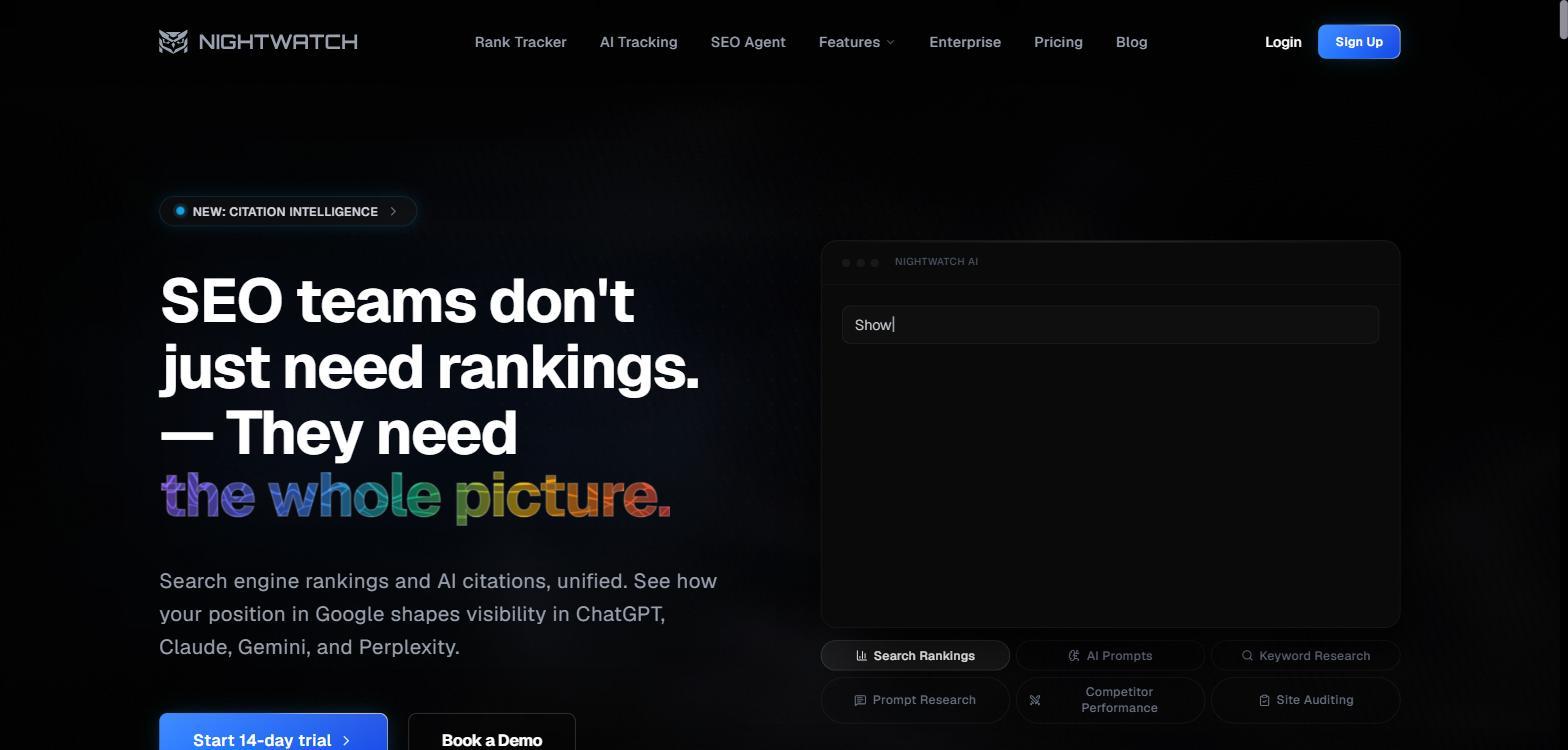
Nightwatch is a rank tracker that reports AI-answer visibility on every plan, with no per-seat charge.
Best for: AI-visibility-first rank tracking with unlimited seats
Standout feature: AI-visibility tracking is on every tier, covering ChatGPT, Claude, Gemini, Perplexity, Google AI Mode and AI Overviews. Starter runs 50 prompts and 1,500 monthly responses. Seats are unlimited on all plans.
Pros:
- Tracks six AI surfaces on every tier
- Adds users at no per-seat cost
- Checks 500 to 20,000+ keywords daily
Cons:
- White label is absent from the EUR 79 Starter tier, so the entry plan can't face a client
- Rank-tracking-first: paid, social and wider channels aren't in the report
Pricing: Starter EUR 79/mo, Professional EUR 159/mo, Agency EUR 399/mo.
What the tracking set says: through August our 1,200-prompt set ran against it. Widest engine coverage in this list. It produces a rank-and-citation report, not a client report.
3. Semrush
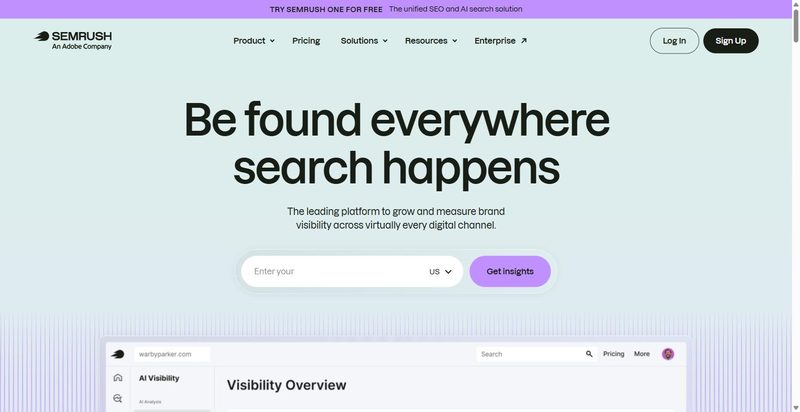
Semrush is a large all-in-one SEO suite that sells reporting and white-labeling on top of the plan.
Best for: teams already standardised on a large all-in-one suite
Standout feature: Every plan includes AI-visibility tracking across Google Search, ChatGPT, Perplexity and Gemini, plus Position Tracking and Site Audit.
Pros:
- Tracks positions and site health on all plans
- Covers four AI surfaces without an add-on
- Reaches 5,000 keywords and 40 sites at Advanced
Cons:
- Scheduled PDF reporting and white-labeling are chargeable add-ons on top of a plan starting above $117/mo
- Each extra seat is $45+/mo on top
Pricing: SEO $139/mo ($117.33/mo billed annually); Base Report add-on $10/mo, Pro Report $20/mo.
What we saw: we priced a 20-client setup in September. Three extra seats plus the Pro Report add-on pushed the SEO plan past $290/mo before a report went out.
Tier 2: White Label SEO Reports Built on Data You Buy Elsewhere
Tier 2 tools are SEO reporting software for clients: they build the report and hold none of the data. Rankings, backlinks, and audits come from a platform bought separately. As SEO reporting tools for agencies they're an addition to a stack, not a replacement: the cost is theirs plus the platform feeding them.
4. AgencyAnalytics
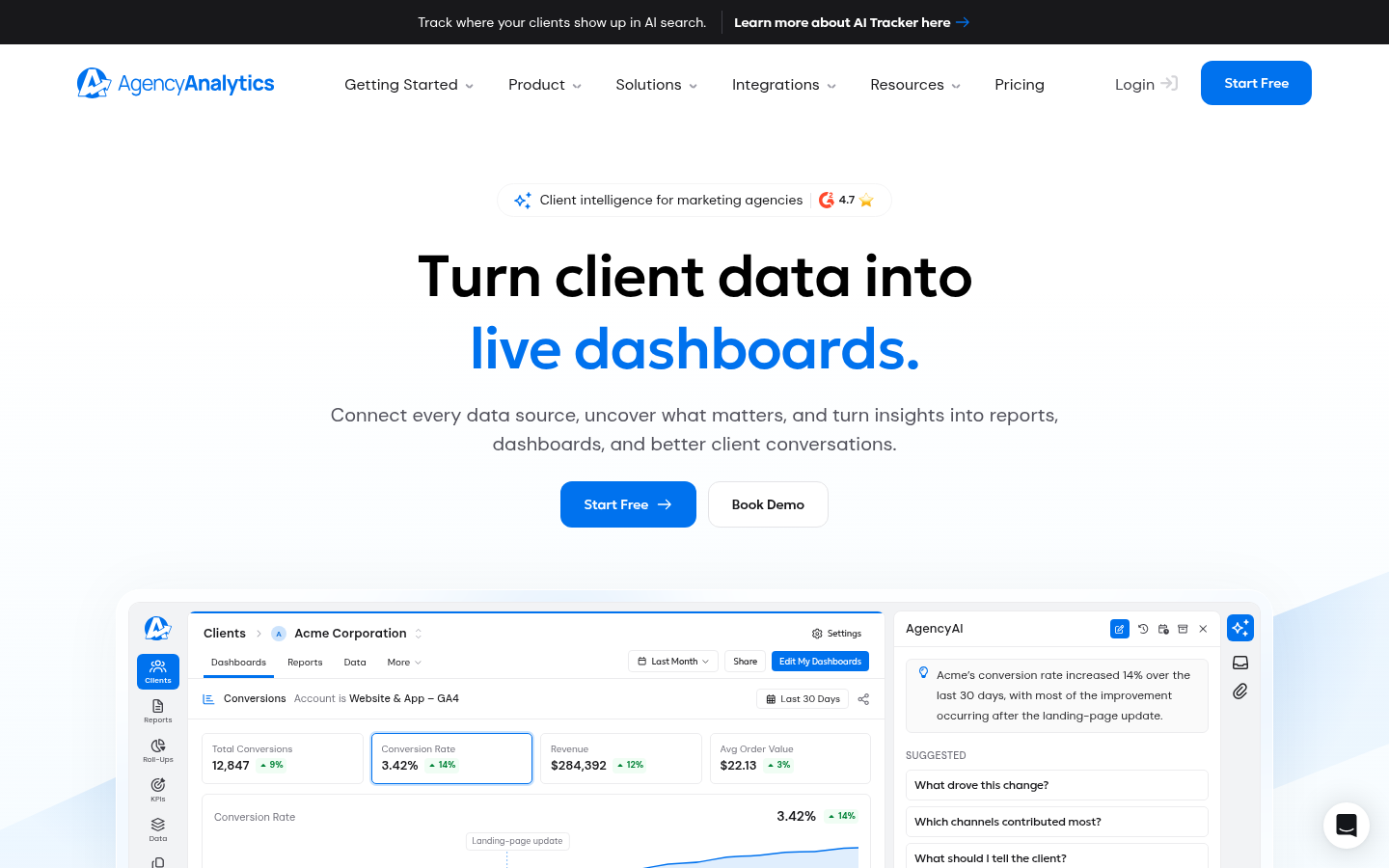
AgencyAnalytics sits among SEO client reporting tools that bill per client, not per seat, suiting roster-led agencies.
Best for: agencies whose client roster, not keyword volume, is the scaling axis.
Standout feature: White label covers logo, colours, custom domain and send-from email, plus a client portal. Staff and client seats are unlimited at $20 per client monthly.
Pros:
- Brands the report, domain and sending address
- Adds unlimited staff and client logins
- Pulls 85+ integrations into one scheduled report
Cons:
- Rank Tracker is $41.67/mo per 500 keywords, metered
- AI Tracker beta is $20.83/mo per 250 credits, also metered
Pricing: $20 per client/month, 20% off annual; custom at 25+ clients.
What we saw: the two metered add-ons, not the $20 headline, set our 20-client cost. Both scale with volume, not clients.
5. Whatagraph
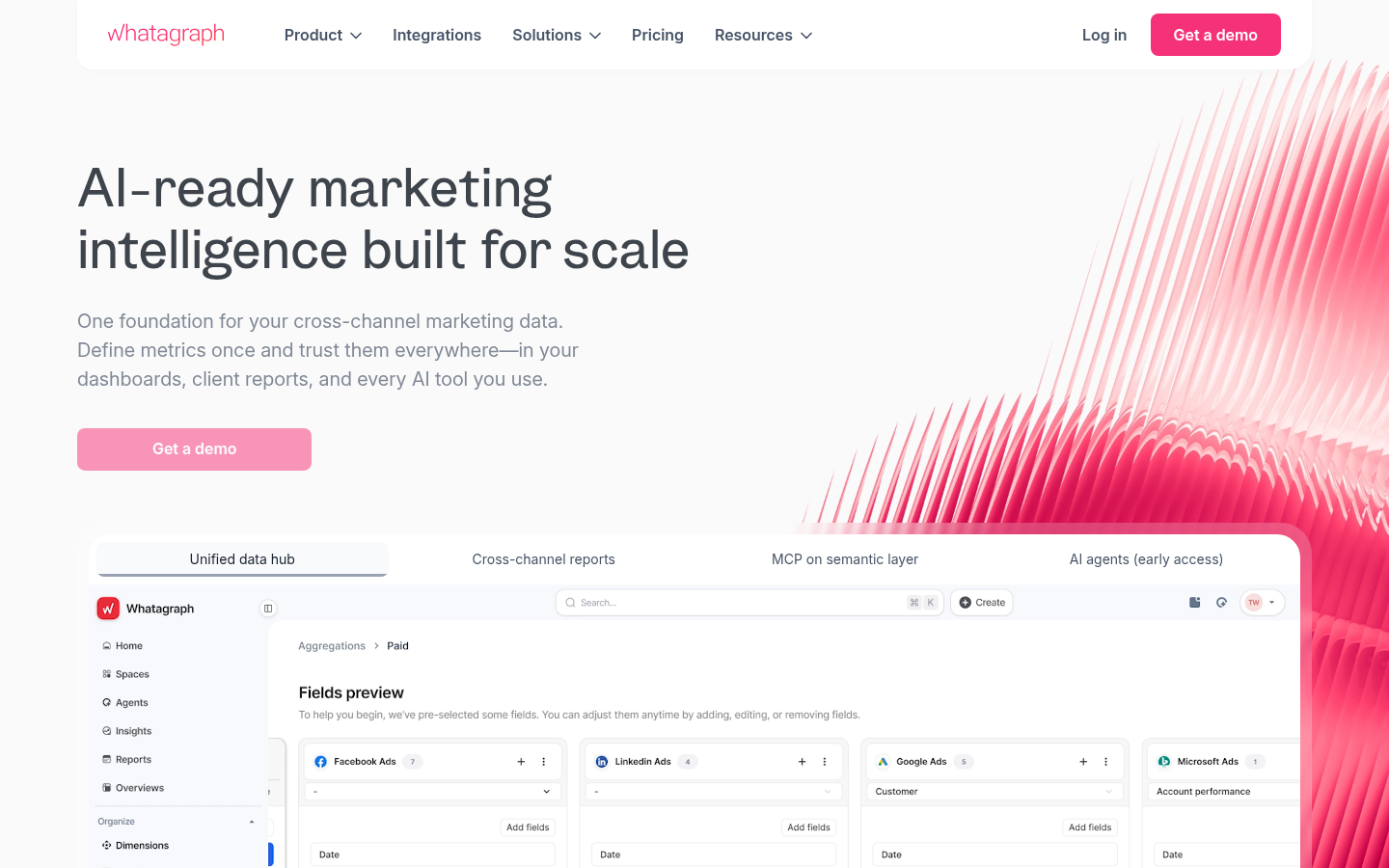
Whatagraph is a multi-source reporting platform that opens at EUR 699 a month and buys consolidation into one report.
Best for: in-house teams consolidating paid and organic sources into one branded report.
Standout feature: Reports and users are unlimited on both tiers, and custom branding is included on each, so report volume never changes the bill.
Pros:
- Runs unlimited reports and users on either tier
- Brands every report at no extra charge
- Assembles reports with AI from connected sources
Cons:
- Public API access and BigQuery transfer are Prime add-ons
- A custom report domain is Prime-only
- No AI-search visibility at all
Pricing: Max EUR 699/month billed annually; Prime is quote-only.
What we saw: wiring it into our stack needed two Prime add-ons.
6. Databox
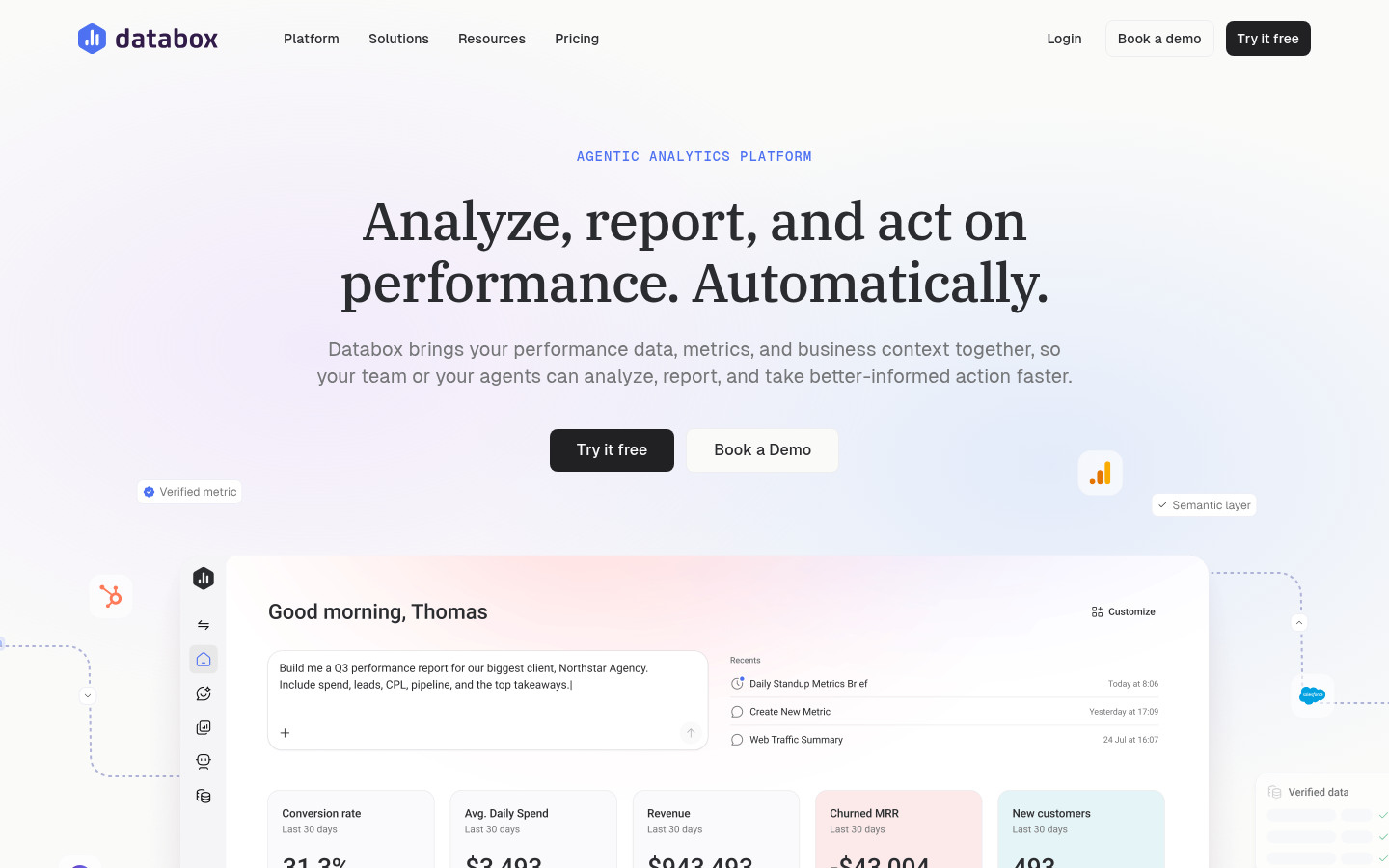
Databox is a dashboard platform now calling itself agentic analytics, so SEO reporting software for clients is one job here.
Best for: teams that want dashboards first and buy white label separately.
Standout feature: The free forever tier is real: three sources, one dashboard, 50 AI credits monthly. Paid tiers add unlimited dashboards and an MCP server.
Pros:
- Keeps a genuine free forever tier
- Builds unlimited dashboards on every paid tier
- Reports across clients from the Agency tier
Cons:
- White label is an $80/month Agency add-on, native only on quote-only Custom
- Priced by data source, not client: GA4, Search Console and Google Ads per client drain it
- No AI-search-visibility tracking: its AI features analyse your own data
Pricing: Free forever; Analyst $71/mo annual; Agency from $99/mo annual.
What we saw: ten client accounts on three connectors each billed as thirty sources.
Tier 3: Free SEO Reporting Tools, and Exactly Where They Stop
Google Search Console and Looker Studio are the two free tools in this ranking. AI referral traffic grew 16x between 2024 and 2026 and still accounts for 0.32% of traffic, with ChatGPT making up 74.78% of it. Neither free tool reports visibility inside ChatGPT.
7. Google Search Console
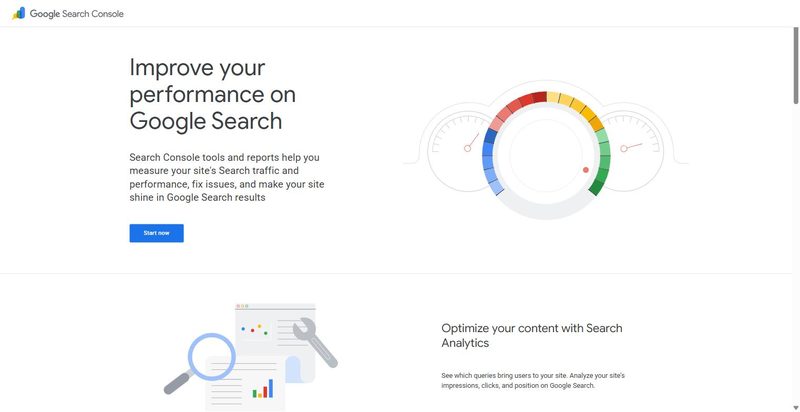
Google Search Console reports Google's own first-party numbers for free, one verified property at a time.
Best for: teams needing Google's first-party numbers as the reference behind every client report.
Standout feature: On 3 June 2026 Google shipped Search generative AI performance reports covering AI Overviews and AI Mode in Search plus generative AI in Discover. Impressions, pages, countries, devices for Search and dates run from hourly to monthly granularity. Rollout is phased to a subset of sites, so it can't be promised to a client. No click breakout.
Pros:
- Runs free on unlimited properties
- Reports Google's AI surfaces
- Feeds reporting connectors
Cons:
- One property at a time: no multi-client roll-up, no white label, no scheduled client-facing report
- Google's AI surfaces only: nothing from ChatGPT, Perplexity, Copilot or Claude
Pricing: Free.
What we saw: through August 2026 the reports reached some client properties, not others.
8. Looker Studio
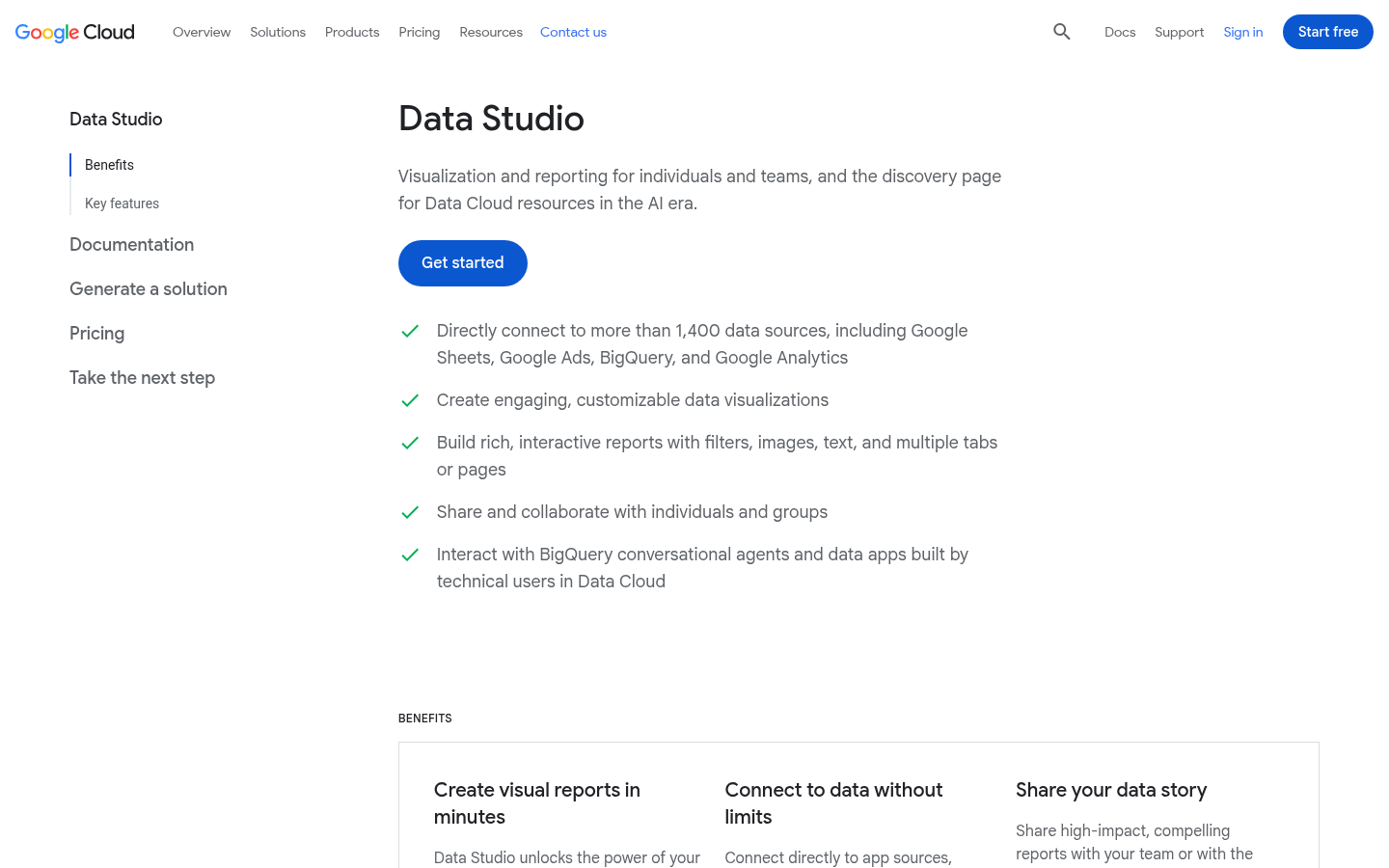
Looker Studio is a free report builder with client-ready output that holds none of the SEO data it charts.
Best for: teams with a data stack that need a free presentation layer they control.
Standout feature: Report building is free and complete: native Search Console and GA4 connections, unlimited pages and charts, scheduled email delivery and per-report sharing. Nothing in the builder is gated behind a paid tier, so a 20-client reporting cycle can run at zero licence cost.
Pros:
- Connects Search Console and GA4
- Builds unlimited reports and pages
- Schedules delivery to clients
Cons:
- Needs third-party connectors for rank tracking, backlinks, site audit and AI visibility, mostly paid separately
- No organizational ownership on the free tier: reports belong to whoever built them
Pricing: Free; Pro is a paid per-user licence.
What we saw: we ran it through 2026. Report ownership sat with the person who built each report.
One column in that table deserves more caution than the rest.
The AI Visibility Number You Probably Should Not Report Yet
In an August 2025 test, three same-day pulls of AI Mode results for the same 10,000 keywords overlapped on only 9.2% of exact URLs, and 21.2% of queries returned zero overlap. A single-pull AI visibility position is close to noise, and putting it in a monthly client deck as a hard number creates a credibility problem next month.
What we saw: same keywords, same day, three pulls, URL lists that barely agreed. What we think it means: an AI visibility position is a sample, not a measurement.
Nobody has years of data here, us included. As Casey Nifong wrote in Search Engine Land in May 2026, there is "no universal GEO dashboard", only the one that "helps your team decide what to do next."
What we changed: our reports carry a rolling range across three weekly pulls and a citation-count trend, never a single-pull position, and the cadence prints next to the number.
Verdict: What We Would Actually Run
What we're running: SE Ranking, for most agency reporting cycles. The reason is structural: rankings, backlinks, audit and AI-visibility data sit in the same system that builds the client report. Nothing gets joined by hand. AI visibility is reportable next to classic SEO, not a second tool, and its live SEO dashboards answer the between-report questions clients ask midweek.
When the roster grows, the Agency Pack adds unlimited scheduled reports and client seats.
Skip If
Skip Whatagraph if your stack needs public API access or a warehouse export and nobody has appetite for a procurement cycle: both sit behind its quote-only tier. Skip the free Looker Studio tier for client-facing work: reports belong to the individual who built them and leave with that person.
Shortlist two or three SEO client reporting tools against one live roster before the next cycle, or start with the top pick and test it there.
Frequently Asked Questions
What is the best tool for SEO reporting?
The best tool for SEO reporting is the one that holds the data it reports. For teams that want rankings, backlinks, site health and the client-facing report in one system, SE Ranking does both. The honest answer depends on whether your team already owns an SEO platform.
What are the best SEO reporting tools for agencies?
The best SEO reporting tools for agencies are judged on delivery, not features: white-label output on the agency's own domain, client seats that do not require paid platform seats, and pricing that scales per client rather than per keyword. AgencyAnalytics and SE Ranking are the two shapes of that answer.
Are there any free SEO reporting tools?
Yes. Google Search Console and Looker Studio are free and first-party, and Databox runs a free tier. The ceiling is clear: no multi-client roll-up, no white label, and Google's surfaces report only Google, so ChatGPT, Perplexity and Claude visibility stays outside them.
What should an automated SEO report include?
Automated SEO reporting should include rankings by search engine and location, organic traffic from a connected analytics source, technical health, and backlink movement. If AI-answer visibility is tracked, state it with its pull cadence and a trend, not as a single number pulled once.