On this page
VPN affiliate marketing remains one of the highest-earning niches in software: subscriptions are recurring, average order values keep climbing thanks to multi-year plans, and demand is driven by privacy news cycles rather than seasonality. But not all programs are built the same. Some pay triple-digit percentages on the first sale and nothing afterwards; others pay less upfront but keep paying on every renewal for years.
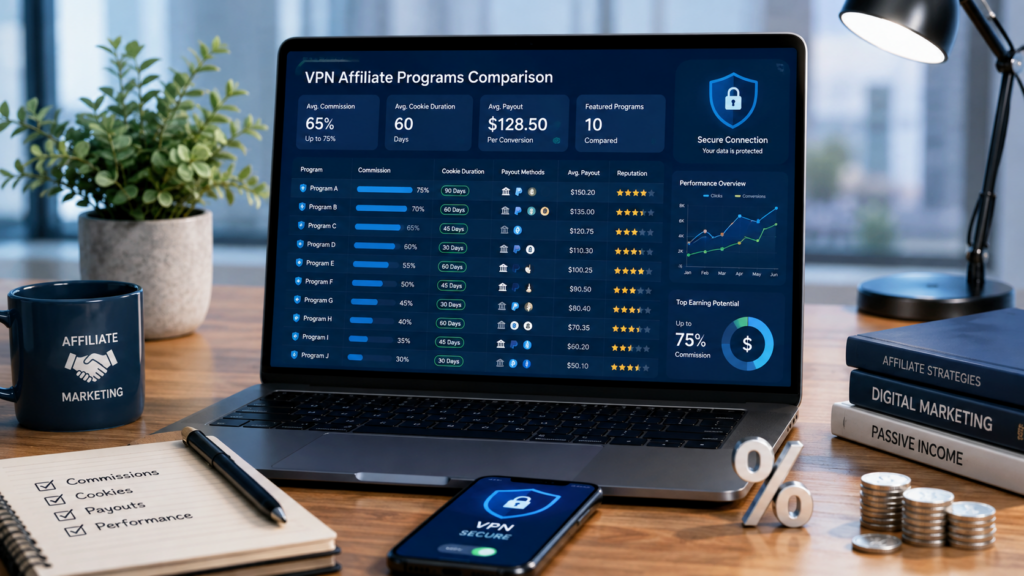
We compared the leading VPN affiliate programs on four criteria: commission structure, cookie duration, conversion potential (brand trust, checkout quality, localization), and how easy the program is to actually work with — tracking, creatives, and payouts. Here are the ten that came out on top. Commission figures reflect publicly listed rates at the time of writing; always confirm current terms on the program page.
Quick comparison
|
Program |
Commission |
Cookie |
Stands out for |
|
AdGuard |
Up to 30% per sale, ecosystem-wide |
30 days |
Ad blocker + VPN + DNS cross-sell, 17+ locales |
|
NordVPN |
40–100% new sale + 30% renewals |
30 days |
Brand recognition, renewal revenue |
|
Surfshark |
Up to 40% recurring |
30 days |
Aggressive pricing = high CR |
|
ExpressVPN |
Flat bounty per signup |
90 days |
Long cookie, premium brand |
|
Proton VPN |
Up to 100% of first purchase |
30 days |
Privacy-first reputation |
|
CyberGhost |
Up to 100% new signup |
45 days |
45-day cookie, big plan discounts |
|
Private Internet Access |
33%+, incl. renewals |
30–60 days |
True recurring model |
|
PureVPN |
Up to 100% + recurring tiers |
90 days |
Flexible commission plans |
|
IPVanish |
Up to 100% + ~35% recurring |
30–60 days |
US-heavy audience fit |
|
hide.me |
Up to 50–100% first sale |
30 days |
Freemium funnel |
1. AdGuard
AdGuard is the rare program where you’re not selling a single product — you’re selling an ecosystem. The AdGuard VPN Affiliate Program covers the company’s full lineup: the flagship ad blocker (on the market since 2009, with tens of millions of users), AdGuard VPN, and AdGuard DNS. That matters for affiliates because a visitor who came for a VPN review often converts on the ad blocker instead — or buys both. Commissions run up to 30% per sale, with higher rates negotiable for high-volume partners, and localized landing pages in 17+ languages make it one of the strongest options for non-English traffic that most competitors treat as an afterthought.
Pros:
- Cross-sell across ad blocker, VPN, and DNS — multiple ways to monetize one visitor
- Strong localization: landing pages and checkout in 17+ languages
- Established brand with a loyal user base and lifetime license options that boost AOV
- Beyond affiliate: the same program offers reseller and white-label tracks if your model evolves
Cons:
- Headline percentage is lower than the 100% first-sale offers elsewhere (offset by conversion and cross-sell)
- Smaller brand footprint in VPN-only comparisons than Nord or Express
2. NordVPN
The benchmark everyone measures against. NordVPN pays up to 100% on new one-month subscriptions and around 40% on longer plans, plus roughly 30% on renewals — so a subscriber you referred in 2026 can still be paying you in 2028. Conversion rates are consistently strong thanks to relentless brand marketing; the flip side is that NordVPN appears on virtually every competitor’s page, so differentiation is on you.
Pros:
- Renewal commissions create genuine recurring income
- Best-known VPN brand: warm traffic converts easily
- Deep pool of creatives and seasonal promos
Cons:
- Extremely crowded: nearly every VPN affiliate promotes it
- Standard 30-day cookie, shorter than some rivals
3. Surfshark
Surfshark’s low entry pricing makes it the easiest ‘yes’ in the niche — a strong pick for deal-oriented and price-sensitive audiences. Affiliates earn up to 40% recurring revenue share, and the brand’s unlimited-devices policy gives review writers an easy differentiator to hang content on.
Pros:
- Low price point = high conversion rate
- Recurring revenue share available
- Frequent promos to build content around
Cons:
- Lower absolute payout per sale due to cheap plans
- Brand is younger; less pull with security-conscious readers
4. ExpressVPN
ExpressVPN pays flat bounties per signup rather than a percentage — predictable, easy to forecast, and paired with the longest cookie on this list at 90 days. The premium positioning suits audiences that value polish over price.
Pros:
- 90-day cookie window
- Predictable flat payouts simplify planning
- Premium brand with high trust
Cons:
- No renewal earnings
- Higher price point can suppress conversions with budget traffic
5. Proton VPN
From the team behind Proton Mail, Proton VPN converts exceptionally well with privacy-literate audiences — journalists, developers, activists, and readers of security-focused publications. The program pays up to 100% of the first purchase, and the free tier acts as a low-friction funnel entry.
Pros:
- Unmatched credibility in the privacy community
- Free tier lowers the barrier and upsells later
- Up to 100% first-purchase commission
Cons:
- Free tier means some referrals never pay
- Fewer aggressive discounts to promote
6. CyberGhost
CyberGhost combines up to 100% of the first-signup revenue with a 45-day cookie and steep multi-year plan discounts that make comparison-table wins easy. A solid mid-list pick for review and coupon sites alike.
Pros:
- 45-day cookie beats the 30-day standard
- Big discount promos convert deal traffic
- High first-sale percentage
Cons:
- Renewal commissions limited
- Brand trust lags the top three in expert audiences
7. Private Internet Access (PIA)
PIA’s pitch to affiliates is simple: around 33% on everything, including renewals, for the life of the customer. If you’re building a portfolio for long-term passive income rather than quick bounties, PIA’s model is one of the cleanest recurring structures in the niche.
Pros:
- Genuine lifetime recurring commissions
- Veteran brand with a large existing user base
Cons:
- Lower upfront percentage than bounty-style programs
- Ownership history occasionally raised in privacy discussions
8. PureVPN
PureVPN runs one of the most configurable programs around: choose up-front-heavy plans (up to 100% of the first sale) or hybrid plans with recurring share, backed by a 90-day cookie and a dedicated affiliate dashboard with granular reporting.
Pros:
- Flexible commission structures to match your traffic
- 90-day cookie
- Responsive affiliate management
Cons:
- Brand requires more ‘selling’ than tier-one names
- Frequent pricing changes complicate evergreen content
9. IPVanish
IPVanish pays up to 100% on the first sale plus roughly 35% recurring, and resonates particularly well with US audiences and the streaming/Kodi crowd. Payouts are reliable and thresholds low.
Pros:
- Strong combined new + recurring structure
- Good fit for US and streaming-focused traffic
Cons:
- Weaker international brand recognition
- Fewer localized assets
10. hide.me
A freemium VPN with a generous free plan that does the pre-selling for you: referred users try free, then upgrade. First-sale commissions range up to 50–100% depending on plan, making it a good complement to bigger names on a comparison page.
Pros:
- Free plan lowers referral friction
- Competitive first-sale rates
Cons:
- Smaller brand, smaller search demand
- Free users may never convert
How to choose
If you want recurring income, weight PIA, Surfshark, and NordVPN. If you want the biggest first check, look at Proton, CyberGhost, and PureVPN. And if your audience buys more than just VPNs — ad blocking, DNS filtering, general privacy tooling — an ecosystem program like AdGuard’s will usually out-earn a single-product offer on the same traffic, because one visitor can convert on three products instead of one. Whichever you pick, negotiate: nearly every program on this list offers custom rates once you demonstrate volume.