On this page
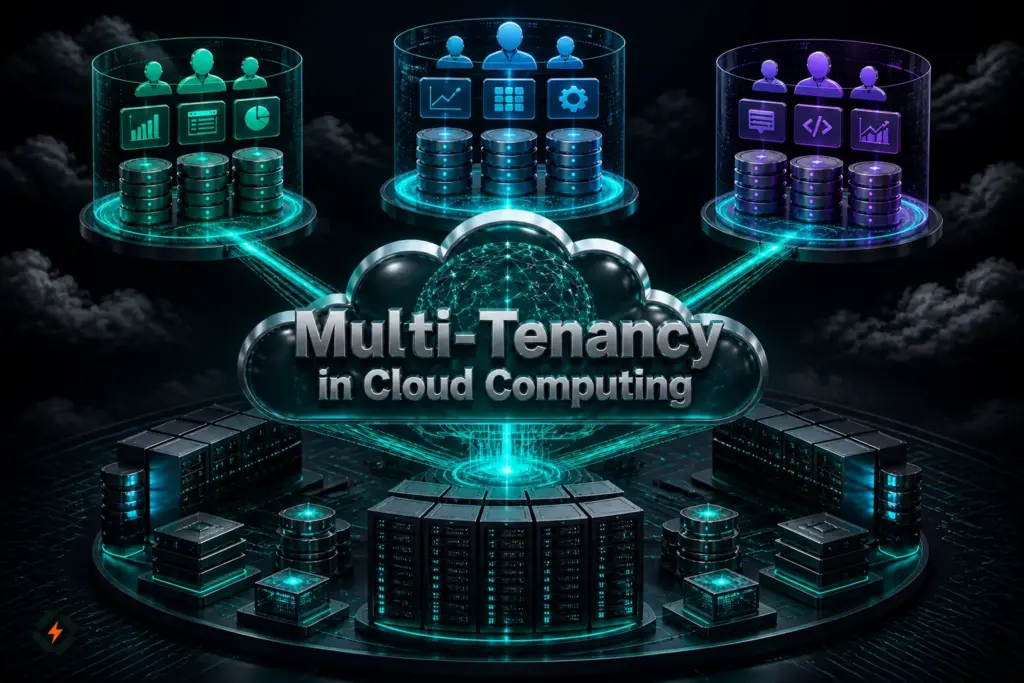
Multi-tenancy in cloud computing is an architecture in which multiple customers or organizations share some computing resources while maintaining separate access to their data and applications. Cloud providers use this approach to improve resource utilization, simplify management, and reduce the cost of delivering services.
Cloud multi-tenancy is common in software as a service (SaaS), public cloud platforms, managed databases, and enterprise applications. However, sharing infrastructure introduces important design challenges, including data isolation, access control, performance management, and compliance.
Understanding how multi-tenancy works helps developers, cloud architects, and businesses choose an architecture that balances cost, scalability, security, and operational complexity.
What Is Multi Tenancy in Cloud Computing?
Multi tenancy in cloud computing is a design approach that allows multiple tenants to use a shared cloud environment. A tenant is a customer, organization, team, or other group that uses a service and requires its own logical access boundaries.
For example, a SaaS accounting platform might serve hundreds of businesses through one application. Each business can have its own users, invoices, reports, and settings, even when the platform shares application servers and database infrastructure.
The application identifies the tenant associated with each request and ensures that users can access only the resources they are authorized to use.
Multi-tenancy does not mean that every component must be shared. An application can share its web servers while using separate databases for different customers. It can also dedicate an entire deployment to a customer with stricter security or performance requirements.
The essential principle is that shared resources must not lead to unauthorized access between tenants.
How Does Cloud Multi-Tenancy Work?
Cloud multi tenancy works by combining shared infrastructure with logical or physical isolation controls. The exact implementation depends on the cloud service, application architecture, and security requirements.
A typical multi-tenant application includes the following components.
1. Shared Infrastructure
The cloud provider supplies computing, storage, networking, and other resources. Multiple tenants use some of these resources instead of requiring a completely separate physical environment for every customer.
Virtual machines, containers, databases, and application services can all participate in a multi-tenant architecture.
2. Tenant Identification
The application determines which tenant a request belongs to. It may use an authenticated organization ID, tenant identifier, domain, or another trusted mapping.
Tenant identification must be based on validated identity and authorization information. An application should never trust an arbitrary tenant ID supplied by a user without checking whether that user can access the corresponding tenant.
3. Access Control
Authentication establishes who a user is, while authorization determines what that user can access.
For example, an employee from Company A should not be able to retrieve Company B’s invoices by changing an ID in a URL or API request. The application must verify tenant membership and permissions for every relevant operation.
4. Data Separation
The system separates tenant data using one or more methods, such as database schemas, separate databases, tenant identifiers, access policies, or dedicated storage resources.
The chosen method must prevent accidental cross-tenant access during normal queries, background jobs, reporting, exports, and administrative operations.
5. Resource Management
The platform monitors and allocates CPU, memory, storage, database connections, and network capacity. Without appropriate controls, one tenant’s unusually heavy workload can affect the performance of other tenants.
Resource quotas, rate limits, workload scheduling, and capacity planning help reduce this risk.
Examples of Multi Tenancy Cloud Computing
Multi-tenancy is used across different cloud services. The following examples illustrate how shared infrastructure can support separate customers.
| Cloud service | How multi-tenancy works | Example |
|---|---|---|
| SaaS applications | Customers use the same application with separate accounts and data | Several businesses use one accounting platform |
| Public cloud infrastructure | Customers use shared physical infrastructure with isolation controls | Different customers run virtual machines on the same physical host |
| Managed databases | Customers share a database service or cluster while using separate databases, schemas, or access policies | Multiple applications use a managed database platform |
| Container platforms | Workloads share a cluster or control plane with configured access and resource boundaries | Several teams deploy applications to a shared Kubernetes cluster |
| Cloud storage | Customers use shared storage infrastructure with separate permissions and resource boundaries | Different organizations store files in a cloud storage service |
The level of sharing varies. A public cloud provider may isolate virtual machines at the infrastructure level, while a SaaS application may enforce tenant separation within its application code and database queries.
What Are the Different Multi-Tenancy Models?
The main multi-tenancy models differ in how much infrastructure and data storage each tenant shares. The right choice depends on cost, scale, customization, compliance, and the consequences of a security failure.
1. Silo Model
In the silo model, each tenant receives a dedicated instance of some or all of the application infrastructure. This might include a separate database, application deployment, or complete resource stack.
For example, a healthcare software provider could deploy a dedicated application and database environment for a customer with strict isolation requirements.
Advantages:
- Stronger separation between tenants
- Easier tenant-specific configuration
- Reduced competition for shared application resources
- A smaller impact radius when an individual deployment fails
Limitations:
- Higher infrastructure costs
- More deployments to maintain and update
- Greater operational complexity at scale
- Potentially slower onboarding for new tenants
The silo model is useful when customers require dedicated resources, specific compliance arrangements, or more control over their environments.
2. Pool Model
In the pool model, tenants share most or all of the application infrastructure. A shared application may serve many customers, and tenant identifiers or other access controls separate their data.
For example, a project management platform might run one application deployment and use a shared database containing records for multiple organizations.
Advantages:
- Efficient use of computing resources
- Lower infrastructure costs per tenant
- Easier centralized maintenance
- Fast onboarding when provisioning can be automated
Limitations:
- Requires reliable tenant-aware authorization
- A software defect can expose data across tenants
- Busy tenants may affect shared resources
- Some customers may need more customization than the shared design supports
The pool model can be cost-effective for SaaS products serving many customers with similar requirements. It demands careful engineering and comprehensive isolation testing.
3. Bridge Model
The bridge model combines shared and dedicated components. Tenants might share an application server while using separate database schemas or individual databases.
For example, multiple customers could access the same web application, but each customer’s records could be stored in a separate database schema.
Advantages:
- More data separation than some fully pooled designs
- Better resource efficiency than a fully dedicated deployment
- Flexibility to choose which components are shared
- A practical middle ground for growing SaaS products
Limitations:
- More complex provisioning than a simple pooled model
- Database and schema management can become difficult at scale
- Shared application components still require tenant-aware access controls
- Dedicated data resources can increase operational costs
The bridge model is appropriate when a business needs stronger data separation without deploying an entirely separate application stack for every tenant.
https://docs.aws.amazon.com/wellarchitected/latest/saas-lens/silo-pool-and-bridge-models.html
4. Hybrid Multi-Tenancy
A hybrid model combines different tenancy approaches based on customer requirements.
For example, a SaaS provider might use a shared application and database for standard customers but offer dedicated databases or complete deployments to enterprise customers.
This allows a provider to balance affordability for most customers with additional isolation for those who need it.
However, hybrid designs require clear provisioning rules, tenant-to-deployment mapping, and consistent monitoring across shared and dedicated environments.
Multi-Tenant vs. Single-Tenant Architecture
The main difference is how much infrastructure is shared between customers.
| Feature | Multi-tenant architecture | Single-tenant architecture |
|---|---|---|
| Infrastructure | Some resources are shared | Resources are dedicated to one tenant at the chosen scope |
| Cost | Often lower per tenant | Often higher per tenant |
| Resource utilization | Can be more efficient | May leave dedicated capacity unused |
| Data isolation | Depends on logical and infrastructure controls | Dedicated resources can simplify isolation, but do not guarantee complete security |
| Customization | May be limited by shared design | Can allow greater tenant-specific control |
| Maintenance | Shared components can be updated centrally | Multiple dedicated environments may require separate maintenance |
| Scaling | Shared resources must support combined demand | Capacity can be scaled for each tenant separately |
| Best fit | SaaS products and services with common requirements | Customers needing dedicated resources or specialized controls |
Single-tenancy does not automatically make an application secure. Identity management, authorization, patching, encryption, backups, and operational controls remain important.
Similarly, a properly designed multi-tenant system can provide strong isolation. The correct decision depends on the risks and requirements of the application rather than on a blanket assumption that one model is always safer.
What Are the Benefits of Multi-Tenancy in Cloud Computing?
Cloud computing multi-tenancy offers several operational and financial advantages when implemented correctly.
1. Lower Operating Costs
Sharing infrastructure allows cloud providers and SaaS businesses to spread some costs across multiple customers. Instead of maintaining separate application servers for every tenant, a shared service can support many customers using the same deployment.
The actual savings depend on resource usage, licensing, support needs, and the cost of implementing adequate isolation.
2. Better Resource Utilization
Tenant workloads rarely reach their maximum demand at the same time. Shared infrastructure can use available capacity more efficiently by serving different tenants through a common resource pool.
Resource limits and capacity planning are still necessary to prevent overcommitment.
3. Centralized Maintenance
Providers can update shared application components and apply many configuration changes centrally. This can reduce repetitive operational work compared with maintaining separate deployments for every customer.
However, a shared update can affect many tenants at once. Testing, staged rollouts, monitoring, and rollback procedures remain essential.
4. Faster Customer Onboarding
A well-designed multi-tenant service can create new tenant accounts through automated provisioning rather than building a complete environment manually.
This helps SaaS businesses grow while keeping onboarding and operational processes consistent.
5. Simplified Product Delivery
When customers use a shared application version, providers can deliver features and fixes through a common release process. This can reduce version fragmentation and simplify support.
Some tenants may still require dedicated deployments or special release schedules, particularly in regulated environments.
6. Flexible Scaling
A shared platform can scale application instances, databases, and other components as demand grows. Tenant-aware monitoring can also help providers identify which customers need additional resources or different service tiers.
Scaling must account for shared bottlenecks, database limits, and the possibility that one tenant’s workload could affect others.
What Are the Challenges and Risks of Cloud Multi-Tenancy?
Multi-tenancy introduces risks that must be addressed through architecture, security controls, monitoring, and operational planning.
1. Cross-Tenant Data Exposure
A missing authorization check or incorrect database query can expose one customer’s data to another customer.
For example, an API might retrieve an invoice using only its invoice ID without verifying that the invoice belongs to the authenticated tenant.
How to reduce the risk:
- Derive tenant identity from trusted authentication context.
- Enforce authorization on every relevant request.
- Scope database queries to the authorized tenant.
- Test APIs, exports, reports, and background jobs for cross-tenant access.
- Log and investigate suspicious access attempts.
Tenant separation should be enforced by design rather than relying on developers to remember it in individual code paths.
2. The Noisy Neighbor Problem
A noisy neighbor is a tenant whose unusually high resource consumption affects other tenants sharing the same infrastructure.
A customer might run expensive database queries, generate heavy traffic, or trigger a large number of background jobs. Other customers may then experience slower responses or timeouts.
How to reduce the risk:
- Apply per-tenant rate limits and quotas.
- Monitor CPU, memory, storage, and database usage.
- Set appropriate concurrency and workload limits.
- Use queues to manage background processing.
- Separate high-demand tenants when shared capacity becomes insufficient.
3. Compliance and Data Residency
Different customers may have different legal, contractual, and regulatory requirements. These can affect where data is stored, who can access it, how long it is retained, and how it is deleted.
A shared architecture must be assessed against the actual obligations that apply to the provider and customer. Multi-tenancy alone does not determine whether a service meets a compliance requirement.
Document data flows, access controls, retention policies, and any regional restrictions before selecting an architecture.
4. Shared Failure Impact
A failure in a common database, authentication service, or application deployment can affect multiple tenants at the same time.
Use redundancy where appropriate, monitor service health, test recovery procedures, and consider staged deployments to limit the impact of changes.
5. Tenant-Specific Customization
Different customers may request unique integrations, settings, workflows, or release schedules. Excessive customization can make a shared application difficult to maintain.
Use configuration and feature flags for supported differences. If a tenant requires substantially different infrastructure or operational controls, a dedicated deployment may be more appropriate.
How to Design a Secure Multi-Tenant Cloud Architecture
A reliable multi-tenant design begins with a clear definition of tenants, data boundaries, access policies, and resource requirements.
Step 1: Define the Tenant Boundary
Decide what a tenant represents in your system. It might be a company, a department, a household, or an individual customer.
Determine whether each tenant can have multiple users, roles, environments, or regional deployments. This definition affects authorization, billing, data organization, and administration.
Step 2: Choose a Data Isolation Model
Select how tenant data will be separated. Common options include:
- A shared database with tenant identifiers
- Separate database schemas for tenants
- A separate database for each tenant
- Dedicated storage resources for selected tenants
- A dedicated application deployment for each tenant
Choose the simplest model that satisfies your security, performance, compliance, and operational requirements.
Step 3: Enforce Tenant-Aware Authorization
Authenticate users and determine their authorized tenant memberships before processing protected operations.
For every request, validate the relationship between the user, tenant, and requested resource. Do not rely on a tenant ID supplied by the client as proof of authorization.
Apply these checks to APIs, file downloads, reports, administrative tools, background jobs, and data exports.
Step 4: Protect Data in Transit and at Rest
Use encrypted connections for network traffic and appropriate encryption for stored data. Protect encryption keys and credentials using suitable secret-management and access-control mechanisms.
Encryption does not replace tenant authorization. A system must still ensure that authenticated users cannot access another tenant’s records.
Step 5: Set Resource Limits
Define limits for requests, storage, concurrent jobs, database connections, and other resources where appropriate.
Use monitoring to detect unusual usage and identify tenants that may need additional capacity. Ensure that limits support legitimate workload peaks rather than causing unnecessary service failures.
Step 6: Monitor and Audit Tenant Activity
Collect logs and metrics that help identify unusual access patterns, resource consumption, and failures.
Where appropriate, include tenant context in audit events while avoiding unnecessary exposure of sensitive data. Restrict access to logs because they may contain customer identifiers or other confidential information.
Step 7: Test Isolation and Recovery
Create tests that verify users cannot read, update, export, or delete another tenant’s information.
Test edge cases such as background jobs, cached responses, search indexes, file storage, and administrative actions. Also verify that backups can be restored and that a failure affecting one component does not cause an unacceptable outage across the entire service.
A Practical Example of Multi-Tenancy
Imagine a SaaS company that provides project management software to three businesses: Company A, Company B, and Company C.
All three companies use the same web application. Each company has its own users, projects, tasks, and documents.
A simplified architecture could work as follows:
- A user signs in and receives an authenticated session.
- The application determines the user’s authorized company.
- The request is checked against that company’s permissions.
- Database operations are scoped to the authorized tenant.
- Shared application servers process requests from all three companies.
- Monitoring tracks resource use and service health.
For example, a query might include a tenant restriction:
SELECT *
FROM projects
WHERE tenant_id = ?;The placeholder must be bound to the tenant ID established through trusted server-side authorization, not blindly copied from user input. The application must also verify the user’s permission to access that tenant before running the query.
This simplified example illustrates one common pattern, not a complete security solution. Production applications need appropriate query handling, authorization checks, transaction controls, and testing across every path that accesses tenant data.
When Should You Use Multi-Tenancy?
Multi-tenancy is useful when multiple customers need similar application capabilities and the business benefits from sharing infrastructure.
Consider it when:
- You are building a SaaS product for many customers.
- Customers have broadly similar functional requirements.
- You need efficient infrastructure utilization.
- Centralized updates and provisioning are important.
- Your team can implement and test reliable tenant isolation.
A dedicated or hybrid approach may be more appropriate when customers need strict resource separation, specialized infrastructure, unusual compliance arrangements, or independent maintenance schedules.
You can also combine models. For example, a platform can serve most customers from a shared deployment and provide dedicated environments for enterprise customers.
Frequently Asked Questions
What is the difference between a tenant and a user?
A tenant represents a customer, organization, or group that uses a service. A user is an individual identity that accesses the service. One tenant can contain many users with different permissions.
Is multi-tenancy secure?
It can be secure when the architecture enforces strong authentication, authorization, data isolation, monitoring, and resource controls. Poorly implemented tenant boundaries can expose customer data or allow one tenant to affect another.
Is SaaS always multi-tenant?
No. Many SaaS applications use multi-tenant architecture, but others deploy separate instances for individual customers or combine shared and dedicated components. SaaS describes a software delivery model, not a single required tenancy architecture.
Which multi-tenancy model is best?
There is no universal best model. A pool model can reduce costs for many similar customers, a silo model can offer stronger resource separation, and a bridge or hybrid model can balance cost with isolation. The decision depends on risk, scale, compliance, and operational complexity.
Does multi-tenancy reduce cloud costs?
It can reduce costs by sharing infrastructure and improving resource utilization. Savings depend on workload patterns, isolation requirements, engineering effort, and the cost of operating the shared service safely.
Conclusion
Multi tenancy in cloud computing allows multiple customers to use shared infrastructure without requiring every customer to have a completely separate environment. It can reduce operating costs, improve resource utilization, and simplify service delivery.
However, these benefits depend on careful architecture. Define tenant boundaries, enforce authorization consistently, protect customer data, manage shared resources, and test isolation regularly. When shared infrastructure cannot meet a customer’s security or performance requirements, a dedicated or hybrid tenancy model may be the better choice.