On this page
Sometimes, batteries on laptops running Linux discharge rapidly. Fans become louder than expected. The CPU usage graph spikes even when you don’t really have anything heavy running. Most of the users are quick to point at the hardware. However, in reality, it is a lack of adequate power management that is the problem most of the time. And TLP Linux is where everything changes.
TLP is an ultra-light, automatic power management software aimed at Linux systems. It can optimize the CPU’s behavior, Wi-Fi power consumption, USB autosuspend, disk settings as well as a whole lot of background processes without you manually trying to adjust any of the settings. After the installation, it stays quiet and out of sight as it does its work in the background. There is no need to constantly check. No difficult configuration.
If you are a laptop user and, lets say, you have an Arch Linux TLP setup or any other rolling distributions, the battery life can be significantly elongated and the amount of heat released can be lowered by employing this tool. A majority of users post a 20% to 40% longer time between charges after turning on TLP Linux.
The article outlines the concept of the TLP tool, usage instructions, and a detailed installation guide for TLP Linux on various distributions. Besides that, we will explore practical commands, the best way to optimize, and how the integration of CyberPanel into the Linux-based ecosystem can facilitate smoother and more efficient operations of systems.
What is TLP Linux?
TLP Linux is a sophisticated power management tool, which automatically applies various smart power-saving settings on laptop batteries. It changes CPU scaling, device power usage, and background hardware behaviour in order to save battery power.
Where manual tuning requires work, TLP runs in the background automatically first time after installation. You simply install it once, enable the service, and it starts working right away.
Therefore, it is a great tool for students, developers, and professionals who run Linux and deal with laptops on the go.
Why Use Linux TLP?
TLP Linux extends your battery life, makes your system less hot and gets the fan less noisy without compromising performance. It toggles intelligently between the battery mode and the AC power mode.
That is why your system will use less power when it is unplugged, and at the same time it can give its full performance when it is plugged in. Here are the benefits:
- Extended battery lifetime
- Less laptop heating
- Lower fan noise
- Improved hardware efficiency
- Completely hands-off operation
TLP is a set and forget solution for most users.
How Does TLP Linux Work?
TLP Linux works by making optimized kernel and hardware settings silently in the background. There is no need for a GUI or continuous monitoring.
It manages:
- CPU frequency scaling
- Disk power saving
- USB autosuspend
- Wi-Fi power mode
- PCIe power management
Radio device control
If you disconnect the charger, TLP will automatically change to battery profile. When you connect it, it will go back to the performance mode.
This intelligent switching is what makes it so effective.
How to Install TLP Linux?
Installing TLP Linux is simple and takes less than a minute on most systems. After installation, just enable the service and reboot.
Ubuntu / Debian
sudo apt update
sudo apt install tlp tlp-rdw
sudo systemctl enable tlp
sudo systemctl start tlp
Arch Linux TLP
For Arch Linux TLP, use pacman:
sudo pacman -S tlp tlp-rdw
sudo systemctl enable tlp.service
sudo systemctl start tlp.service
Arch users especially benefit because Arch ships minimal power optimizations by default.
Fedora
sudo dnf install tlp tlp-rdw
sudo systemctl enable tlp
sudo systemctl start tlp
Verify Installation
sudo tlp-stat -s
Expected output:
TLP power save = enabled
Mode = battery
If you see enabled, TLP is working.
How to Use TLP Linux After Installation?
Most users don’t need to configure anything. How to use TLP Linux is simple because it runs automatically.
Basic commands:
Check status
sudo tlp-stat -s
Show full report
sudo tlp-stat
Restart TLP
sudo tlp start
Stop TLP
sudo tlp stop
For advanced users, you can edit:
/etc/tlp.conf
This file allows custom battery and performance settings.
Why Arch Linux TLP is Highly Recommended?
Arch Linux TLP has gained popularity due to the nature of Arch installations which only consist of the bare minimum system components. Heavy background power managers are absent from the default Arch installation.
Therefore, TLP is able to operate in a cleaner and more efficient way on Arch than on some other distributions.
- Many Arch users report:
- Larger battery gains
- Reduced idle power consumption
- Quicker system reactions
If your laptop runs Arch, TLP must be among the first packages you install.
TLP Linux Features Overview
| Feature | What It Controls | Real Benefit |
|---|---|---|
| CPU scaling | CPU frequency behavior | Less heat and longer battery |
| Wi-Fi power save | Wireless card usage | Reduced background drain |
| USB autosuspend | Idle USB devices | Saves power automatically |
| Disk management | HDD/SSD power state | Better efficiency |
| PCIe runtime PM | Hardware bus power | Lower idle consumption |
| Auto mode switching | Battery vs AC profiles | Smart performance control |
Common Errors People Make When Using TLP Linux
Some people have several power tools installed together which results in the tools clashing.
Avoid:
- Using TLP along with other power management software at the same time
- Removing laptop-mode, tools and installing TLP instead
- Overriding too many settings manually
- Keep it simple. TLP is sufficient on its own.
The Functionality of CyberPanel in Linux Power and System Management
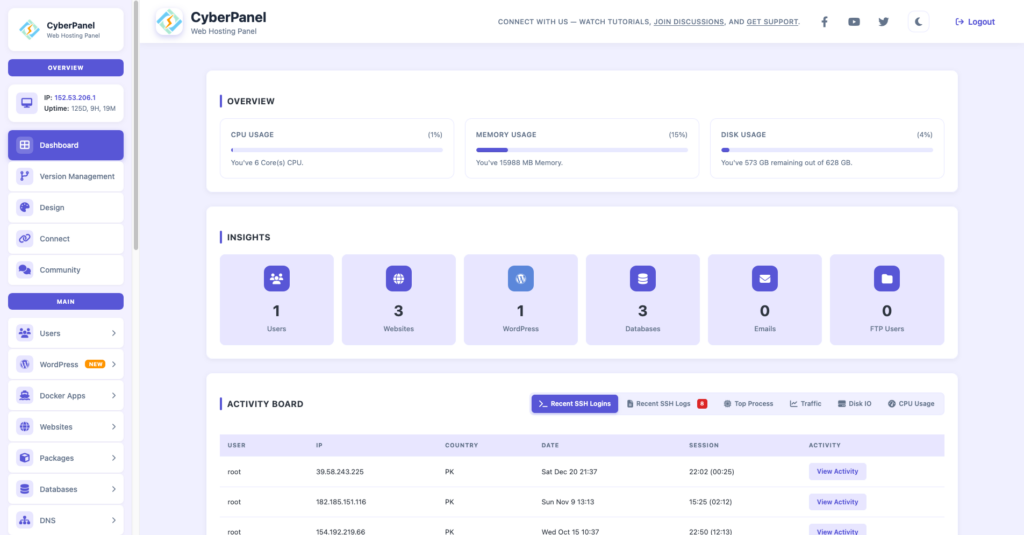
CyberPanel is your free and open-source web hosting control panel. It doesn’t directly influence battery consumption as TLP does but it greatly helps productivity in Linux-based environments.
If you are using Linux laptops or servers for development, hosting, or client work, CyberPanel as your companion will let you:
- Host your projects and websites
- Manage your servers smoothly
- Cut down the waste of computer resources
- Operate minimalistic infrastructural setups
As an illustration, you might operate TLP Linux on your laptop to maximize battery life when working from a remote location, while on your Linux server, you could have CyberPanel installed to provide application and hosting management of minimal overhead.
A TLP Linux Installation Can Be a Final Solution to Battery Issues!
If you have a Linux laptop and have never installed TLP Linux, then you are missing out on easy performance gains. It is lightweight, automatic, and has been proven to extend battery life.
Simply install it, enable it, and allow it to run silently in the background. Combine it with other efficient tools such as CyberPanel for your Linux infrastructure, and you get a powerful yet optimized system.
One installation is all it takes. Consistently save power.
People Also Ask
Is Arch Linux TLP necessary?
It is highly recommended. Arch does not include strong power optimizations by default, so TLP provides noticeable improvements.
How to install TLP Linux quickly?
Use your package manager, enable the service, and start it. After that, it works automatically.
Is Linux TLP safe to use?
Yes. TLP only adjusts system settings and does not harm hardware. It is widely used across major Linux distributions.