On this page
Kubernetes simplifies the process of application deployment. However, the storage aspect presents some difficulty. Although containerized applications operate within short timeframes, the data must still be reliably stored, consistent and always accessible. Ceph Kubernetes demonstrates this point.
If your application is stateful (data requires durability), you need a storage system that scales with your cluster. Your applications require a distributed storage solution that provides you with block, file, and object storage. And when utilizing Ceph with Kubernetes, you can obtain a scalable storage solution that suits the needs of modern-day applications.
This guide will show you how to implement Ceph on Kubernetes, how to install a Ceph cluster on Kubernetes, and why Ceph is often used in production environments.
What is Ceph Kubernetes?
Ceph is an open source software storage solution.
Ceph Kubernetes is the usage of Ceph (an open-source distributed file system) as the backend storage for your Kubernetes cluster.
Ceph provides:
- Block Storage (for use with databases)
- File Storage (to allow multiple users to access a single copy of the files stored in the file system)
- Object Storage (which utilizes object storage via an S3-compatible interface).
Therefore, Ceph is beneficial for your containerized application storage needs.
Ceph on Kubernetes
Ceph is deployed and managed via Kubernetes.
As such, we typically use:
- Rook operator
- Kubernetes CSI drivers
To automate Ceph storage deployment and management.
How Does Kubernetes Ceph Function?
Kubernetes Ceph provides persistent volumes to containers for storage.
Workflow:
- Application requires storage
- Kubernetes creates a Persistent Volume (PV)
- Ceph serves as back-end storage
- Data is stored across multiple nodes
By doing this, Ceph provides high availability and reliability.
What is Ceph for Kubernetes?
Ceph for Kubernetes is a cloud storage solution for containerized workloads.
Applications:
- Database platforms (MySQL, PostgreSQL)
- Cloud-native applications
- Backup/recovery solutions
- Big data workloads
Ceph supports dynamic provisioning, thereby simplifying storage management.
Ceph Cluster Kubernetes
Ceph cluster Kubernetes setup includes multiple components. So that, data is distributed across nodes. It ensures no single point of failure. Here are the core components with their function:
| Component | Function |
|---|---|
| MON (Monitor) | Maintains cluster state |
| OSD (Object Storage Daemon) | Stores data |
| MDS (Metadata Server) | Manages file system metadata |
Advantages of Ceph Kubernetes
Here are a few advantages of using Ceph Kubernetes:
Scalability
Expand by adding nodes.
High Availability
Data is available across multiple nodes.
Flexibility
Ceph for Kubernetes may store data in three ways: block, file, and object formats.
Economically Viable
The system runs on low-cost standard hardware.
Organizations with a large amount of dat find these benefits of Ceph for Kubernetes to be appealing.
StorageClass for Ceph: Example
apiVersion: storage.k8s.io/v1
kind: StorageClass
metadata:
  name: ceph-storage
provisioner: rook-ceph.rbd.csi.ceph.com
parameters:
pool: replicapoolExpected Result
- Kubernetes provisions storage dynamically
- Ceph manages data distribution
- Applications get persistent storage
Ceph vs Traditional Storage
| Feature | Traditional Storage | Ceph Kubernetes |
|---|---|---|
| Scalability | Limited | High |
| Cost | Expensive | Low |
| Flexibility | Low | High |
| Availability | Medium | High |
Ceph and Kubernetes Challenges
Even though powerful, Ceph can present challenges while using Kubernetes.
Complexity
Ceph setup requires planning.
Resource Usage
Ceph requires CPU, RAM and disk storage.
Learning Curve
Ceph requires knowledge of distributed storage systems.
With the right configurations, these challenges can be resolved.
CyberPanel’s Role in Kubernetes Storage Solutions
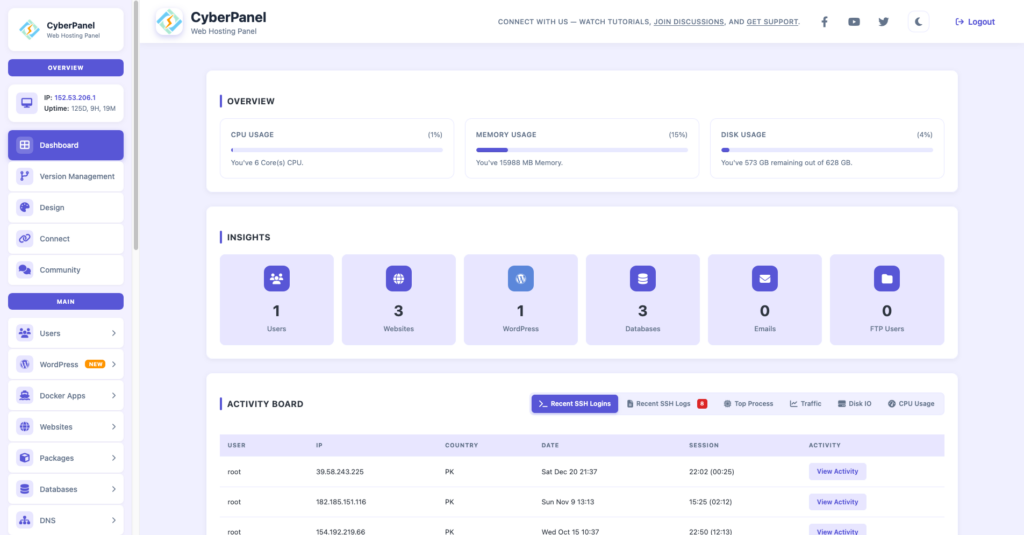
CyberPanel is a free and open-source web hosting control panel. It provides a platform to manage applications built on top of storage solutions like Ceph.
Features offered by CyberPanel include:
- website hosting
- domain name registration
- SSL configuration and installation
- monitoring and reporting capabilities
Ceph manages the storage while CyberPanel provides the management tools for building applications on top of the storage.
Conclusion
Managing data storage on a Kubernetes cluster is an important aspect of any Kubernetes cluster. Ceph provides an effective way to manage data within your cluster with great scalability, reliability, and flexibility.
Organizations can build next generation applications that will leverage strong storage capabilities by utilizing Ceph as their storage solution for Kubernetes.
A properly configured Ceph storage cluster will allow the applications deployed to the Kubernetes cluster to have higher availability and performance.
Deploying Ceph on your Kubernetes cluster today will allow your organization to develop scalable and reliable storage systems.
FAQs
How does Ceph integrate with Kubernetes’ CSI?
CSI Drivers are utilized to supply dynamic storage provisions and volume management for workloads that are running in Kubernetes.
Is it appropriate to use Ceph with small clusters in Kubernetes?
It is technically possible, but it will be more efficient in medium to large clusters due to the high number of resources required.
What function does Rook have with Ceph Kubernetes?
The function of Rook is to operate as an operator that manages/modifies how Ceph behaves with identified Kubernetes nodes.