On this page
Modern applications are all about communication. Every time you access a website, send an email, stream a video, or connect to a remote server, your computer is communicating with other computers over a network. And at the heart of all this communication are sockets.
A Linux socket is an endpoint for communication. It enables processes, whether they’re running on the same system or across different networks, to communicate with each other. Whether you’re developing applications or managing Linux servers, it’s important to have a general understanding of how communication works at the application level.
This guide explains what a Linux socket is, how it works, the different types of sockets, and where they’re used.
What Is a Linux Socket?
A Linux socket is a software construct that allows two processes to communicate with each other. A process will typically open a socket and listen for incoming connections. Another process can then connect to that socket and start sending and receiving data.
Sockets are used in a wide range of applications, including:
- Web servers
- Web browsers
- Database servers
- Email servers
- SSH
- File transfer
- APIs
- Cloud applications
Without sockets, applications wouldn’t be able to communicate over a network.
How Linux Sockets Work
A socket works by creating a communication channel between two endpoints.
The typical process looks like this:
| Step | Description |
|---|---|
| Create Socket | The application creates a socket. |
| Bind | The socket is attached to an IP address or local path. |
| Listen | The server waits for incoming requests. |
| Connect | A client establishes a connection. |
| Transfer Data | Both sides exchange information. |
| Close | The connection ends after communication finishes. |
This sequence occurs every time you load a webpage, log in to an SSH server, or use an online application.
Types of Linux Sockets
Linux OS offers many types of sockets depending on the required purpose of an application interacting through a program. These various socket programs are created because of the differing needs of the applications designed for specific operations. The types of Linux sockets mainly include the stream, datagram, and UNIX sockets.
Stream Sockets (TCP)
Stream sockets are created under the Transmission Control Protocol (TCP). Stream sockets are the primary type of Internet communication. Some of the benefits of using this socket type are the reliability, error-checking and correction, and flow control features that come with TCP. The web, email servers, Application Programming Interfaces (APIs), and secured terminals are some of the areas where stream sockets are commonly used.
Datagram Sockets (UDP)
Datagram sockets are used with the User Datagram Protocol (UDP). Unlike TCP, UDP is geared towards speed rather than reliability. Therefore, these types of sockets are mostly used when the application requires faster data transfer. Some of the areas where datagram sockets find their application include video conferencing, online gaming, voice over IP, and Domain Name System (DNS), among others. The use of UDP is preferred in cases where precision is not desired.
UNIX Domain Sockets
The UNIX domain sockets were created to allow services to communicate within the same server without having to use the Internet. In this case, the domain sockets are used to replace the stream sockets for applications such as MySQL, MariaDB, Docker, NGINX, PHP-FPM, and Redis, among others. Communication over domain sockets is faster compared to the Transmission Control Protocol (TCP).
Common Applications That Use Linux Sockets
Most Linux services depend on sockets in some way.
Examples include:
| Application | Socket Usage |
|---|---|
| Apache | HTTP requests |
| OpenLiteSpeed | Website communication |
| NGINX | Reverse proxy connections |
| MySQL | Database communication |
| SSH | Remote login |
| Docker | Container communication |
| Redis | Local data exchange |
Even if you never create a socket yourself, your Linux system uses them continuously.
TCP vs UNIX Domain Sockets
Administrators often choose between TCP sockets and UNIX sockets depending on the workload.
| Feature | TCP Socket | UNIX Socket |
|---|---|---|
| Network Communication | Yes | No |
| Local Communication | Yes | Yes |
| Faster for Local Services | No | Yes |
| Accessible Remotely | Yes | No |
| Uses IP Address | Yes | No |
For services running on the same server, UNIX sockets frequently offer better performance.
Viewing Active Linux Sockets
Linux includes several tools for inspecting socket connections.
One commonly used command is:
ss -tulnThis displays active listening sockets along with their ports.
Another useful command is:
netstat -tulnAlthough many modern Linux distributions recommend using ss, both commands help administrators troubleshoot network services.
Why Linux Sockets Matter
Sockets are a fundamental concept that underlies many aspects of modern software development. They provide the communication layer that enables applications to interact with each other. Specifically:
- Without sockets, browsers would not be able to load websites
- Applications would not be able to query databases
- Remote server administration would be impossible
- APIs would not be able to exchange data
- Cloud services would not be able to communicate
In short, almost all internet services and applications rely on sockets in one way or another.
Best Practices for Working with Linux Sockets
As a developer or system administrator, there are a few things you can do to improve your security posture and performance when working with Linux sockets. These include:
- Closing unused connections
- Using secure protocols (HTTPS, SSH)
- Monitoring open ports and services
- Disabling unnecessary daemons
- Using UNIX sockets where possible
- Keeping networking software up to date
- Reviewing firewall rules regularly
Linux Sockets and CyberPanel
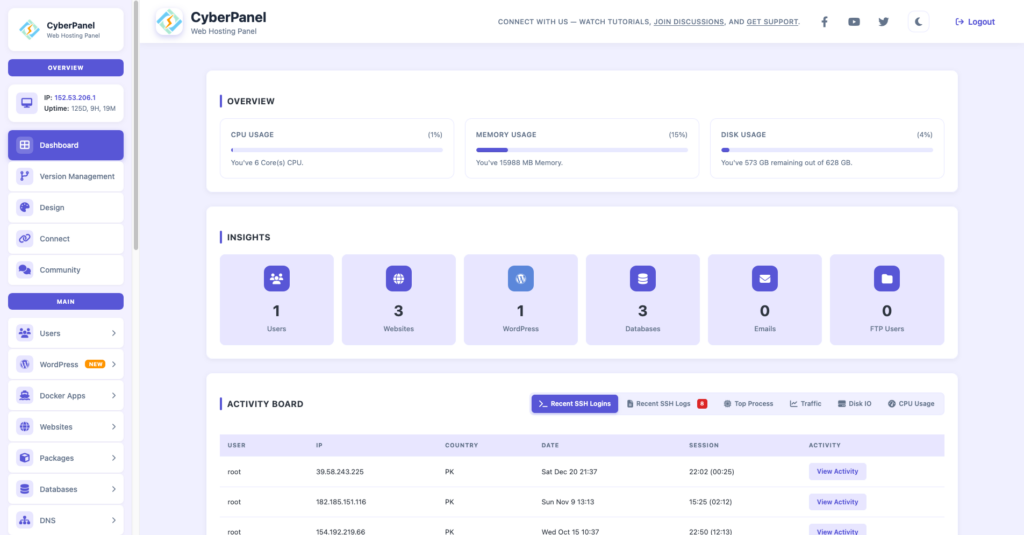
Many of the services managed by CyberPanel, a web hosting control panel, communicate with each other using Linux sockets. Web servers, PHP-FPM, databases, and other services often use TCP or UNIX sockets to exchange data. While CyberPanel makes it easy to manage websites, emails, DNS records, databases, and more, Linux sockets provide the underlying communication layer that enables all these services to function.
Is Learning About Linux Sockets Worth It?
It depends on your needs. If you are a developer, learning about Linux sockets can help you understand how applications communicate with each other and design better software. If you are a system administrator, it can help you troubleshoot problems with web servers, databases, and other services. In general, it is a good idea to have a basic understanding of how Linux sockets work, as they are a fundamental part of any Linux-based system.
With the rise of cloud computing and containerization, Linux sockets are becoming increasingly important. They are used in a wide variety of applications, from simple command-line utilities to complex distributed systems. By understanding how they work, you can improve your skills as a developer or system administrator and better understand how the software you use is built.
Final Thoughts
Linux sockets are an integral part of the operating system’s network stack. They enable communication between processes at the local level as well as over the internet. In other words, web servers, databases, APIs, and many other services and utilities rely on them.
Therefore, studying, learning, or even simply understanding them better can be extremely helpful for your Linux experience, whether you are a developer, system administrator, or someone interested in the technical details of computer networking.
Have you ever worked with Linux sockets or network programming in general? Let us know below in the comments!
FAQs
Are Linux sockets only used for internet communication?
No. Linux also supports UNIX domain sockets, which allow applications on the same machine to communicate without using the network.
Which command is recommended for checking socket connections?
The ss command is generally recommended because it is faster and provides detailed information about active socket connections.
Is Socket Linux secure?
Sockets themselves are communication endpoints. Security depends on the protocols, encryption, authentication, and firewall rules used by the applications.