On this page
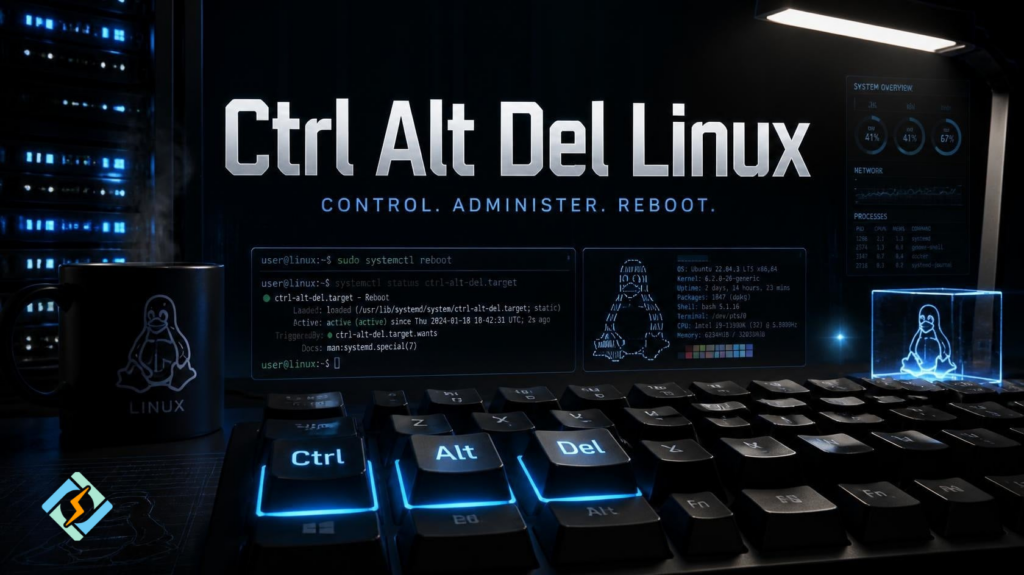
If you are looking for Ctrl Alt Del Linux, you are probably trying to figure out what the Ctrl+Alt+Delete key combination actually does on a Linux system. Unlike Windows, where Ctrl+Alt+Delete opens a security screen, Linux traditionally uses the combination as a system-level reboot shortcut when it is pressed on a virtual console. Modern Linux systems using systemd normally route it through ctrl-alt-del.target, which is generally associated with rebooting the machine.
The important part is that Ctrl+Alt+Delete is not the Linux equivalent of the Windows security screen. Its behavior depends on where you press it, which Linux distribution you use, whether you are in a graphical desktop or virtual console, and how the system has configured the shortcut.
If your real goal is simply to restart Linux, you usually have safer and more predictable options, such as systemctl reboot or reboot. If you manage a Linux server, a control panel such as CyberPanel can also make common server-management tasks easier without relying on a physical keyboard shortcut.
What Does Ctrl+Alt+Delete Do in Linux?
On Linux, Ctrl+Alt+Delete is the key combination that reboots the computer if sent to the system console. In modern systemd-based OSes, the ctrl-alt-del.target is set to be activated in response to the key combination by default.
The target’s purpose is to reboot the system, which is the default action for most Linux distributions. However, there is also a possibility to change the default behavior because the ctrlaltdel command is used by the kernel to handle the key combination. It can be set to perform a hard reboot or send a signal to the init process instead of shutting down the entire system.
This creates an important difference between Linux and Windows:
| Keyboard shortcut | Typical Windows behavior | Typical Linux behavior |
| Ctrl+Alt+Delete | Opens Windows security options | Can initiate system reboot |
| Ctrl+C | Stops a running command | Stops a foreground process |
| Ctrl+Alt+F1/F2/etc. | Not normally used for virtual consoles | Switches between virtual terminals on many systems |
| Alt+Tab | Switches applications | Switches applications in graphical desktops |
So if you searched for control alt delete for Linux because you expected a Windows-style security menu, that is the key distinction to remember.
Is Ctrl+Alt+Delete the Same on Every Linux Distribution?
No. The exact behavior depends on the Linux environment. A graphical desktop may intercept the key combination before it reaches the underlying Linux console. A virtual machine, remote console, desktop environment, or physical server may also handle the shortcut differently.
Systemd-based distributions generally use ctrl-alt-del.target for the sequence.
The table below gives you a practical overview:
| Situation | What Ctrl+Alt+Delete may do |
| Linux virtual console | Trigger the configured reboot action |
| systemd-based Linux | Start ctrl-alt-del.target, normally leading to reboot |
| Graphical desktop | May be intercepted or handled by the desktop environment |
| Virtual machine console | May be captured by the hypervisor |
| Remote desktop session | May be captured by the client or remote OS |
| SSH terminal | Usually cannot be used as a physical Ctrl+Alt+Delete console shortcut |
| Custom system configuration | Behavior may differ from the default |
This is why pressing the combination and expecting one universal result can be misleading.
How to Reboot Linux Without Ctrl+Alt+Delete
If you simply want to restart your Linux machine, you do not need the keyboard shortcut.
The most straightforward command is:
rebootOn a system using systemd, you can also use:
sudo systemctl rebootThese commands tell Linux to perform a normal reboot rather than relying on the keyboard sequence.
You can also use:
sudo shutdown -r nowHere, -r tells shutdown to reboot the system, while now tells it to perform the action immediately.
Which Linux Reboot Command Should You Use?
| Command | Purpose | Best use |
| reboot | Restarts the system | Quick interactive administration |
| sudo systemctl reboot | Requests a systemd-managed reboot | Modern systemd distributions |
| sudo shutdown -r now | Shuts down and restarts | Traditional shutdown workflow |
| sudo reboot | Restarts the system with elevated privileges | Systems requiring sudo |
For most modern Linux servers, sudo systemctl reboot is a clear choice because it explicitly asks systemd to perform the reboot.
What Is the Difference Between Ctrl+Alt+Delete and reboot?
The primary distinction between Ctrl+Alt+Delete and reboot is how these commands are treated by the OS’s kernel.
Specifically, Ctrl+Alt+Delete is simply a keyboard interrupt that can be processed by the console in Linux. On the other hand, reboot is an administration command that is used in the shell.
It is important to note that the Linux reboot system call had been used to implement the Ctrl+Alt+Delete reboot in the past. This is why both terms are sometimes used interchangeably in Linux documentation.
For day-to-day administration, the command-line method is usually easier to understand and automate.
For example:
sudo systemctl rebootis much more obvious in a shell script or administration procedure than relying on someone physically pressing three keys.
How to Check What Ctrl+Alt+Delete Does on Linux
If you want to investigate the current configuration instead of testing the shortcut blindly, start by checking the systemd target:
systemctl status ctrl-alt-del.targetYou can also inspect where the target points:
systemctl cat ctrl-alt-del.targetOn a typical systemd installation, the target is associated with the reboot process. The systemd documentation describes ctrl-alt-del.target as the target started when Control+Alt+Delete is pressed on the console.
You can also check whether the traditional ctrlaltdel command is available:
which ctrlaltdelIf it exists, its manual page provides the available behavior modes.
Can You Disable Ctrl+Alt+Delete on Linux?
Yes.
This can be useful on servers where an accidental reboot would be disruptive.
On systemd-based systems, you can mask the target:
sudo systemctl mask ctrl-alt-del.targetAfter masking it, an attempt to activate the target will be blocked.
To restore the target later:
sudo systemctl unmask ctrl-alt-del.targetBefore changing this behavior on a production machine, make sure you have another reliable way to reboot the server. A disabled console shortcut is not useful if it leaves you without an alternative recovery method.
The exact configuration can vary between distributions and system setups, so check your distribution’s documentation before applying system-level changes.
What If Ctrl+Alt+Delete Does Nothing?
If Ctrl Alt Del Linux does not appear to work, that does not necessarily mean Linux is broken.
There are several possible reasons.
1. You are using a graphical desktop
Your desktop environment may capture the key combination rather than passing it directly to the Linux console.
2. You are inside a virtual machine
Virtualization software may capture Ctrl+Alt+Delete for the host or guest operating system.
3. You are connected through remote access software
Remote desktop tools often have their own rules for sending system-level key combinations.
4. The shortcut has been disabled
An administrator may have deliberately changed the system’s Ctrl+Alt+Delete behavior.
5. You are connected through SSH
SSH gives you a shell on the remote machine, but your local keyboard does not automatically behave like a physical Linux console. If your objective is to reboot the remote machine, use:
sudo systemctl rebootThis is one reason command-line administration is preferable for remote Linux servers.
What Is control alt delete linux Used For on a Server?
On a Linux server, Ctrl+Alt+Delete is rarely the best way to manage a reboot.
Servers are often administered remotely. You may be connected through SSH, a hosting provider’s console, a cloud dashboard, or a server management panel. In those situations, a physical keyboard shortcut may be unavailable or may be intercepted by another system.
A command is more practical:
sudo systemctl rebootBefore rebooting a production server, check whether important jobs, backups, database operations, updates, or deployments are running.
A safer basic workflow is:
uptimeThen check active services if necessary:
systemctl --failedAnd finally:
sudo systemctl rebootThis gives you a little more visibility before taking the server offline.
How CyberPanel Can Help With Linux Server Management
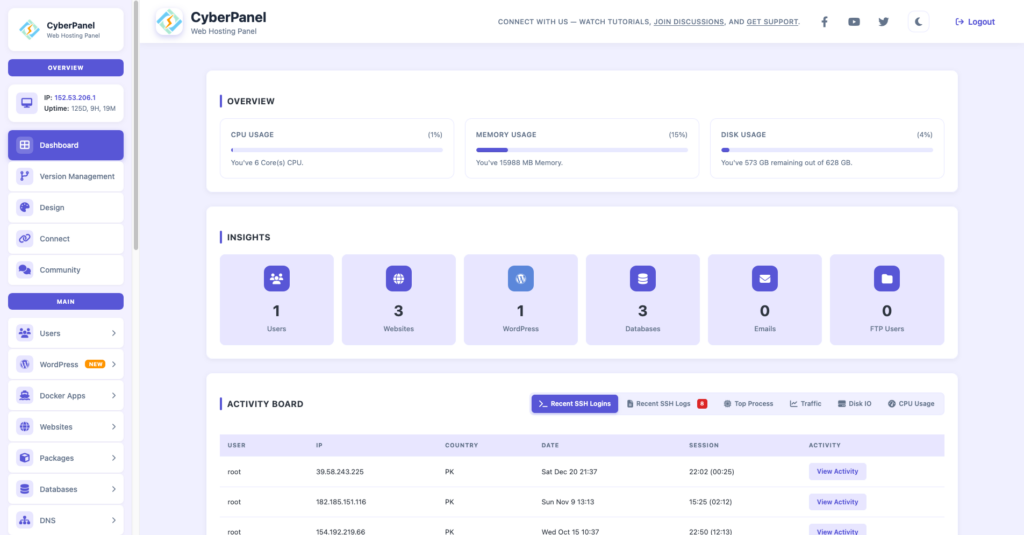
Running a business that is hosting websites on a Linux server is an exercise in patience if you are doing everything manually in the terminal. CyberPanel is a web hosting control panel for managing websites and other Linux server hosting-related tasks. Their current interface is built around OpenLiteSpeed and offers website management, SSL, email, DNS, docker apps, backups, and much more.
This does not mean that CyberPanel removes the need for Linux system administration. It does, however, provide the hosting admin with a graphical interface to manage many common tasks.
CyberPanel also has a Web Terminal, which allows the admin to connect to the server through a terminal emulator in their web browser.
For example, if you are working on a CyberPanel server and need to restart the entire machine, you can still use the terminal:
sudo systemctl rebootThis is often more useful than trying to send Ctrl+Alt+Delete through a browser-based management session.
CyberPanel’s own installation documentation also provides reboot as the command to restart a server after installation when needed.
Ctrl+Alt+Delete vs CyberPanel vs Terminal
| Method | Requires physical keyboard? | Good for remote servers? | Best for |
| Ctrl+Alt+Delete | Usually | No | Console-based quick reboot |
| reboot | No | Yes | Simple server reboot |
| systemctl reboot | No | Yes | Modern Linux administration |
| CyberPanel Web Terminal | No | Yes | Browser-based server management |
| Hosting provider console | No | Yes | Recovery and emergency access |
If your server runs websites through CyberPanel, keeping both the control panel and command-line method available gives you more flexibility when troubleshooting.
What Does “Alt Linux” Mean?
The keyword alt linux can refer to something different from the Ctrl+Alt+Delete topic.
ALT Linux is also the name of a Linux distribution and project. Therefore, it should not automatically be treated as a shortened version of “Alt” in the Ctrl+Alt+Delete keyboard combination.
If you searched for “alt linux” while looking for information about the keyboard shortcut, the more precise search terms are:
- ctrl alt del linux
- ctrl alt delete for linux
- control alt delete for linux
- control alt delete linux
These searches point much more clearly toward the keyboard shortcut and reboot behavior.
Ctrl+Alt+Delete vs Other Ways to Restart Linux
You have several options when Linux needs to be restarted.
Graphical desktop
If your Linux desktop is still responsive, use its normal power or restart menu.
Terminal
For command-line administration:
sudo systemctl rebootSSH
For a remote Linux machine:
ssh username@server-ip

sudo systemctl rebootYou will lose the SSH connection when the machine goes offline, which is expected.
Physical or virtual console
Ctrl+Alt+Delete may be available depending on the console and system configuration.
Should You Use Ctrl+Alt+Delete to Reboot Linux?
For a personal Linux desktop or physical console, it can be convenient if the shortcut is configured to reboot the system.
For a production server, however, it is usually better to use an explicit reboot command:
sudo systemctl rebootThat approach works naturally over SSH and is easier to document, automate, and troubleshoot.
Most importantly, do not confuse a normal reboot with a forced reset. A normal reboot gives running services and the operating system an opportunity to shut down cleanly. A forced reset should generally be reserved for situations where normal administration is no longer possible.
Quick Reference: Ctrl Alt Del Linux Commands
| Task | Command |
| Reboot Linux | reboot |
| Reboot with systemd | sudo systemctl reboot |
| Restart immediately with shutdown | sudo shutdown -r now |
| Check Ctrl+Alt+Delete target | systemctl status ctrl-alt-del.target |
| Inspect the target | systemctl cat ctrl-alt-del.target |
| Disable the systemd target | sudo systemctl mask ctrl-alt-del.target |
| Re-enable the target | sudo systemctl unmask ctrl-alt-del.target |
| Check failed services | systemctl –failed |
| Check system uptime | uptime |
FAQs
Can Ctrl+Alt+Delete cause a Linux computer to reboot?
It can on a Linux system where the console and the system configuration permit it to do so. For systemd systems, the default action for Ctrl+Alt+Delete is to run the ctrl-alt-del.target, which by default reboots the system.
Why is my Linux virtual machine responding to Ctrl+Alt+Delete differently?
Because the software that runs your virtual machine may intercept the key presses. It depends on whether you are viewing your virtual machine’s desktop in the host’s graphical environment, in a virtual console or from a remote access utility.
Can Ctrl + Alt + Delete be dangerous on the Linux server?
Indeed, it can, if it is set to reboot the system and if a user accidentally presses these keys. In a production environment, it is vital to understand how exactly Ctrl + Alt + Del is configured on a Linux server and whether it is needed there or not. It is better to turn it off if there is a possibility of a disastrous reboot via keystrokes.
Final Thoughts: The Most Optimal Way to Reboot a Linux Server
Ctrl Alt Del Linux is not just a Windows analogue key combination; in fact, on many Linux systems (systemd-based, in particular), it is used to reboot the computer. It all depends on what action exactly is mapped to it in the system. For a regular desktop OS, it is fine to use these keystrokes to restart the machine. However, for a remote server, it is more convenient to type sudo systemctl reboot or another command.
In case of a web hosting management system, a control panel such as CyberPanel can be very helpful. It allows one to manage the server without risking a system crash since the underlying Linux system is still available.
Before pressing any keys or typing any commands to reboot a production server, it is necessary to ensure that all important processes are closed/down and that one has a way to access the server again. In the end, the most optimal way to reboot Linux servers depends on the individual situation. It can either be something as simple as entering Ctrl + Alt + Del or a complex set of commands depending on the specific Linux distribution and system setup. It is not recommended to use key combinations from Windows in Linux just because they are familiar. On the contrary, take advantage of the conveniences provided by the Linux terminal.
Now it is time to manage your Linux hosting environment the easy way.
Get CyberPanel, configure your Linux server hosting, and keep both the control panel and the underlying Linux operating system for managing resources and running commands available!