On this page
Somewhere around 2 A.M., a production incident occurs. The application is slow, and error rates are rising. A DevOps engineer and an SRE are both mentioned in the same Slack channel because, during the hiring process, the two roles were treated as almost the same. While they often work closely together, their responsibilities are not identical. This is where the confusion around SRE vs DevOps begins.
Job descriptions do not always make the difference clear. Some companies use the terms DevOps and SRE interchangeably, while others treat them as separate roles with different goals. This can make it hard to understand what each role actually does.
In this guide, we will look at DevOps and SRE, explain where they differ, where they overlap, and when a company may benefit from one or both.
DevOps vs SRE in a Nutshell
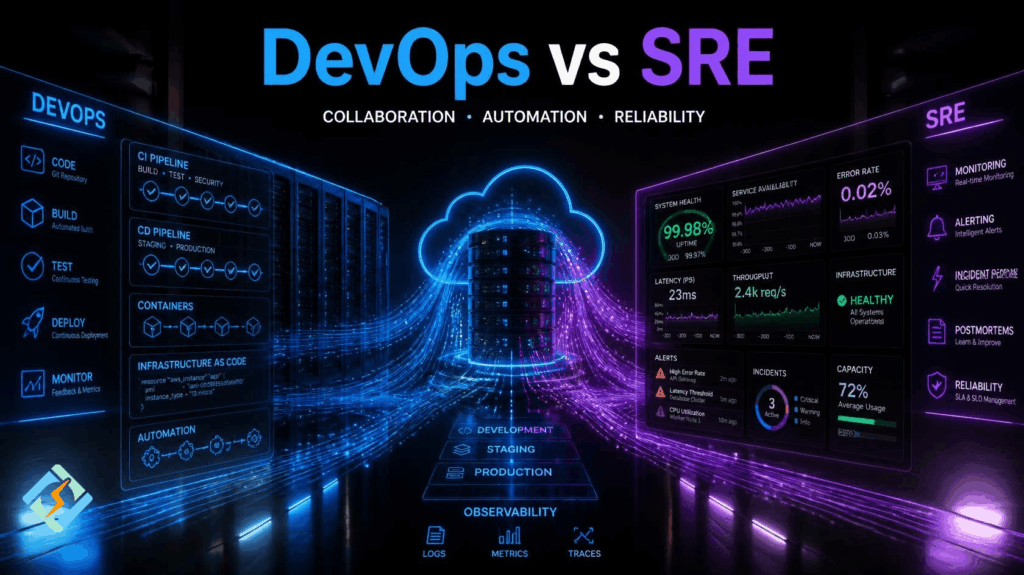
- DevOps represents a culture and set of practices that aim to shorten the feedback loop between developers and operations.
- SRE is an engineering discipline that employs software engineering principles to operations, focusing on system reliability and availability.
DevOps defines how to deliver software, and SRE prescribes how to measure software delivery.
DevOps vs SRE: Definitions
DevOps emerged to solve a common problem in software development and IT operations: teams were working in separate silos. Developers built and released applications, while operations teams were responsible for running and maintaining those applications in production.
This separation often caused delays, communication gaps, and conflicts. When something went wrong after a release, it was not always clear who was responsible for fixing it. DevOps brought these teams closer together by encouraging collaboration, shared responsibility, automation, and better communication throughout the software delivery process.
Some of the main DevOps practices include:
- Continuous integration and continuous delivery (CI/CD)
- Infrastructure as code (IaC)
- Automation of repetitive tasks
- Shared responsibility between development and operations teams
- Smaller and more frequent releases
- Monitoring and automated processes
The main goal of DevOps is to help teams build, test, and release software faster without sacrificing quality or stability. DevOps engineers often work with deployment pipelines, cloud infrastructure, containers, monitoring tools, and automation to make the software delivery process more efficient.
What Is SRE?
Site Reliability Engineering (SRE) is an approach to managing production systems that uses software engineering principles to improve reliability. It focuses on keeping applications and infrastructure available, stable, scalable, and responsive while still allowing teams to release changes.
SRE teams use automation, monitoring, performance testing, and other engineering practices to reduce manual operational work. They also use concepts such as service level indicators (SLIs), service level objectives (SLOs), and error budgets to measure and manage reliability.
In simple terms, DevOps focuses on bringing development and operations together, while SRE applies engineering practices to keep software systems reliable in production. The two approaches share many practices, including automation, monitoring, and continuous delivery, but their main areas of focus are different.
DevOps And SRE Differences
| Aspect | DevOps | SRE |
| Origin | Agile/Lean movement, ~2008 | Google, early 2000s |
| Core idea | Cultural collaboration + automation | Reliability engineered with software methods |
| Primary metric | Deployment frequency, lead time | SLIs, SLOs, error budgets |
| Main goal | Ship faster, reduce silos | Keep systems reliable at scale |
| Team structure | Often embedded in product teams | Dedicated reliability team, on-call rotations |
| Failure response | Fix and move on | Blameless postmortems, root-cause tracking |
| Best fit | Startups, mid-size companies, general delivery | Large-scale systems, high-traffic platforms |
| Typical background | Sysadmin, cloud, automation-heavy | Software engineering + systems background |
Where SRE and DevOps Actually Overlap?
DevOps and SRE are not completely separate worlds. Both aim to make software delivery faster, more stable, and less dependent on manual work. Automation is important in both roles because it reduces repetitive tasks and leaves less room for human error.
The main difference is in what each approach puts at the center. DevOps focuses more on the way development and operations work together and how software moves into production. SRE puts more attention on the reliability of the systems running that software.
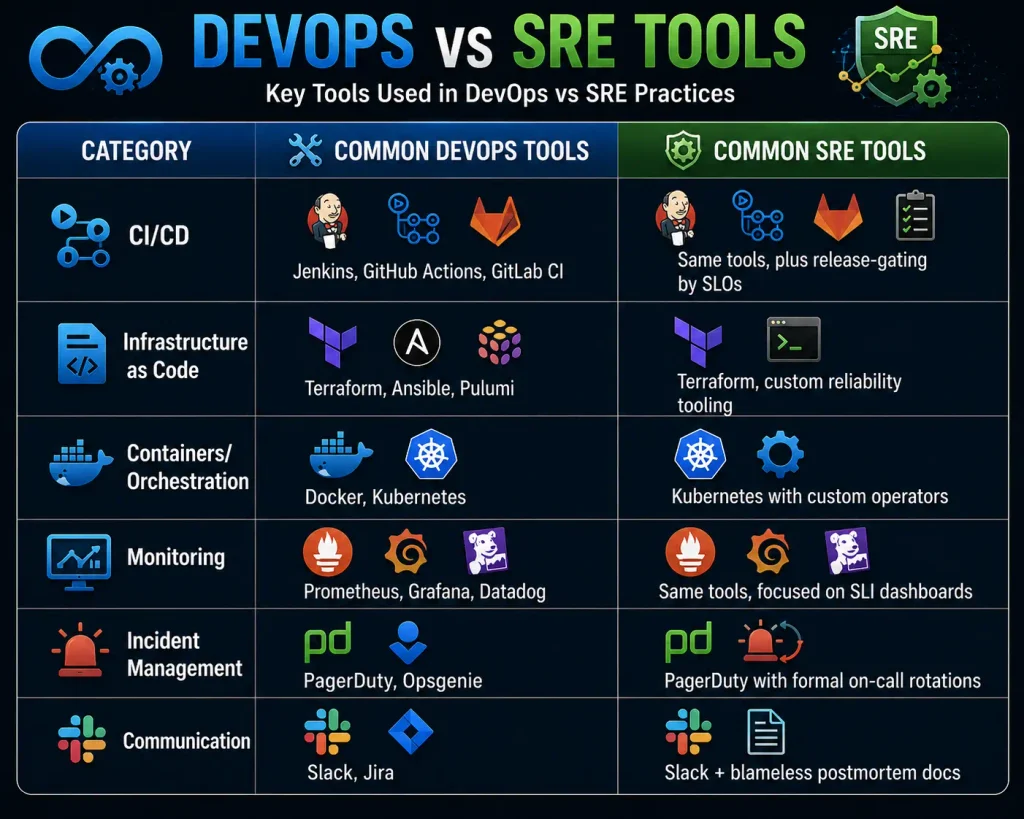
Because of this overlap, one person may handle both DevOps and SRE responsibilities, especially at a smaller company. The same tools can also be used for both roles. What changes is how those tools are used and what the team is trying to achieve.
SRE vs DevOps: What Each Discipline Actually Uses Daily
Salary and Career Reality in 2026
DevOps and SRE can both be well-paid technical careers, but the salary for either role depends heavily on experience, location, company size, and the skills listed in the job description.
The two career paths also overlap. A DevOps engineer who develops strong programming and systems skills can move toward SRE. In the same way, an SRE may work with many of the same automation, cloud, and deployment tools used by DevOps teams.
At junior and mid-level positions, the difference between the two roles can be quite clear. At senior levels, the lines often become less obvious because both roles require strong knowledge of infrastructure, automation, software, and production systems.
For anyone choosing between the two careers, the job description matters more than the title. Companies do not always use DevOps and SRE titles in the same way, so it is worth checking the actual responsibilities before applying.
The Decision Matrix: DevOps, SRE, Both?
Neither DevOps nor SRE is automatically the better choice. The right approach depends on the size of the company, the systems it runs, and how much reliability those systems require.
Consider adopting a DevOps-first approach if:
- You are a small or medium-sized company building your first delivery pipeline.
- You need better cooperation between development and operations teams.
- You want to automate builds, testing, deployments, and infrastructure tasks.
- Your systems are not highly critical and do not need a formal reliability program yet.
- You want one team to manage and improve the software delivery process.
Consider adopting an SRE-focused approach if:
- You run a large or highly used system where downtime can have a major impact.
- You need clear reliability targets for your services.
- You want to use SLIs, SLOs, and error budgets to guide technical decisions.
- Your team needs a structured way to handle incidents and recurring failures.
- You can support dedicated reliability engineering responsibilities.
Consider using both approaches if:
- You want to improve delivery speed without losing sight of system reliability.
- Your company is growing, and your systems are becoming more complex.
- You want DevOps practices across development and operations while also introducing formal reliability targets.
- You are building a platform engineering layer that can support teams across the organization.
For many growing companies, using both approaches makes the most sense. DevOps can provide the culture, collaboration, and automation needed for smooth software delivery, while SRE can add a stronger focus on reliability and measurable service performance.
The two do not need to compete. They can work together as the needs of the company change.
The Case for a Web Hosting Control Panel in DevOps and SRE
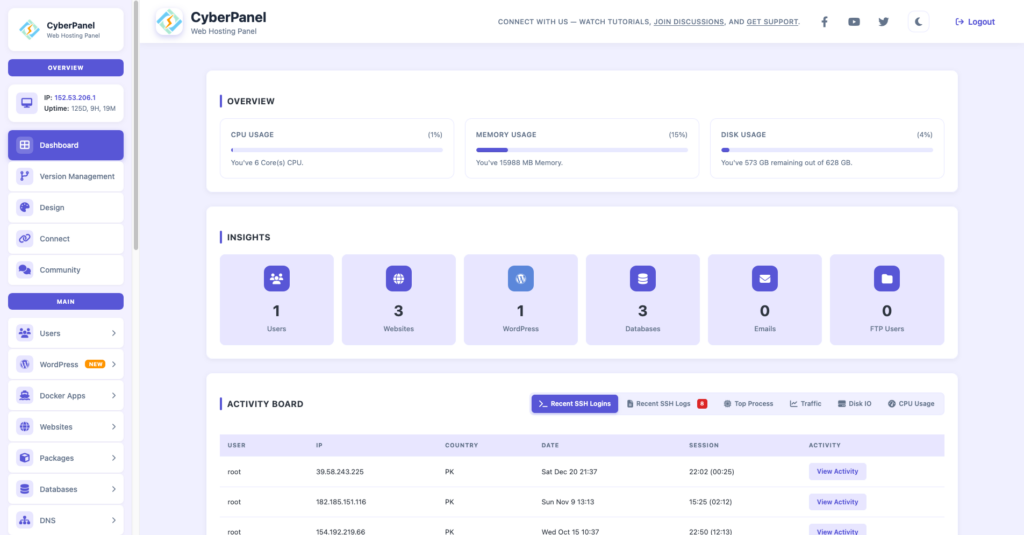
Both roles rely on the same physical servers, and regardless of the approach to software development and operations, someone will have to manage those servers. A control panel is a good idea for a company that hosts websites because it allows the team to configure the system’s critical aspects without spending time on routine tasks. CyberPanel is a web hosting control panel. It offers a variety of tools that simplify the task of hosting management.
In a DevOps context, it allows the team to automate the monotonous aspects of website hosting, eliminating the need to perform them manually and accelerating time-to-market. In an SRE context, it allows operations engineers to reduce the risk of failures by ensuring consistent and reliable performance, including access security, email configuration, and database performance. CyberPanel is useful in both contexts because it makes the routine aspects of system administration easier to automate, standardize, and enforce, reducing the overhead associated with hosting management.
The choice of the control panel is also critical. CyberPanel is a good option for a small team that manages a few websites because it is relatively easy to configure and offers a variety of tools that make life easier for sysadmins. It would not be a good choice for a large enterprise that needs to host thousands of sites using Kubernetes because it lacks the features and scalability required for such a use case.
Common Misconceptions Worth Correcting
“SRE replaced DevOps.” No, because SRE existed long before the term DevOps was coined, and addresses a narrower set of issues around quantified reliability. DevOps is a bigger cultural umbrella term.
“You need SRE to be reliable.” Not really, no – smaller systems can achieve consistent uptime through good DevOps, and formalized error budgets add the most value at large scale once you’ve passed the point where “good enough” is obvious.
“DevOps engineers don’t need to write code.” No, but they do need to write code at some point – scripting, automation, and more recently full programming languages are a part of the job, just a smaller and more specific one than in SRE.
“SRE is just Ops with a new name.” No, because SRE explicitly and intentionally avoids the purely operational role – toil reduction, the proactive identification and elimination of repetitive manual tasks through engineering, is a stated goal.
Frequently Asked Questions
Can one person be both a DevOps engineer and an SRE at the same company?
Yes, and at smaller companies this is common. The person typically builds and maintains the deployment pipeline (DevOps work) while also tracking uptime, response times, and incident patterns (SRE work). As the company grows, these responsibilities usually split into separate roles or teams.
Does adopting SRE mean giving up DevOps practices?
No. SRE is generally layered on top of existing DevOps foundations rather than replacing them. You still need CI/CD, automation, and infrastructure as code — SRE adds the measurement layer (SLOs, error budgets) on top of that foundation.
What happens when a team exceeds its error budget?
The standard practice is to pause new feature releases and redirect engineering effort toward stability and bug fixes until the service is back within its reliability target. This is one of the clearest operational differences from a typical DevOps workflow, which doesn’t have a built-in mechanism to formally halt releases based on a numeric threshold.
Is SRE only relevant for companies the size of Google or Netflix?
Not exclusively, but the value scales with traffic and criticality. A company with millions of daily requests benefits enormously from error budgets and structured on-call. A five-person startup with a few hundred daily users may get more value from simply having solid DevOps automation first.
Do DevOps and SRE teams use different cloud providers or infrastructure?
Generally no. Both typically work on the same cloud infrastructure (AWS, Google Cloud, Azure, or self-managed servers). The difference isn’t the infrastructure itself but how each team measures success on top of it: delivery speed for DevOps, measurable reliability for SRE.
Final Thoughts: Is SRE Better Than DevOps?
SRE and DevOps are not competing approaches. They solve different parts of the same problem.
DevOps focuses on improving collaboration between development and operations, automating routine work, and making software delivery faster and smoother. SRE puts more focus on keeping production systems reliable by using clear targets, monitoring, error budgets, and engineering practices.
For many companies, the best approach is to use both. DevOps provides the processes and automation needed to deliver software, while SRE adds a stronger focus on system reliability and performance.
The right choice depends on the company’s size, systems, and business needs. A smaller team may get enough value from strong DevOps practices, while a larger or high-traffic platform may benefit from dedicated SRE practices.
The important thing is not choosing a title. It is building a development and operations setup that can deliver software efficiently while keeping the systems behind it reliable.