On this page
Moving multiple websites from cPanel to a free Linux panel can reduce recurring control panel costs and give you more control over your hosting environment. The safest way to migrate from cPanel is to plan the transfer in stages, back up every account, test the destination server, and switch DNS only after the websites are verified.
For multiple websites, a bulk migration is more efficient than rebuilding every account manually. Tools such as CyberPanel’s cPanel importer can help move supported website data to a CyberPanel server running OpenLiteSpeed.
Why Migrate from cPanel When Managing Multiple Websites?
cPanel is widely used for managing websites, databases, email accounts, domains, backups, and other hosting tasks. However, its licensing model can become expensive as the number of accounts and servers grows.
This is especially important for hosting resellers, agencies, developers, and businesses managing several VPS servers.
A free Linux panel can provide many of the core functions needed to manage websites without adding a separate control panel license to the monthly server cost.
Common reasons to migrate include:
- Reduce recurring control panel licensing costs
- Manage multiple websites from one server
- Move to an open-source hosting environment
- Use OpenLiteSpeed for supported workloads
- Gain root-level control over the VPS
- Consolidate websites onto a new server
- Avoid increasing control panel costs as accounts grow
However, migration should not be treated as simply copying website files. A complete migration can involve websites, databases, email accounts, DNS records, SSL certificates, cron jobs, PHP versions, permissions, and application settings.
What Should You Prepare Before a Bulk cPanel Migration?
Before moving the first account, create an inventory of every website you plan to migrate.
Record the following information:
| Item | What to Check |
|---|---|
| Domain | Primary domain and aliases |
| Website files | Document root and total size |
| Database | Database name, user, and size |
| PHP | Current PHP version |
| Accounts, forwarding, and storage | |
| SSL | Certificate and HTTPS status |
| Cron jobs | Scheduled tasks |
| DNS | A, MX, TXT, CNAME, and other records |
| WordPress | Plugins, themes, and cache |
| Traffic | Peak traffic and busy periods |
This list gives you a baseline for testing after the migration.
You should also confirm that the destination VPS has enough disk space, RAM, CPU capacity, and network bandwidth for all websites.
If you are still selecting a server, review how to choose the right VPS for CyberPanel hosting before starting the migration.
How Do You Plan a Bulk cPanel Migration?
A bulk migration works better when websites are moved in groups rather than all at once.
Start by dividing the accounts into logical groups.
For example:
- Low traffic websites
- Business websites
- WordPress websites
- High traffic websites
- Email-heavy accounts
- Large database websites
- Client websites with strict uptime requirements
Start with a small group of low-risk websites. This gives you an opportunity to identify compatibility problems before moving important production websites.
Lower DNS TTL Before Migration
DNS changes can take time to propagate. Lowering the TTL before migration can make the final switch easier.
Do this before the migration window.
For example, if your normal DNS TTL is several hours, temporarily reducing it gives DNS resolvers a shorter caching period.
Do not assume that a lower TTL instantly changes DNS everywhere. Existing DNS caches can still remain until their previous TTL expires.
Create a Migration Checklist
For every account, record:
- cPanel username
- Domain name
- Database names
- PHP version
- Email accounts
- Cron jobs
- DNS records
- SSL status
- WordPress configuration
- Special server requirements
This checklist becomes your verification sheet after migration.
How to Migrate from cPanel to CyberPanel
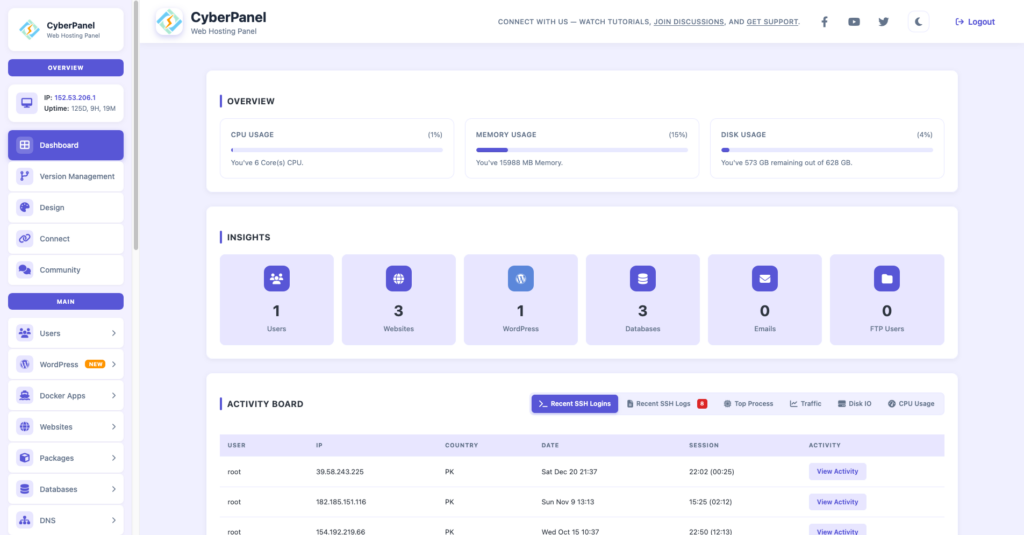
CyberPanel provides a cPanel import process that can help transfer supported cPanel accounts to CyberPanel.
The general migration process is:
- Prepare the new VPS.
- Install CyberPanel.
- Configure the required PHP versions and services.
- Confirm that the destination server has enough resources.
- Prepare the cPanel server for migration.
- Start the cPanel import process.
- Transfer the selected website data.
- Verify websites and databases.
- Test email and DNS requirements.
- Perform the final DNS change.
The exact migration process can vary depending on the cPanel account structure, website type, server configuration, and data being transferred.
For supported accounts, CyberPanel’s [cPanel importer] can reduce the amount of manual work required during migration.
Should You Migrate Everything at Once?
Not necessarily.
A safer approach is to migrate a small batch first.
For example:
| Migration Stage | Websites | Purpose |
|---|---|---|
| Test batch | 2 to 5 | Find compatibility issues |
| First production batch | 5 to 10 | Validate the process |
| Medium batch | 10 to 25 | Increase migration speed |
| Final batch | Remaining accounts | Complete migration |
The exact number depends on server resources and website complexity.
Large websites and important business applications should receive additional testing before their DNS records are changed.
Can You Use a Bulk Backup Migration Script?
Yes. A bulk backup migration script can automate repetitive tasks when you have many accounts to move.
A script can potentially help with tasks such as:
- Creating account backups
- Downloading backup archives
- Transferring files through SSH
- Moving database dumps
- Creating destination directories
- Importing databases
- Checking transferred files
- Recording migration status
However, automation does not remove the need for verification.
A script that successfully transfers a directory does not automatically prove that the website works.
For example, a WordPress website may have all of its files but still fail because of:
- Incorrect database credentials
- Missing PHP extensions
- Incorrect file permissions
- Different PHP versions
- Rewrite rule differences
- Missing cron jobs
- Incorrect DNS records
For this reason, use automation for repetitive operations while keeping verification steps manual or independently checked.
How Do You Transfer cPanel to OpenLiteSpeed?
Moving from Apache-based cPanel hosting to OpenLiteSpeed requires more than copying website files.
When you transfer cPanel to OpenLiteSpeed, check how the website depends on Apache-specific behavior.
Important areas include:
1. Website Files
Move the complete website directory, including hidden files where required.
For WordPress websites, this includes files such as:
wp-config.php.htaccesswp-content- Themes
- Plugins
- Uploads
2. Databases
Export the required MySQL or MariaDB database and import it on the destination server.
Check:
- Database name
- Database user
- Database password
- Database host
- Character set
- Table prefixes
For WordPress, verify the database credentials in wp-config.php.
3. PHP Version
The destination server should support the PHP version required by the website.
If a website runs on an older PHP release, test it before migration instead of assuming that the newest version will work.
4. Rewrite Rules
Apache .htaccess rules may not always behave exactly the same way on another web server, so review how CyberPanel’s OpenLiteSpeed .htaccess module handles Apache-compatible directives.
OpenLiteSpeed supports .htaccess compatibility, but website-specific rules should still be tested after migration.
5. PHP Extensions
Check whether the destination server has the PHP extensions required by the application.
Common examples include:
mysqlicurlmbstringxmlzipgdimagickintl
The required extensions depend on the application.
6. Caching
If the website previously used another caching system, review its configuration after migration.
WordPress websites using LiteSpeed Cache can take advantage of LiteSpeed-specific caching features when the destination environment is configured correctly.
What Is a Free cPanel Migration Tool?
A free cPanel migration tool can mean different things.
Some tools automate the transfer of hosting accounts. Others provide scripts or utilities that help copy files and databases.
The important question is not simply whether a tool is free. You should check what data it actually transfers.
A migration tool may support:
- Website files
- Databases
- Email accounts
- DNS information
- SSL certificates
- Account settings
- Cron jobs
But support varies between tools.
For CyberPanel migrations, the built-in cPanel import functionality is useful when the source account meets the supported migration requirements.
Manual migration may still be necessary for unsupported configurations or custom server setups.
How Can You Migrate Multiple cPanel Websites With Minimal Downtime?
The safest approach is to separate the initial transfer from the final DNS switch.
Step 1: Back Up the Source
Create verified backups of every website.
Do not rely on a backup that has never been tested.
Step 2: Transfer the Initial Copy
Move the website files and databases to the destination server.
For large websites, this initial transfer can happen before the final migration window.
Step 3: Test the Website
Use a temporary hostname, hosts file entry, or another suitable testing method to access the website before changing public DNS.
Check:
- Homepage
- Internal pages
- Login
- Forms
- Images
- Search
- Database-driven features
- WordPress admin
- Plugins
- SSL
- Redirects
Step 4: Perform the Final Sync
If the website changed after the initial transfer, synchronize the latest files and database data.
This is especially important for websites with frequent orders, comments, registrations, or other database activity.
Step 5: Change DNS
After verification, point the domain to the new server.
Update the relevant A or AAAA records and review MX records if email is also being moved.
Step 6: Monitor the Old Server
Do not immediately delete the old accounts.
Keep the source server available while DNS propagation and application checks are completed.
What Happens to Email During cPanel Migration?
Email requires special attention because moving a website does not automatically guarantee that mail delivery will work correctly.
Before migration, document:
- Email addresses
- Forwarders
- Mailbox sizes
- MX records
- SPF records
- DKIM records
- DMARC records
If email is being moved to the new server, verify that all required mailboxes exist before changing MX records.
If email remains on the existing provider, keep the MX records pointing to that provider.
This distinction is important because changing DNS incorrectly can interrupt email even when the website itself works perfectly.
What Should You Check After Moving From cPanel?
A migration is not complete when the files finish copying. Once the site is imported, use CyberPanel’s website management tools to review the site’s PHP version, SSL state, logs, rewrite rules, cron jobs, and other settings.
Use a post-migration checklist.
| Check | What to Verify |
|---|---|
| Website | Homepage and important pages load |
| HTTPS | SSL certificate works |
| Database | Dynamic content loads correctly |
| PHP | Required version is active |
| Extensions | Application requirements are installed |
| Permissions | Files and directories are accessible |
| WordPress | Admin and plugins work |
| Cron | Scheduled tasks execute |
| Sending and receiving work | |
| DNS | Records point to the correct server |
| Redirects | HTTP to HTTPS and URL redirects work |
| Logs | No repeated critical errors |
Also test the website from an external connection after DNS changes.
What Are the Most Common cPanel Migration Problems?
Migration problems usually come from differences between the source and destination environments.
500 Internal Server Error
A 500 error can result from incorrect permissions, unsupported PHP settings, missing extensions, or rewrite rules.
Check the website and server error logs first.
Database Connection Error
If the website cannot connect to its database, verify the database name, username, password, host, and database server status.
Missing PHP Extension
A website may depend on an extension that is not installed on the new server.
Review the application’s requirements and install the required extension for the active PHP version.
Incorrect File Permissions
Files copied from another server may have ownership or permission settings that do not match the destination environment.
Correct ownership and permissions before changing application code.
For a deeper understanding of Linux permissions, see the guide to Linux file permissions.
Broken .htaccess Rules
Some Apache-specific rules may require adjustment when moving to a different server environment.
Review redirects, rewrite rules, security rules, and caching directives.
DNS Still Points to cPanel
A correctly migrated website will still appear to be running on the old server if its DNS records have not been updated.
Check the domain’s A, AAAA, and relevant DNS records.
How Can Agencies Handle Large cPanel Migrations?
Agencies and hosting providers often have dozens or hundreds of websites.
In this situation, migration should be treated as a repeatable process.
Create a standard workflow:
Inventory → Backup → Initial Transfer → Test → Final Sync → DNS Change → Verification → Monitoring
Assign every website a migration status.
For example:
| Status | Meaning |
|---|---|
| Not Started | Website has not been prepared |
| Backup Complete | Source backup verified |
| Transferred | Initial data copied |
| Testing | Destination website being checked |
| Ready | Migration passed testing |
| DNS Changed | Domain points to new server |
| Verified | Website confirmed after DNS change |
| Monitoring | Old server retained temporarily |
This prevents accounts from being forgotten during a large migration.
Should You Keep the Old cPanel Server After Migration?
Yes, temporarily.
Do not immediately cancel the old server after changing DNS.
Keep it available until you have confirmed:
- DNS has propagated
- Websites work correctly
- Email works
- SSL works
- Databases are stable
- Cron jobs run
- No important data remains on the old server
The retention period depends on the website and migration risk.
Once everything has been verified and the required backup period has passed, the old hosting environment can be decommissioned.
cPanel to Free Linux Panel Migration Checklist
Use this checklist before considering a bulk migration complete:
| Stage | Checklist |
|---|---|
| Planning | Inventory every cPanel account |
| Server | Confirm VPS resources |
| Backup | Create and verify backups |
| DNS | Reduce TTL where appropriate |
| Transfer | Copy files and databases |
| Configuration | Match PHP and required extensions |
| Testing | Test websites before DNS changes |
| Verify mailboxes and DNS records | |
| Final Sync | Transfer the latest changes |
| DNS | Point domains to the new server |
| Monitoring | Watch errors and traffic |
| Backup | Retain the old server temporarily |
| Completion | Decommission old hosting only after verification |
Is Migrating From cPanel Worth It for Multiple Websites?
The answer depends on your hosting requirements, technical experience, website complexity, and licensing costs.
For a small number of simple websites, manual migration may be manageable.
For agencies, developers, resellers, and businesses managing many accounts, a structured bulk migration can make the process much more efficient.
The key is to avoid treating every website as identical. WordPress sites, ecommerce stores, email-heavy accounts, and custom applications can have very different migration requirements.
A free Linux panel can remove the recurring control panel license from the hosting stack, but server administration, backups, security, monitoring, and application maintenance still require attention.
Frequently Asked Questions
Can I migrate multiple cPanel accounts at once?
Yes. Multiple accounts can be migrated as a batch when the destination panel and migration method support the required account data. For large migrations, start with a small test group before moving the remaining accounts.
Is there a free cPanel migration tool?
Free migration options include panel import tools, scripts, and manual transfer methods. The important consideration is which account data and configurations the tool supports.
Should I migrate all websites at once?
For a large hosting environment, moving everything simultaneously increases the impact of a migration problem. A staged approach lets you test the process with a smaller group first.
Final Takeaway
To migrate from cPanel successfully, treat the process as a controlled deployment rather than a simple file transfer.
Back up every account, inventory its configuration, prepare the destination VPS, transfer the initial data, test each website, perform a final synchronization, and change DNS only after verification.
For multiple websites, this staged approach can make migration faster while reducing avoidable downtime and configuration errors. A free Linux panel such as CyberPanel can also provide a practical destination for websites that need an OpenLiteSpeed-based hosting environment without a separate cPanel license.
If you are ready to move your websites, start with a small test batch, verify the complete workflow, and then scale the same process across the remaining cPanel accounts.