On this page
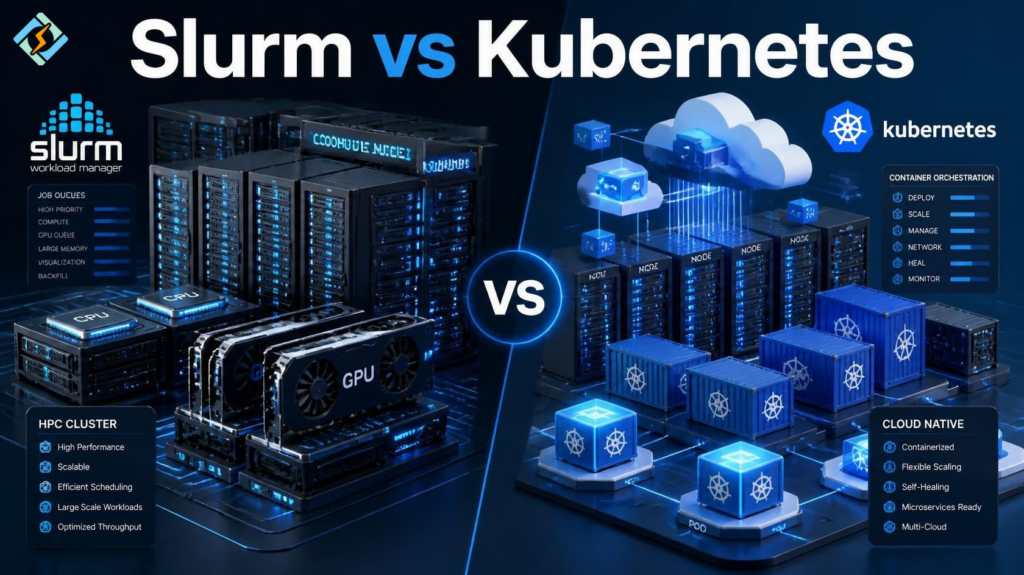
If you are managing a multi-CPU-GPU-maybe-some-specialized-accelerator research cluster, you have asked yourself one question at some point: is it best to use Slurm, Kubernetes, or both?
And if you have asked yourself that question, you know that the wrong choice can lead to either wasted GPU time or an excruciatingly long infrastructure fight. This guide attempts to detail the ways in which the two cluster management systems differ and what kind of workload and team size each is best suited for.
Slurm vs Kubernetes At a Glance
Before the deep dive, here is the short version for anyone who needs to make a fast call.
| Factor | Slurm | Kubernetes |
| Built for | Batch HPC jobs, tightly coupled MPI workloads | Containerized microservices, dynamic apps |
| Best hardware fit | Fixed, mostly uniform clusters | Mixed, elastic, cloud-style clusters |
| Job model | Exclusive allocation until the job finishes | Pods that can be rescheduled and scaled |
| GPU scheduling | Native, mature, fine-grained | Good, but needs device plugins and operators |
| Setup difficulty | Moderate, Linux-native | Steeper learning curve, more moving parts |
| Multi-tenancy | Queue- and fairshare-based | Namespace and RBAC-based |
| Elastic scaling | Limited without add-ons | Native autoscaling |
| Community strength | Dominant in academic HPC and Top500 systems | Dominant in cloud-native and MLOps |
| Ideal user | Research labs, universities, national HPC centers | Startups, ML platform teams, cloud-first orgs |
Slurm is the most popular scheduling software in the HPC community and is used on about 60% of the supercomputers on the Top500 list, holds roughly 20% of the overall supercomputer market, and holds dominance in the academic space. That fact alone is why many research clusters default to it, but it does not rule out Kubernetes once your cluster is no longer uniform.
Slurm Vs Kubernetes
What Slurm Actually Does
Slurm is known as the Simple Linux Utility for Resource Management. But nothing about the resource management under the hood is simple. It was built to schedule batch jobs across mostly identical machines. It allocates CPU and GPU resources precisely. And manage tightly coupled, long-running workloads such as MPI simulations.
The easiest way to think about Slurm is a strict queue manager. You submit a job with a script. Slurm finds nodes that match your request. And it grants you exclusive access to the nodes until the job finishes or fails.
That’s why national labs, universities, and government HPC centers still lean on Slurm. Researchers write a bash script, request a number of nodes and GPUs, and walk away. No containers to build, no YAML to debug.
Where Slurm shines
● Large-scale MPI simulations (climate modeling, molecular dynamics, computational fluid dynamics)
● Multi-node distributed training where GPU-to-GPU communication speed matters
● Environments where the same team owns hardware for years
● Labs that need strict fairshare accounting between departments or grants
Where Slurm struggles
There is no official web dashboard for Slurm (most job management and monitoring is done through the command line), and community tools have not become a standard. Secondly, Slurm expects nodes to be nearly identical (same Linux user IDs, group IDs, and software versions), which can be a real headache when a cluster becomes heterogeneous hardware over time. If your cluster started with one GPU generation and added a different accelerator type, or a few nodes that run a different OS image, Slurm’s node model can become a problem.
What Kubernetes actually does
Kubernetes, often shortened to K8s, was not built for supercomputers in the first place. It is a set of core building blocks used to deploy, maintain, and scale applications. It lets users describe to the cluster what kind of cluster they want (by processor type, count, and memory). The workload manager automatically builds and maintains that environment. It emerged in 2014 from Google.
It does not assign whole nodes. But rather schedules pods, small, portable units of deployment that package an application and its dependencies. A Kubernetes cluster consists of a control plane and worker nodes that can be provisioned dynamically.
This is why Kubernetes took over cloud-native software. It does not care if your cluster is uniform. It cares if a pod’s resource request can be satisfied somewhere, by anything.
Where Kubernetes shines
● Mixed-hardware clusters where nodes vary in CPU, GPU, or memory
● Pipelines that combine data prep, training, evaluation, and model serving in one system
● Teams that need to scale resources up and down based on demand
● Multi-tenant platforms with strict isolation between projects using namespaces and RBAC
Where Kubernetes struggles
MPI integration is native in Slurm, and for workloads that rely on NCCL all-reduce communication, Slurm’s process group model is perfectly aligned with how it can distribute work across nodes. Kubernetes MPI operator implementations exist, but add abstraction layers between the scheduler and the communication fabric, which could hurt performance at scale. Kubernetes also has a steeper learning curve for researchers who are used to writing a batch script and submitting it and not managing containers, operators, and cluster manifests.
The main difference in Scheduling Philosophy
Most comparisons only stop at the feature checklists; the actual difference is philosophical. Slurm was built specifically for HPC environments in which maximizing compute efficiency is the main objective, and Kubernetes is built to orchestrate containers and microservices at mass scale.
That sentence explains almost every practical difference you will run into:
- Slurm optimizes for utilization. It wants every GPU busy, every CPU cycle spoken for, and every job accounted for against a budget or grant.
- Kubernetes optimizes for resilience and flexibility, wanting services to stay available and scale with demand, and recover automatically if something fails.
The scheduler in Kubernetes focuses on cluster health and not on maximizing utilization, while Slurm takes more factors into consideration about the job’s priority, fairshare, and resource accounting that are extremely important in HPC, as AI and simulation workloads live and die by GPU utilization.
For a heterogeneous research cluster, this matters more than any spec sheet. If your top priority is to squeeze maximum throughput out of expensive GPU nodes shared across research groups, Slurm’s model is built for that fight. If your top priority is to have a mixture of training jobs, inference services, notebooks, and data pipelines without babysitting each one, Kubernetes fits better.
Kubernetes Vs Slurm For Heterogeneous HPC Research Clusters: The Deciding Factor
A heterogeneous cluster means that you have different types of hardware. You could have nodes with old CPUs, new GPUs, or maybe some nodes for memory-intensive genomic calculations and others for deep learning.
So when to choose between Slurm vs Kubernetes? It’s all about heterogeneous clusters.
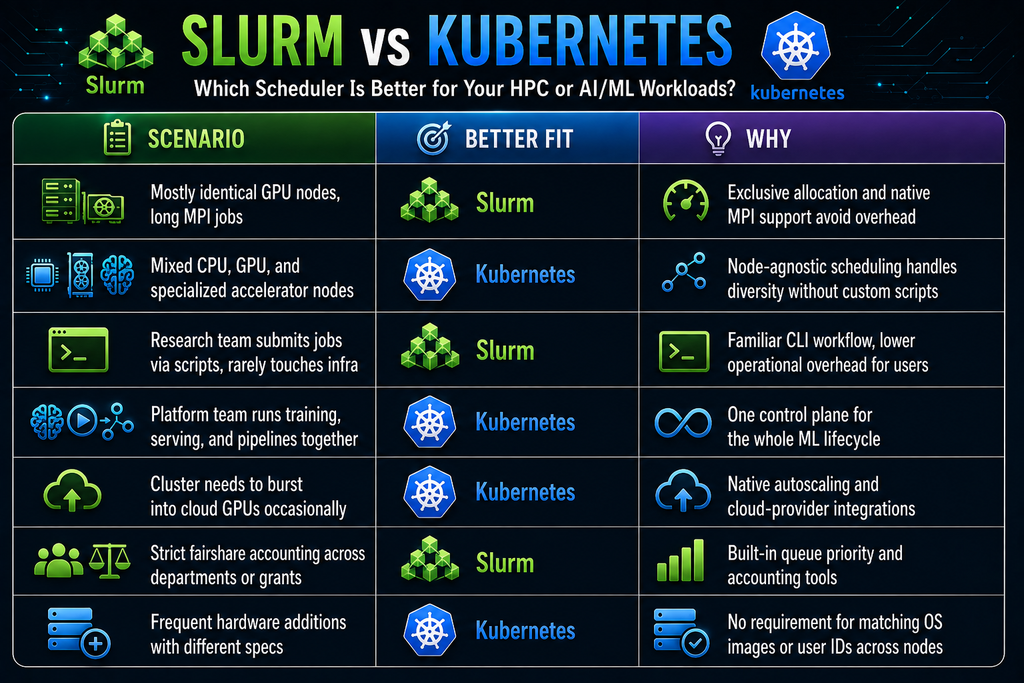
Heterogeneity favors Kubernetes scheduling, as the use case for Slurm was predicated on homogeneous nodes, but heterogeneous clusters are rarely fully heterogeneous and often have a majority of nodes dedicated to running traditional MPI-based simulation workloads with only a minority of accelerators. In such cases, Slurm plus some additional scripting can often be a far less costly and complicated option than a complete Kubernetes migration
Cost and Operational Overhead
While both are free software, they both require significant engineering investment to operate.
Slurm requires an administrator with broad knowledge of Linux and networking technologies. It includes InfiniBand.
Kubernetes requires a more diverse set of expertise, as there is no single component that Kubernetes administrators are responsible for operating, maintaining, and troubleshooting; rather, they must be conversant in all components, from the control plane, registry, and networking plugins to the service mesh, if one is used.
The trade-off is that Kubernetes allows a far broader range of users to self-service deploy their applications with varying degrees of operational complexity, but the software has a steeper learning curve and requires a larger team of maintainers. The majority of cloud providers offer managed Kubernetes as a service, which significantly reduces the burden of operations, especially in cloud environments, as compared to on-premises hardware.
Can We Run Both Schedulers?
Yes, And Many Users Are Doing So.
There are three practical ways to use Slurm and Kubernetes together.
The first option is to run two separate clusters. A third-party management tool can move nodes between the Slurm and Kubernetes environments when needed. Since the two systems do not directly share resource information, the management tool is responsible for deciding where jobs should run. Dell’s Omnia toolkit is one example of this approach.
The second option is to run both schedulers on the same infrastructure. A Slurm-Kubernetes integration can allow Slurm to manage and prioritize both traditional Slurm jobs and Kubernetes workloads. This works well when Kubernetes is used for shorter, container-based jobs, while Slurm handles large, parallel workloads such as MPI jobs. Kubernetes workloads can still use features such as kubelet, sidecars, and operators, while researchers can continue managing HPC jobs through the familiar Slurm interface.
The third option is to run Slurm on Kubernetes. In this setup, Slurm itself runs inside Kubernetes. Login nodes can run as Kubernetes pods, while compute nodes are represented by slurmd pods running on physical machines. The Slurm controller, slurmctld, can also run as a Kubernetes pod. This gives teams the benefits of Kubernetes infrastructure while allowing researchers to keep using the Slurm workflow they already know. This model is becoming increasingly popular among GPU cloud providers that want to support both self-service Kubernetes workloads and traditional HPC jobs.
Some Additional Notes on Ownership
If you are considering a long-term commitment to one of the two solutions, it is worth noting that Slurm has been primarily maintained by a company called SchedMD, which was acquired by Nvidia in late 2025, which suggests that they are likely to continue to prioritize features relevant to GPU scheduling, which may be desirable for users with heterogeneous clusters.
Decision Checklist: What to Look For When Making Your Choice
This is not an exhaustive list, but it should serve as a useful primer in thinking through the decision.
Pick Slurm if:
- Your cluster is largely homogeneous or nearing homogeneity
- The majority of your workloads are long-running, tightly coupled simulation or MPI training jobs
- The majority of your users are researchers who prefer the script and submit paradigm
- Your organization requires a highly granular and built-in fairshare accounting across grants or teams
- You have existing Linux systems administration expertise in-house
Pick Kubernetes if:
- Your cluster is heterogeneous or predicted to become heterogeneous
- Your organization has a data science/analytics stack that requires full end-to-end pipelines that span from training to data preparation to evaluation to serving, or you require autoscaling at any of these layers
- Your organization requires the ability to run both research and production workloads and prefers to manage them in a single unified stack
- You have existing container and cloud operations expertise in-house
Consider running both if:
- There are multiple constituencies within your organization that have very different needs, such as traditional HPC researchers and machine learning platform teams
- There is existing expertise in one stack, and there is sufficient political will/buy-in to implement the necessary management layer or to run Slurm on Kubernetes
- The size of your organization is large enough that it makes economic sense to run separate node pools for each stack.
Common Pitfalls and Assumptions Made by Users
- Migrating everything to Kubernetes because it is the cool new thing, but in practice, such a move often negates the performance advantages of tightly coupled jobs, and can result in serious performance headaches for the technical staff supporting the new infrastructure.
- Falling into the trap of only using Slurm because your users are accustomed to it while your infrastructure has long since gone heterogeneous, and continuing to fight node uniformity year after year, is similarly incredibly costly both in terms of time and institutional knowledge.
- The importance of staffing cannot be overstated, as the most optimal solution is little use if the staff tasked with operating it does not have the requisite expertise.
- Many users assume that they have to choose one or the other, but there are valid technical reasons why maintaining both scheduling systems is a reasonable decision, particularly as Kubernetes matures and begins to offer more features tailored to large-scale analytics, and as mentioned above, there are ways to run both systems, or to allow users to interact with Kubernetes infrastructure in a way similar to traditional Slurm-based clusters.
How CyberPanel Fits Into Modern Infrastructure Management
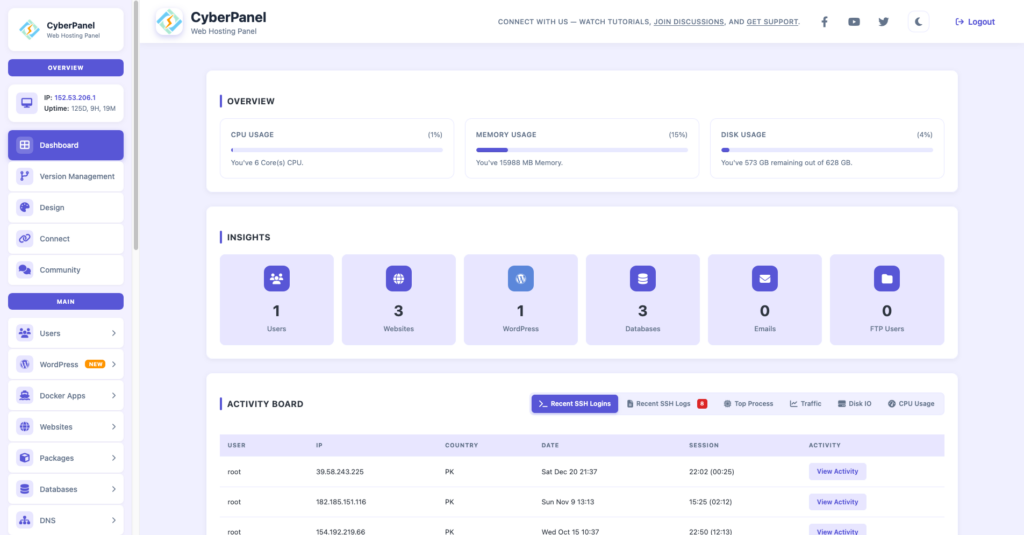
CyberPanel is a web hosting control panel. It helps make complex infrastructure tasks easier to manage for developers, system administrators, and hosting providers. While Slurm and Kubernetes are designed for specialized cluster scheduling and workload orchestration, platforms such as CyberPanel operate at a different layer by simplifying server management and hosting operations.
For teams managing web applications alongside compute-intensive workloads, understanding this distinction is important. Slurm can handle resource allocation for HPC jobs, while Kubernetes can orchestrate containerized applications and workloads. CyberPanel can complement these environments by providing a user-friendly management layer for web hosting infrastructure.
This makes CyberPanel particularly relevant when an organization needs to manage its web hosting environment alongside modern cloud, DevOps, and infrastructure technologies without exposing every user to the complexity of underlying server administration.
In summary
Slurm and Kubernetes were built for different purposes, even though both are now being used for AI and data-intensive workloads.
Slurm was designed for HPC environments. It is a strong choice for large, long-running jobs such as MPI simulations and distributed training. It focuses on efficient resource use and job scheduling.
Kubernetes was designed for containerized applications. It is a better fit for teams running different types of workloads, especially when they need flexible scaling, mixed hardware, and tools for data and AI workflows.
For a heterogeneous research cluster, there is no single answer that works for everyone. If most of your workloads are traditional HPC jobs, Slurm may be the better choice. If you need to support a wider range of workloads across different types of hardware, Kubernetes may be a better fit.
You do not always have to choose one. Running Slurm and Kubernetes together can make sense when different teams have different needs. This approach lets each platform handle the workloads it is best suited for.
In the end, the right choice depends on your workloads, hardware, team skills, and infrastructure goals. The best scheduler is the one that fits your actual needs, not simply the one that is most popular.
Frequently Asked Questions
Does Kubernetes support MPI workloads at all?
Yes, through community MPI operators, but the extra abstraction layer between the scheduler and the network fabric can reduce performance on latency-sensitive, tightly coupled jobs compared to Slurm’s native MPI handling.
Can a small research lab with limited IT staff run Kubernetes?
It’s possible using a managed Kubernetes service from a cloud provider, which removes most control-plane maintenance. Running Kubernetes fully on-prem without cloud support usually needs a dedicated platform engineer.
Is Slurm still being actively developed, or is it a legacy tool?
It’s actively developed. Nvidia’s 2025 acquisition of SchedMD, the company behind Slurm, points to continued investment, especially around GPU scheduling
Does switching from Slurm to Kubernetes mean rewriting all existing job scripts?
Mostly yes. Slurm batch scripts don’t translate directly to Kubernetes manifests or pod specs, so migration usually means re-architecting jobs as containers, not just porting scripts.
What is Slurm on Kubernetes, and is it different from running them side by side?
It’s a setup where Slurm’s own components (login nodes, compute daemons, controller) run as Kubernetes pods, giving users a familiar Slurm interface while the underlying infrastructure is fully Kubernetes-managed. This differs from side-by-side setups where separate node pools are dedicated to each system independently.