On this page
What if your files could continuously be updated on all your devices without the use of cloud storage? No third party. No monthly fees. No data mining. Only secure, peer-to-peer file sharing that you have complete control over.
This is exactly what Syncthing Docker is delivering.
Syncthing is an open-source software that allows files to be synchronized by connecting devices together. Putting it in a Docker container means that the deployment is much neater, management becomes easier, and it is highly scalable. This guide will take you through Syncthing Docker in the easiest language.
If cloud independence, privacy, and encryption are your main concerns when syncing your files, then this can be considered your complete point of origin.
What Is Syncthing?
Syncthing is an open-source and free software that keeps files between two or more devices synchronized almost immediately.
Syncthing connects devices directly with encrypted connections, making the need to upload files to a central server unnecessary. Your data remains yours.
Major features:
- End-to-end encryption
- No central cloud server required
- Real-time sync
- Cross-platform support
- Open-source transparency
What Is Syncthing Docker?
A Syncthing Docker container is a container running Syncthing inside a Docker environment. This means no manual installation, and also everything is kept isolated from the host system.
Why use Docker?
- Easy setup
- Clean updates
- Portable configuration
- Better resource management
- Simplified backups
Nowadays, most users prefer running Docker Syncthing rather than installing it directly on the host system.
Syncthing Docker Compose Setup
Syncthing Docker Compose is a better, sustainable solution than running a lone container command.
Docker Compose also makes it possible to:
- Set volume definitions visibly
- Handle ports properly
- Automatically restart
- Keep the configuration in a neat manner
What Does a Syncthing Docker Compose YML File Do?
Most Syncthing Docker Compose configurations:
- Map a directory for syncing files
- Map a directory for configuration
- Open the web interface port
- Put in place restart policies
This is how your data is ensured to stay persistent even if the container is restarted.
Syncthing Docker Container: How It Works?
Once your Syncthing Docker container is up and running:
- It produces a unique device ID
- It establishes a secure connection with other devices
- It allows the sharing of chosen folders
- It keeps syncing changes automatically
Basically, there isnt a conventional cloud. The devices communicate with each other directly.
This is what makes it perfect for:
- Home labs
- Small teams
- Developers
- Self-hosting enthusiasts
- Privacy-focused users
Syncthing Discovery Server Docker Explained
Syncthing, by default, employs global discovery servers to enable devices to locate each other.
However, some seasoned users occasionally set up their own Syncthing discovery server Docker instance.
Reasons for running a discovery server on your own?
- Complete privacy controlInternal corporate networks
- Air-gapped environments
- Enterprise setups
When you host your own discovery server in Docker, you have absolute command over device coordination.
Key Benefits of Using Syncthing with Docker
| Feature | Standard Install | Syncthing Docker |
|---|---|---|
| Easy Updates | Manual | Pull new image |
| System Isolation | Limited | Full container isolation |
| Backup Simplicity | Moderate | Volume-based |
| Portability | Device-bound | Move container anywhere |
| Scalability | Manual effort | Compose-managed |
Where CyberPanel Fits Into Syncthing Docker
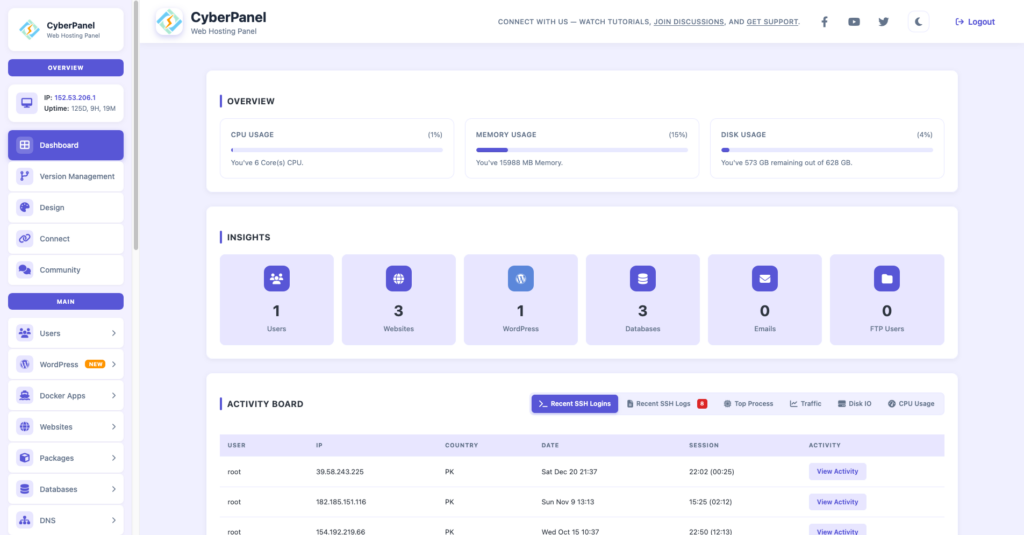
CyberPanel is your free and open-source web hosting control panel. If you install Syncthing on a VPS or remote server, then CyberPanel becomes a handy tool for managing your hosting environment.
CyberPanel can assist you:
- Set up a secure HTTPS reverse proxy
- Protect the Syncthing web GUI
- Manage firewall rules
- Monitor the server’s performance
- Handle domain configuration
Take for instance, the process of allowing a user to directly access Syncthing’s web interface on a raw port; instead, a more secure way is through secure routing with SSL enabled through CyberPanel.
If you are facing a public sync node or public discovery server, then this step is a must.
Real-World Use Cases
Personal Cloud Alternative
If you want to get rid of Google Drive or Dropbox, why not switch to private peer-to-peer sync instead?
Developer Backup
You can sync the project folders between the systems in the office and at home.
Business File Sync
Small teams can share and sync the directories securely without involving cloud vendors.
Remote VPS Sync
Make use of a server as a sync relay, which is always on, for those devices that are not always online.
Security Best Practices
- Secure the web GUI by authentication
- Do not expose raw ports directly to the public
- Apply firewall restrictions
- Look through sync logs regularly
- Upgrade Docker images frequently
- Security becomes a matter of configuration discipline
Common Mistakes to Avoid
- Not backing up configuration volumes
- Wrong folder type settings (Send Only, Receive Only)
- Exposing GUI to the public internet without SSL
- Not paying attention to the disk usage increase
- Handling conflict files incorrectly
Setting up correctly will help you avoid sync conflicts and the risk of downtime
Conclusion
By running Syncthing in a Docker container, you’ll be able to have encrypted file synchronization where you are in full control of your files without using the popular cloud storage providers.
You can use Syncthing Docker Compose as a tool to easily manage and deploy your Syncthing containers in an orderly fashion. If you want more freedom and control over your Syncthing setup, then running a Syncthing discovery server Docker container is the way to go.
Syncthing, combined with CyberPanel as a hosting platform and management tool, makes for a very strong self-hosted cloud solution that you can rely on.
Take the first step now by installing a Syncthing Docker container on your primary device. Add your second device, confirm that the two devices sync changes in real-time, and then grow by using Docker Compose and CyberPanel.
People Also Ask
Can Syncthing Docker run behind a reverse proxy?
Yes. It works well behind reverse proxies like Nginx or those managed via CyberPanel for secure web access.
Is Syncthing Docker suitable for enterprise environments?
Small to mid-sized businesses use it successfully, but large enterprises may require additional monitoring and redundancy tools.
Can Syncthing Docker handle versioned file history?
Yes. Folder versioning options allow you to retain older file versions, helping recover from accidental changes or deletions.