
On this page
It’s nearly impossible to manually maintain control of hundreds, if not thousands, of servers at the same time. Smaller configuration errors can lead to applications not running smoothly, create security vulnerabilities, or lead to outages.
This is why we have Configuration Management Tools.
Puppet is one of the most popular configuration management tools for automating infrastructure.
With Puppet Configuration Management, system administrators can automate server deployments, enforce consistent configurations, and manage infrastructure at scale.
Most organizations utilize Puppet to install packages, configure systems, and maintain compliance automatically without having to log into every server individually. An administrator defines their compliance rules once, and they are applied throughout their organization.
You will learn in this document about how Puppet’s software works for configuration management, how it functions in regard to its overall architecture, and how it differs from other tools in Chef Puppet configuration management environments.
What Is Puppet?
Puppet is an open-source application automation engine for managing and configuring your IT resources in a repeatable way.
Using Puppet, system administrators are able to define configuration values using declarative language, and the configuration is automatically applied to their servers.
Some examples of what can be controlled using Puppet are:
- Packages deployed on servers
- Users configured on servers
- Services running on servers
- Security policies enforced on servers
This method of managing Infrastructure is commonly referred to as Infrastructure as Code (IaC).
Benefits of Configuration Management
| Benefit | Explanation |
|---|---|
| Consistency | All servers follow the same configuration rules |
| Automation | Reduces manual system administration tasks |
| Scalability | Manage hundreds of servers easily |
| Compliance | Enforce security policies automatically |
| Faster deployments | Infrastructure can be configured quickly |
Puppet Configuration Management System
This software has a centralized architecture and consists of several parts, including:
- A server (the main storage area for rules)
- Agents (connected systems that run on managed nodes)
- Manifests (declarative configuration files)
- Catalogs (compiled lists of configurations that the agents apply to each node).
Each time an agent contacts the server, it receives instructions from the server and applies them automatically.
Puppet Configuration Example
Here is a simple Puppet manifest that installs and enables a web server for you:
package { 'nginx':
  ensure => installed,
}

service { 'nginx':
  ensure => running,
  enable => true,
}
Puppet Configuration Management System Architecture
A typical puppet configuration management system follows this structure.
| Component | Role |
|---|---|
| Puppet Server | Stores configuration policies |
| Puppet Agent | Applies configuration to nodes |
| Puppet Master | Controls automation workflow |
| Nodes | Managed servers |
Puppet vs Chef Configuration Management
Many organizations compare Chef Puppet configuration management tools while building automation pipelines. Chef is a software that is a popular configuration management platform.
| Feature | Puppet | Chef |
|---|---|---|
| Configuration Style | Declarative | Imperative |
| Learning Curve | Moderate | Steeper |
| Automation Approach | Policy-driven | Script-driven |
| Language | Puppet DSL | Ruby |
Puppet Offers Many Features
Puppet is a powerful configuration management tool, offering many features to users.
Use of Puppet for Infrastructure as Code
All system configurations are stored as code.
Automated Enforcement of Configuration State
Ensures the systems will always remain in their correct state.
Scalable Management of Infrastructure
Scaleable to thousands of nodes.
Reporting and Monitoring for Configuration Compliance
Provides visibility into configuration compliance.
These features contribute to Puppet’s high level of popularity in the enterprise environment.
When to Use Puppet?
Puppet is an ideal configuration management solution for environments with large amounts of server infrastructure.
There are several common use cases for Puppet as a configuration management tool. These include:
- large-scale infrastructure management
- security policy enforcement
- automating the deployment of software applications
- maintaining consistent environments.
Some simpler automation tools may suffice for smaller environments, while automation is of great benefit to large organizations with Puppet.
CyberPanel’s Role in Puppet-Managed Environments
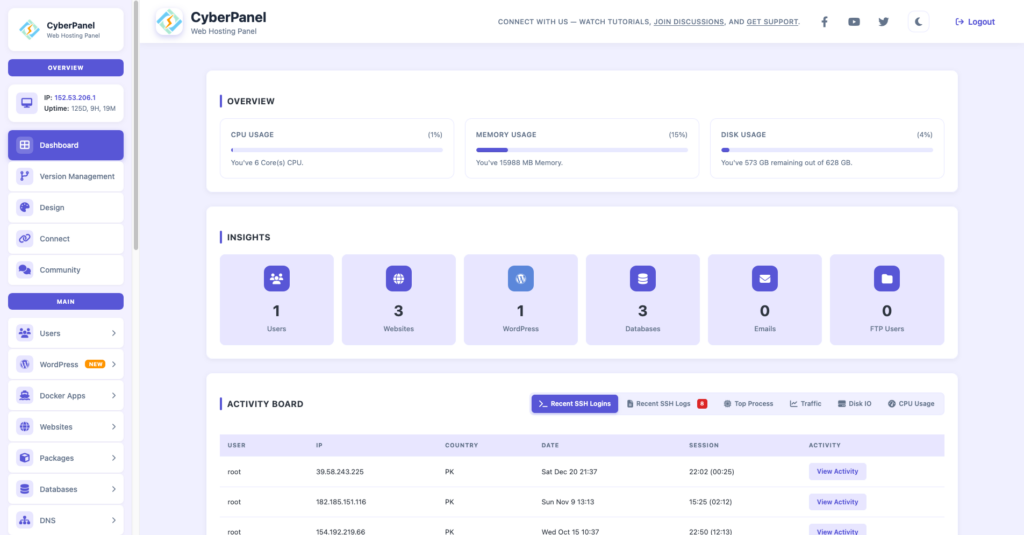
CyberPanel is your free and open-source web hosting control panel. If you are managing a web service via Puppet, CyberPanel can assist with managing web infrastructure at the server level.
CyberPanel has tools available for many management tasks, including:
- domain management
- DNS configuration
- automating SSL certificates
- monitoring the server
- managing the firewall
While Puppet is designed to automate how a server is configured, CyberPanel will help you manage the hosting environment and web services.
The combination of Puppet and CyberPanel is an effective and efficient way to manage your entire infrastructure.
Puppet’s Common Challenges
Puppet is a very powerful tool, but many administrators struggle with using it successfully.
Here are some of the more common problems:
- An initial configuration that is complicated to set up.
- Learning how to use Puppet’s DSL (Domain Specific Language).
- Managing large configurations stored in a configuration repository.
- Maintaining communication between agents.
These challenges have been identified, and proper documentation and infrastructure plans can help alleviate them.
Puppet’s Future in DevOps
Even though containers and cloud infrastructures are gaining in popularity, there are still many reasons to continue using configuration management tools.
Puppet continues to be updated to support:
- Hybrid Cloud Environments.
- Automation of Infrastructure.
- Automation of Security Compliance.
Puppet software configuration management continues to have relevance to modern-day DevOps environments.
Final Thoughts!
The inefficiency of traditional methods of infrastructure management has made these approaches extremely risky. To avoid the risks of traditional methods of infrastructure management and the challenges of infrastructure management as a whole, effective Puppet configuration management should be used to automate the server configuration process, provide consistency and scalability for operations, and provide security.
Using Puppet configuration management system, administrators are able to establish rules for the infrastructure once and then apply them throughout the entire environment. By combining this capability with other effective infrastructure management tools, automation becomes an even more powerful tool for managing infrastructure.
Use Puppet configuration management in your infrastructure today to define your server configurations as code, automate your deployments, and create a stable environment that will grow with your organization.
FAQs
Will Puppet integrate into a CI/CD pipeline?
Yes – Puppet can integrate into your automation pipeline in order to keep your infrastructure consistent across deployments.
Will Puppet require programming knowledge?
Puppet has its own declarative language and, as a result, is much easier to understand than the majority of traditional scripting languages.
Does Puppet continue to be used in the present day within modern-day DevOps?
Yes – Many companies have continued to utilize Puppet to automate their large-scale infrastructure and ensure compliance regarding configuration.