On this page
The Search was the First Clue! If you’ve typed “backtrack linux” into Google with the hope of landing on a download link, you probably hit a wall. Nothing wrong with your search or ability-the OS is gone. However, you can find its DNA practically all throughout the ethical hacking courses, pen-testing labs, and the Security+.
So what was BackTrack Linux, why is it a “former”, and what is its successor?
If you came here while learning penetration testing or researching Linux security distros, it’s your lucky day.
What Is BackTrack Linux?
BackTrack Linux was released in 2006 as a result of the merging of two existing security-related projects known as WHAX and the Auditor Security Collection, both of which are derived from Knoppix (a leading Live Linux distribution originally built from the Knoppix distribution in the early years of Linux’s rise). BackTrack was developed and maintained by the same group of people behind today’s Kali Linux, called Offensive Security.
What’s special about this distribution when compared to the manual installation of one’s own OS is how they’ve pre-packaged most of the commonly used hacking and forensic tools required to perform the required testing, without the user needing to install them individually. The system came with popular applications such as: Nmap, Metasploit, Wireshark, Aircrack-ng, and John the Ripper, all bundled in a one-disc system ready to be used.
A Quick Timeline: How BackTrack Came Together
Understanding the lineage helps explain why BackTrack earned so much trust in the security community.
• Knoppix – the original bootable Live Linux distro that inspired the entire lineage
• Whoppix (WhiteHat Knoppix) – an early security-focused fork of Knoppix
• WHAX – Whoppix rebuilt on Slax after a base OS change
• Auditor Security Collection – a parallel Knoppix-based security project
• BackTrack (2006) – formed by merging WHAX and Auditor into one distribution
• BackTrack 4 and 5 – later versions switched their base from Slackware to Ubuntu, expanding hardware and driver support
• Kali Linux (2013) – the full rebuild that replaced BackTrack for good
BackTrack ran through several versions between 2006 and 2012, with BackTrack 5 R3 marking its final release in August 2012. By March 2013, Offensive Security officially retired the name and launched Kali Linux as its direct successor.
Why Is BackTrack Linux OS No Longer Available?
The company supported their Linux penetration testing OS for nearly seven years quite competently, though the internal design couldn’t compete as the security industry grew. Offensive Security has four main reasons they chose to restart:
Messy internal structure: Tools were available under /pentest on the file system and weren’t called system-wide (as most tools are).
This made things cumbersome for automation and scripting.
Poor choice of Ubuntu package release: A friendly, preconfigured desktop environment comes part and parcel with Ubuntu’s releases, though it’s not a testing repository like the Debian one that Kali has. While the user gets a better UI experience in some situations, the patching of available packages falls behind.
No rolling release: Every version had to be rebuilt fresh (and even manually installed) or undergo a painful, manual migration. There is no ‘yum upgrade’ for a bleeding-edge, no-pain-all-gain experience to install tools and security updates, on demand.
Poor ARM compatibility: Due to the nature of security and pentesting expanding to exploit, manage, and evaluate other systems that are not x86 and the expansion of the security niche to router, IoT, and mobile environments, this has proven to be painful for most.
Kali Linux was built from the ground up, addressing all of these concerns. It uses a testing branch of Debian, a rolling-release, systematic $PATH organization for tools, along with ARM support that allowed it to be installed on platforms such as the Raspberry Pi.
BackTrack For Linux vs Kali Linux: Side-by-Side Comparison
| Feature | BackTrack Linux | Kali Linux |
| Base OS | Slackware (v1-3), Ubuntu (v4-5) | Debian |
| Release model | Fixed versions, manual upgrades | Rolling release |
| Tool access | Fixed /pentest directory | Callable via system $PATH |
| ARM support | Limited | Extensive, built for Raspberry Pi and mobile |
| Status | Discontinued in 2013 | Actively maintained today |
| Developer | Offensive Security | Offensive Security |
What took BackTrack Linux’s place?
In order to download BackTrack Linux currently, you just have to do it through its descendant. The same can’t be said for BackTrack in the past. Even if BackTrack Linux is now obsolete the tools are well represented by its modern successor as is the approach with its expanded and updated functionality and a comprehensive suite of offensive security and forensic tools that can serve every kind of professional in IT security, it does contain much, much more functionality, but on the plus side that will prepare you for use in any role where forensics are necessary, and in just about every other job that can even come close the security’s security role the same argument as it stands there as for the first point.
Where a Solid Hosting Panel Fits Into the Picture
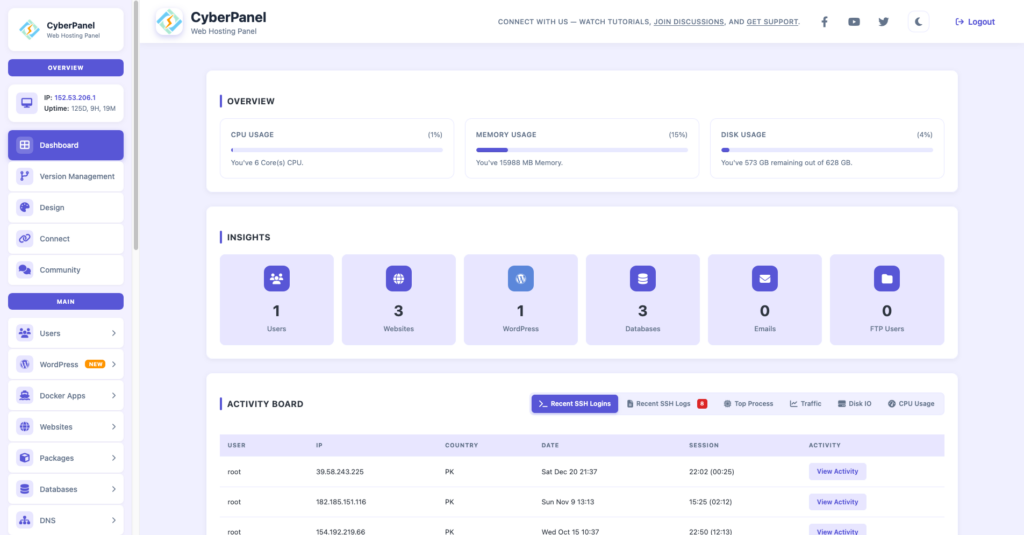
Penetration testers, persons getting into cybersecurity, and Linux server admins share one thing in common: they need a stable, well-managed server environment to actually do their work. Whether you are hosting a lab environment, a vulnerable-by-design test target, or a production site you want locked down against the same attack tools like these simulate, the server layer matters just as much as the testing tools.
This is where CyberPanel comes in. It is a free and open-source web hosting control panel. It gives you a clean, web-based way to manage your Linux VPS, handle firewall rules, configure SSL, monitor server resources, and deploy websites without wrestling with raw command-line configuration every time. If you are running security labs on isolated VPS instances or hardening a production Linux server against the kind of exploits BackTrack-era tools were built to find, CyberPanel keeps the server management side simple so you can focus on the security work itself.
FAQs
Is BackTrack Linux still available to download?
Offensive Security no longer hosts or maintains BackTrack. Old ISO files circulate on third-party mirrors, but they carry outdated packages, unpatched vulnerabilities, and no official support. Kali Linux is the maintained path forward.
Was BackTrack Linux free?
Yes. BackTrack was fully open source and free to download and use, just like Kali Linux is today.
Can I still use BackTrack Linux for penetration testing in 2026?
Technically yes, but it is not recommended. Its tools and kernel are over a decade out of date, which means missing patches, outdated exploit databases, and compatibility issues with modern hardware and networks.
Who created BackTrack Linux?
Mati Aharoni and Devon Kearns developed BackTrack under Offensive Security, the same organization that later built and maintains Kali Linux.
Did BackTrack Linux support Windows dual boot?
Yes. Like most Linux distros of that era, BackTrack could be installed alongside Windows in a dual-boot setup, or run entirely as a live disc without touching the existing OS.
Conclusion
BackTrack Linux is an OS that wouldn’t be in production in 2026. But it’s still an important technology. BackTrack had laid the foundation for many modern penetration testing methods, and its departure paved the way for the creation of today’s go-to security distro, Kali. So the next time you’re ready to kick off the development of your first Linux server, either for running your set of favorite security tools, setting up your test lab, or hardening your production machines against hacking, set up your VPS with CyberPanel, let it handle the low-level issues, and let you enjoy working in security!
Ready to begin the journey of creating a free Linux server with minimal effort and setup involved? Sign up today.