
On this page
If you are a Linux user, there is a high chance you have encountered the modprobe command prompt. It is often used in Linux distributions during installation, drivers, and troubleshooting. Let’s have a look at modprobe Linux!
Whether you are trying to install a Wi-Fi driver, a USB driver, or you encountered the “modprobe: FATAL: Module vfat not found” error on Arch Linux, learning more about what the modprobe command does can be useful.
Most Linux users are not aware that modprobe is not just another command-line utility.
In fact, modprobe is critical for the proper functioning of the Linux kernel. It is used to manage kernel modules instead of using file operations. In this article, you will learn about:
- What is modprobe in Linux
- How to install it if it is not present on your Linux distribution
- How to use it on Arch Linux, and
- How to troubleshoot common errors such as “modprobe vfat not found.”
What Is Modprobe in Linux?
Modprobe is a command-line utility for managing modules in Linux. It is used to load, unload, and manage modules in the Linux kernel.
Linux kernel modules are used to add functionality to the Linux kernel. They can be loaded and unloaded on-demand without requiring the entire system to restart. This allows the operating system to be modular and only use the required resources.
Linux modules can be used for a variety of purposes such as:
- Networking
- USB
- Filesystems
- Graphics
- Bluetooth
- Virtualization
- Storage controllers
Instead of manually locating and loading modules, modprobe can be used to load the required modules and their dependencies.
How Does Modprobe Linux Work?
When modprobe is executed, the Linux OS will search the modules directory for the requested module. If other modules need to be loaded before the specified one, they will also be loaded by modprobe.
For example:
sudo modprobe vfatThis command loads support for the VFAT file system.
If the module depends on another kernel module, modprobe loads it without requiring additional commands.
Common Modprobe Commands
Here are the commands most Linux users work with.
Load a Module
sudo modprobe module_nameExample:
sudo modprobe iwlwifiRemove a Module
sudo modprobe -r module_nameExample:
sudo modprobe -r btusbShow Module Information
modinfo module_nameList Loaded Modules
lsmodAlthough lsmod does not load modules, it helps verify whether a module is already active.
How to Install Modprobe on Linux
Most Linux distributions include modprobe by default as part of the kmod package.
If the command is missing, install the appropriate package for your distribution.
Ubuntu and Debian
sudo apt update
sudo apt install kmodFedora
sudo dnf install kmodArch Linux
sudo pacman -S kmodAfter installation, verify that modprobe is available.
modprobe --versionHow to Use Modprobe on Arch Linux?
The Arch Linux distribution strives to provide the bare minimum of system software, which means that the end-user is more likely to have to engage with the kernel module subsystem.
Some common use cases include:
- Loading video drivers
- Enabling virtualization
- Testing Wi-Fi drivers
- Loading USB modules
- Storage drivers
Since Arch Linux is developmental, it is common to be testing new hardware or kernel versions, which makes modprobe particularly useful for this distro.
Fixing “Arch Linux Emergency: Modprobe VFAT Not Found”
One of the most common errors users encounter is:
modprobe: FATAL: Module vfat not foundThis usually appears during boot or while mounting FAT formatted USB drives.
Possible causes include:
- Missing kernel modules
- Corrupted initramfs
- Incorrect kernel version
- Damaged module directory
- Custom kernel without VFAT support
Step 1: Verify the Running Kernel
uname -rStep 2: Check Available Modules
find /lib/modules/$(uname -r) -name "*vfat*"If nothing is returned, the module may not exist for your current kernel.
Step 3: Rebuild initramfs
On Arch Linux:
sudo mkinitcpio -PThen reboot the system.
Step 4: Reinstall the Kernel
If the module is still missing, reinstall the Linux kernel package.
sudo pacman -S linux linux-headersThen regenerate the initramfs again.
When Should You Use Modprobe?
Modprobe is used for the following purposes:
- When new hardware is installed
- for troubleshooting
- to test
- to install virtualization modules
- to install drivers for a file system
- to manage the network interfaces
Unlike many other Linux utilities, modprobe has to be used with caution and requires root privileges.
Modprobe vs Insmod
| Feature | Modprobe | insmod |
|---|---|---|
| Handles dependencies | Yes | No |
| Searches module directories | Yes | No |
| Easier to use | Yes | No |
How CyberPanel Fits Into the Picture?
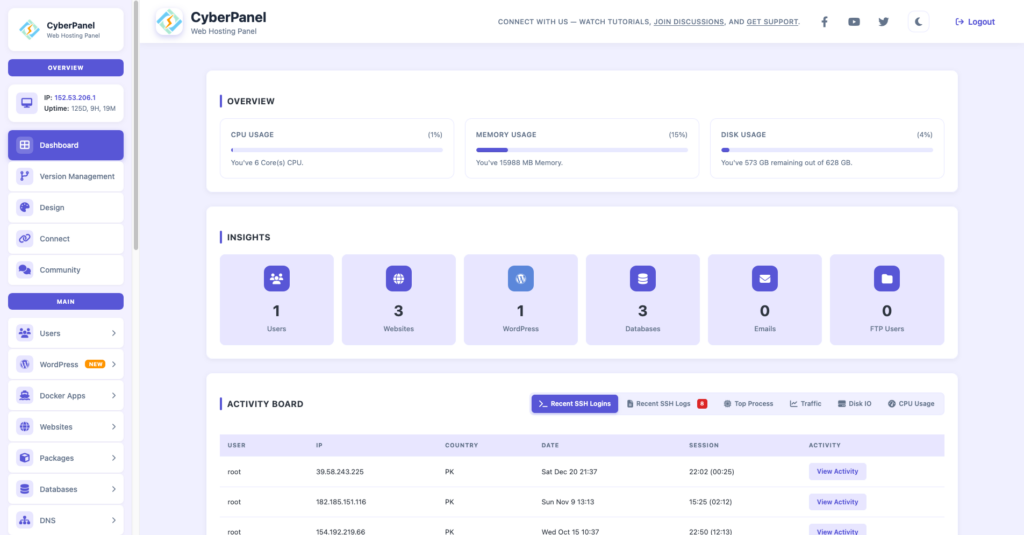
If you are working with Linux servers, learning about the kernel modules would become essential. The key features of your operating system, like file systems, network stacks, storage devices, and virtual machines, all require their kernel modules to function properly.
While modprobe gives you a low-level overview of your system’s modules, CyberPanel is a powerful web hosting control panel that lets you manage your server at a higher level. Instead of working with individual hosting services, it lets you deploy whole websites, configure databases and SSL certificates, and monitor server resources per website.
For developers, learning about modprobe and CyberPanel together would give them a more comprehensive understanding of how the Linux kernel works. At the same time, they would be able to manage their servers more efficiently by utilizing CyberPanel’s automation.
Final Thoughts!
Modprobe is one of the most powerful commands for working with kernel modules in Linux. Whether you are trying to access new hardware devices, debug your system software, or fix errors like modprobe: FATAL: Module vfat not found on Arch Linux, knowledge of modprobe will greatly enhance your Linux skills.
By learning how to use it, you will be able to view and edit all kernel modules on your system, making troubleshooting much easier. If you are also managing websites, you can pair your modprobe skills with CyberPanel to get a better overall view of your server. At the same time, you will be able to automate many of the high-level tasks associated with managing websites.
People Also Ask
Why does Arch Linux modprobe show “modprobe vfat not found”?
This usually indicates a missing kernel module, a mismatched kernel version, or an initramfs issue.
How do I install modprobe?
Install the kmod package using your distribution’s package manager, such as apt, dnf, or pacman.
Is modprobe installed by default?
Yes. Most Linux distributions include it through the kmod package.