On this page
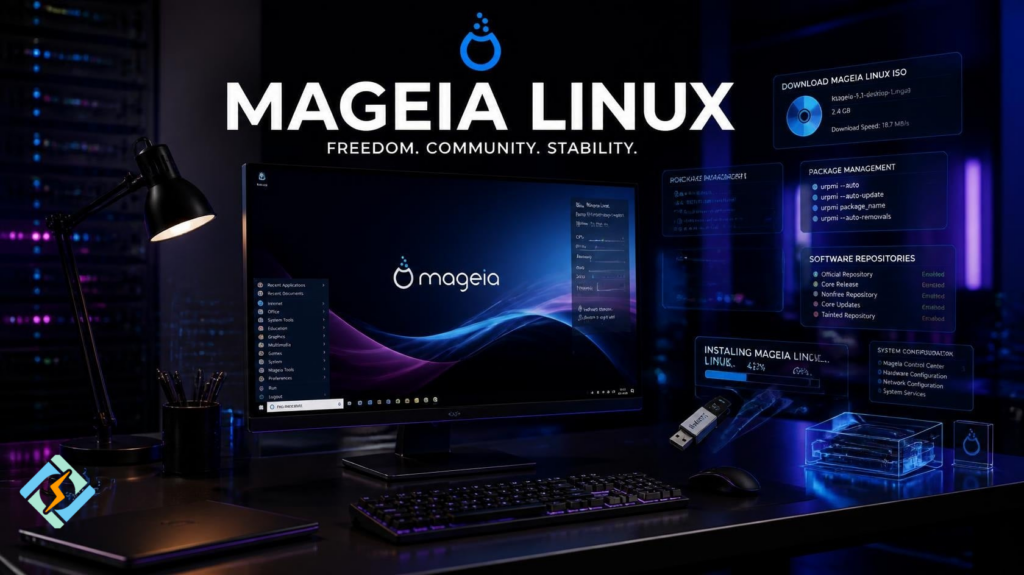
Mageia Linux is a free and open-source operating system for desktop and server computers. The Mageia 10 release in July 2026 delivers updated hardware drivers, desktop environments, application software, and multiple installation methods, including traditional CDs and network tools, all under a community-oriented approach.
But is Mageia still worth your consideration? How does it compare to other Linux distributions? Which version is best for you or your company? Is Mageia compatible with hosting systems such as CyberPanel?
This Mageia Linux review contains the answers to these frequently asked questions and provides all the necessary details about Mageia 10 to help you make an informed decision and perform a smooth Mageia Linux download.
Linux Mageia Overview
Mageia Linux is a community-developed and community-maintained GNU/Linux OS designed to provide the benefits of a community-driven project, including choice and flexibility, to both desktop and server users. Mageia Linux is based on Mandriva Linux main repository and codebase, forked by Mageia developers to form an independent project that now maintains its own repositories, documentation, and development platforms.
The Mageia Linux developers position their product as a community-driven Linux distribution with a unique approach to end-user freedom of choice. Its primary differentiators are the selection of desktop environments and tools, with Mageia 10 featuring the wide software compatibility of Window Managers and desktops such as Plasma, GNOME, Xfce, MATE, LXQt, Cinnamon, and lighter or Wayland-based alternatives.
This versatility makes Mageia a compelling choice for users who seek a traditional Linux desktop experience but desire more flexibility in customizing their working environment than what other popular Linux distributions may offer.
What’s New in Mageia 10?
Mageia 10 is the latest stable version of Mageia Linux in 2026 and was released in July 2026. It follows the standard Mageia development and stabilization cycle, incorporating the latest technologies, applications, and tools.
Linux kernel version 6.18 LTS from the Long Term Support series is at the core of Mageia 10, and the OS also includes updated desktop environments and software development tools for enhanced productivity.
Meanwhile, the Mageia Linux 10 review highlights include browsers, office suites, media players, and servers’ tools and applications updated to their latest versions.
Besides, the Mageia 10 release notes promise extensive hardware support, including graphic cards, processors, and motherboards from Advanced Micro Devices (AMD) and Intel. All of the above makes Mageia 10 a compelling choice for Linux enthusiasts who want to benefit from cutting-edge technology in their OS.
Mageia Linux Download Options
mageia.org provides multiple download options for Mageia Linux 10. First, note that Mageia Linux 10 comes in both 64-bit and 32-bit variants. Then, there are three types of installation modes:
• Live: This option is suitable for testing Mageia Linux on a computer without making any changes to its hard drive.
• Traditional: This option requires a larger ISO file and is suitable for users who want to install Mageia Linux on their computers.
• Network: This option has fewer components, so it is more appropriate for those who plan to perform a Mageia Linux download over the internet.
These Mageia download options imply that there are several Mageia Linux ISO images for each category and the variants (64-bit and 32-bit). As a result, a Mageia Linux user gets to make more informed decisions about which version of Mageia Linux to adopt.
This Mageia Linux review highlights that the 2026 Mageia Linux version is a compelling operating system that offers users more choice and flexibility. Mageia 10 is built on an updated Linux kernel, providing improved hardware support while also offering greater customization and compatibility with a variety of software tools and applications.
Users can choose from a variety of Mageia Linux download options, depending on their preferred desktop environments and computer configuration. Overall, Mageia Linux 10 is a great choice for those who want a more traditional but highly customizable Linux experience.
Some notable components include:
| Component | Mageia 10 |
| Linux kernel | 6.18 LTS |
| KDE Plasma | 6.5.5 |
| GNOME | 49.0 |
| Xfce | 4.21 |
| Python | 3.13.13 |
| GCC | 15.2.0 |
| Rust | 1.95.0 |
| Git | 2.52 |
| Docker | 28.5.2 |
| PostgreSQL | 18.4 |
| Firefox | 140.11.0 ESR |
| LibreOffice | 26.2.3.2 |
These versions come from Mageia’s June 2026 release announcement, so individual packages can change as updates are published through the distribution’s repositories.
Mageia also continues to support both newer and older hardware. The project specifically notes that Mageia 10 can make use of newer hardware capabilities while retaining support for older 32-bit hardware.
Why Is Mageia Linux Different From Other Distributions?
Mageia is not an attempt to ‘do Ubuntu but with a different wallpaper’.
It aims to provide the user with the tools to shape their system as they see fit.
For instance, Mageia 10 offers over 20 desktop environments/window managers to choose from, and you can even have multiple ones installed at the same time.
The Mageia Control Center is another plus, as it offers a graphical interface to manage many aspects of the system’s behaviour, removing the necessity to remember every single command.
This way, Mageia is a good choice for the user that does not want to sacrifice flexibility for the ‘out-of-the-box’ experience that comes with specialized distros but does not want to type every command in a terminal.
Which Desktop Environment Should You Choose in Mageia 10?
Your choice of desktop environment can have a noticeable effect on how Mageia feels.
| Desktop | Best for | General character |
| KDE Plasma | Modern desktops and customization | Feature-rich |
| GNOME | Minimal, workflow-focused desktop | Clean and streamlined |
| Xfce | Older or modest hardware | Lightweight |
| LXQt | Very lightweight systems | Resource-efficient |
| Cinnamon | Traditional desktop users | Familiar |
| MATE | Users who prefer a classic interface | Traditional |
| Enlightenment | Lightweight/custom setups | Flexible |
| IceWM | Very old or low-resource hardware | Extremely lightweight |
Mageia 10’s available choices extend beyond this list, with additional window managers and Wayland compositors such as labwc, niri, Sway, and Hyprland.
If you are unsure, KDE Plasma is a sensible starting point for a modern computer. If the machine is older, Xfce or LXQt may be a better fit.
What Are the Mageia Linux System Requirements?
Mageia is relatively modest about hardware requirements.
The project’s hardware requirements list 512 MB of RAM as the minimum, while 2 GB is recommended. For lightweight graphical environments such as Xfce, 1 GB can be workable. More demanding environments such as GNOME and Plasma are better suited to systems with at least 2 GB of RAM.
Storage requirements depend on how you install and use the operating system.
| Requirement | Mageia recommendation |
| Processor | AMD, Intel, or VIA processor |
| RAM minimum | 512 MB |
| RAM for lightweight desktop | 1 GB |
| RAM recommended for Plasma/GNOME | 2 GB |
| Minimal installation storage | 5 GB |
| Casual desktop installation | 20 GB |
| Architecture | 32-bit and 64-bit options |
These figures come from Mageia’s current hardware requirements documentation.
A practical desktop installation should have more storage than the minimum. If you plan to install applications, store personal files, and keep updates, an SSD with at least 20 GB available is a much more comfortable starting point.
Where Can You Download Mageia Linux?
For a Linux Mageia download, use the official Mageia download page rather than an unofficial mirror or random software site.
Download Mageia 10 from the official Mageia website
Mageia provides several installation formats. The current download page offers 64-bit and 32-bit editions, while alternative downloads include Live Xfce, Live Plasma, Live GNOME, and network-installation images.
The current stable download options include:
| Download | Architecture | Approx. size |
| Mageia 10 | 64-bit | 5.3 GB |
| Mageia 10 | 32-bit | 4.5 GB |
| Live Xfce | 64-bit | 4.3 GB |
| Live Xfce | 32-bit | 3.7 GB |
| Live Plasma | 64-bit | 4.8 GB |
| Live GNOME | 64-bit | 4.5 GB |
| Netinstall | 64-bit | 109 MB |
| Netinstall nonfree | 64-bit | 176 MB |
The listed sizes are from Mageia’s current alternative download page and can change as new images are published.
Which Mageia Linux Download Should You Choose?
That’s where many newbies make mistake.
You aren’t obliged to study all of them before making a choice. Here are several recommendations:
Select 64-bit version if you have modern PC
Right now most of Intel-compatible processors use x86-64 architecture. Mageia download page even suggests that 64-bit version is recommended for most modern computers.
Choose Live Xfce if you want to try Mageia before installing it
In that case you will launch Mageia from removable media (USB flash drive). Using Live session is a good way to see how the OS works before making a final decision. By the way, 32-bit version is also appropriate for older computers.
Opt for Live Plasma if you want to try out Mageia’s desktop environment
This is another excellent option for experimenting with Mageia. It will give you an opportunity to become familiar with KDE Plasma desktop without actually installing the system on your PC.
Consider Live GNOME if you are a fan of this desktop
It is similar to the previous two Live versions but comes with GNOME desktop.
Go for Netinstall if you are an experienced Linux user
The reason for this option is that it has smaller size than others because it does not include any packages. Such type of Mageia Linux is recommended for those who know what they are doing and have enough technical skills. Netinstall will allow you to complete the installation process by connecting to network repositories.
This is also a good time to mention that the BitTorrent protocol is suggested for downloading Mageia Linux. The reason is that it can provide a more reliable connection than a standard link.
How Do You Install Mageia Linux?
The installation process is really simple and clear:
1. Download Mageia 10 ISO file. For security reasons, you should always check downloaded files.
2. Burn it to a USB stick.
3. Reboot your PC and enter Mageia installer or Live session.
4. Set your preferred language, keyboard layout and other options.
5. Choose what you want to install.
6. Finish the installation and remove the USB once you are prompted to do so.
Actually, Mageia documentation states that you can launch Mageia from removable media. In addition, the official website provides IsoDumper for Linux users and describes how to create the installation medium in case you are using Windows.
By the way, do not forget to back up your data before repartitioning your hard drive. The fact is that any operating system can cause your stored information to become inaccessible if something goes wrong.
Is Mageia Linux Difficult for Newbies?
It depends. In some sense, Mageia can be recommended to newbies because it offers a graphical interface, variety of desktop environments, software management tools, and so on. Nevertheless, I would not recommend Mageia to someone who is looking for the easiest and most comprehensive guide or community support when they start their journey. There are a lot of better alternatives, such as Ubuntu, Linux Mint, or Fedora, which have more extensive documentation and active communities. This means that if you encounter any problem, you will find a solution much quicker.
On the other hand, Mageia has its own support ecosystem to help you get rid of various difficulties. In addition, it provides you with all the necessary tools for managing and maintaining the system.
Is Mageia Linux Still Maintained?
Yes.
This is an important point because some searches for older Linux distributions can lead to outdated information.
Mageia 10 is the current release, and the project states that it will receive support until March 31, 2028. Security and bug-fix updates are published on an ongoing basis through Mageia’s update system.
So, if you see older articles describing Mageia 8 or Mageia 9 as the current version, those pages should not be treated as current guidance for a new installation.
Mageia Linux Review: Pros and Cons
After looking at the current release rather than older versions, Mageia has a fairly clear personality.
Pros
- Free and open source
- Community-driven development
- Current stable release available
- Supports desktop and server use
- Large choice of desktop environments
- 32-bit support remains available
- Lightweight desktop options
- Graphical system administration tools
- Large software repositories
- Long support period for Mageia 10
- Live images make testing easier
Cons
- Smaller community than Ubuntu, Fedora, or Debian
- Fewer third-party tutorials than mainstream distributions
- Some documentation can feel less polished than that of larger projects
- The large number of desktop choices can overwhelm new users
- Not every commercial Linux application targets Mageia directly
The biggest question is not whether Mageia is technically capable. It is whether its ecosystem matches your needs.
If you value choice and a traditional Linux experience, Mageia can be a strong option.
If you frequently depend on software vendors that officially support only Ubuntu, RHEL, or Debian, another distribution may save you time.
Mageia Linux vs Ubuntu vs Fedora
A quick comparison helps put Mageia in context.
| Feature | Mageia | Ubuntu | Fedora |
| Free/open source | Yes | Yes | Yes |
| Beginner-friendly | Yes | Yes | Yes |
| Multiple desktop choices | Excellent | Excellent | Excellent |
| 32-bit support | Yes | Limited/varies by component | Limited/varies |
| Community size | Smaller | Very large | Large |
| Long-term support options | Yes | Yes | Yes |
| Traditional administration tools | Strong | Strong | Strong |
| Best known for | Choice and control | Broad ecosystem | Newer Linux technologies |
This is not a performance ranking. Each distribution makes different trade-offs.
Mageia’s strongest selling point is the combination of choice, graphical administration, traditional Linux tooling, and community development.
Can You Use Mageia Linux as a Server?
Yes.
Mageia is intended for both desktop and server usage.
Mageia 10 has server-related packages such as Apache, PostgreSQL, Postfix, and Docker in its updated software list.
That doesn’t mean that everything should be hosted on Mageia, but for a personal server, development, lab, or other machine,Mageia can be a great choice.Mageia may not be the best option for hosting businesses since, in such cases, the compatibility with the control panel is paramount. For example, if you want to use CyberPanel, you need to check if Mageia is on CyberPanel’s supported OS list.
Can You Install CyberPanel on Mageia Linux?
This is where you need to be careful.
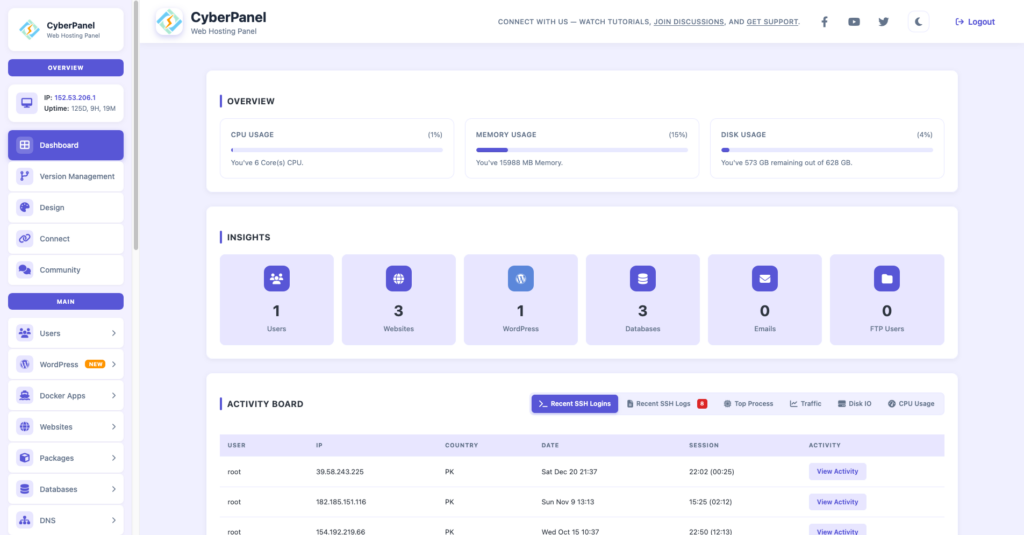
Mageia is not on CyberPanel’s supported OS list, so it is best to avoid installing CyberPanel on Mageia Linux. CyberPanel documentation lists AlmaLinux, Rocky Linux, CloudLinux, and Ubuntu servers as supported platforms, while Mageia Linux is not mentioned. So, in most cases, you should refrain from trying to run CyberPanel on Mageia.
CyberPanel is a web hosting control panel that is supposed to provide an easy-to-use interface for managing a server with various scripts and applications. A control panel usually means additional work and extra software to learn and manage, but in some cases, a control panel is much easier to use and provides more convenience and features than managing everything via the terminal.
If your goal is to run CyberPanel for website hosting, choose a supported operating system instead.
For example, a supported server could use:
Ubuntu
↓
CyberPanel
↓
OpenLiteSpeed
↓
Websites + PHP + Database + SSL
Mageia can still be useful as your desktop or development operating system while your production hosting server runs a distribution officially supported by CyberPanel.
That separation is often the cleaner approach.
Mageia Linux vs CyberPanel: They Solve Different Problems
It is also worth clearing up a common misconception.
Mageia is an operating system.
CyberPanel is a web hosting control panel.
They are not alternatives to one another.
| Technology | What it does |
| Mageia Linux | Operating system |
| Ubuntu | Operating system |
| AlmaLinux | Operating system |
| CyberPanel | Hosting control panel |
| OpenLiteSpeed | Web server |
| Docker | Application container platform |
A server can therefore have an operating system underneath and a control panel or server software layer above it.
The issue is compatibility. CyberPanel requires a supported operating system, so Mageia is not a suitable base for a CyberPanel production installation simply because it is another Linux distribution.
Is Mageia Linux Good for Developers?
Mageia 10 has a strong selection of development tools.
The current release includes packages such as GCC, Rust, Python, Perl, Git, Docker, and PostgreSQL.
That makes it suitable for a range of development tasks.
For example, a developer could use Python:
python3 --versionor Git:
git --versionor Docker:
docker --versionThe bigger consideration is ecosystem compatibility. If your development workflow depends on a vendor-provided package that officially targets Ubuntu or RHEL-based systems, check its documentation before choosing Mageia.
Is Mageia Linux Good for Old Computers?
It can be.
One of the reasons why I think it is worth considering is because the project offers 32-bit install options, and on supported hardware it promotes light desktop environments such as Xfce for low-memory computers.
Mageia 10 specifically is notable for its commitment to run on older 32-bit machines, but also on modern computers.
I would recommend going with the lighter desktop environments such as Xfce or other options from the window manager list, if only to have a better experience on older computers.
Your mileage on performance will vary depending on the class and clock speed of the processor, amount of memory, storage medium, graphics processing unit, and computer age.
Does Mageia Linux Have a Software Manager?
Yes, it does.
The Mageia project offers graphical software-management and system-administration tools, alongside its repository system.
There is also an online database for applications available for Mageia, which is helpful if one wants to avoid using the terminal or not memorize a long list of package-management commands.
The graphical tools are light enough for older computers but still provide decent features, while more advanced users can use the terminal.
It is a decent middle ground between modern Linux graphical user interfaces and more traditional command-based Linux systems.
How Long is the Support for Mageia 10?
According to the Mageia website, Mageia 10 will be supported until March 31st, 2028.
This means that security and bug fix updates will be available to users running Mageia 10 via the official repositories.
That is a long time to receive support, so if one were to ask my recommendation for a fresh Mageia installation in 2023, I would point them towards Mageia 10, unless they have specific needs which require an older version.
Should You Download Mageia Linux in 2026?
If you want a community-driven Linux distribution with extensive desktop choice, support for older hardware, graphical administration tools, and a traditional Linux experience, Mageia 10 is worth trying.
The project is active, Mageia 10 is currently supported, and official download options cover everything from Live desktop images to traditional and network installations.
The biggest reason not to choose Mageia is not performance or capability. It is ecosystem size.
If you need a huge third-party software ecosystem, maximum tutorial coverage, or software with official Ubuntu/RHEL support, a more mainstream distribution may be easier.
But if you want something independent, configurable, and community-driven, Mageia deserves more attention than its relatively small profile might suggest.
Frequently Asked Questions
Can Mageia Linux run Windows applications?
Mageia itself is a Linux operating system, so Windows applications do not run natively simply because Mageia is installed. Compatibility layers such as Wine can run some Windows software, but compatibility depends on the individual application.
Does Mageia Linux support gaming?
Yes. Mageia can run Linux games and supports common Linux gaming software, but the experience depends on the game, graphics hardware, drivers, and compatibility layer involved. For a gaming-focused machine, it is worth checking the specific games you play before choosing a distribution.
Can Mageia Linux replace Windows?
For many everyday tasks, yes. Web browsing, office work, media playback, development, programming, and many creative tasks can be handled on Mageia. The deciding factor is usually application compatibility rather than the operating system’s basic capabilities.
Is Mageia Linux good for privacy?
Mageia gives you the control and transparency associated with free and open-source software, but privacy is not something that can be guaranteed simply by installing a particular Linux distribution. Your browser, applications, network configuration, online accounts, and services you use still matter.
Is Mageia Linux based on Debian?
No. Mageia is not a Debian-based distribution. It originated as a fork of Mandriva Linux and has its own package repositories and tooling.
Final Verdict: Is Mageia Linux Worth It?
Yes, it is definitely worth considering Mageia Linux in 2026.
Mageia 10 is a living OS, not some dead-end project. It offers an impressive variety of desktop environments, from lightweight to heavy, extensive software repository, graphical tools, and support for both modern and legacy hardware.
The easiest way to try Mageia is to download the ISO file for Mageia 10, burn it to a USB stick, and try the system in a virtual machine or on real computer hardware.
For an old PC, it makes sense to try Xfce first. For a modern PC, you can experiment with more visually appealing but heavier desktop environments, such as Plasma or GNOME. For a server, you’ll have to do some research and planning ahead before selecting the OS version and features.
If your primary goal is to set up a web server with CyberPanel, do not mix Mageia and CyberPanel. Mageia can be a great Linux distribution for everyday use or for setting up a hosting server, but CyberPanel must be installed on one of the supported OS versions, not Mageia.
So, if you are thinking of trying Mageia, head over to the Mageia website, download the ISO file for Mageia 10, and experiment with it in a virtual machine or on real computer hardware. First, try Mageia in a virtual machine: burn the ISO file to a USB stick, boot your computer from it, and play around with Mageia before you commit to installing it on your computer. If you are setting up a server, you’ll have to choose between Mageia and CyberPanel, because they are not compatible. If you need CyberPanel, install it on one of the supported OS versions, not Mageia.