On this page
A managed WordPress hosting business lets agencies, developers, and hosting providers manage WordPress websites for clients while charging a recurring fee for hosting, maintenance, security, backups, and support. A VPS can provide the infrastructure needed to start small and scale as your customer base grows.
The challenge is not simply putting WordPress websites on a server. A profitable hosting business needs a reliable architecture, clear service limits, automated backups, strong security, monitoring, support processes, and pricing that leaves enough margin after infrastructure costs.
This guide explains how to build that system from the ground up.
What Is Managed WordPress Hosting?
Managed WordPress hosting is a hosting service where the provider takes responsibility for more than simply keeping a website online.
Depending on the package, managed services can include:
- WordPress installation
- Server management
- Security hardening
- SSL certificates
- Automatic backups
- WordPress updates
- Performance optimization
- Malware monitoring
- Uptime monitoring
- Technical support
- Database management
- Server level caching
- Migration assistance
The exact services depend on the hosting company.
For customers, the main value is convenience. They pay a recurring fee and do not have to manage every server and WordPress task themselves.
For the provider, the business model works when recurring customer revenue remains higher than the combined cost of infrastructure, software, support, maintenance, and customer acquisition.
Can You Build a Managed WordPress Hosting Business on a VPS?
Yes. A VPS can be a practical starting point for a small managed WordPress hosting operation. Before choosing the server, consider CPU, RAM, storage, and network capacity based on the websites you plan to host.
Instead of purchasing dedicated infrastructure immediately, you can start with a VPS that provides dedicated virtual resources and root access.
A typical starting architecture can look like this:
Customers → DNS → VPS → Web Server → WordPress Websites → Database + Storage + Backups
As the number of websites grows, additional VPS servers can be introduced instead of placing every customer on one machine.
The important principle is to scale the architecture before the server becomes a single point of failure.
What Do You Need to Start a Managed WordPress Hosting Business?
A basic hosting operation needs more than a VPS. Before accepting customers, make sure your infrastructure meets the current WordPress hosting requirements, including supported PHP, database, and HTTPS requirements.You also need a hosting control panel to manage websites, databases, users, SSL, and other server functions efficiently.
You should prepare:
| Requirement | Purpose |
|---|---|
| VPS | Runs customer websites |
| Hosting panel | Simplifies server and website management |
| Domain | Business and service website |
| SSL | Encrypts customer websites |
| DNS | Directs domains to the hosting infrastructure |
| Backups | Protects customer data |
| Monitoring | Detects outages and problems |
| Security | Protects websites and servers |
| Billing | Handles recurring customer payments |
| Support system | Manages customer requests |
| Documentation | Reduces repetitive support work |
| Terms and policies | Defines service responsibilities |
CyberPanel can be used as the hosting management layer on a VPS and is a free, open-source web hosting control panel powered by OpenLiteSpeed.
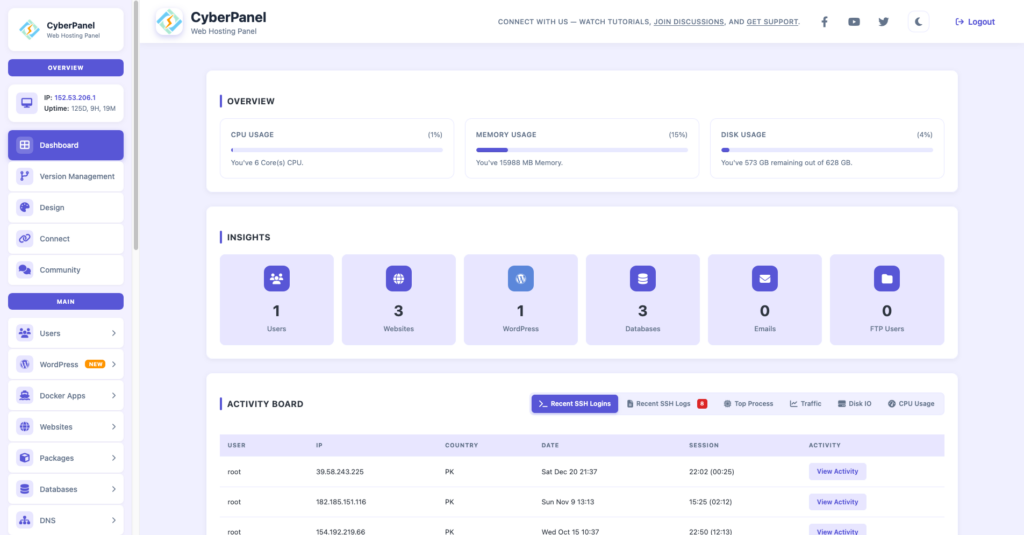
The control panel is only one part of the business. Your processes around it determine how reliable the service becomes.
How Should a Managed WordPress Hosting VPS Be Designed?
The first architectural decision is how many websites to place on each VPS.
Do not choose an arbitrary number such as 100 or 500 websites and assume every server can handle that amount.
WordPress workloads vary significantly.
A simple company website may use very few resources. An ecommerce website can generate much higher CPU, RAM, database, disk, and network usage.
Instead, monitor actual resource consumption.
A basic architecture could be:
| Layer | Starting Setup |
|---|---|
| Hosting | VPS |
| Web server | OpenLiteSpeed |
| CMS | WordPress |
| Database | MySQL or MariaDB |
| Control panel | CyberPanel |
| Cache | LiteSpeed Cache where appropriate |
| Backup | Separate remote storage |
| DNS | Managed DNS or DNS provider |
| Monitoring | Uptime and server monitoring |
| Support | Ticket or help desk system |
This creates a foundation that can be expanded as customer demand increases.
How Many WordPress Websites Can One VPS Host?
There is no universal number.
The practical capacity depends on:
- CPU resources
- RAM
- Storage performance
- Database workload
- PHP workers
- Traffic
- Concurrent visitors
- WordPress plugins
- WooCommerce usage
- Cron jobs
- Cache hit rate
- Backup workload
- Email services
- Customer behavior
For example, 50 lightweight brochure websites may consume fewer resources than five busy WooCommerce stores.
Instead of selling server space based only on the number of websites, monitor:
- CPU utilization
- RAM usage
- Disk I/O
- Storage capacity
- Network traffic
- Database load
- PHP worker usage
Set internal thresholds before the server becomes overloaded.
How Does the Business Model Work?
A managed WordPress hosting business usually uses recurring subscriptions.
A customer pays a monthly or annual fee in exchange for hosting and management services.
For example:
| Plan | Example Price | Target Customer |
|---|---|---|
| Starter | $15/month | Small website |
| Business | $30/month | Growing business |
| Pro | $60/month | High value website |
| Agency | $120/month | Multiple websites |
These are example pricing structures, not recommended market prices.
Your actual price should reflect infrastructure costs, support requirements, included services, customer acquisition costs, taxes, payment processing, and desired margin.
The Basic Profit Formula
A simple model is:
Monthly Profit = Customer Revenue − Infrastructure − Software − Support − Operations − Acquisition Costs
Suppose you have:
- 30 customers
- Average monthly revenue of $25
- Monthly revenue of $750
- Infrastructure and operating costs of $250
That leaves $500 before other business expenses and taxes.
The calculation becomes more attractive when infrastructure is shared efficiently across multiple customers without reducing service quality.
How Can You Price Managed WordPress Hosting?
Avoid competing only on storage and bandwidth.
Managed hosting is a service business.
Customers may pay more for:
- Faster support
- Automatic backups
- Security monitoring
- WordPress updates
- Migration assistance
- Performance optimization
- Staging environments
- Malware cleanup
- Uptime monitoring
Your plan should clearly explain what is included.
For example:
| Feature | Basic | Business | Agency |
|---|---|---|---|
| WordPress websites | 1 | 5 | 20 |
| SSL | Yes | Yes | Yes |
| Backups | Daily | Daily | Daily |
| Security monitoring | Basic | Advanced | Advanced |
| WordPress updates | Yes | Yes | Yes |
| Support | Standard | Priority | Priority |
| Migration | Optional | Included | Included |
| Staging | No | Yes | Yes |
| White label | No | No | Yes |
The exact package limits should be based on your actual infrastructure and support capacity.
How Do You Build a Reseller Hosting Business on a VPS?
A reseller hosting business VPS model allows an agency, developer, or hosting entrepreneur to purchase server resources and sell hosting services to their own customers.
The business owner becomes responsible for the customer experience.
A reseller operation can offer:
- Website hosting
- WordPress management
- Domain services
- SSL
- Backups
- Security
- Maintenance
- Website migrations
- Technical support
The key difference from traditional reseller hosting is the level of management you provide.
If you only provide server space, customers may compare you mainly on price.
If you manage WordPress updates, security, backups, performance, and support, you are selling a managed service.
How Do You Build White Label Hosting Platform?
A white label hosting platform allows an agency or hosting business to provide hosting under its own brand instead of presenting the underlying infrastructure provider as the primary customer-facing brand.
The basic structure is:
Your Brand → Hosting Portal → VPS Infrastructure → Customer Websites
A white-label setup should cover more than the logo.
Consider:
- Brand domain
- Customer portal
- Billing
- Support email
- Documentation
- Login experience
- Server naming
- Error pages
- Service notifications
- Terms of service
- Privacy policy
- Backup policy
Your infrastructure provider may still appear in technical records, payment records, or network information. White labeling does not mean that the underlying infrastructure becomes invisible in every situation.
What Should an Agency Hosting Architecture Look Like?
An agency hosting architecture should separate customer websites logically while keeping management simple.
A starting structure could look like:
                    Internet
                       |
                    DNS Layer
                       |
                 Load / Traffic
                       |
                VPS 1: Hosting
              /        |        \
         Client A   Client B   Client C
             |          |          |
          WordPress  WordPress  WordPress
              \        |        /
                Database Layer
                       |
                Backup Storage
As the business grows, move toward multiple hosting nodes.
For example:
                Customer Traffic
                       |
                    DNS/CDN
                       |
          +------------+------------+
          |                         |
       VPS Node 1                VPS Node 2
          |                         |
     Client Sites             Client Sites
          |                         |
          +------------+------------+
                       |
                 Remote Backups
This reduces the impact of a single server failure.
How Should You Isolate Customer Websites?
Multi-tenant hosting creates an important security challenge.
One compromised website should not become an easy path to other customer websites.
Use separate website users and appropriate filesystem permissions.
Avoid giving one customer unnecessary access to another customer’s files.
At minimum, review:
- File ownership
- Directory permissions
- PHP execution
- Database permissions
- SSH access
- User accounts
- WordPress administrator accounts
- Control panel permissions
You should also keep the server operating system, control panel, web server, PHP versions, and WordPress installations updated.
For more detailed server hardening, follow a dedicated VPS security checklist before onboarding production customers.
How Important Are Backups for Managed WordPress Hosting?
Backups are one of the most important parts of a managed hosting service.
A hosting provider should not treat backups as an optional feature.
A useful backup strategy should include:
- Automatic backups
- Off-server storage
- Retention periods
- Backup monitoring
- Restore testing
- Clear recovery procedures
Do not store the only backup copy on the same VPS as the website.
If the VPS fails, the backup can become unavailable at the same time.
A better architecture is:
Website → VPS Backup → Remote Storage
For higher-value customers, maintain multiple recovery points.
How Should You Handle WordPress Security?
WordPress security is a continuous process.
Your managed hosting service should address both server and application security.
Important controls include:
- Strong administrator passwords
- Multi-factor authentication where available
- Regular WordPress updates
- Plugin updates
- Theme updates
- Malware monitoring
- Firewall rules
- Limited user permissions
- Secure file permissions
- SSL
- Database access controls
- Regular backups
Do not promise that a hosting package can prevent every security incident.
Instead, clearly define the security measures included in the service and explain what remains the customer’s responsibility.
Should You Offer WordPress Updates as a Managed Service?
Yes, if your processes can support them safely.
Automatic updates can introduce compatibility problems between WordPress core, themes, and plugins.
A managed service can reduce this risk by using:
- Backup
- Update
- Health check
- Error monitoring
- Rollback when required
For important websites, test major changes before applying them to production.
How Can You Improve WordPress Performance?
Performance is another area where managed hosting can provide value.
A VPS alone does not automatically make WordPress fast.
Performance depends on:
- Web server
- PHP configuration
- Database performance
- Page caching
- Object caching
- Image optimization
- Plugin quality
- Theme design
- Server resources
- Network performance
OpenLiteSpeed can provide a strong foundation for WordPress hosting, particularly when paired with appropriate LiteSpeed caching features.
However, avoid promising a fixed loading time for every customer.
Website performance depends on the website itself as well as the hosting environment.
How Can You Automate a Managed Hosting Business?
Automation is essential if you want to manage many websites without increasing manual work at the same rate.
Automate repetitive tasks such as:
- Website provisioning
- SSL installation
- Backups
- Backup notifications
- WordPress updates
- Monitoring alerts
- Resource monitoring
- Billing notifications
- Customer onboarding
- Renewal reminders
The goal is not to automate everything.
Automate predictable tasks and keep human review for operations where an automated failure could affect customer websites.
How Do You Manage Customer Support?
Support can become the highest operating cost in a managed hosting business.
Define your support scope before selling the service.
For example:
Included
- Server availability
- Hosting configuration
- SSL
- Backup restoration
- WordPress installation
- Basic WordPress troubleshooting
Optional
- Custom development
- Theme customization
- Plugin development
- Content changes
- Complex application debugging
This prevents customers from treating a hosting subscription as unlimited development support.
Set response targets based on your actual team size.
Do not promise 24/7 support if you do not have the people or systems required to provide it.
What Metrics Should You Track?
A profitable managed hosting business needs more than server monitoring.
Track both technical and business metrics.
| Metric | Why It Matters |
|---|---|
| Monthly recurring revenue | Measures recurring income |
| Customer count | Shows business growth |
| Churn | Measures customer retention |
| Average revenue per customer | Shows account value |
| Support tickets | Measures support workload |
| Server utilization | Shows infrastructure capacity |
| Backup success rate | Measures recovery readiness |
| Uptime | Measures service reliability |
| Acquisition cost | Measures marketing efficiency |
| Gross margin | Shows business economics |
A growing customer count does not automatically mean a healthy business.
If support costs rise faster than recurring revenue, profitability can decline even while sales increase.
When Should You Add Another VPS?
Do not wait until the existing VPS is completely overloaded.
Consider adding another server when:
- CPU remains consistently high
- RAM usage approaches operational limits
- Disk I/O becomes a bottleneck
- Database performance declines
- Backup jobs interfere with production workloads
- Customer traffic grows significantly
- One server contains too many high-value websites
You can then distribute customers across multiple hosting nodes.
For example:
VPS 1
Small Business Sites

VPS 2
Agency Sites

VPS 3
WooCommerce / High Traffic Sites

Remote Backup
All NodesThis approach also makes future maintenance easier.
How Do You Handle Customer Migration?
Migration can become a valuable sales feature.
A customer may already have a WordPress website with another provider. A customer may already have a WordPress website with another provider. A documented cPanel migration process can make the transfer more consistent when you are onboarding several customers.
Offer a structured migration process:
- Collect website details.
- Confirm access.
- Create a backup.
- Transfer the website.
- Test the destination.
- Verify SSL.
- Change DNS.
- Monitor the website.
- Confirm completion.
If you are moving multiple websites from another hosting provider, use a repeatable migration checklist instead of handling every customer differently.
What Are the Biggest Mistakes in Managed WordPress Hosting?
Several mistakes can make the business difficult to operate.
Putting Too Many Websites on One VPS
More accounts are not always better.
Overloading one server can affect every customer.
Selling Unlimited Support
Unlimited support can create unpredictable operating costs.
Define exactly what your managed service includes.
Keeping Backups on the Same Server
A backup stored on the same failed server is not a reliable disaster recovery strategy.
Ignoring Security Isolation
Customer websites should not have unnecessary access to each other.
Underpricing the Service
Hosting revenue must cover infrastructure, support, backups, monitoring, payment costs, taxes, and other operating expenses.
Promising Guaranteed Performance
Website performance depends on application code, plugins, themes, traffic, and configuration as well as server resources.
Scaling Too Late
If you wait until a server is already overloaded, moving customers becomes more difficult.
Plan capacity before reaching the limit.
A Practical Managed WordPress Hosting Launch Plan
You do not need a large infrastructure on day one.
Start with a controlled environment.
Phase 1: Build
Set up:
- VPS
- CyberPanel
- OpenLiteSpeed
- WordPress
- SSL
- Remote backups
- Monitoring
- Billing
- Support
Phase 2: Test
Host your own websites or a small number of test websites.
Test:
- Backups
- Restores
- Updates
- SSL
- Security
- Monitoring
- Resource usage
- Server recovery
Phase 3: Launch
Create a small number of clearly defined plans.
Avoid offering every possible feature at launch.
Phase 4: Standardize
Document:
- Customer onboarding
- Migration
- Backup restoration
- Security response
- Update procedures
- Support escalation
- Server replacement
Phase 5: Scale
Add additional VPS nodes when resource usage and customer demand justify them.
Managed WordPress Hosting Business Checklist
Before accepting paying customers, verify the following:
| Area | Ready? |
|---|---|
| VPS | Yes |
| Hosting panel | Yes |
| WordPress stack | Yes |
| SSL | Yes |
| Remote backups | Yes |
| Restore testing | Yes |
| Security | Yes |
| Monitoring | Yes |
| Billing | Yes |
| Support | Yes |
| Terms of service | Yes |
| Privacy policy | Yes |
| Migration process | Yes |
| Customer onboarding | Yes |
| Scaling plan | Yes |
Frequently Asked Questions
Can I start a managed WordPress hosting business with one VPS?
Yes. A single VPS can be used as a starting point for a small hosting operation. The number of websites it can safely host depends on their resource requirements and traffic.
Is managed WordPress hosting profitable?
It can be, but profitability depends on pricing, customer retention, infrastructure costs, support workload, acquisition costs, and how efficiently the service is operated.
Can I use CyberPanel for managed WordPress hosting?
Yes. CyberPanel can provide the hosting management layer on a VPS, while OpenLiteSpeed provides the web server environment for supported workloads.
How many WordPress websites should I host on one VPS?
There is no fixed number. Measure actual CPU, RAM, storage, database, PHP, and network usage instead of using an arbitrary website limit.
What is white label hosting?
White label hosting allows a business to sell hosting under its own brand while using infrastructure and software supplied by underlying providers.
Final Takeaway
Building a managed WordPress hosting business on a VPS is not simply a matter of installing WordPress and selling server space.
The business needs a complete operating system around the infrastructure.
Start with a reliable VPS, a suitable hosting panel, isolated websites, automated backups, security controls, monitoring, defined support limits, and clear pricing.
Then standardize migrations, maintenance, updates, and customer onboarding.
As the number of customers increases, monitor resource usage and move toward multiple hosting nodes rather than continuously pushing more websites onto one server.
The strongest foundation is a hosting service that is predictable for both sides: customers know what they are paying for, and the provider knows what each account costs to operate.