
On this page
If you need to rotate logs Linux, the standard tool to use is logrotate. It automatically rotates, compresses, removes, and manages old log files so they do not consume all available disk space.
Linux servers can generate thousands of log entries every day. Web servers, applications, authentication services, databases, firewalls, and system processes can all create logs. Without proper Linux log rotation, these files can grow until they affect server storage and performance.
This guide explains how to rotate logs in Linux using logrotate, create custom rules, test configurations, force rotation, and troubleshoot common problems.
What Is Linux Log Rotation?
Linux log rotation is the process of regularly moving, compressing, renaming, or deleting old log files while keeping the current log available for new entries.
For example, a server may have a file such as:
/var/log/example.logAfter rotation, the system could have:
example.log
example.log.1
example.log.2.gz
example.log.3.gzThe newest file continues receiving log entries while older logs are retained for a defined period.
The logrotate utility is designed specifically for this purpose. It can rotate logs based on time or file size and can also compress and remove older files.
Why Is Log Rotation Important?
Without rotation, a frequently updated log can become extremely large.
This creates several problems:
| Problem | What can happen |
|---|---|
| Disk usage | Large logs consume valuable storage |
| Server stability | Extremely low disk space can affect services |
| Troubleshooting | Huge files become harder to inspect |
| Backups | Large logs increase backup size |
| Performance | Applications may spend more resources writing and managing large files |
| Security monitoring | Important events can become harder to find |
Log rotation keeps active logs manageable while preserving older entries for troubleshooting and auditing.
How Does Logrotate Work in Linux?
logrotate reads configuration files that define how individual logs should be handled.
The main configuration file is:
/etc/logrotate.confAdditional application-specific configurations are commonly stored in:
/etc/logrotate.d/For example:
/etc/logrotate.d/nginxA typical configuration can define:
- How often a log is rotated
- How many old files are retained
- Whether old logs are compressed
- Whether empty logs should be skipped
- Whether a command should run after rotation
- Whether a service needs to reload its log file
On systems using systemd, logrotate may be triggered by a timer. Traditional installations may use a daily cron job.
Common Logrotate Options
| Directive | Purpose |
|---|---|
daily | Rotate logs daily |
weekly | Rotate logs weekly |
monthly | Rotate logs monthly |
size | Rotate when a file reaches a specified size |
rotate | Number of old rotations to keep |
compress | Compress rotated logs |
delaycompress | Compress the previous rotation during the next cycle |
missingok | Do not report an error if the log is missing |
notifempty | Skip rotation when the log is empty |
copytruncate | Copy the current log and truncate the original |
create | Create a new log file after rotation |
postrotate | Run commands after rotation |
The exact behavior depends on the directives used in the configuration.
Where Is the Logrotate Configuration in Linux?
There are two locations you should check first.
Main Configuration
/etc/logrotate.confThis file contains global settings and can also include additional configuration files.
Application Configurations
/etc/logrotate.d/List the available configurations with:
ls -lah /etc/logrotate.d/You may see files for services such as:
nginx
apache2
mysql-server
rsyslogThe exact files depend on the software installed on your server.
To inspect the main configuration:
sudo cat /etc/logrotate.confTo inspect an application-specific rule:
sudo cat /etc/logrotate.d/nginxDo not edit an existing application configuration unless you understand why it was created. A package update may also replace or modify configuration files.
How to Check Linux Log Rotation Configuration
Before changing anything, inspect the current configuration.
Start with:
sudo logrotate -d /etc/logrotate.confThe -d option enables debug mode. It shows what logrotate would do without actually rotating the files.
For more detailed output, you can use:
sudo logrotate -dv /etc/logrotate.confThis is useful when you are troubleshooting linux log rotate behavior.
You can also check whether a systemd timer exists:
systemctl list-timers | grep logrotateOn systems using the timer, you may see a scheduled logrotate service.
To check its status:
systemctl status logrotate.timerIf your distribution uses cron instead, inspect the relevant scheduled task.
How to Create a Custom Linux Log Rotation Rule
You can create a custom configuration inside:
/etc/logrotate.d/Suppose your application writes logs to:
/var/log/myapp/*.logCreate a configuration file:
sudo nano /etc/logrotate.d/myappAdd:
/var/log/myapp/*.log {
    daily
    rotate 7
    compress
    delaycompress
    missingok
    notifempty
    create 0640 root adm
}This configuration tells logrotate to:
- Check the application logs daily.
- Keep seven rotations.
- Compress older rotations.
- Delay compression of the newest rotated file.
- Ignore missing logs.
- Skip empty files.
- Create a new log file with the specified permissions.
The result may look similar to:
myapp.log
myapp.log.1
myapp.log.2.gz
myapp.log.3.gzThe exact file names can vary depending on your configuration and distribution.
Why Use Compression?
Old logs often contain valuable information but do not need to remain uncompressed.
The compress directive uses compression for rotated logs, reducing their storage footprint.
This is especially useful on servers that generate large access or error logs.
However, do not remove logs simply because they are old. Retention should match your troubleshooting, operational, and compliance requirements.
How to Rotate Logs Linux Manually
If you need to rotate logs in Linux immediately, you can run logrotate manually.
For a normal configuration run:
sudo logrotate /etc/logrotate.confHowever, logrotate maintains state information to determine when a log was last rotated. As a result, running the command does not necessarily mean every configured log will rotate immediately.
If you want to test what would happen first, use:
sudo logrotate -d /etc/logrotate.confThis is safer than immediately forcing changes.
How to Force Log Rotation in Linux
Sometimes you need to rotate logs regardless of the normal schedule.
Use:
sudo logrotate -f /etc/logrotate.confThe -f option forces rotation.
Use this carefully on production servers. Forcing every configured log to rotate may trigger actions such as service reloads or scripts defined in configuration files.
A better approach is often to test first:
sudo logrotate -d /etc/logrotate.confThen force the rotation if the result is expected:
sudo logrotate -f /etc/logrotate.confHow to Test Logrotate Without Changing Files
Testing is one of the most important parts of linux log rotation.
Use debug mode:
sudo logrotate -d /etc/logrotate.confFor verbose debug output:
sudo logrotate -dv /etc/logrotate.confThe command shows which files logrotate finds, which rules apply, and whether a rotation would occur.
This lets you identify configuration problems before making changes to production logs.
Test a Specific Configuration
If you created:
/etc/logrotate.d/myappyou normally test the complete configuration through:
sudo logrotate -d /etc/logrotate.confThis allows included configurations to be evaluated in the same context as a normal logrotate run.
If the debug output shows unexpected behavior, fix the configuration before forcing rotation.
How to Check Whether Log Rotation Worked
After running a rotation, inspect the relevant directory.
For example:
ls -lah /var/log/myapp/You may see:
myapp.log
myapp.log.1
myapp.log.2.gz
myapp.log.3.gzCheck the timestamps:
ls -lah --time-style=long-iso /var/log/myapp/You can also inspect the contents of a compressed log without extracting it:
zcat /var/log/myapp/myapp.log.2.gzFor a large file, you can use:
zless /var/log/myapp/myapp.log.2.gzThis makes historical logs easier to inspect without manually extracting every compressed file.
How to Rotate Logs Based on File Size
Time-based rotation is not always enough.
A busy application could generate several gigabytes of logs before the next daily rotation.
You can use a size condition:
/var/log/myapp/*.log {
    daily
    size 100M
    rotate 7
    compress
    missingok
    notifempty
}Here, the configuration checks the specified size condition as part of logrotate’s normal decision process.
For very active services, size-based rules can help prevent individual log files from becoming unnecessarily large.
Do not assume size and time-based directives always behave the way you expect when combined. Test the configuration with debug mode before deploying it.
What Is the Difference Between Size and Daily Rotation?
daily tells logrotate to consider the log on a daily schedule.
size introduces a size-based condition.
For example:
daily
size 100Mdoes not simply mean “rotate once every day and whenever the file reaches 100 MB.” The interaction between directives matters.
If your requirement is precise, test the actual configuration with:
sudo logrotate -d /etc/logrotate.confThis avoids guessing how the directives will behave together.
How Many Old Logs Should You Keep?
The rotate directive controls the number of old rotations retained.
For example:
rotate 7keeps seven rotated files according to the configuration’s rotation cycle.
A weekly configuration might therefore retain several weeks of historical logs.
A daily configuration with seven rotations provides a shorter retention window.
Choose retention based on:
- Disk capacity
- Log volume
- Troubleshooting requirements
- Security monitoring needs
- Compliance requirements
- Backup strategy
There is no single retention number that is correct for every Linux server.
How to Handle Services That Keep Log Files Open
Some applications continue writing to the same file descriptor after a log has been renamed.
This can cause problems if the application does not reopen its log file after rotation.
One possible solution is copytruncate:
/var/log/myapp/*.log {
    daily
    rotate 7
    compress
    copytruncate
    missingok
    notifempty
}With copytruncate, logrotate copies the existing file and then truncates the original.
However, it is not always the ideal solution because there can be a small window between copying and truncating in which log entries may be lost.
When the application supports reopening its logs, a postrotate or prerotate action may be more appropriate.
For example:
postrotate
    systemctl reload myapp >/dev/null 2>&1 || true
endscriptThe correct command depends on the application.
Never copy this example blindly into a production configuration. Confirm the service name and its supported log reload behavior first.
How to Troubleshoot Linux Log Rotation
If linux log rotation is not working, start with the configuration rather than immediately deleting files.
1. Run Debug Mode
sudo logrotate -dv /etc/logrotate.confLook for messages explaining why a file was skipped.
2. Check the Log Path
Make sure the configured path actually exists:
ls -lah /var/log/myapp/A typo in the path can prevent rotation.
3. Check File Permissions
Inspect ownership and permissions:
ls -lah /var/log/myapp/logrotate must have sufficient permissions to rename, create, compress, or remove files according to the configuration.
4. Check the State File
logrotate tracks rotation state so it knows when logs were last processed.
A common state file is:
/var/lib/logrotate/statusThe exact location can vary depending on how logrotate was installed or invoked.
5. Check the Scheduler
If manual rotation works but automatic rotation does not, check whether the scheduled job is running.
For systemd:
systemctl status logrotate.timerYou can also inspect recent service activity:
journalctl -u logrotate --since "24 hours ago"6. Check Disk Space
A full filesystem can prevent new files from being created.
Run:
df -hThen identify large directories:
sudo du -xh /var | sort -h | tail -20This is especially important when a server is already experiencing disk pressure.
7. Check Inode Usage
A filesystem can also run out of inodes even when it still has free storage.
Run:
df -iIf inode usage is at or near 100%, investigate directories containing huge numbers of small files.
How to Prevent Logs From Filling Your Linux Server
Log rotation should be part of a broader log management strategy.
Do not simply rotate logs and forget about them.
Monitor:
- Log size
- Disk usage
- Retention periods
- Compression
- Application errors
- Authentication events
- Security events
- Backup requirements
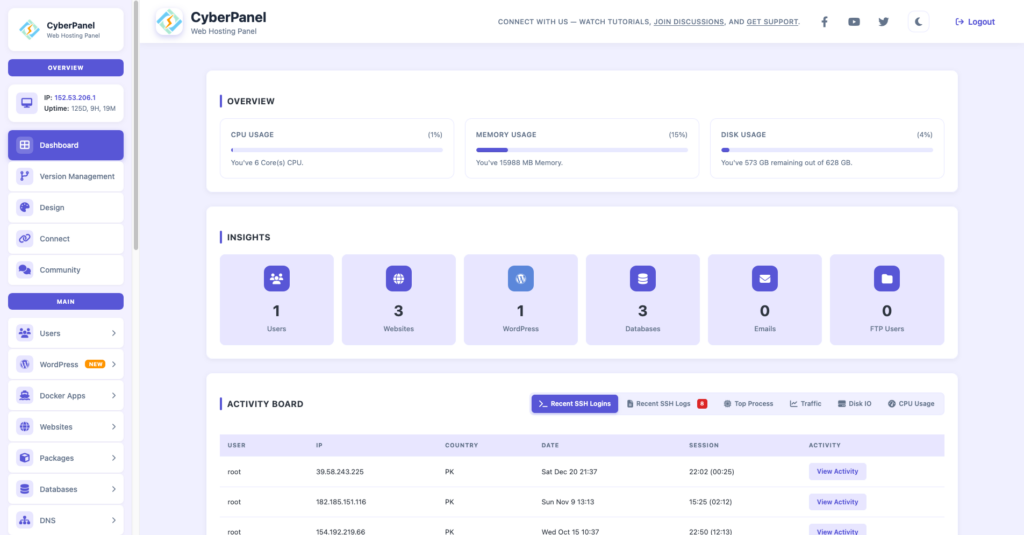
CyberPanel also has a dedicated guide covering server log management, including monitoring, log rotation, and log backup practices.
For security-related events, logs can be especially useful when investigating suspicious activity. CyberPanel’s Linux hardening guide also discusses monitoring and logging as part of broader server security.
Log Rotation Best Practices
Follow these practices when configuring linux rotate logs rules.
Use a Dedicated Configuration File
Place custom rules in:
/etc/logrotate.d/This keeps application-specific settings separate from the main configuration.
Test Before Forcing Rotation
Always use:
sudo logrotate -d /etc/logrotate.confbefore:
sudo logrotate -f /etc/logrotate.confCompress Older Logs
Use:
compresswhen historical logs do not need to remain uncompressed.
Keep a Reasonable Retention Period
Do not retain unlimited logs without considering storage capacity.
Avoid Blindly Using copytruncate
If the application supports a proper reload or reopen operation, that approach may be preferable.
Monitor Disk Usage
Use:
df -hregularly or through server monitoring.
Protect Sensitive Logs
Logs can contain IP addresses, usernames, URLs, authentication information, and other sensitive operational data.
Restrict access to logs and make sure your retention and backup policies match your security requirements.
Keep Security and Log Management Separate
Log rotation does not secure a server by itself.
A firewall controls network access, while log rotation manages stored log files. If you are hardening a Linux server, review your firewall configuration separately. CyberPanel’s CSF firewall and ModSecurity guide covers network and web application security layers.
Linux Log Rotation Quick Reference
| Task | Command |
|---|---|
| Check logrotate version | logrotate --version |
| Test configuration | sudo logrotate -d /etc/logrotate.conf |
| Verbose test | sudo logrotate -dv /etc/logrotate.conf |
| Run normal rotation | sudo logrotate /etc/logrotate.conf |
| Force rotation | sudo logrotate -f /etc/logrotate.conf |
| View configurations | ls -lah /etc/logrotate.d/ |
| Check disk space | df -h |
| Check inode usage | df -i |
| Check systemd timer | systemctl status logrotate.timer |
| Inspect rotated logs | ls -lah /var/log/ |
Frequently Asked Questions About Rotating Logs in Linux
What happens if a log file becomes too large before rotation?
If a log grows faster than its rotation schedule, it can consume significant disk space before the next scheduled rotation.
A size-based rule can help:
size 100M
Test the complete configuration before deploying it.
Can logrotate compress old logs?
Yes. Add:
compress
to the relevant configuration.
Older rotated logs can then be stored in compressed formats such as .gz.
What is Linux logrotate?
logrotate is a Linux utility that automates the rotation, compression, retention, and removal of log files. It can manage logs based on time or file size.
Final Thoughts
Knowing how to rotate logs in Linux is an important part of server administration. logrotate provides a structured way to control log growth, retain useful historical data, compress older files, and prevent unnecessary storage consumption.
Start by understanding the existing configuration in /etc/logrotate.conf and /etc/logrotate.d/. Then create application-specific rules when needed, test them with debug mode, and monitor the resulting files.
Most importantly, do not treat log rotation as a simple delete operation. A good rotation policy balances storage, troubleshooting, security, and retention.
If you manage Linux servers regularly, make log rotation part of your routine server maintenance instead of waiting until a filesystem reaches 100% usage.