
On this page
Do you still ignore Codex Linux? Coding these days has moved far beyond simply typing commands into the terminal. With the advent of modern development and the inclusion of AI, the days of searching forums and documentation to solve simple problems or debug code are now gone. AI code assistants can make your life as a developer much easier and are even helping you generate entire functions, explain code, debug code, and automate repetitive processes.
And if you are working on Linux, you have access to all of these features through OpenAI Codex.
Whether you are building web applications, managing a server, or even trying to get into coding, you can save time, improve your code quality, and get work done much faster with Codex. There is no reason to be jumping around documentation, searching forums, and online resources to get your code the way it should be, or to solve simple errors. You have Codex right in your IDE! This is why people are looking for an easy solution and not necessarily to set up the environment to be a complete and full-fledged assistant.
We’ll dive into what Codex is, how to set it up to run in your Linux environment, and how it fits in your modern development process.
What is Codex?
OpenAI’s Codex is an AI-based coding tool that assists programmers by translating natural language into code.
It works by using a language model that has been trained on a massive dataset of both natural and computer code in various programming languages. This tool can help developers write, understand, and even debug their programs in a much faster and more efficient manner.
Why Linux Developers Use Codex
Linux has always been a favorite platform for programmers. It offers flexibility, powerful command-line tools, and excellent support for development frameworks.
Adding Codex to your Linux environment makes everyday tasks even easier.
For example, instead of searching for the correct Bash command, you can simply ask Codex:
“How do I find files larger than 500 MB?”
Or if you’re learning Python, you might ask:
“Write a Python script that reads a CSV file and removes duplicate rows.”
Instead of spending several minutes researching, Codex provides an answer within seconds.
This makes it especially useful for:
- Software developers
- DevOps engineers
- System administrators
- Students
- Web developers
- Linux enthusiasts
System Requirements
| Requirement | Details |
|---|---|
| Operating System | Ubuntu, Debian, Fedora, Arch Linux, or other modern Linux distributions |
| Node.js | Latest LTS version recommended |
| npm | Installed with Node.js |
| OpenAI Account | Required |
| Internet Connection | Required for AI responses |
Codex Install Linux
Installing Codex for Linux only takes a few minutes if your system already has Node.js installed. Let’s install Codex Linux:
Step 1: Update Your System
Start by updating your package lists.
sudo apt update && sudo apt upgradeIf you’re using Fedora or Arch Linux, use the package manager that matches your distribution.
Step 2: Install Node.js
Check whether Node.js is already installed.
node -vIf the command returns a version number, you’re ready for the next step.
Otherwise, install the latest LTS release of Node.js from your distribution’s repositories or the official Node.js source.
Step 3: Install Codex
Once Node.js and npm are available, install the Codex CLI globally.
npm install -g @openai/codexThe installation usually finishes within a minute, depending on your internet connection.
Step 4: Verify the Installation
After installation, confirm that Codex is available.
codex --versionIf the version number appears, the installation was successful.
Step 5: Authenticate Your Account
Before using Codex, you’ll need to authenticate with your OpenAI account.
Follow the prompts shown in your terminal and complete the sign-in process.
Once authentication is complete, Codex is ready to use.
Basic Codex Commands
Here are a few simple examples that demonstrate how Codex works.
Generate a Bash command.
codexThen ask:
Show me the command to compress a folder into a ZIP archive.
Need help understanding code?
Ask:
Explain this Python function line by line.
Looking for SQL help?
Ask:
Write an SQL query that lists customers who placed more than five orders this month.
The responses are conversational, making them easier to understand than many technical manuals.
Can I Get a Codex App Linux?
A question that seems to come up a lot is: can I get a Codex app for Linux? So far, this doesn’t seem to be available, nor does it really seem to fit with how Codex was intended to be used.
The way the app is set up at present, it’s meant to be used at the command-line interface, right in your own workflow.
By using a command-line tool for Codex, you get access to AI features without leaving your workflow where you already write code and run commands.
Best Ways to Use Codex Linux
Installation is only the first part of using Codex. It’s about using it as an integral part of your workflow. Whether you write code, fix bugs, or learn new programming languages, using it effectively could boost productivity without stifling your thought process. Read on for several handy uses of Codex Linux.
Write Boilerplate Code
Beginning a project from scratch means you often write standard setup code again and again.
Codex can generate initial structure:
You could use it to create a basic Python web server or an API from the ground up. If you need a backup script or a Dockerfile, or even a GitHub Action workflow, Codex is your tool. You are still checking the output. But you are just saving time.
Understand Existing Code
Starting an old project can be painful. Thousands of lines and functions you have never seen before can slow you down significantly.
You don’t need to browse through countless lines to understand an entire file.
Just pass the code to Codex. It will summarize an entire file or give an explanation of a given function, which could help a ton if you have joined an ongoing project.
Fixing errors
Code errors are normal in development. There isn’t anyone who doesn’t make one. The usual pattern is Copy Error → Paste on search engine. You could just pass the error into Codex.
It could identify the source of the problem, and possibly offer the best way to fix it.
Learning through experience
Codex is also a useful learning companion.
You can ask questions like:
- What does this Linux command do?
- Explain this regular expression.
- Why is this SQL query slow?
- Show me a better way to write this function.
The answers often include explanations instead of just code, making it easier to improve your skills over time.
Can You Use Codex with VS Code?
Yes, in fact, many developers work with Codex integrated in Visual Studio Code as it makes for a really nice addition to the development experience.
A popular workflow consists of the following:
- Write your code in VS Code
- Open up a Linux Terminal
- Then invoke Codex to write code, understand what error is happening, improve code, etc.
- Run your tests and refine the output right in VS Code
This way you don’t need to flip between browser windows or search StackOverflow for answers.
Some Installation issues
Almost every installation goes like clockwork, but sometimes you run into issues with some of the following common ones.
Node.js Is Missing
If you see an error saying that node is not found, install the latest LTS version of Node.js before installing Codex.
npm Is Not Available
Some Linux installations do not include npm by default. Installing Node.js usually installs npm as well.
Authentication Problems
If Codex cannot connect to your account, check your internet connection and confirm that you are signing in with the correct OpenAI account.
Permission Errors
If you receive permission-related errors during installation, avoid using random fixes from online forums. Review your npm configuration or follow the official installation guidance to keep your system secure.
How CyberPanel Fits In?
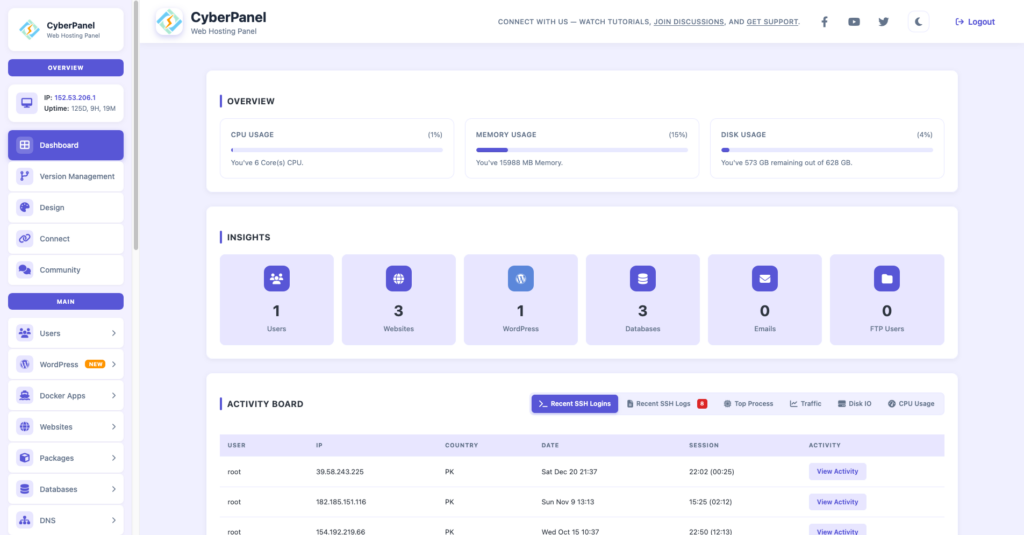
If you’re doing any kind of development or maintenance on Linux-based sites, then I think you’ll find Codex and CyberPanel to be a good pair. CyberPanel is a free and open-source web hosting control panel.
Imagine that you are about to deploy some PHP app on a VPS. You can use Codex to write a script for it, examine configuration files for any problems, and figure out how to execute all the necessary commands for setup.
And when you actually need to get to work, CyberPanel can help you deploy the site by streamlining the process: instead of fiddling around with dozens of configuration files, you can use the intuitive interface to
- set up sites
- set up domains
- set up SSL
- install WordPress
- set up databases
- backup the system regularly
- monitor the server’s performance
This way you spend less time doing boring operations and more time working on your apps. Isn’t it worth it? It’s a match made in heaven for developers.
Closing Thoughts!
OpenAI Codex brings coding help from AI straight to your Linux system to get your code written and help you with understanding projects and fixing issues quickly. The setup process is simple, and once that’s done, Codex is really quickly added to your workflow as an integral tool for getting work done on an everyday basis. Whether you are taking your first steps learning to program or already in a production environment maintaining existing apps, Codex can free up your time by taking away some of the repetitive chores, so you can get focused on fixing the things that need real thought to solve.
If your workflow involves the hosting of websites or managing Linux servers, coupling Codex with CyberPanel offers a powerful and productive working environment.
Codex Linux helps you to build, to troubleshoot, and, in a more generally productive sense, helps you develop better, faster code, while CyberPanel gives you a user-friendly graphical way to manage and deploy web applications, manage domains, and manage your web servers. Using these together helps you go from code to deployed in the quickest, most hassle-free, and efficient way.
FAQs
Does Codex replace developers?
No. Codex is a productivity tool, not a replacement for developers. It helps automate repetitive tasks and provides suggestions, but human review and decision-making are still essential.
Is there a Codex desktop app for Linux?
Codex is mainly designed as a command-line tool. At the time of writing, developers primarily interact with it through the terminal rather than a dedicated Linux desktop application.
Which Linux distributions support Codex?
Most modern distributions work well, including Ubuntu, Debian, Fedora, Arch Linux, and Linux Mint, provided the required dependencies are installed.