On this page
Every growing company faces two mutually exclusive challenges right now. Firstly, it wants to launch its software products faster. Secondly, it wants to ship high-quality data faster than ever before. In other words, companies are looking for both DataOps and DevOps practices.
Despite the similarity of their names, the two notions may have nothing in common. They may also intersect, depending on the teams and the practices they use. In this article, you will understand what DataOps and DevOps are, how they relate to each other, and what a web hosting control panel can do for you to get a good ROI.
What Is DevOps?
Using the DevOps approach, you can strengthen the collaboration between two groups: software development and IT operations. Moreover, you can unify the two processes so that developers and operations personnel work in parallel to create the end product.
This working method is focused on rapidly developing and testing the software and delivering it to the end-users. In parallel, operations teams need to constantly troubleshoot and ensure everything works well. Thus, the DevOps approach should include a set of good practices, such as:
• Continuous integration and continuous delivery/development (CI/CD)
• Automated testing
• Infrastructure as code
• Constant evaluation of the production software
• Quick feedback mechanism
Using DevOps, a company can release new functions and updates dozens of times more often than previously. Moreover, the frequency is expected to increase due to the automation of many processes without spending much time. Thus, instead of making updates once or twice a year, the company can do this dozens of times a day.
What Is DataOps?
DataOps takes the same approach but applies it to data – specifically, the life cycle of a data asset, from appearance to its finished form, a report or dashboard, ready for consumption.
For example, data from sales, marketing, and customer service systems is collected in a data warehouse. If there is no proper DataOps, this data can be in multiple places, in different formats, and contain errors. DataOps deals with the processes of data pipelines in the same way that DevOps deals with code pipelines.
The key aspects of DataOps include:
• Automated testing and validation of data pipelines
• Version control of data pipelines
• Quality monitoring and management
• Collaboration and communication between data engineers, analysts, and stakeholders
• Fast delivery of high-quality data
In other words, while DevOps ships code, DataOps ships data. Moreover, they both emphasize the quality of delivered elements – be it code or data.
DevOps And DataOps: Similarities and Differences
To see the differences between DevOps and DataOps, take a closer look at the table below.
| Aspect | DevOps | DataOps |
| Main focus | Software code and applications | Data pipelines and data quality |
| Main teams involved | Developers and IT operations | Data engineers, analysts, scientists |
| Main goal | Faster, safer software releases | Faster, trusted data delivery |
| Key practice | CI/CD pipelines | Data pipeline automation and testing |
| Common tools | Jenkins, Docker, Kubernetes, GitHub Actions | Airflow, dbt, Talend, Great Expectations |
| Output | Working software features | Clean, ready-to-use data |
| Failure risk | Buggy app or downtime | Wrong numbers or bad business decisions |
This comparison table shows why DevOps and DataOps are worth mentioning separately. However, you can see that the two methodologies are rather similar and address interrelated challenges.
DataOps and DevOps Similarities
Although DataOps and DevOps tackle different problems and seem to have nothing in common, they are united by several key concepts and practices. First, both methodologies rely on automation to ensure the best results. Second, they implement continuous feedback to regularly check the quality of code and data. Third, they introduce the concept of collaboration, which removes the borders between the teams that traditionally work in isolation.
Furthermore, DataOps and DevOps practices are united by version control, continuous improvement, and the importance of speed. All the methodologies aim to provide the fastest delivery of high-quality products. As you can see, DevOps and DataOps share many similarities.
DataOps and DevOps Differences
Many companies practice both DataOps and DevOps to optimize their operations. These methodologies are often used together because analysts and developers need to collaborate constantly. For instance, analysts provide data to developers to build data-driven products. At the same time, DevOps pipelines may affect data flows if the code changes the data collection logic.
Key Differences That Actually Matter
Speed and automation sound similar on paper, but the daily work looks different. Here is a deeper table comparing specific differences that teams run into.
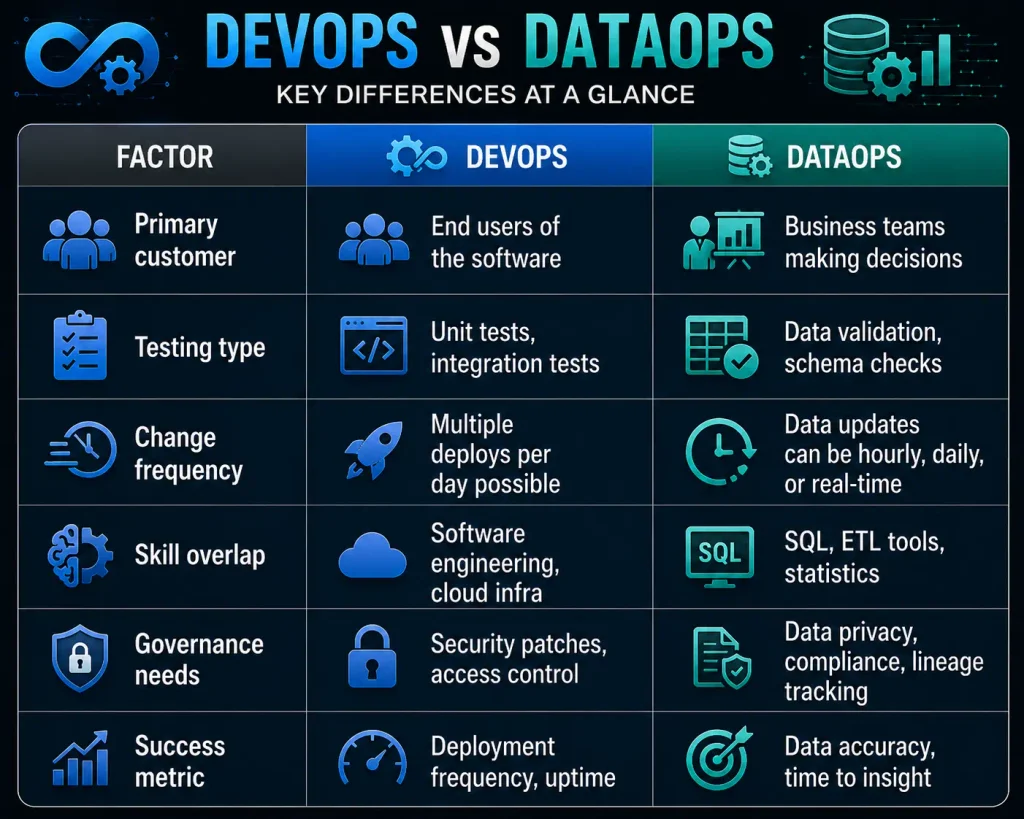
Notice the difference in the areas of governance. While for DevOps, the main questions are about who has access to push code, for DataOps, the focus is on who has access to sensitive data and whether such data meets privacy standards (such as GDPR).
Why Companies Should Practice DevOps and DataOps
A company that practices only DataOps or only DevOps will not be successful in the long run. DataOps pipelines ensure that companies get high-quality data, but they cannot help optimize the application development process. At the same time, DevOps practices make it possible to build an excellent product, but they cannot improve the quality of the data sets
However, companies that introduce both DataOps and DevOps practices can reap the rewards of a powerful combination. Developers will release new versions of the product frequently, and data engineers will make sure that the information is correct and suitable for analysis.
This approach is sometimes referred to as DevDataOps, and companies practice it to unify their data and software delivery pipelines. The DevDataOps approach is crucial for many successful businesses that want to stay ahead of their competitors. Small companies tend to adopt DevOps practices first and move to DataOps as their product and business grow.
The Role of CyberPanel In DevOps and DataOps
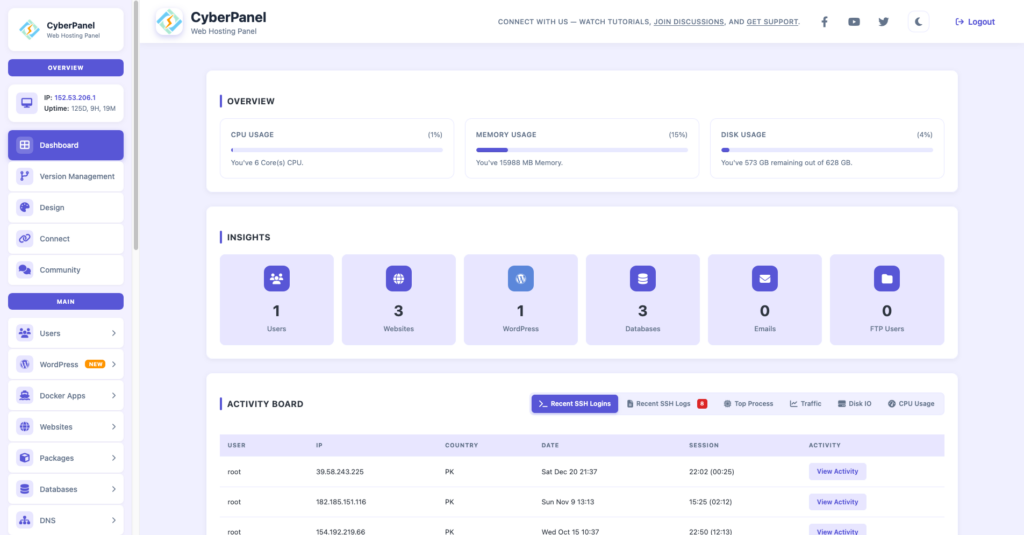
Companies that want to practice DevOps and DataOps usually have one major infrastructure-related decision to make. They should invest in a reliable web hosting control panel that will allow their engineers to create and manage the virtual machines that run the code and store the data sets.
CyberPanel is a web hosting control panel. It helps reduce infrastructure costs by providing all the necessary tools in one place. Secondly, engineers no longer need to learn how to use different command-line interfaces for their virtual machines. Instead, they can manage them with a few clicks of a mouse.
The DevOps and DataOps pipelines are the backbone of many successful companies. Therefore, it is logical to invest in a reliable infrastructure that will serve them in the best possible way.
Common Tools for DevOps and DataOps Practices
When it comes to DevOps and DataOps practices, there are dozens of tools to consider. Choosing the best ones for your business.
DevOps Tools
- Jenkins and GitHub Actions for CI/CD
- Docker and Kubernetes for containers
- Terraform for infrastructure as code
- Prometheus and Grafana for monitoring
DataOps Tools
- Apache Airflow for pipeline scheduling
- dbt for data transformation
- Great Expectations for data testing
- Snowflake or BigQuery for data warehousing
As you can see, there are plenty of tools for building and monitoring DevOps and DataOps pipelines. Some of them are used by both sets of engineers because they are universal. You will also notice that certain tools are united by the same objectives, such as monitoring.
Challenges of Adopting DevOps and DataOps Practices
Adopting DevOps and DataOps practices is a challenging process that requires businesses to overcome a number of significant obstacles. First of all, it may be difficult to get people on board. Data engineering is not as popular as application development, so data engineers may be reluctant to learn new automation techniques.
Moreover, DevOps and DataOps pipelines require companies to invest in new infrastructure, which may be expensive for small businesses. Finally, different teams may struggle to understand each other, especially when a problem occurs in one pipeline and affects the performance of the other.
The best way to address these challenges is to educate the teams and begin with a few easy tasks. For instance, you can use automation to deploy code and ship it right away. Or you can implement data validation processes to ensure that your data sets are error-free.
DevOps and DataOps Practices Outlook for 2026
DevOps and DataOps methodologies will continue to evolve and become even more sophisticated in 2026. Artificial intelligence will play a more important role in the automated testing and data validation processes. It will be able to spot bugs and data errors faster and replace some tedious manual tasks.
In 2026, companies will increasingly rely on platform engineering to build their own systems for DevOps and DataOps pipelines. They will also embrace no-code automation tools to achieve a higher degree of collaboration between data engineers, data scientists, developers, and operations engineers.
A web hosting control panel will be even more important because it will allow you to manage your virtual machines without writing any code. Companies will rely on such tools more and more to host their applications and databases to ensure that there is enough storage and processing power for their needs.
Frequently Asked Questions
Can one person handle both DevOps and DataOps in a small company?
Yes, especially in startups. One engineer often wears both hats early on. As the company grows, most teams split these roles because the skill sets and daily priorities become too different to manage well by one person.
Does DataOps require coding skills like DevOps does?
Not always at the same depth. DataOps professionals need strong SQL and some scripting knowledge, but they do not always need the deep software engineering background that DevOps requires. However, the overlap is growing as more DataOps tools use Python.
How does DataOps affect machine learning projects?
Machine learning models depend entirely on clean, well-structured data. DataOps supports ML teams by making sure training data stays accurate and updated, which directly affects how well a model performs in production.
Is DataOps only useful for large enterprises?
No. Even small businesses with a handful of spreadsheets and one database can benefit from basic DataOps habits, like version-controlled data pipelines and automated checks for missing or duplicate data.
What happens if a company skips DataOps entirely?
Teams often end up with conflicting numbers across departments. Marketing might report different revenue figures than finance, simply because no one validated the data pipeline. This slows down decisions and damages trust in reports.
Final Thoughts
DataOps and DevOps are not at odds with one another. They are two sides of the same coin, aimed at achieving the same goal: fast, reliable results without sacrificing quality. DevOps is concerned with keeping your software running smoothly. In turn, DataOps keeps the numbers running behind that software up to standard.
Companies that invest in both and have the infrastructure to support them (like a user-friendly web hosting control panel, for example) will be quicker to adapt and act on their findings than those who rely on outdated systems of control.