
On this page
Jenkins is powerful on its own. However, without plugins, it is merely a basic automation server. The true power of Jenkins lies in its ecosystem of extensions. If you’ve ever googled Jenkins plugins, you are aware of the one thing. Customizing Jenkins is when it is truly powerful. Plugins help Jenkins to be a full-fledged CI/CD platform, from accessing Git repositories to running Kubernetes workloads.
In this article, you will find out what Jenkins plugins are, which ones are the most important, how they work, and how to manage them safely in production environments. Jenkins relies on plugins to enhance its capabilities.
What are Jenkins Plugins?
Jenkins plugins are basically software components that add new features to Jenkins. Without plugins, Jenkins is limited to running basic builds only. With plugins, it can:
- link with Git repositories
- deploy to various cloud platforms
- use Docker integration
- connect with Kubernetes clusters
- perform secure credential management
- send notifications
Plugins give Jenkins the capability to be both flexible and enterprise-ready.
Why Are Jenkins Plugins So Important?
Jenkins comes with the support of over a thousand plugins. This implies it can be molded to fit nearly any work process. This is the rationale behind the significance of plugins:
- They incorporate external tools
- They automate sophisticated pipelines
- They link CI with CD
- They enhance scalability
- They support modern
DevOps tools, on the other hand, applying an excessive number of plugins haphazardly can lead to performance and security problems. Always install only what you need.
Jenkins Git Plugin in Detail
A very significant plugin, among others, is the Jenkins Git plugin. With the help of this plugin, Jenkins can:
- Pull source code from Git repositories
- Trigger builds upon change detection
- Handle branches and tags
- Support GitHub
- GitLab
- Bitbucket
Jenkins without this plugin is hardly capable of integrating with Git, based workflows. Most CI pipelines are reliant on this plugin simply because version control is the point from which automation takes off.
Most Popular Jenkins Plugins
| Plugin | Purpose |
|---|---|
| Git Plugin | Connect Jenkins to Git repositories |
| Kubernetes Plugin | Run dynamic build agents in clusters |
| Docker Plugin | Build and manage containers |
| Pipeline Plugin | Create scripted CI/CD pipelines |
| Credentials Plugin | Secure secret management |
Jenkins Kubernetes Plugin Explained
The Jenkins Kubernetes plugin extension is an interface for the two that enables Jenkins to execute its builds by launching pods on a Kubernetes cluster.
Jenkins running on a single static server can only handle a few builds; however, it can dynamically create build agents with the help of the Jenkins Kubernetes plugin.
Besides auto-scaling, spinning up containers on demand, and creating dynamic build agents, scaling can also be made automatic with the Jenkins Kubernetes plugin. Hence, the overall server resource utilization is better, and fewer idle resources are wasted due to the timely release of resources to the server pool.
This can also be a good setup for cloud-native environments.
By adding Kubernetes capabilities, Jenkins is not only very scalable but also highly energy-efficient.
How to Install a Jenkins Plugin?
The following are the steps of how you can install a plugin Jenkins:
- Open the Jenkins dashboard
- Navigate to Manage Jenkins
- Click on Manage Plugins
- Enter your plugin in the search box
- Install the plugin and reboot if it asks you to do so
Before you install anything, make sure that the plugin you are installing is compatible.
Best Practices for Managing Jenkins Plugins
- Only install the plugins that you will need and use.
- Regularly update your plugins to the latest versions.
- Keep an eye on any dependencies your plugins might have.
- Uninstall any plugins that you no longer use.
- Use a staging environment to test plugin updates.
If you neglect the control over the plugin versions in use, it is more likely that the plugins will be incompatible, leading to build failures.
Common Plugin Issues
Plugin Conflicts
Some plugins require an exact version of the Jenkins core or other plugins in order to work.
Performance Problems
Packing too many active plugins can cause a sluggish Jenkins startup.
Security Vulnerabilities
Old plugins can be a potential source of security risks.
Doing regular maintenance can ward off these problems.
How CyberPanel Can Assist in Jenkins Deployments
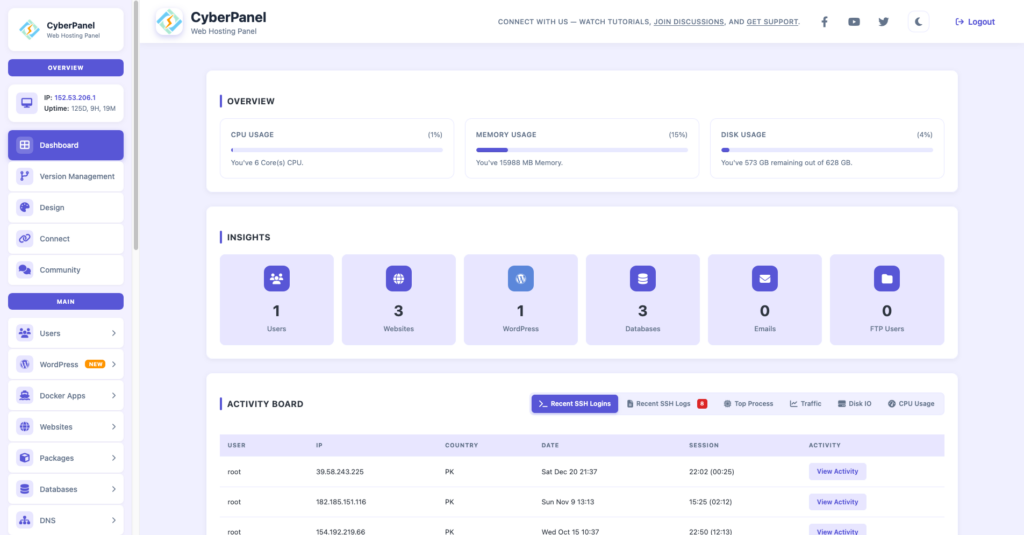
CyberPanel is your free and open-source web hosting control panel. If you decide to run Jenkins on a VPS or a dedicated server, CyberPanel can be your assistant for server operations.
CyberPanel empowers you to:
- Set up a reverse proxy with SSL
- Lock down the Jenkins dashboard with HTTPS
- Manage firewall settings
- Track server healthlink custom domains
Don’t expose Jenkins to the internet directly; instead, you can safely tunnel it via CyberPanel.
Security is the utmost concern for CI/CD servers.
When Should You Use a Kubernetes Plugin?
The Jenkins Kubernetes plugin is the right tool when:
- Builds need to be done in containers isolated from each other
- There are different sizes of workloads
- You want auto-scaling
- Running cloud-native infrastructure
If your projects are small, local, static agents may suffice. However, if you are dealing with production, grade systems, Kubernetes integration becomes a must.
Security Tips for Jenkins Plugins
- Turn off anonymous access
- Take advantage of role-based access control
- Do not share credentials
- Go for HTTPS
- Keep an eye on audit logs
Since Jenkins is frequently used to communicate with code repositories and deployment systems, the security of plugins has a direct influence on the security of your infrastructure.
Conclusion
Jenkins plugins play a role in making Jenkins not only an automation server but also a full-fledged CI/CD engine. The Jenkins Git plugin takes care of the source code connection. The Jenkins Kubernetes plugin supports the power of scalable builds. The right use of jenkins plugin can make your pipelines not only stable but also safe.
By combining it with secure hosting and SSL setup via CyberPanel, Jenkins can be a trustworthy base for contemporary DevOps workflows.
Look into your Jenkins environment now. Take out the redundant plugins, update the vital ones such as Git and Kubernetes, secure your access with HTTPS through CyberPanel, and make your CI/CD pipeline stable and scalable.
People Also Ask
How many Jenkins plugins are safe to install?
There is no fixed number. The best practice is to install only required plugins and regularly review dependencies to avoid conflicts.
Does Jenkins automatically update plugins?
Jenkins can notify you about updates, but manual review before upgrading is recommended in production environments.
Can the Jenkins Git Plugin support multiple repositories?
Yes. It can manage multiple repositories and branches within different jobs or pipelines.