
On this page
Setting up a private cloud sounds powerful, but deploying an OpenStack-based platform can be difficult. The OpenStack platform provides full control of compute, storage, and networking, but manual setup can be complex, time-consuming, and error-prone.
This is why using OpenStack Ansible is critical.
By automating OpenStack deployment using Ansible, you will be able to deploy OpenStack faster with very few mistakes and consistent configuration across all the nodes.
Another frequent question among individuals is whether to use Kolla Ansible or OpenStack Ansible, especially when it pertains to producing a production environment that will be deployed.
This guide will teach you what OpenStack Ansible is, as well as show you the best way to deploy OpenStack and help you choose the method of deployment that is best suited for you.
What is OpenStack Ansible?
OpenStack is an open-source cloud platform that allows you to build your very own Private/Public Cloud.
OpenStack Ansible allows for the ability to deploy and manage OpenStack Infrastructure with Ansible.
With OpenStack Ansible, you can:
- automate the deployment of your cloud services
- configure networking and storage
- manage your compute resources
- easily scale infrastrcutre
By using OpenStack Ansible, you will have a much faster and more reliable way to set up your cloud.
The Integration of Ansible and OpenStack
While using Ansible and OpenStack, Ansible automates the setup of OpenStack components. Here is the basic workflow:
- Developing Infrastructure using Playbooks
- Defining and Configuring Nodes (Controller, Compute, Storage)
- Installing OpenStack Services
- Automatically Applying Configuration
This is done to ensure that all servers have a consistent level of deployment.
Ansible OpenStack Deployment Overview
| Component | Purpose |
|---|---|
| Nova | Compute service |
| Neutron | Networking |
| Cinder | Block storage |
| Keystone | Identity service |
| Glance | Image management |
Ansible Deploy OpenStack Example
- name: Install OpenStack packages
  hosts: controllers

  tasks:
    - name: Install required packages
      apt:
        name: openstack
state: presentResult:
- OpenStack packages installed
- services configured automatically
- infrastructure ready for use
Kolla Ansible vs OpenStack Ansible
| Feature | Kolla Ansible | OpenStack Ansible |
|---|---|---|
| Deployment Type | Container-based | Bare metal / VM |
| Complexity | Lower | Higher |
| Flexibility | Moderate | High |
| Maintenance | Easier | Advanced control |
Key Difference
- Kolla Ansible uses containers (Docker-based deployment)
- OpenStack Ansible deploys services directly on servers
When to Choose
- Use Kolla Ansible for simplicity and faster setup
- Use OpenStack Ansible for full control and customization
Advantages of OpenStack Ansible
The use of OpenStack Ansible provides major advantages.
Automation
It removes the need for manual configuration.
Consistency
Each node has the same configuration.
Scalability
Infrastructure can be added easily.
Reliability
Human error is greatly reduced.
The above make OpenStack Ansible very suitable in production environments.
Considerations and Challenges
However there are challenges.
Complexity
You need to be able to understand both OpenStack and Ansible.
Resource Requirements
You will need multiple servers for full deployment.
Learning Curve
Advanced configurations take time to master.
By properly planning and testing, the above can be addressed.
OpenStack Environments and CyberPanel
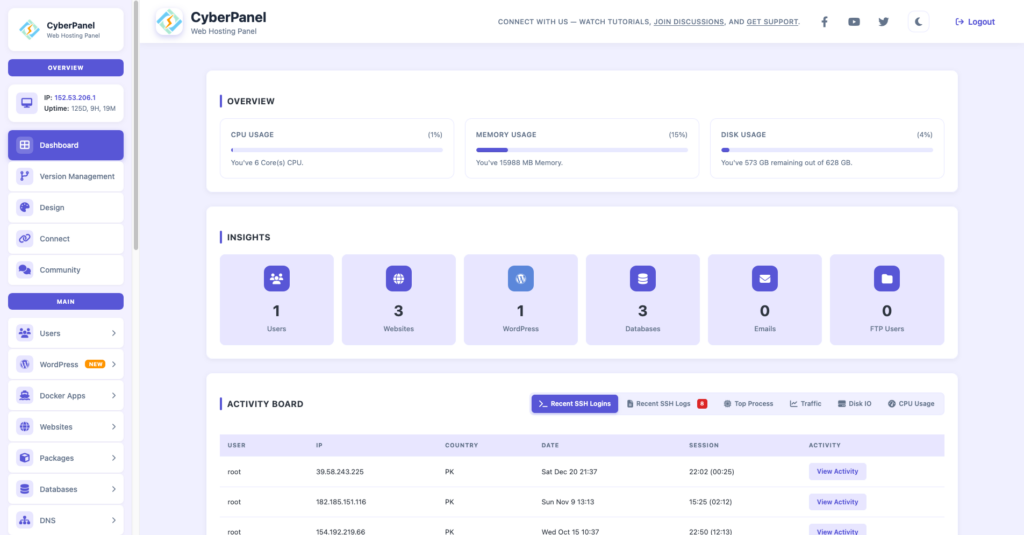
CyberPanel is a free and open-source web hosting control panel. The CyberPanel application can be used in conjunction with the OpenStack Infrastructure. If you are hosting an application, you can gain benefits from CyberPanel against your OpenStack Infrastructure.
CyberPanel provides the following capabilities that can help with:
- Website Deployment
- Domain Management
- SSL Configuration
- Monitoring of Server Performance
The OpenStack provides the infrastructure, and CyberPanel helps manage the applications.
Conclusion
The challenges of deploying a cloud platform can be complex and time consuming. However, OpenStack Ansible can simplify this process. By leveraging both Ansible and OpenStack, organizations can automate their deployments, create uniformity across their OpenStack deployments, as well as to easily scale their infrastructure.
Start using Ansible today to deploy your OpenStack faster, reduce mistakes when deploying with manual intervention, and create a scalable private cloud environment.
FAQs
Can OpenStack Ansible be used for production environment?
Yes, OpenStack Ansible is widely used to automate large cloud deployments in production.
Do I need Docker for OpenStack Ansible environment?
No. Docker is used in Kolla Ansible but not in OpenStack Ansible.
Does Ansible support upgrading OpenStack versions?
Yes, you can use Ansible playbooks to automate upgrades with proper configuration.