On this page
Not all Linux distributions aim to get attention through eye-catching features and fancy packaging. Many just want to do a couple of things very well: provide a quick, reliable, and stable experience without consuming your computer’s hardware resources in return. One such distribution is Sparky Linux. Debian-derived Sparky is a good lightweight OS choice for users wanting to minimize the strain on their system. It features a smooth user interface and the hardware support needed to run on either modern or somewhat dated hardware.
Sparky doesn’t burden you with lots of extra stuff or complex configuration wizards. Rather, it hands you an out-of-the-box system that is ready for productivity work, self-improvement, creation of software products, or just regular use.
Russian and international users love Sparky Linux’s ability to adapt and change easily. No matter if you install it on an old machine that can’t run a modern OS very smoothly or build a fresh workstation for your programming needs, in such scenarios, the appropriate version of Sparky that matches your requirements will be available. Sparky Linux 7, version from Debian 12, brings users brand new software packages, a broader choice of supported hardware (hardware support), and an enhanced level of reliability.
This article is aimed mainly at those looking for information on Sparky Linux, like what sets it apart, how to install it, support for Sparky Linux 32-bit, and a few other topics about its suitability as a beginner-friendly or even an expert-level OS choice. In particular, the focus of this tutorial will be on explaining the features of Sparky Linux, the process of installing it on your computer, the availability of the 32-bit version of Sparky Linux, and its role as a platform suitable for novice as well as experienced Linux users.
What Is Sparky Linux?
One Linux distribution, Sparky Linux, aims to deliver a light operating system that still offers a very good user experience and functionality.
To distinguish, for example, that a standard Debian installation may still need many setups and configurations before being functional, Sparky Linux comes already with most of the useful tools pre-packaged and configured. Sparky Linux features a GUI installer, several desktop environments, multimedia support, and various system utilities that guide you through the initial setup of the computer instead of spending hours just to do the configuration manually.
The project started years ago, and because of its nice balance between performance and simplicity, a loyal community followed it up.
Sparky Linux could be the right choice for you. If you switch from a Windows environment, or you are a beginner getting into Linux, or you simply already have a Linux distribution that you prefer, and you look for something lighter than it.
Why Choose Sparky Linux?
Although there are many Linux distributions now, Sparky Linux is still a top choice for a lot of users.
It’s simply because of two things. It has the reliability of Debian while at the same time, it simplifies the interface for newbies.
Highlights:
- Fast startup and shutdown times
- Low RAM and CPU usage
- Easy installation process
- Access to Debian’s extensive software repositories
- Multiple desktop environments
- Stable and semi-rolling release options
- Excellent performance on older computers
Besides a lot of pre-installed apps, Sparky Linux does not load your system with apps that you may never use. It just comes with what is strictly necessary and allows you to add the rest later or to delete what is no longer needed.
In short, it results in a cleaner and more efficient OS.
What’s New in Sparky Linux 7?
Sparky 7 is based on the new Debian 12 (Bookworm) distribution, and it brings a lot of security and stability enhancements as well as compatibility features that were missing in the older versions.
Highlights:
Some notable improvements include:
- Updated Linux kernel
- Newer desktop environment packages
- Better hardware detection
- Improved installer performance
- Updated security patches
- Refreshed software repositories
While the changes may not seem dramatic at first glance, they make everyday computing smoother and help ensure long-term stability.
Does Sparky still run 32-bit OSes?
Yes. Yet, if you choose a particular version, that choice will probably determine the amount of software support available.
If what you want to do is just bring back into use an old desktop or your laptop, then the 32-bit version of Sparky Linux is still a very attractive choice. Lightweight versions like MinimalGUI or LXQt are, in particular, created to run well even on older machines with limited RAM or weak-performance processors.
On the upside, if your machine can be upgraded to at least a 64- bit processor, the 64-bit Sparky will still probably suit you better. For one thing, you’re going to get better performance and higher security, and at the same time you’ll be able to run newer software without issues.
How to Install Sparky Linux
Installing Sparky Linux is straightforward, even if you’ve never installed Linux before.
1. Download the ISO
Visit the official Sparky Linux website and download the edition that best matches your needs.
2. Create a Bootable USB
Use a tool like Rufus, Ventoy, or Balena Etcher to write the ISO file to a USB flash drive.
3. Boot from the USB Drive
Restart your computer and choose the USB device from your BIOS or UEFI boot menu.
4. Launch the Installer
Once the live environment loads, open the installer from the desktop.
5. Configure Your Settings
Choose your language, keyboard layout, time zone, and preferred disk partitioning option.
If you’re new to Linux, the automatic partitioning option is usually the safest choice.
6. Create Your User Account
Enter your username, password, and computer name.
7. Complete the Installation
The installer copies the operating system files, installs the GRUB bootloader, and prepares your system for first boot.
After restarting your computer, you’ll be greeted by your new Sparky Linux desktop.
Sparky Linux vs Debian
| Feature | Sparky Linux | Debian |
|---|---|---|
| Installation | Beginner-friendly graphical installer | More manual setup |
| Desktop Experience | Ready to use | Minimal installation |
| Performance | Lightweight | Lightweight |
| Package Manager | APT | APT |
| Pre-installed Utilities | More tools included | Basic installation |
Using Sparky Linux with CyberPanel
Sparky Linux is also a solid workstation for managing servers and web applications besides just being a desktop OS that many developers use.
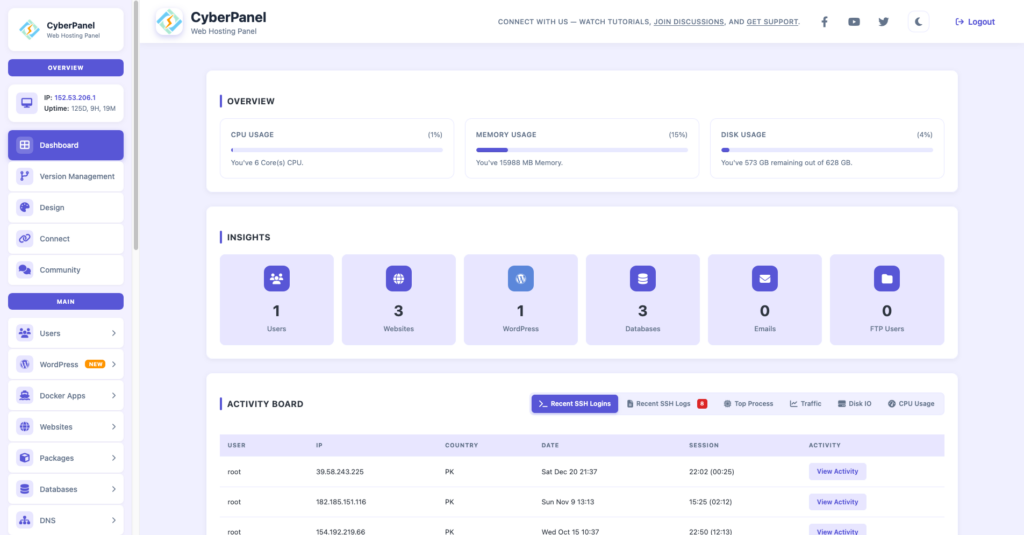
CyberPanel is a free and open-source web hosting control panel. With CyberPanel, managing virtual private servers or even dedicated servers running websites becomes a whole lot easier and hassle-free for you.
One of the biggest advantages of managing hosting tasks on a command-line interface is that you can easily get overwhelmed with the complexity and depth of the commands. However, CyberPanel UI allows users to do so many activities at the click of a mouse, such as site creation, WordPress deployment, database management, SSL certificate configuration, server resource monitoring, etc alongside handling backups.
The combination proves to be mainly advantageous to the developers. While the former enables them to work on a regular system, the developer can manage a Linux server remotely with CyperPanel so that he is more into coding and less on administrative server tasks.
Is Sparky Linux Worth Trying?
Sparky Linux is definitely one Linux flavor to add to the list if you’re after a distro that is small in size yet stable, easy on maintenance, and resource-demanding. It doesn’t try to replace Debian with its features; rather, Debian’s stability is the backbone while Sparky makes the user experience a breeze.
Besides that, be it bringing an old computer to life or establishing a dependable workstation, Sparky offers an overall performance that is very quick, efficient, and well-designed – a pleasant surprise for many who think lightweight OS equals an unpolished user experience.
Final Thoughts
Sparky Linux proves that a Linux distribution doesn’t need to be bloated to be powerful. It combines Debian’s rock-solid stability with a lightweight design, making it suitable for beginners, developers, and anyone who values speed and simplicity.
The improvements in Sparky Linux 7, continued support for older hardware, and straightforward installation process make it an excellent choice for everyday computing. And if your work involves hosting websites or managing Linux servers, pairing Sparky Linux with CyberPanel creates a productive environment where desktop performance and server management go hand in hand.
Whether you’re exploring Linux for the first time or looking for a dependable Debian-based distribution, Sparky Linux is well worth downloading and trying.
FAQs
Is Sparky Linux based on Debian?
Yes. Sparky Linux is built on Debian and uses the APT package manager, giving users access to Debian’s extensive software repositories.
Is Sparky Linux beginner-friendly?
Yes. The graphical installer, preconfigured desktop environments, and built-in tools make it accessible even for users who are new to Linux.
Can I install Linux Sparky on an old laptop?
Yes. One of Sparky Linux’s biggest strengths is its excellent performance on older hardware, especially when using lightweight desktop environments.