
On this page
Using Ansible by running it on the command line works, but as soon as you want to track it, it becomes difficult. There is no central dashboard, no straightforward way to keep track of runs, and the scheduling is not integrated. As teams grow, this issue keeps getting bigger. You become blind, start manually repeating the same tasks, and have problems with access control. That’s where Ansible Semaphore completely alters the workflow.
Ansible Semaphore is basically a simple web-based interface that you can use to manage and run your Ansible playbooks. Instead of relying on manual execution, you get structured automation with logs, scheduling, and team access. It is lightweight, easy to deploy, and does not require heavy infrastructure like enterprise tools.
Nowadays, with DevOps, it’s not just about doing something fast, but you should also have control and quality in the process. So, you should schedule your jobs properly, you should track the results, and automation should be integrated with the pipeline. When you use Semaphore Ansible, you will be organized and automated instead of being manual and poorly segregated. In terms of power and complexity, it is an ideal solution for small to mid-sized teams.
This guide will give you a lot of information, including the working of Ansible Semaphore, its comparison with AWX, your usage of the Ansible Semaphore API, and the alternatives. At the same time, you will also see that each part of this guide is determined by the real use, practical understanding, and you making a decision that you can implement in your environment.
What Is Ansible Semaphore?
Ansible Semaphore is a lightweight, open-source web interface. It allows you to run, schedule, and manage Ansible playbooks from a browser. It provides the following things:
- A graphical UI for Ansible
- Task scheduling
- Execution logs
- Role-based access control
w Use Semaphore Ansible Instead of CLI?
Employing Ansible CLI is sufficient for individual use, but it creates restrictions when working in a team environment.
Without Semaphore:
- Executing playbooks manually
- Absence of central logging
- Unavailability of scheduling
- Limited opportunities for team collaboration
With Semaphore:
- Execution through UI
- Setting up scheduled jobs
Main Features of Ansible Semaphore
| Feature | Description |
|---|---|
| Web UI | Run playbooks from browser |
| Scheduling | Automate recurring tasks |
| Access Control | Manage team permissions |
| Logs | Track execution history |
| Multi-project | Manage multiple environments |
How Does Ansible Semaphore Work internally?
| Step | Action |
|---|---|
| User action | Trigger task from UI |
| API call | Request sent internally |
| Execution | Ansible runs playbook |
| Output | Logs stored and displayed |
How to Run A Playbook Using Ansible Semaphore?
Here is a common workflow:
- First, you have to create a project
- Then, connect a Git repository
- After that, add an inventory
- Then, create a task
- Finally, run the playbook
Here is an example playbook:
- hosts: localhost
  tasks:
    - name: Test message
      debug:
msg: "Hello from Semaphore"Output:
Hello from SemaphoreWhat is Ansible Semaphore API & What Are The Ways To Use It?
The Ansible Semaphore API provides you with a way to manage Semaphore via programming. It is considered one of the most ignored yet very strong aspects.
The possibilities with an API:
- Run plays remotely
- Get logs after execution
- Connect with continuous integration/continuous deployment pipelines
An API call illustration
curl -H "Authorization: Bearer YOUR_TOKEN" \
http://localhost:3000/api/projectsReal Use Case
You can connect Semaphore with:
- GitHub Actions
- Jenkins
- Deployment scripts
This turns Semaphore into a fully automated system.
Ansible AWX vs Semaphore
| Feature | Semaphore | AWX |
|---|---|---|
| Setup | Simple | Complex |
| Resource usage | Low | High |
| UI | Basic | Advanced |
| Scalability | Limited | High |
| Best for | Small teams | Enterprise |
Decision Guide
Choose Semaphore if:
- You are short on resources
- You desire a fast installation
- You want basic automation
Go for AWX if:
- You control extensive infrastructure
- You need sophisticated role-based access control (RBAC)
- You want a package of enterprise features
When not to use Ansible Semaphore?
Actually Ansible Semaphore isn’t perfect for every use case.
In fact, you shouldn’t use it if:
- You need enterprise-grade orchestration
- You require complex workflow automation
- You manage large-scale distributed systems
Best Ansible Semaphore Alternatives
| Tool | Best Use Case |
|---|---|
| AWX | Enterprise automation |
| Jenkins | CI/CD pipelines |
| Rundeck | Job orchestration |
| CLI Ansible | Simple tasks |
Real-life Applications of Semaphore Ansible
- Scheduled server updates
- Automated deployments
- Configuration management
- Integrating CI/CD pipelines
These use cases demonstrate why Semaphore is an essential tool in the everyday life of a DevOps engineer.
What Role Does CyberPanel Play in This Workflow?
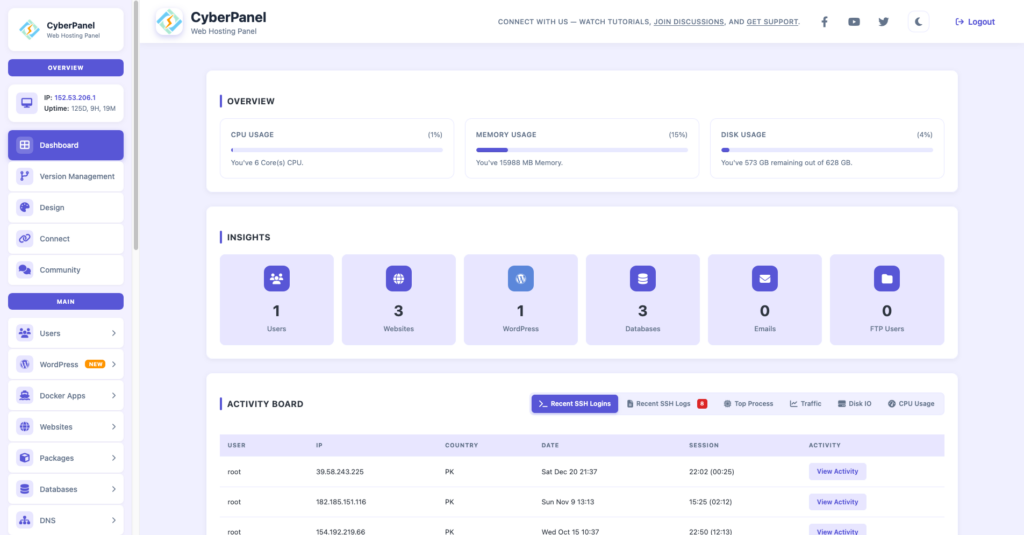
It is equally important to manage servers efficiently after you automate infrastructure. This is where CyberPanel steps in.
You can think of CyberPanel as a free and open source web hosting control panel that uses OpenLiteSpeed. It makes the server and site management tasks easy without compromising on speed and efficiency.
Combined workflow
- You can manage Multiplayer Semaphore project playgrounds
- Run automated configuration deployments
- Manage hosting & various services with CyberPanel
Thus, it forms a unified system:
- Automation
- Deployment
- Management
Common Problems & Solution
| Mistake | Problem | Solution |
|---|---|---|
| Wrong repo setup | Tasks fail | Verify Git connection |
| API misuse | Unauthorized access | Use correct tokens |
| Overuse in large setups | Performance issues | Choose right tool |
Best Practices to Follow
Here are some best practices for you to follow:
- You should store playbooks in Git
- You should use API for automation
- Always try to keep tasks modular
- Make it a habit to monitor logs regularly
- Always secure access tokens
Conclusion
Ansible Semaphore would be a great fit for those teams who want automation to be well organized without the hassle of complicated systems. With a neat interface, you can do away with manual CLI workflows and get scheduling and tighter control.
If your operations are small to medium scale, you stand to gain in both time and consistency. Besides, if your requirements increase, you can still switch to more powerful tools like AWX.
What matters most is how well the tool fits your workflow.
You can begin by installing Semaphore, linking your first repo, and executing a simple playbook. Just by doing that, you will have made a significant step toward structured automation from manual
FAQs
Does Semaphore support multiple users?
Yes, it includes role-based access control.
Is Ansible Semaphore free to use?
Yes, it is completely open-source and free.
Is Semaphore better than AWX?
It depends on your needs. Semaphore is simpler, AWX is more powerful.