
On this page
Have you ever attempted to get data from another host in Ansible? When you use Ansible, you will be confused about where the data is saved. It’s a problem in automation on multiple servers. The variable configurations are saved on different hosts. Sometimes we need to access another host; that’s what Ansible hostvars is for. In an actual DevOps environment, servers do not operate independently.
An application server might need data from a database server, or a load balancer might want to know about the back-end hosts. Rather than managing this data ourselves, Ansible has a feature called hostvars ansible, to get variable information from any host in the inventory.
When using Ansible access hostvars, you are able to get values such as IP configurations and custom variables on all managed nodes.
This is how automation becomes dynamic and scalable. But care should be taken while using it, as wrong usage can make playbooks complex and difficult to debug. In this post, you will learn details of how Ansible hostvars work, how to use Ansible get hostvars, how to utilize Ansible debug hostvars for debugging, and how to organize multi-host automation with practical examples.
What Is Ansible hostvars?
Ansible hostvars is a built-in dictionary that stores variables for all hosts in the inventory. It allows you to access variables of any host from any other host in the playbook.
Working of hostvars Ansible
Ansible collects all host-related variables during inventory parsing. Then stores them in a global dictionary called hostvars. Here is the structure:
hostvars
 ├── host1
 │    ├── ip
 │    ├── ansible_facts
 ├── host2
 │    ├── ip
│ ├── custom_varsHow to Access Ansible hostvars?
When you use Jinja2 syntax, you can access it. Let’s learn with the help of an example:
- hosts: localhost
  tasks:
    - name: Show host variable
      debug:
msg: "{{ hostvars['server1']['ansible_host'] }}"Output
192.168.1.10What is Ansible Access hostvars Used For?
It is the feature used when one host needs data from another host. Here are a few real use cases:
- Load balancer getting backend IPs
- App server reading DB credentials
- Central logging systems are collecting host data
How to Use Ansible get hostvars?
You can fetch values dynamically from any host. Here is an example:
- hosts: localhost
  tasks:
    - name: Get remote host IP
      debug:
msg: "{{ hostvars['web1']['ansible_default_ipv4']['address'] }}"Output
10.0.0.5Ansible debug hostvars
You can use it to inspect all available variables for a host. Here is an example:
- hosts: localhost
  tasks:
    - name: Debug hostvars
      debug:
var: hostvarsYou can use this to troubleshoot variable issues, understand inventory structure, and check fast collection.
Importance of hostvars in Ansible
Without hostvars:
- You cannot share data across hosts
- Playbooks become static
- Multi-node automation becomes difficult
With hostvars:
- Dynamic infrastructure becomes possible
- Cross-host communication is enabled
- Automation becomes scalable
Real-world example of hostvars in action
Scenario: Web + DB setup
- Web server needs DB IP
- DB server has static IP
Playbook
- hosts: web
  tasks:
    - name: Show DB IP
      debug:
msg: "{{ hostvars['db']['ansible_host'] }}"Output
10.0.0.20Mistakes, Problems, Fixes
| Mistake | Problem | Fix |
|---|---|---|
| Wrong host name | Key not found | Check inventory |
| Missing facts | Empty output | Enable fact gathering |
| Deep nesting errors | Debug failure | Inspect structure carefully |
Best Practices for Using Ansible hostvars
Here are a few best practices for you to use:
- Always verify inventory names
- Use debug before production use
- Avoid deeply nested calls
- Combine with group_vars when possible
Advanced Usage of hostvars
One of the advanced uses is that you can combine hostvars with a loop and conditions. Here is the example:
- hosts: localhost
  tasks:
    - name: Loop through hosts
      debug:
        msg: "{{ hostvars[item]['ansible_host'] }}"
loop: "{{ groups['all'] }}"Role of CyberPanel in Automation Workflows
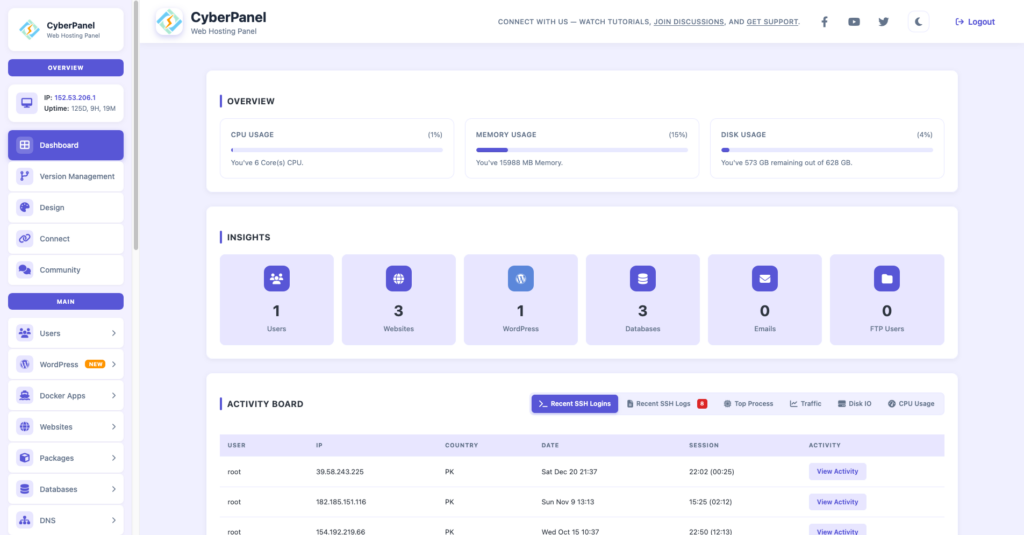
Deploying multiple servers with Ansible is just as much about visibility and control as it is about automation.
CyberPanel is a free and open source web hosting control panel based on OpenLiteSpeed.
It is also an effective way to manage your servers, websites, and hosting environments.
How it fits:
- Ansible handles automation
- hostvars manages cross-server data
- CyberPanel manages hosting layer
Together, they create a structured infrastructure system.
Conclusion
Ansible hostvars is mainly useful in a multi-server setup. It enables dynamic variable reference per host, saving the effort of defining variables for each server.
This feature streamlines automation, allowing for easier management and enhanced scalability.
Once you grasp the method of retrieving and debugging hostvars, your playbooks will be infinitely more powerful. Begin to utilize hostvars in your new multi-host configuration to go from static automation to complete dynamic infrastructure management!
FAQs
How do I access hostvars in Ansible?
Use hostvars['hostname'] syntax.
Is hostvars available in all playbooks?
Yes, it is built-in by default.
Can hostvars access another host’s IP?
Yes, using Ansible facts or custom variables.