

On this page
You are working on a C program that needs to execute a shell command, capture its output, and continue. It may seem like a straightforward task. But without caution, you might find yourself with a zombie process, a memory leak, or worse, silently vanished output due to a single wrong function call. The popen and pclose Linux functions are a great rescue in these situations.
If you are here and you are looking up pclose Linux, the use of popen and pclose on the Linux platform, or the role of fclose in this context, then more than likely you are dealing with the reality of debugging a situation. We can help you out.
What popen and pclose Linux Actually Do
You may imagine popen as a channel. On one side is your C program, whereas on the other side is the shell, ready to launch a shell command that you send to it. For example, ls, grep, ping, or a custom script. popen establishes communication, and you get hold of a stream, similar to a normal file, which you can read from or write to.
pclose is the function that, after you are done, shuts the bridge down. It first closes the stream that was opened by popen, then waits for the termination of the child process and finally returns its exit status. The exit status will tell you if the command really succeeded or not.
Essence put into a single line: popen launches a process and gives you a way to communicate with it through a pipe pclose terminates the process and reports how much success the process had.
Both are functions declared in stdio.h and were developed mostly to make command execution much less of a pain to implement when it is not just for you to code, but you have to use fork, exec, and pipe management.
Why People Confuse Linux fclose pclose
This mix-up is common enough that it deserves its own section. fclose and pclose look almost identical in how you call them, but they are not interchangeable.
fclose closes a file stream that was opened with fopen. It is meant for actual files sitting on disk.
pclose closes a process stream that was opened with popen. It is meant for a pipe connected to a running command, not a file.
Here is the part that trips people up. A FILE pointer returned by popen looks exactly like a FILE pointer returned by fopen. Your compiler will not stop you from calling fclose on a popen stream. But doing that skips the step where the system waits for the child process and collects its exit status. The process can turn into a zombie, sitting in the process table doing nothing useful, until something finally reaps it.
The rule is simple and worth memorizing: whatever opens the stream should close it. fopen pairs with fclose. popen pairs with pclose. Never cross them.
The popen Function, Explained Properly
The function signature looks like this:
FILE *popen(const char *command, const char *type);command is the shell command you want to run, written exactly as you would type it in a terminal.
type is either “r” or “w”. Use “r” when you want to read the command’s output into your program. Use “w” when you want to send data into the command’s input.
A basic read example:
#include <stdio.h>

int main() {
    FILE *fp;
    char buffer[256];

    fp = popen("ls -l /var/log", "r");
    if (fp == NULL) {
        perror("popen failed");
        return 1;
    }

    while (fgets(buffer, sizeof(buffer), fp) != NULL) {
        printf("%s", buffer);
    }

    pclose(fp);
    return 0;
}Under the hood, popen forks a new process, runs /bin/sh with your command, and connects a pipe between that shell and your program. That is why it behaves so much like reading or writing a file, even though there is a live process on the other end.
The pclose Function, Explained Properly
The signature is short:
int pclose(FILE *stream);You pass it the exact FILE pointer that popen gave you. It closes the pipe, waits for the shell process to exit, and returns the command’s exit status wrapped in the same format as wait or waitpid.
That return value matters more than most tutorials let on. A lot of code checks only whether pclose returned -1, which just tells you the call itself failed. To know whether the actual shell command succeeded, you need to unpack the status using WEXITSTATUS.
int status = pclose(fp);
if (status == -1) {
    perror("pclose failed");
} else if (WIFEXITED(status)) {
    printf("Command exited with status %d\n", WEXITSTATUS(status));
}
Skip this step, and you can end up trusting output from a command that actually failed silently, which is a nasty bug to track down later.
Popen and Pclose Functions in Linux: Using Them Together
The Linux popen pclose functions come in a pair, and most of the bugs are born if the developers use one without the other. A good pattern is:
- Call popen with the command and the correct mode.
- Check that the returned pointer is not NULL.
- Read from or write to the stream using normal file functions like fgets, fread, fprintf, or fwrite.
- Call pclose on that same pointer once you are done.
- Check the exit status before trusting the result.
Let’s take a simple example.
We wrote some data into the command instead of reading from the command.
#include <stdio.h>

int main() {
    FILE *fp = popen("sort > sorted_output.txt", "w");
    if (fp == NULL) {
        perror("popen failed");
        return 1;
    }

    fprintf(fp, "banana\n");
    fprintf(fp, "apple\n");
    fprintf(fp, "cherry\n");

    pclose(fp);
    return 0;
}
Common Errors and How to Debug Them
popen returns NULL: One reason might be the system running out of resources; it could be that the system cannot fork another process, or it has been unable to create the pipe. Just after the failed call, you should do a quick check on the system error variable, that is errno, using the strerror function, which is called perror.
Program hangs and never returns: It really could be that either (1) the command you have sent to popen is waiting on an input you’ve never delivered to the command, and that means hanging the entire program, or (2) you made it in “r” mode, but the command is still expecting stdin. So go back and check very carefully that the mode is matching that which the command is demanding of it.
More and more zombie processes: This is a mistake of using fclose in case of pclose that one came across previously. Go over your codebase and look for those popen streams which have been closed with fclose rather than pclose; those are the errors, and you should fix them.
A wrong exit status is always seen: Bear in mind pclose gives you the plain wait status and not a simple exit code. Because of this, only after a call to WIFEXITED to confirm that the exit status is the reason for termination is correct, then you can safely call WEXITSTATUS on pclose.
Buffer overflows and output are getting sliced off because of small buffers used in reading. In many cases, the command has a large output, and your buffer size is small such that during the reading it is not sufficient and it gets cut. Because of this, instead of assuming that a one-time call is enough for capturing everything, you should make a loop on the fgets or fread.
Best Practices to Adopt
It is recommended that you check the return value of the popen before reading from the returned stream. The usage of a NULL pointer as a stream will surely crash the program.
Avoid constructing command strings by pasting user input directly into the command without sanitization. Since popen executes in a shell, this is the path through which a Command Injection can be made if a user enters into variables something like ; rm -rf /.
Make sure that every popen command is matched by an appropriate pclose and that every pclose has been executed on each code path – this includes, for example, early returns and all error handling branches.
Finding out how the system executed the command is also very important. One can hardly call the two concepts the same if the command ran successfully and the command was executed successfully.
In case the command contains a parameter which is close to or similar to data that the user has given, it is better to fork, exec, and set up a pipe to the process by calling those system functions, which is a more accurate means of communication, or to use a safer wrapper. Although being convenient, popen does not guarantee safety. Because of this, do not use popen unless you are completely certain.
Where This Shows Up in Real Server Work
If you are running a Linux-based server, it is likely that this kind of code, which uses system calls and popen, is already working behind your back most of the time. System monitoring, checking disk usage, automated deployment scripts, etc. generally communicate with your system through popen and pclose to launch a command and read its output or input, respectively.
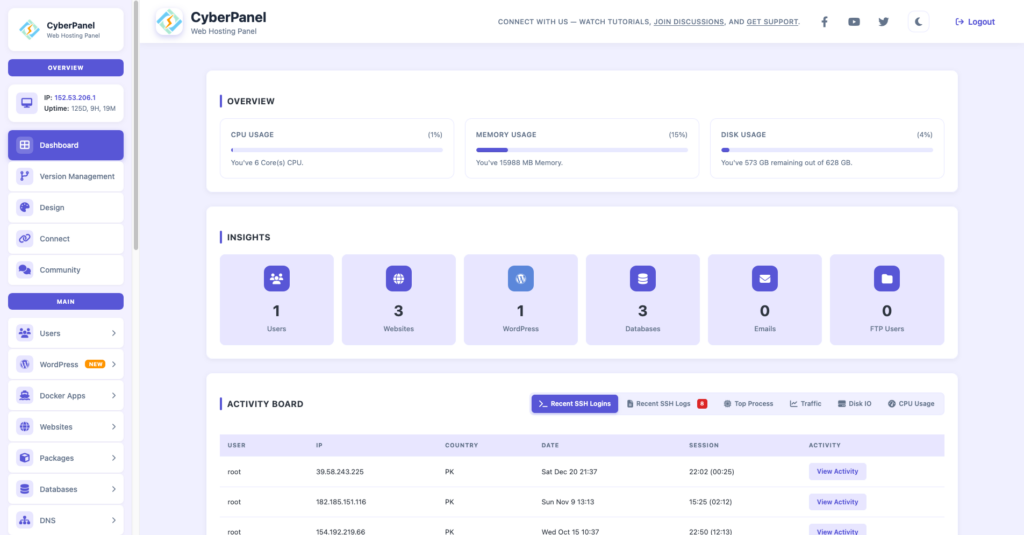
Such low-level handling of the processes is the kind of thing that makes a decent hosting panel worth the money. For instance, CyberPanel is a free and open-source web hosting control panel. It takes care of various process management tasks like automatic backups, service restart, and log monitoring. Because of this, you can rely on your code and applications with the knowledge that a large portion of the burden has been taken.
Final Remarks!
The best way to actually understand popen and pclose is to break something on purpose. Take the read example above, run it, then deliberately swap pclose for fclose and watch what happens to your process list with ps aux afterward. Once you see the difference firsthand, the fopen versus popen distinction stops being a rule you memorized and becomes something you actually understand.
And if you are managing the server where these scripts run, it is worth checking whether your current setup is making process management easier or harder on you. CyberPanel gives you a clean, visual way to handle the server-side tasks that scripts like these often automate, so you can spend less time chasing zombie processes and more time building.
People Also Ask
Can pclose fail even if popen succeeded earlier?
Yes. pclose can return -1 if the stream pointer is invalid, if it was already closed, or if waitpid encounters an error while trying to collect the child process status. This is separate from the exit status of the command itself, so a failed pclose call and a failed shell command are two different problems to check for.
Is there a performance cost to using popen repeatedly in a loop?
Yes, and it adds up. Every popen call forks a new process and spins up a shell, which is expensive compared to a direct system call. If you are running the same type of command hundreds of times, look at batching the work into a single command, or use a lower-level API that avoids repeated shell startup costs.
Does popen block my program while the command runs?
Yes, by default your program will wait wherever it tries to read or write to the stream until data is available or the pipe closes. If you need non blocking behavior, you would combine popen with fcntl to set the underlying file descriptor to non blocking mode, though this adds complexity most simple use cases do not need.



Your observation captures a core concept succinctly and effectively.