On this page
Real-time data processing is a key requirement in a world where banks monitor financial transactions, ride-sharing apps track drivers on a block-by-block basis, and streaming services recommend the next show to watch before the current one ends. These applications cannot be built around traditional batch-processing technologies that batch, process, and store results hours or days later. They require a fundamentally different approach:
- systems that can ingest and act on data as it happens.
- Apache Flink was designed to do exactly that.
This guide describes what Apache Flink is and how it works, where it is used in the modern data stack, and how it compares to Apache Kafka, a common point of confusion for those unfamiliar with real-time data pipelines.
What Is Apache Flink?
Apache Flink is an open-source framework for executing stream-processing applications in real time. Apache Flink enables developers to write applications that consume data. As it is ingested, performing computations, transformations, or alerts at the millisecond level, rather than the traditional approach of waiting for a daily or hourly batch window to finish.
Apache Flink was initially developed as a research project at the Technical University of Berlin in 2010. And later rebranded as Apache Flink. It officially became an Apache Software Foundation Top-Level Project in 2014, with ongoing contributions from the wider open-source community as well as enterprise vendors like Alibaba, Confluent, and Ververica.
At the most basic level, Apache Flink is a stream-processing engine that treats data as a continuous stream rather than a set of discrete batches. This architectural difference is what enables Apache Flink to process and calculate results on the fly rather than waiting for data to be staged.
Why Apache Flink Exists
Before Apache Flink and similar systems were developed, companies had to rely on a mixture of homegrown scripts, cron jobs, and micro-batch processing frameworks to tackle real-time analytics use cases. This hybrid approach worked but was not optimized for latency or system reliability.
Apache Flink was developed to address three specific challenges associated with these legacy approaches:
- Truly event-driven processing: Applications written in Apache Flink are triggered at the millisecond level versus the traditional approach of batch processing.
- Exactly-once statefulness: Apache Flink can recover from crashes without corrupting or duplicating data.
- Unified batch/stream processing: A single framework and API for processing both real-time and historical data.
How Apache Flink Works: The Architecture
Apache Flink’s architecture can help further explain some of the concepts mentioned above.
Apache Flink utilizes a master-worker architecture, where the system is divided between a JobManager and a set of TaskManagers.
- The JobManager is responsible for scheduling jobs, coordinating checkpoints, and recovery in the case of a task failure.
- The TaskManagers are responsible for receiving tasks from the JobManager and passing data to and from other TaskManagers as needed for the job.
When a user submits an application to a Flink cluster, their code is parsed into a dataflow, which is then partitioned and distributed to the TaskManagers to process data in parallel.
Streams, State, and Time
Apache Flink is built around three core concepts: Streams, State, and Time.
- Streams are continuous flows of data records that are emitted and processed by either an application or a function.
- State is the information associated with each stream that must be retained for downstream processes such as aggregation, sessionization, or windowing
- Time semantics define how Apache Flink will process streams of data that are out of order or that contain timestamps.
Windows, Watermarks, and Checkpointing
- Windows are temporal boundaries associated with a stream that help define when a stream should be cut off for aggregation functions such as COUNT or SUM.
- Watermarks define how late or out-of-order data in a stream should be handled at the boundaries of windows.
- Checkpointing ensures that state in a Flink application is regularly saved to persistent storage so that it can be recovered in the event of a crash.
What Is New in Apache Flink (2026)
Apache Flink has seen a number of exciting updates and innovations in 2026, several of which are likely to accelerate its adoption in the coming years.
- Flink Agents: A new subproject of Apache Flink, Flink Agents allow for the development of event-driven AI agents with direct invocation of tools and the same statefulness and checkpointing guarantees as the main Flink framework.
- Native S3 filesystem support: Users no longer need to rely on older Hadoop or Presto dependencies to interact with cloud storage.
- Materialized tables: Apache Flink is evolving to be a more comprehensive query engine, with better support for SQL and materialized view paradigms.
- PyFlink’s DataFrame API: This Python API aims to make building analytics pipelines easier, particularly for data analysts who typically rely on Python.
- Fluss: Apache Flink 2026 now includes Fluss, a companion streaming storage engine that is often used in tandem with Apache Flink to store and retrieve evolving schemas with millisecond latency.
The trend in Apache Flink over the last several years has been to evolve from a narrow-stream processor into a more general-purpose real-time data analytics engine. One sign of this trend is that it is now much easier to execute Apache Flink applications using SQL rather than Java or Python code.
Common Apache Flink Use Cases
Apache Flink typically addresses use cases where real-time data processing is a critical requirement.
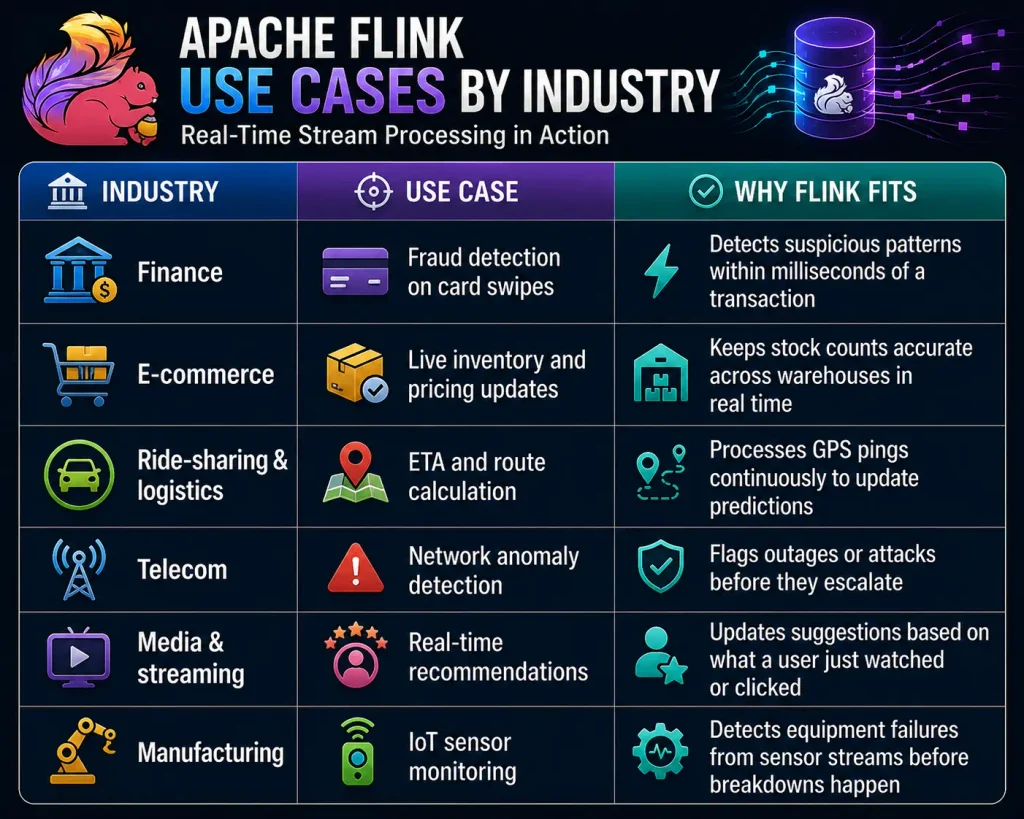
Many of the companies in this space run production-grade Apache Flink workloads at large scale, including Alibaba, Uber, Netflix, and ING Bank.
Apache Flink vs Kafka: What’s The Difference
This is one of the most common comparisons in the data engineering space, and it’s not hard to see why; the two often appear in the same pipeline, and it’s easy to confuse the two. However, they have very different purposes.
Apache Kafka is a messaging/storage system. It’s used to pass data from producers to consumers and to store a durable log of that data.
Apache Flink is a processing engine. It is used to read, process, aggregate, and write data, often reading and writing from Kafka.
In summary, Kafka transports data, and Flink thinks about it.
| Aspect | Apache Kafka | Apache Flink |
| Primary role | Distributed event streaming and message broker | Stream and batch data processing engine |
| Core function | Stores and moves data reliably between systems | Transforms, aggregates, and analyzes data |
| Data retention | Persists events for a configurable time period | Processes data in motion; state is for computation, not long-term storage |
| Typical use | Decoupling producers and consumers, event logs | Real-time analytics, fraud detection, complex event processing |
| Processing logic | Minimal, mainly Kafka Streams for lightweight cases | Rich windowing, joins, CEP, and machine learning pipelines |
| Works well with | Flink, Spark, consumers, databases | Kafka, Kinesis, Pulsar, S3, JDBC sources |
| Learning curve | Moderate, simpler mental model | Steeper, due to state and time semantics |
So do you need both? Well, in most production real-time systems, yes. Kafka is the durable pipe that ingests and buffers the events coming from a myriad of sources, and Flink is downstream doing the actual processing and storing the results in a database or dashboard or another topic. They are complementary and different tools, and the question is akin to roads vs trucks; you generally need both.
Apache Flink vs Spark Streaming
Apache Spark Streaming is another common point of comparison for Apache Flink, and for good reason: the two products are often compared by analysts and customers looking to choose between them. Apache Spark Streaming (via Structured Streaming) has the capability to process both real-time and historical data in small batches, while Apache Flink handles these queries in a continuous, event-driven manner.
In general, Apache Flink tends to outperform Apache Spark in latency-sensitive production environments, but Apache Spark has significant advantages for certain types of machine learning workloads. Both products have a number of similarities, including the ability to run on Kubernetes, but Apache Flink provides better overall performance for most real-time use cases.
Web Hosting Control Panel For Apache Flink
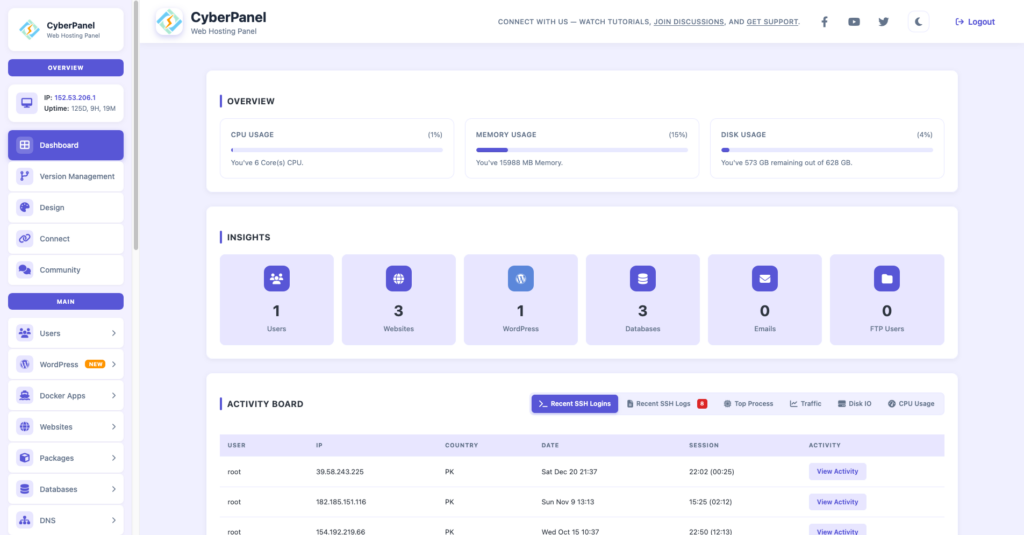
When it comes to getting started with Apache Flink, many tutorials focus on the software itself without providing much detail on the infrastructure requirements for hosting the application. Depending on the hosting methodology, this can add significant complexity and overhead. If you are self-hosting Apache Flink (typically on a VPS or dedicated server) versus using a managed cloud service, you will have very different requirements in terms of server resources.
A good place to start with a self-hosted solution is a web hosting control panel. CyberPanel is a free and open-source web hosting control panel. It can simplify many technical aspects of server management.
Key areas where a control panel can be valuable for Apache Flink hosting include:
- Configuring permissions and proxy rules
- Installing and managing Java dependencies
- Monitoring server and application performance
- Keeping the underlying operating system up to date
The ability to host an application inside a control panel is often a key differentiator for a web hosting provider: while some companies offer full command of a server via SSH, others operate managed cloud services that abstract many of these details.
Is Apache Flink Free?
Apache Flink is an open-source project that is freely available under the Apache License 2.0. There are no costs associated with the software itself, but infrastructure, monitoring, and maintenance can add up depending on a company’s needs. There are also a number of managed cloud services (including Amazon, Alibaba, Confluent, and Ververica) that offer Apache Flink as a service for an additional fee.
Apache Flink Hosting Options Compared
| Deployment Type | Best For | Trade-off |
| Self-managed on-premises | Full control, data residency requirements | Requires in-house ops expertise |
| Self-managed on cloud VPS | Cost control, custom setups | You manage scaling and patching yourself |
| Managed cloud service (AWS, Alibaba, Confluent) | Fast setup, auto-scaling | Higher recurring cost, less low-level control |
| Kubernetes-native (Flink Operator) | Teams already running K8s workloads | Adds container orchestration complexity |
Frequently Asked Questions
Is Apache Flink a database?
No. Flink doesn’t store data long-term the way a database does. It processes data as it flows through a pipeline and can hold temporary “state” for calculations, but for permanent storage it writes results out to an actual database, data warehouse, or file system.
Can Apache Flink replace Kafka entirely?
No, and it isn’t designed to. Kafka’s job is durable message storage and delivery between systems. Flink’s job is computation. Some smaller setups skip Kafka and read directly from other sources like databases or files, but for most production event-driven systems, Kafka still handles ingestion while Flink handles the logic.
What programming languages does Apache Flink support?
Flink supports Java and Scala natively through its DataStream API, plus Python through PyFlink. It also offers Flink SQL, which lets teams write streaming logic using standard SQL syntax without writing a full application in code.
How is Apache Flink different from Apache Storm?
Apache Storm was an earlier real-time processing framework, but it lacked strong state management and exactly-once guarantees out of the box. Flink was built later with these gaps specifically in mind, which is a big reason most new projects choose Flink over Storm today.
Does Apache Flink support machine learning?
Yes, through the Flink ML library, which offers feature engineering tools and classical ML algorithms designed for streaming data, including models that update continuously as new data arrives rather than retraining from scratch.
Final Thoughts
Apache Flink represents a fundamental shift in how data is processed and analyzed. In contrast to traditional, rigid frameworks, Apache Flink embraces the real-time nature of data as a continuous stream. Combined with Apache Kafka for durable message queuing and the right infrastructure to support it (such as a comprehensive web hosting control panel), Apache Flink gives organizations the ability to build sophisticated data pipelines that react to what is happening “right now”. This has crucial implications for a wide range of applications, including financial fraud detection, inventory management, and real-time dashboards that help executives make informed business decisions.