On this page
Have you ever deployed an application successfully on one server, only to spend hours trying to replicate the same configuration on another? Managing one server manually is easy. Managing ten is tedious. Managing a hundred is a full-time job, unless you use Ansible.
Nowadays, DevOps engineers are expected to do a lot more than just provisioning infrastructure, configuring servers, or deploying applications. They may also be involved in security policy management and making sure that there is consistency among hundreds or even thousands of different systems. Ansible addresses these challenges efficiently through its agentless automation, human-readable playbooks, and strong orchestration features. Regardless of whether you are running a small startup or a large enterprise cloud platform, Ansible can help you get rid of repetitive work and enhance your service reliability.
In this guide, you’ll learn exactly what Ansible for DevOps means in practice: the core concepts, how to get started, what Jeff Geerling’s legendary Ansible for DevOps book teaches, and, critically, how you can use Ansible to automate CyberPanel server deployments at scale.
What is Ansible for DevOps?
Ansible for DevOps means using Ansible as the primary tool to automate the management of infrastructure, applications, configurations, and deployments throughout the DevOps lifecycle.
With Ansible, organizations can automate:
- Server provisioning
- Configuration management
- Application deployment
- Security hardening
- Cloud infrastructure
- Continuous delivery workflows
Instead of manually configuring systems, administrators define infrastructure in code, making environments reproducible and consistent.
Reasons Why DevOps Teams Choose Ansible
Automation is a major focus of modern DevOps.
Without automation, teams can be vulnerable to:
- Configuration drift
- Deployment failures
- Human error
- Slow release cycles
- Scaling challenges
Ansible is a solution to these problems through declarative automation.
Key Benefits
| Benefit | Description |
|---|---|
| Agentless Architecture | No software required on target hosts |
| Simple YAML Syntax | Easy to learn and maintain |
| Idempotent Operations | Repeatable and predictable results |
| Multi-Platform Support | Linux, Windows, cloud environments |
| Strong Community | Extensive modules and documentation |
Core Ansible Concepts Every DevOps Engineer Should Know
Before getting into the details of playbooks and CyberPanel automation, it makes sense to place yourself first with the most basic building blocks.
Inventory
An inventory is essentially a file (or dynamic source) that communicates to Ansible which servers are to be controlled. At the very least, it is a text file that has IP addresses or hostnames listed:
[webservers]
192.168.1.10
192.168.1.11

[dbservers]
192.168.1.20
Besides grouping servers, you can set variables for each group, and even get a dynamic inventory listing of your servers from cloud providers like AWS, DigitalOcean, or Vultr.
Playbooks
A playbook is a YAML file that outlines a sequence of operations that are performed on a set of hosts. Each operation is linked to an Ansible module – a work unit like installing a software package, copying a file, or restarting a service.
- name: Configure web server
  hosts: webservers
  become: yes

  tasks:
    - name: Install Nginx
      apt:
        name: nginx
        state: present

    - name: Start and enable Nginx
      service:
        name: nginx
        state: started
        enabled: yes
Roles
Roles are an excellent way of breaking down a playbook into components that are reusable and well-structured. A role could contain all the elements required to set up a database server, such as tasks, templates, variables, and handlers. By using roles, your Ansible code becomes modular, testable, and shareable.
Variables and Templates
Through Jinja2 templates, Ansible allows you to create configuration files that are dynamic. Variables can be specified in the playbook, in separate variable files, or given on the command line at execution time – this makes your automation work seamlessly across different environments.
Handlers
Handlers are tasks that only get executed if they are triggered by some other task. The usual example: restart Nginx only if the configuration file for it has been changed.
Real-World DevOps Use Cases For Ansible
Ansible is widely used across DevOps pipelines.
Infrastructure Provisioning
Teams automate server creation and configuration.
Example:
- name: Configure web server
  hosts: web

  tasks:
    - name: Install Apache
      apt:
        name: apache2
state: presentApplication Deployment
Deploy applications consistently.
Example:
- name: Deploy application
  copy:
    src: app.jar
dest: /opt/app/Security Hardening
Automate security configurations.
Example:
- name: Disable root SSH login
  lineinfile:
    path: /etc/ssh/sshd_config
    regexp: '^PermitRootLogin'
line: 'PermitRootLogin no'Patch Management
Apply updates across multiple servers.
Example:
- name: Update packages
  apt:
    update_cache: yes
upgrade: distAnsible for DevOps By Jeff Geerling: The Must-Have for Every DevOps Engineer
If you want to learn about Ansible the most productive way, one person’s name will pop up regularly in the community discussions: Jeff Geerling with his book Ansible for DevOps.
Jeff Geerling is a software engineer, writer, and open-source developer widely recognized in the Ansible and Raspberry Pi communities. He is the author of many popular Ansible roles available on Ansible Galaxy and has played a major role in making Ansible accessible to anyone, regardless of their skill level.
What’s in Ansible for DevOps?
Ansible for DevOps is an extensive, self-published manual that leads you all the way from scratch to production-grade automation. It is universally seen as the definitive guide to learning Ansible and is widely acclaimed for its hands-on, example-rich approach rather than dry theory.
Things the book explains:
- How to install Ansible and your first inventory
- How to write and organize playbooks
- How to manage users, packages, files, and services
- How to deploy full application stacks (LAMP, Node.js, etc.)
- How to use Ansible Vault for secrets management
- How to create and test roles with Molecule
- How to orchestrate multi-tier deployments
- How to combine Ansible with CI/CD pipelines
- How to scale infrastructure with Ansible Tower / AWX
Ansible for DevOps 2nd Edition
Geerling’s Ansible for DevOps, second edition, is a thoroughly revised and modernized version of the book, reflecting the changes in the Ansible community, like collections, updated module syntax, and newer deployment patterns. If you have been using the old copy, it is definitely worth switching to the 2nd edition as the changes in the ecosystem are quite substantial.
Where to purchase Ansible for DevOps 2nd Edition PDF
You can buy Ansible for DevOps from Jeff Geerling directly on LeanPub. Ansible for DevOps 2nd edition PDF is available together with EPUB and MOBI formats. Buying from LeanPub directly will give you access to all future updates without additional payment and at the same time support the author. The book is very reasonably priced and updates regularly; so please, stay away from pirated versions, as buying a legitimate one will give you the latest content.
Ansible Vs Other DevOps Automation Tools
| Tool | Primary Focus |
|---|---|
| Ansible | Agentless automation |
| Terraform | Infrastructure provisioning |
| Puppet | Configuration management |
| Chef | Infrastructure automation |
| SaltStack | Remote execution and automation |
Many organizations use Ansible alongside Terraform rather than replacing one with the other.
How CyberPanel Supports Ansible in DevOps?
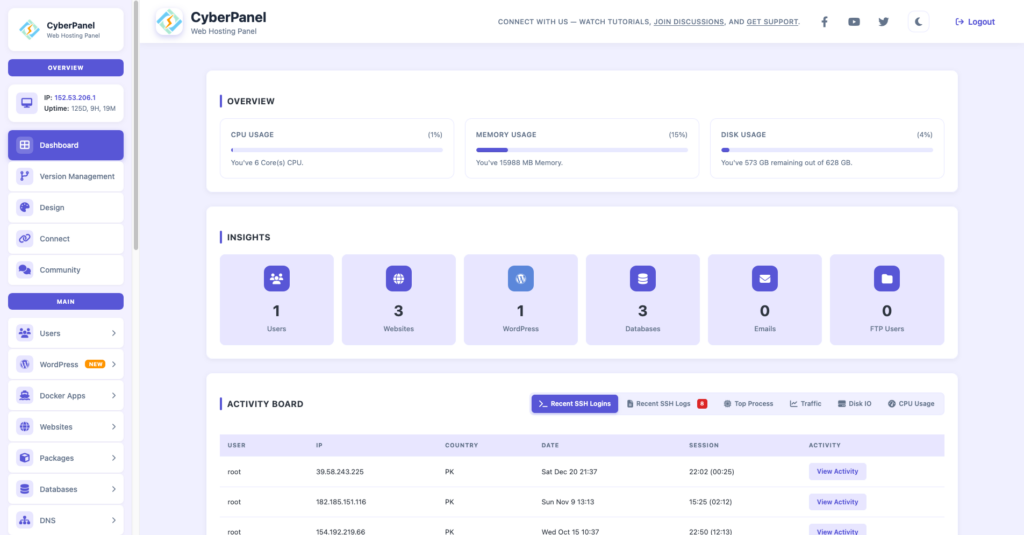
Automation is not just about server setup; it can also involve managing websites and apps.
CyberPanel is an open-source, free web hosting control panel based on OpenLiteSpeed. It can help teams efficiently handle websites, databases, SSL certificates, emails, and hosting environments.
Here is an example of a DevOps-related workflow:
- Provisioning Linux machines with Ansible
- Setting up infrastructure automatically
- Release of software products
- Management of hosting services via CyberPanel
In this way, you can automate infrastructure and also do operational management with the least effort.
Best Practices To Follow
Here is what successful teams follow:
- Use Roles
- Keep playbooks idempotent
- Store secrets securely
- Version control everything
- Test before production
Getting Started: Your Next Steps with Ansible for DevOps
If you’re new to Ansible, here’s a practical roadmap:
- Install Ansible on your local machine or a dedicated management server.
- Set up a test environment — a single VPS or a local VM with Vagrant works perfectly for learning.
- Write your first playbook — start with something simple like installing Nginx and confirming it’s running.
- Read Ansible for DevOps by Jeff Geerling — the 2nd edition is the most comprehensive single resource available. Grab the PDF from LeanPub.
- Explore Ansible Galaxy — the community repository of pre-built roles. Search for “CyberPanel” and related roles to see what others have shared.
- Integrate with your CI/CD pipeline — once you’re comfortable, hook Ansible into GitHub Actions or GitLab CI to automate deployments on every push.
Automate your CyberPanel stack — use the playbook examples above as a starting point and build out a full role for your hosting environment.
Conclusion
As a DevOps automation tool, Ansible remains the most efficient and robust method for infrastructure automation, even in 2026. The range of Ansible’s functionality is not limited to provisioning servers and security hardening; it also includes deploying applications and managing cloud infrastructure. In short, Ansible enables organizations to create workflows that are not only reliable and repeatable but also scalable. Whether you are reading the Ansible for DevOps book, learning from Ansible for DevOps by Jeff Geerling, or doing automation in production environments, being an expert in Ansible can greatly help you in achieving higher efficiency, greater consistency, and overall operational excellence.
Make automation your new habit and change manual infrastructure operations into repeated and well-defined DevOps workflows.
FAQs
Should I Learn Ansible Or Terraform First?
It depends on your goals. Terraform focuses on infrastructure provisioning, while Ansible specializes in configuration management and automation. Many DevOps teams use both together.
Do DevOps Engineers Need To Learn Ansible?
In many organizations, Ansible is considered a valuable skill for infrastructure automation, deployment, and configuration management.
Can Ansible Manage Cloud Infrastructure?
Yes. Ansible supports AWS, Azure, Google Cloud, and many other cloud providers through dedicated modules.