On this page
Imagine that you want to run the same job on 500 servers, and Ansible treats them one by one. The automation of your infrastructure would be painfully slow, right? Yes, nowadays DevOps teams may have to handle hundreds of thousands of systems. So, the speed of the deployment is now a crucial point.
This is why Ansible forks should be familiarized with. Among Ansible’s greatest advantages is the feature of parallel execution.
In fact, instead of connecting one host after the other, Ansible makes use of forks to run tasks on multiple hosts simultaneously. With proper fork settings, the performance of your playbook execution can be greatly improved, leading to faster deployments and more efficient large-scale infrastructure operations.
In fact, you need to learn these concepts to be able to create efficient automation flows. An inappropriate fork value can result in the infrastructure being unavailable, and tight settings can make the deployment unnecessarily slow. We will cover all.
What Are Ansible Forks?
Ansible forks determine how many parallel connections Ansible can establish when executing tasks against managed hosts.
In simple terms, forks control how many systems Ansible can work on simultaneously.
Consider an inventory containing:
web01
web02
web03
web04
web05If forks are set to:
5Ansible can process all five hosts at the same time.
If forks are set to:
1Ansible processes hosts sequentially.
This directly impacts execution speed.
Why Ansible Forks Shouldn’t Be Ignored?
Running tasks concurrently online is a very important aspect of present-day communications.
For example, without forks:
- deployment workflows may be unnecessarily lengthy
- inability to respond promptly to changes
- difficulty in scaling up
- ending maintenance downtime becomes tough
Forks help:
- reduce execution time
- improve operational efficiency
- accelerate large deployments
- optimize automation workflows
Real Examples of Use For Ansible Forks
Fork tuning can be most useful in very large infrastructure environments.
Operating System Patching
Some companies patch hundreds of servers at the same time.
Rather than manually updating each host, Ansible breaks down the task and relies on a number of worker processes to complete the job, which dramatically shortens the downtime window.
Application Deployments
Modern CI/CD (Continuous Integration/Continuous Deployment) pipelines regularly deploy software in several environments.
If it is possible to set higher fork values, it can result in application updates finishing in less time, So improving overall release velocity.
Cloud Infrastructure Management
By their very nature, cloud environments have a large number of virtual machines running at any given time.
With fork optimization, cloud administrators can be more productive when it comes to provisioning, configuring, and updating cloud resources.
Configuration Drift Remediation
If there has been a divergence of infrastructure configurations from the approved ones, a quick action like role execution with Ansible can ensure consistency is maintained among all hosts.
Common Mistakes When Configuring Forks
While higher concurrency can boost performance, some errors might lead to operational problems.
Setting Fork Values Too High
A number of admins think big values will give them better results.
Not Considering Network Limitations
Network latency and bandwidth limitations can really hamper your performance when you try to do parallel execution at a huge scale.
In fact, even if the control node is supercharged, network limitations can still put a cap on the extent of performance boosts.
Ignoring SSH Limits
Certain operating systems set caps on the number of SSHs that can be done simultaneously.
Setting fork values very high might result in connection failures or lead to authentication errors.
Overlooking Performance Assessment
There are quite a few differences between various infrastructure environments.
One fork value performing like a charm in one environment may be the cause of really bad results in another one.
We should not give up on testing.
Performance Impact Of Fork Tuning
Fork optimization can significantly reduce playbook execution times.
Consider a scenario where a task requires approximately thirty seconds per host and must be executed across one hundred servers.
With five forks:
100 Hosts ÷ 5 Forks = 20 Batches
20 × 30 Seconds = 600 SecondsTotal runtime:
Approximately 10 MinutesWith twenty-five forks:
100 Hosts ÷ 25 Forks = 4 Batches
4 × 30 Seconds = 120 SecondsTotal runtime:
Approximately 2 MinutesThis example demonstrates how a simple configuration change can reduce execution time by nearly eighty percent.
However, higher fork values also increase resource consumption on the control node. Every worker process requires CPU cycles, memory allocation, and network resources.
Ansible Forks Vs Serial
| Feature | Forks | Serial |
|---|---|---|
| Controls Parallelism | Yes | No |
| Controls Deployment Batch Size | No | Yes |
| Improves Speed | Yes | Indirectly |
| Supports Rolling Updates | No | Yes |
| Limits Risk During Deployments | No | Yes |
How To Configure ansible.cfg Forks
The most common way to modify forks is through the Ansible configuration file.
Example Configuration
[defaults]
forks = 20This setting instructs Ansible to process up to twenty hosts simultaneously.
The configuration file is commonly located at:
/etc/ansible/ansible.cfgor
project_directory/ansible.cfgHow To Set Forks From The Command Line
Fork values can also be specified during execution.
Example
ansible-playbook site.yml --forks 25This overrides the value configured in ansible.cfg.
Many DevOps teams use command-line forks when running temporary large-scale deployments.
How CyberPanel Works By Your Side With Infrastructure Automation
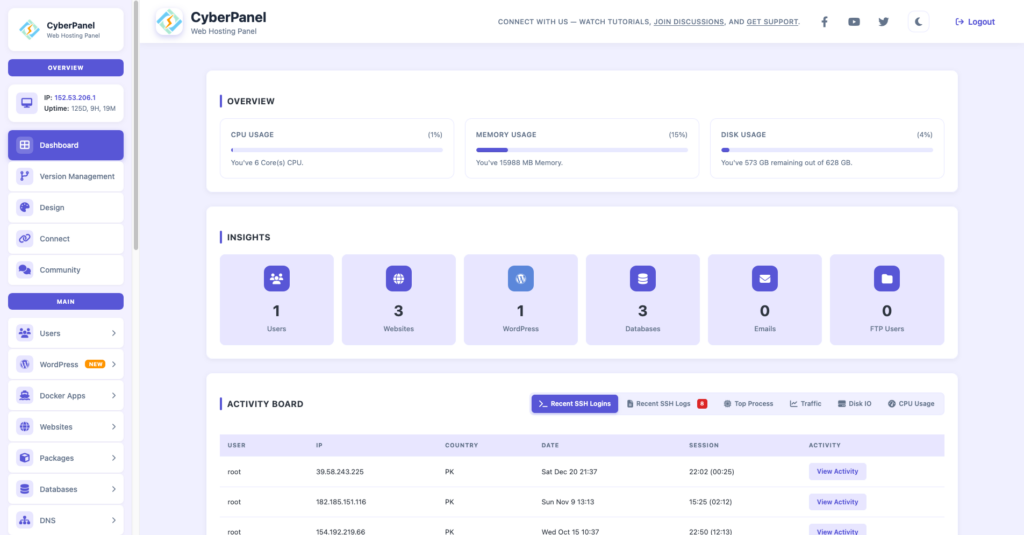
While organizations automate infrastructure with Ansible, a central platform for managing websites applications databases, and hosting environments is often a requirement.
CyberPanel. a web hosting control panel, is free and open-source, powered by OpenLiteSpeed. It not only makes server management easy but also brings powerful features for website deployment security backups, DNS management, and application hosting.
Typically:
- Linux servers are provisioned with Ansible
- Infrastructure setup is done through playbooks
- Deployment performance is optimized by fork tuning
- Hosted services are handled through CyberPanel
With this approach, teams can automate infrastructure and have operational control over hosted applications at the same time.
Final Thoughts!
Ansible forks are among the juiciest performance-boosting features for infrastructure teams yet they remain underestimated, or even ignored at times. By setting the number of hosts that Ansible can simultaneously manage, forks have a direct impact on deployment speed, operational efficiency, and scalability. A thorough grasp of how Ansible forks, ansible.cfg forks, ansible default forks, ansible playbook forks, and Ansible forks vs serial interplay together helps administrators in crafting faster and more reliable automation workflows. Even if you are managing ten servers or ten thousand, a well-tuned fork can greatly enhance the effectiveness of your DevOps operations and, at the same time, reduce the execution time of your infrastructure.
FAQs
Do Forks Affect Target Servers?
Indirectly. Higher concurrency increases the number of simultaneous connections and operations performed against managed hosts.
Can Forks Be Different For Individual Playbooks?
Yes. The --forks option allows administrators to override the default configuration during execution.
Does Increasing Forks Always Improve Performance?
Not necessarily. Performance gains depend on available system resources, network capacity, and workload characteristics. Extremely high values can actually reduce efficiency.