
On this page
If you don’t have the proper targeting set up before automating your tasks, then your effort will probably not be very effective. When automating with Ansible, you need to have a clear definition of which servers Ansible will manage and how they will be configured, and that’s where Ansible inventory comes in as the heart of your automation workflow.
All playbooks use the Ansible inventory file to tell Ansible where to run the tasks specified in the playbook. This allows you to maintain control and scalability over many servers regardless of whether they’re cloud-based or on-premises. Having a properly structured Ansible inventory file is key to being successful with Ansible’s automation capabilities.
In this article, we will discuss how to properly structure and organize an Ansible inventory file, how to access Ansible inventory variables, and how to scale your Ansible dynamic inventory within real-world examples.
What Is Ansible Inventory?
An Ansible inventory defines the hosts that Ansible is going to manage overall, and the attributes of each system under management.
The Ansible inventory file basically contains (as the name implies) all of the following information related to Ansible:
- hostnames of the target servers
- groupings of the target servers
- network connection details
- configuration variables used to set up the servers
Once Ansible knows this information, it can run tasks against specific servers using Ansible.
What Is an Ansible Inventory File?
An Ansible inventory file is a static file that contains host and group definitions.
Example Inventory File
[web]
192.168.1.10
192.168.1.11[db]
192.168.1.20[all:vars]
ansible_user=ubuntuKey Elements
| Element | Description |
|---|---|
| Hosts | Individual servers |
| Groups | Logical collections of hosts |
| Variables | Configuration values |
This structure helps organize infrastructure clearly.
How to Use Variables Defined in Inventory
Many users want to know how Ansible use var defined in inventory effectively.
Example with Variables
[web]
web1 ansible_host=192.168.1.10 ansible_port=22[web:vars]
app_port=8080
env=productionUsing Variables in Playbook
- hosts: web
  tasks:
    - name: Show app port
      debug:
msg: "App runs on port {{ app_port }}"Output
App runs on port 8080This shows how Ansible inventory variables simplify configuration management.
Types of Ansible Inventory
Ansible provides two main types of inventory for use with your automation:
Static Inventory – as the name implies, it is manually defined within a file, and thus has:
- Simple setup
- Easy to understand
- Works well for small environments
Dynamic Inventory – as the name suggests, it is automatically populated by pulling in data from external sources, such as:
- Cloud Platforms
- APIs
- Databases
Dynamic inventories are great for larger and more scalable environments.
Dynamic inventory is the process of automatically fetching host details from external sources to be used as inventory within Ansible, as opposed to updating a file manually.
Examples of Dynamic Inventory use cases include:
- AWS EC2 Instances
- Kubernetes Clusters
- Cloud-Based Infrastructure
Dynamic inventory ensures real-time accuracy of your inventory, which is important when using automation tools such as Ansible.
Example Dynamic Inventory Command
ansible-inventory --listOutput Example
{
  "web": {
    "hosts": ["192.168.1.10", "192.168.1.11"]
  }
}This command displays dynamically generated inventory data.
Ansible Inventory Best Practices
If you’re trying to put together an Ansible Inventory that will work for your environment, there are some general best practices that should be followed.
Grouping by Group
Organize your servers based on a logical grouping structure (e.g., Web Servers, DB Servers, Staging).
Using Descriptive Names
You should try to avoid using names such as “server1” because they don’t really provide any clear indication of what the server is doing.
Separating Environments
Whatever Inventory file you are using, create separate inventory files for Development, Staging and Production.
Using Variables Wisely
You should only use variables that are reusable to help you avoid duplicating variable definitions.
Utilizing Dynamic Inventory When Scaling
If you are working in a Cloud Environment, you should make use of dynamic inventories.
Common Mistakes to Avoid
Avoid these common mistakes when creating or working with your Ansible Inventory file:
- mixing multiple environments into one Inventory file
- hardcoding any Private Data (Password, SSH Keys, etc.)
- not keeping to the Group Hierarchy Structure
- excessively using Host Specific Variables
Avoiding these types of mistakes can help you achieve a more scalable and maintainable Ansible inventory.
Utilizing CyberPanel Along with Ansible in Managed Environments
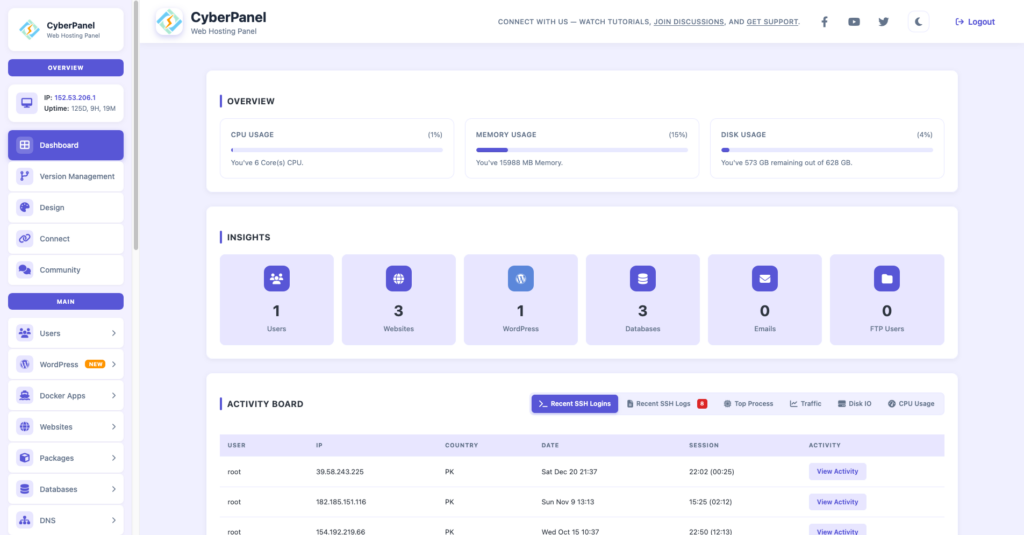
CyberPanel is your free and open-source web hosting control panel. When deploying your Servers using Ansible, you can also use CyberPanel to manage them after deployment.
CyberPanel can provide you with:
- Domain Name and DNS Management
- SSL Configuration Management
- Website Hosting
- Server Monitoring
By using Ansible, you can automate the configuration of your servers, and then manage the services that run on them using CyberPanel.
Final Thoughts!
Ansible requires a direct relationship between automation execution and the underlying physical and virtual resources’ structure. Maintaining a well-organized ansible inventory will enable successful automation, regardless of whether you’re using a basic ansible inventory file or an advanced ansible dynamic inventory.
By learning how to effectively use ansible inventory variables (with these variables being defined in your Ansible inventory), you will be able to create versatile and repeatable automation tasks.
Utilize an organized ansible inventory that contains relevant hosts and corresponding variables, and thus gain complete control over your automation environment.
FAQs
Can I create my inventory in YAML rather than INI format?
Yes. Ansible supports the creation of YAML-based inventories which provide a more human-readable and structured way to represent your inventory (especially useful when dealing with more complex configurations).
Does dynamic inventory functionality work with all cloud providers?
Most of the dynamic inventories can be created via plugins/scripts for all major cloud providers including but not limited to AWS, Azure, and GCP.
How do I keep sensitive variables used in inventory secure?
It is generally not good practice to store secrets in cleartext format; so, when possible, use Ansible Vault to encrypt any type of sensitive information such as passwords or API keys.