
On this page
What if your playbook could fetch data from anywhere and use it instantly? It could be files, environment variables, and APIs.
Usually, automated systems fail not because the tasks are incorrect but mainly because the data they rely on is not accessible when needed. Hardcoding values can be a quick solution for small setups. But in real-world environments, it becomes very difficult to manage. Probably, you would like to have a method to get data dynamically without modifying your playbooks each time that something changes.
And that is the point where Ansible Lookup steps in.
Using Lookup Ansible, you can get the data from external sources at the moment of execution and inject it straight into your tasks. It does not matter whether you are reading local files using Ansible Lookup File, working with multiple Ansible Lookup Plugins, or implementing Lookup File Ansible patterns for configuration-driven automation. All these lookup functions provide your playbooks with quite a bit of flexibility and control.
What you get then is execution that is dynamic and driven by the data rather than just static automation.
This tutorial is designed to guide you through the operation of Ansible Lookup, helping you figure out the best places to use it and how to implement it in real-world situations without your workflow getting too complicated.
Let’s have a look at Ansible Lookup!
What is Ansible Lookup?
Ansible offers Ansible Lookup Plugins to retrieve data from external sources and make it available inside playbooks. Lookup runs on the control node. It doesn’t run on the remote host. It means:
- It reads the data locally.
- It executes before tasks run.
- It injects values into playbooks.
Why Use Lookup Ansible?
You will find powerful automation when it adapts to changing data. When you use Ansible Lookup, you can do the following things:
- You can fetch the configuration from files.
- You can also read environment variables.
- You can pull secrets or credentials.
- You can also dynamically populate variables.
Without Lookup, you will be left with hardcoded values, repeated edits, and less flexibility. And using it, you will be able to have dynamic execution, reusable playbooks, and centralized data handling.
Ansible Lookup File: Most Common Use Case
The Ansible lookup file is one of the most widely used lookup types. Here is an illustration for you:
- name: Read file content
  debug:
msg: "{{ lookup('file', '/etc/app/config.txt') }}"What this actually does:
- It reads the file from the control node.
- It returns content as a string.
- It makes it usable inside the playbook.
This is a very basic Lookup File Ansible pattern.
Working
Here is how Ansible lookup works:
- Firstly, the playbook starts.
- Then, the lookup is executed locally.
- After that, the data is retrieved.
- Finally, value is injected into the task.
Ansible Lookup File: Reading Local Data the Right Way
The mostly used pattern is Ansible Lookup File. It allows you to read file content from the control node. After that, it injects it directly into your playbook. Here is an example for a basic file Lookup:
- name: Read local configuration file
  debug:
msg: "{{ lookup('file', 'config.txt') }}"In the above example, the file is not transferred anywhere. Its content is simply read and made available inside the playbook.
Using with Templates
When you work with templates, you can have a more practical use of Lookup File Ansible:
- name: Generate config using file data
  template:
    src: app.conf.j2
    dest: /etc/app/app.conf
  vars:
file_data: "{{ lookup('file', 'config.txt') }}"Here, lookup helps you keep your template clean while storing large or reusable values externally. This is especially useful in production environments where configuration management needs to stay organized.
Common Ansible Lookup Plugins And Use Case
| Plugin | Purpose | Example Use Case |
|---|---|---|
| file | Read local files | Load configs |
| env | Read environment variables | Access system values |
| url | Fetch remote data | API integration |
| pipe | Run local commands | Dynamic outputs |
Few Common Examples
Now, let’s understand Ansible Lookup by following advanced examples:
Using Environment Variables
This is useful in environment where values differ between systems. But, it should not be hardcoded.
- name: Get home directory
  debug:
msg: "{{ lookup('env', 'HOME') }}"Fetching External Data
This allows your automation to respond to live data, which is important in dynamic systems.
- name: Fetch API response
  debug:
msg: "{{ lookup('url', 'https://api.example.com/data') }}"Lookup vs Remote File Modules
| Feature | Lookup | Remote File Access |
|---|---|---|
| Execution | Control node | Remote host |
| Purpose | Fetch external data | Read remote files |
| Use case | Config injection | System inspection |
Real-World Use Cases of Ansible Lookup
Lookup Ansible is essentially a tool that can be used to make automation more flexible and maintainable in production environments.
Configuration Management
Instead of hardcoding, load values from external files.
Environment-Specific Deployments
Use environment variables to change the behavior.
API-Based Automation
Pull real-time data for decision-making.
Template Optimization
Make your templates clean and easily reusable.
Common Mistakes to Avoid
Many problems will arise if lookup is misinterpreted.
A common mistake is to think that lookup executes on remote hosts when it actually doesn’t. Another is to rely so heavily on lookup for static values that the playbooks become less readable.
Other users simply go with hard-coded file paths, which makes the flexibility drop. Paths should be parameterized so they can switch to other environments.
Best Practices for Using Ansible Lookup
Choosing clarity and purpose is the best way to go with Ansible Lookup.
- Resort to Lookup only when your data is really dynamic.
- Don’t make your playbooks less easy to read by hiding them in layers of nesting.
- Make sure that the data comes from trustworthy sources and is reachable from the control node.
One of the strongest combinations is lookup + templates because it keeps data and logic separate while working at the same time on their flexibility.
CyberPanel Role in Automation Workflow
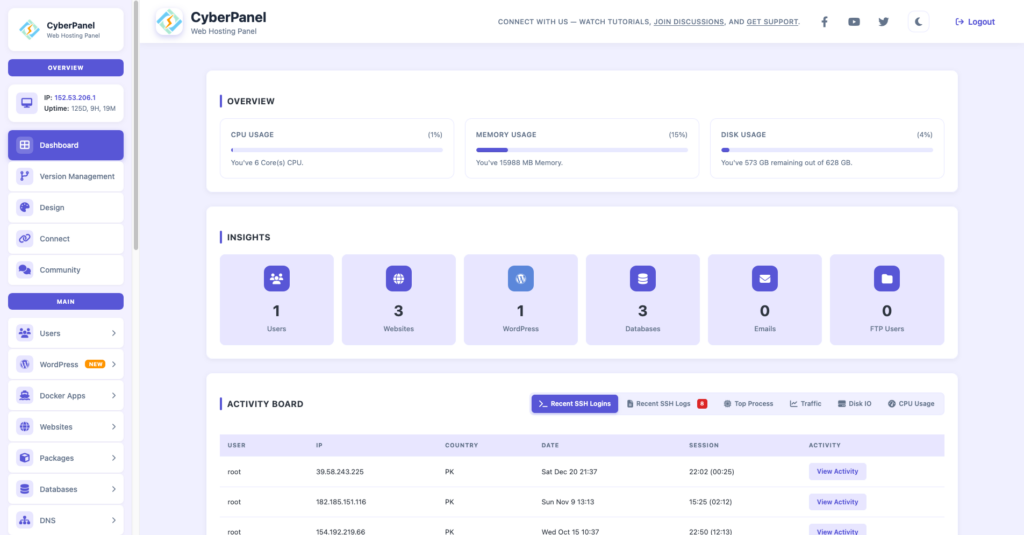
CyberPanel is a free and open-source web hosting control panel. It serves as a good partner to automation workflows especially when handling the demand for infrastructure management.
When Ansible Lookup is fetching changing data, CyberPanel is the one actually offering a place where the management of servers, web applications, and configurations is done in an organized way. How they collaborate Lookup acquires the configuration data Ansible executes the automation logic CyberPanel is responsible for the hosting and services
Example
If you decide to use Ansible Lookup File to obtain configuration values and then execute them through a playbook, managing the finally resultant service might be done by CyberPanel. This sets up a system where automation and infrastructure control together produce a complementary result.
Summary
Ansible Lookup turns automation from being just simple static scripts into systems that are capable of changing. By working with Lookup Ansible, Ansible Lookup File, and numerous other Ansible Lookup Plugins, you will be able to create playbooks which are well suited to real-life conditions rather than being stuck with predetermined values.
The secret is not only in using a lookup but using it properly. If it is given a structure and a purpose, it enhances versatility, lessens repetition, and simplifies the maintenance of automation. Find one part of your present playbook where the values are hardcoded and substitute it with Ansible Lookup File or an environment variable lookup. This minor action will give you greater flexibility immediately and also pave the way for more scalable automation.
FAQs
Can Ansible Lookup handle structured data like JSON or YAML?
Yes, lookup results can be combined with filters such as from_json or from_yaml to parse structured data inside playbooks.
Can I chain multiple lookup plugins in one task?
Yes, lookup outputs can be combined or nested, but this should be done carefully to maintain readability.
Is Ansible Lookup suitable for large files?
It is not ideal for large files, as it reads content into memory. For large data, alternative approaches are recommended.