

Infrastructure automation only works as well as the underlying code does. One tiny mistake in an Ansible role can result in deployment failures, downtime, or misconfiguration of the servers. As Infrastructure as Code (IaC) is adopted widely in the areas of DevOps, cloud computing, and enterprise IT, it is no longer a question of whether to test your automation before production. It is actually a necessary part of every deployment pipeline.
That’s the point where Ansible Molecule enters the scene.
It is a testing structure designed in particular for Ansible roles. Rather than manually running playbooks on test servers, Molecule automates the entire testing lifecycle: developers can create temporary environments, run their Ansible roles, check the outcomes, and then remove the environment after testing. This leads to quicker development, safer deployments, and more dependable automation.
Since Docker is the platform used widely for creating lightweight testing environments, many DevOps engineers end up looking for molecule ansible, ansible molecule docker, ansible molecule docker image, and ansible molecule dockerfile.
This article will teach you the main idea of Ansible Molecule, its importance, the connection between Docker and Molecule, how to create your own Docker images, and tips for testing Ansible roles in 2026.
What Is Ansible Molecule?
Ansible Molecule is a free testing system created to check the quality of Ansible roles before implementing them in production.
It is capable of the whole testing workflow automation, such as:
- Environment setup
- Dependencies administration
- Execution of playbook
- Check configuration
- Clean up the environment
That means there is no need to manually provision VMs or containers for each test, as Molecule will automatically generate disposable test environments.
This a lot raises the speed and reliability of developing Infrastructure as Code.
Why Testing Ansible Roles Matters?
One of the main ways automation fails is by deploying roles that haven’t been properly tested.
In the absence of testing, an organization may run into:
- Deployment failures
- Misconfigurations
- Errors in package installations
- Service crashes
- Downtime of production
Testing with Molecule ensures that these problems are discovered before they impact the live infrastructure.
How Molecule Operates?
Molecule is based on a predefined sequence of testing stages.
Generally, it looks like:
- Spin up a temporary environment.
- Deploy the Ansible role.
- Check the configuration.
- Conduct test automation.
- Take down the environment.
Since every test is performed on a clean system, the outcomes will clearly be consistent and reproducible.
Main Features Of Molecule Ansible
Now, let’s discuss the main features of Molecule Ansible:

Automated Provisioning
Molecule generates a completely isolated testing environment by itself.
Among the platforms it supports are:
- Docker
- Podman
- Virtual machines
- Cloud providers
- Role Testing
It is possible to test each Ansible role separately before they are deployed in production.
Idempotence Testing
Molecule will test whether re-running the same role multiple times results in no changes being made.
In fact, this is a major concept in Ansible automation.
Configuration Verification
For example, tests can verify that:
- A service is up and running
- A file is present
- A package is installed
- A port is open
- A user is created
- Simple CI/CD Integration
Molecule can easily work with:
- GitHub Actions
- GitLab CI/CD
- Jenkins
- Azure DevOps
This enables automated testing whenever code changes are committed.
Installing Ansible Molecule
Installation is typically performed using Python’s package manager.
python3 -m pip install moleculeTo install Docker support:
python3 -m pip install molecule[docker]Verify the installation:
molecule --versionCreating Your First Molecule Project
Initialize a testing scenario with:
molecule init scenarioMolecule generates a project structure containing configuration files, test scenarios, and verification templates.
Common files include:
- molecule.yml
- converge.yml
- verify.yml
- destroy.yml
These files define the testing workflow.
Ansible Molecule Docker Integration
One of the main advantages of Molecule is its excellent handling of Docker.
Instead of allocating the virtual machines, Ansible Molecule Docker makes it possible for every test to be run within containers that can be discarded afterwards.
The benefits are:
- Initiating operations more speedily
- Using smaller amounts of resources
- Getting the same environments for multiple runs
- Having a simple cleanup
Because of its ease and quickness, Dockers have become the go-to choice for most Molecule projects.
Getting to Know Ansible Molecule Docker ImageThe
Molecule Ansible Docker image is the software environment that is present during the testing phase.
Instead of your own computer, Molecule will create a new Docker container when running the tests.
Commonly used images are:
- Ubuntu
- Debian
- Rocky Linux
- AlmaLinux
- CentOS Stream
- Fedora
If you have many Docker images, then you can be sure that your roles are usable in a number of different Linux distributions.
Making A Personalized Ansible Molecule Dockerfile
Sometimes you will need to have some extra packages installed or even make some custom configuration for your testing environment.
In this case, you may decide to create your own Ansible Molecule Dockerfile.
An own Dockerfile could have:
- Python
- Systemd
- SSH
- Development libraries
- Pre-installed dependencies
Typical Molecule Testing Workflow
Most Molecule workflows include five main steps.
Create
Set up the environment for testing.
Converge
Run the Ansible role.
Verify
Perform automated tests to validate the changes.
Idempotence
Confirm that repeated runs do not introduce any changes.
Destroy
Dispose of the testing environment post-execution.
These steps together aim at the dependable testing of Infrastructure as Code.
Benefits Of Using Docker With Molecule
Docker can make a big difference in the testing experience.
Among the major benefits it brings are:
- Making new containers really fast
- Delivering stable environments
- Cutting down on infrastructure expenses
- Allowing testing in parallel easily
- Almost no cleaning up needed
In fact, for the large majority of Ansible users, Docker strikes the perfect balance between speed and flexibility.
Best Practices For Molecule Testing
Some best practices to increase the trustworthiness of testing are:
- Always run tests on separate roles.
- Work on different Linux distros.
- Test idempotence.
- Make sure test environments can be thrown away easily.
- Connect Molecule with CI/CD pipelines.
Common Challenges
Even though Molecule makes testing easier, users can face a few difficulties.
Missing Dependencies
The Docker images might not have the necessary packages.
Systemd Support
A few services will be working only if the containers are configured with systemd.
Longer Test Suites
If you are running tests on several operating systems, the duration will be longer.
Learning Curve
It might take some time for fresh users to grasp the scenario and verification techniques of Molecule.
Yet, the advantages of automated testing far surpass the time invested in setting it up initially.
How CyberPanel Supports DevOps Workflows?
Automating infrastructure is not only about server configuration but also about website deployment and hosting management.
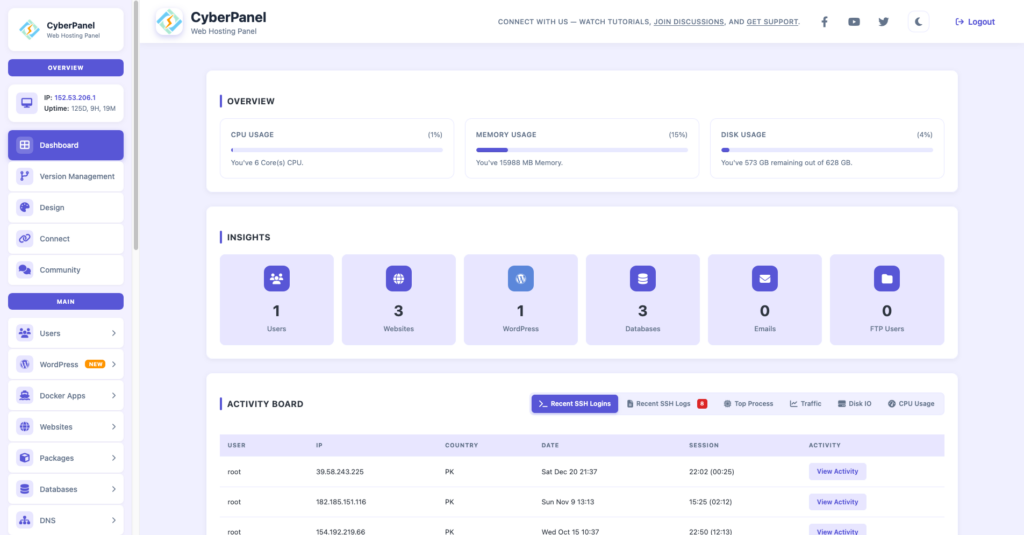
CyberPanel is a free and open-source web hosting control panel that uses OpenLiteSpeed. It makes the deployment of websites, SSL management, backups, databases, email services, and general server administration easier.
By working with Ansible and Molecule, teams can implement automated infrastructure testing while running CyberPanel-managed production environments, thus enjoying a more efficient DevOps workflow.
Conclusion
Ansible Molecule has rapidly emerged as one of the most effective Infrastructure as Code testing tools. It is a wonderful approach that developers can use to spot the configuration problems early, enhance deployment reliability, and create less error-prone automation projects by incorporating automated role testing with containerized environments like Ansible Molecule Docker. Whichever way you are doing – creating custom images with Ansible Molecule Docker, writing an Ansible Molecule Dockerfile, or automating the execution of Molecule tests in your CI/CD pipeline – turning to automated testing is one great turning point in DevOps workflows becoming more robust.
Would you like to make some significant progress in the quality of your Ansible automation? Then look no further!
Test every role thoroughly before you deploy it to production by using Ansible Molecule.
FAQs
Can Molecule Be Used In Enterprise CI/CD Pipelines?
Absolutely. Molecule is widely integrated into enterprise DevOps pipelines to automate infrastructure validation before deployment.
Is Docker Mandatory For Molecule?
No. Molecule supports multiple drivers, including Podman, virtualization platforms, and cloud environments. Docker is simply the most commonly used option.
Does Molecule Replace Manual Testing Completely?
No. Molecule significantly reduces manual testing, but production validation and environment-specific checks may still be necessary for critical infrastructure.