
On this page
HTTP/3 can improve how browsers communicate with your web server by using the QUIC protocol instead of traditional TCP based HTTP connections. If you run OpenLiteSpeed, you can enable HTTP/3 by configuring QUIC support, ensuring the required UDP port is available, and then verifying that the server is actually responding over HTTP/3.
For websites managed through CyberPanel, this setup is particularly relevant because CyberPanel uses OpenLiteSpeed as its web server. This guide explains how HTTP/3 works, how to enable HTTP3 on OpenLiteSpeed, configure the required network settings, and verify that the setup is working correctly.
What Is HTTP/3 & How Does It Work?
HTTP/3 is the third major version of the HTTP protocol used to transfer web resources between browsers and servers.
Unlike HTTP/1.1 and HTTP/2, which traditionally use TCP, HTTP/3 uses QUIC, a modern transport protocol built on UDP.
The basic difference is:
HTTP/1.1 → TCP → HTTP
HTTP/2 → TCP → HTTP
HTTP/3 → QUIC → HTTP
QUIC was designed to reduce connection setup delays and handle packet loss more efficiently than traditional TCP based connections.
This makes HTTP/3 particularly useful for modern websites where connection latency and network conditions can affect loading performance.
What Do You Need to Enable HTTP3 Server?
HTTP/3 uses QUIC as its transport protocol.
QUIC provides features such as:
- Encrypted connections
- Faster connection establishment
- Stream multiplexing
- Connection migration
- Reduced head of line blocking
- Better handling of changing network conditions
Unlike HTTP/2 over TCP, independent QUIC streams do not have to wait for a lost packet from another stream in the same way.
This is one reason HTTP/3 can provide a better experience on networks with packet loss or changing connectivity.
What Is the QUIC Protocol Network?
The QUIC protocol is a transport protocol that operates over UDP.
HTTP/3 uses QUIC for communication between the client and server.
For a typical HTTP/3 connection, the browser connects to the server using UDP port 443.
That means enabling HTTP/3 is not simply a matter of switching on a setting in OpenLiteSpeed.
The server must also be able to receive QUIC traffic through the network.
Does OpenLiteSpeed Support HTTP/3?
Yes. OpenLiteSpeed supports HTTP/3 through QUIC.
This makes OpenLiteSpeed suitable for websites that want to serve modern browsers over HTTP/3 without replacing the web server.
However, support depends on the OpenLiteSpeed version and configuration.
Before changing the configuration, make sure your OpenLiteSpeed installation is updated to a version that supports the HTTP/3 features you intend to use.
What Do You Need Before Enabling HTTP/3?
Before starting an OpenLiteSpeed QUIC setup, check the following:
| Requirement | Why it matters |
|---|---|
| OpenLiteSpeed | Provides HTTP/3 and QUIC support |
| Valid SSL certificate | HTTP/3 is used over HTTPS |
| UDP port 443 | Required for QUIC traffic |
| TCP port 443 | Still required for HTTPS and fallback |
| Supported OpenLiteSpeed version | Provides current HTTP/3 functionality |
| Firewall access | Must allow QUIC traffic |
| DNS pointing to server | Browser must reach the correct server |
The most commonly missed requirement is UDP 443.
Opening TCP 443 alone does not allow HTTP/3 traffic.
How Do You Enable HTTP3 OpenLiteSpeed?
The exact interface can vary by OpenLiteSpeed version and hosting environment, but the general process is straightforward.
Step 1: Confirm HTTPS Is Working
HTTP/3 is normally used with HTTPS.
Open your website using:
Make sure the SSL certificate is valid before proceeding.
If HTTPS itself is not working correctly, fix that first.
Step 2: Check Your OpenLiteSpeed Version
Before configuring QUIC, check the installed OpenLiteSpeed version.
You can check this from the server environment or through your hosting control panel.
On a command line installation, you can use:
/usr/local/lsws/bin/openlitespeed -vThe exact command can vary depending on how OpenLiteSpeed was installed.
If you are using CyberPanel, you can manage many OpenLiteSpeed related server settings through the CyberPanel interface rather than editing configuration files manually.
Step 3: Enable QUIC Support
OpenLiteSpeed provides QUIC and HTTP/3 support through its listener configuration.
The HTTPS listener should be configured to accept secure connections and HTTP/3 traffic.
Depending on your OpenLiteSpeed version, the relevant HTTP/3 or QUIC settings may appear in the listener configuration.
Do not copy an old configuration from another server without checking your installed version first.
Step 4: Allow UDP Port 443
This is one of the most important steps.
HTTP/3 uses QUIC over UDP.
Therefore, allow:
UDP 443You should generally keep:
TCP 443open as well.
TCP remains important because browsers can fall back to HTTP/2 or HTTP/1.1 when HTTP/3 cannot be established.
Your firewall should therefore allow both protocols on HTTPS:
| Protocol | Port | Purpose |
|---|---|---|
| TCP | 443 | HTTPS, HTTP/2, fallback |
| UDP | 443 | QUIC and HTTP/3 |
Step 5: Restart or Reload OpenLiteSpeed
After changing the configuration, reload or restart OpenLiteSpeed so the new settings take effect.
For example:
systemctl restart lswsThe exact service command depends on your installation.
If you manage the server through CyberPanel, use the available service management controls where appropriate.
Step 6: Verify HTTP/3
Do not assume HTTP/3 is working simply because QUIC is enabled.
Test the website from a browser or HTTP/3 testing tool.
You want to confirm that the browser actually establishes an HTTP/3 connection.
How Do You Check if HTTP/3 Is Enabled?
There are several ways to verify HTTP/3.
Check Your Browser
In Chromium based browsers, open Developer Tools and inspect the Network panel.
You can often add or inspect the protocol information to determine whether a request was served through:
h3If the connection shows h3, the request is using HTTP/3.
Check With cURL
A recent version of cURL with HTTP/3 support can be used to test the server.
For example:
curl --http3 -I https://yourdomain.comIf the installed cURL version does not support HTTP/3, the command will fail even if your server is correctly configured.
Check support with:
curl --versionLook for HTTP/3 support in the listed protocols or features.
Check HTTP Response Headers
HTTP/3 is not usually confirmed simply by seeing a normal HTTPS response.
The connection protocol itself needs to be checked.
A response such as:
HTTP/3 200is a strong indication that the request was served through HTTP/3.
How Do You Enable HTTP3 in CyberPanel?
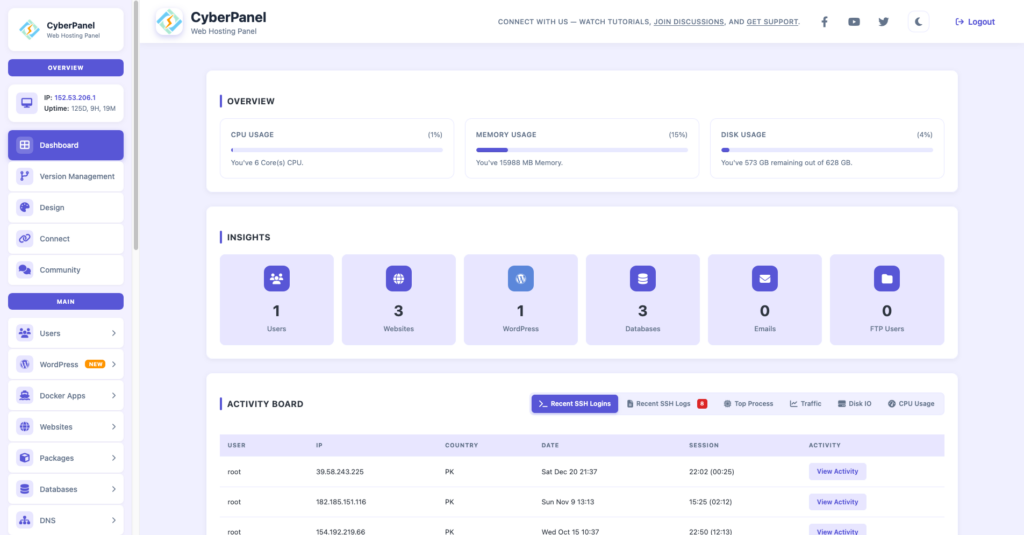
If your website is hosted on CyberPanel, the process starts with the OpenLiteSpeed server configuration.
CyberPanel is a free and open-source web hosting control panel. It uses OpenLiteSpeed for its web server stack, making it a natural environment for HTTP/3 and QUIC.
A typical workflow is:
CyberPanel → OpenLiteSpeed → HTTPS listener → QUIC/HTTP/3 → UDP 443
Before changing anything, make sure:
- Your website has a valid SSL certificate.
- OpenLiteSpeed is installed and running.
- UDP 443 is allowed by the firewall.
- TCP 443 remains available.
- Your DNS records point to the correct server.
- Your OpenLiteSpeed version supports the required HTTP/3 functionality.
CyberPanel simplifies server management, but HTTP/3 still depends on the underlying OpenLiteSpeed and network configuration.
How Do You Configure OpenLiteSpeed QUIC?
For an OpenLiteSpeed QUIC setup, think about the configuration in three layers.
Layer 1: Web Server
OpenLiteSpeed must support and have QUIC enabled.
Layer 2: Network
UDP 443 must be reachable from the internet.
Layer 3: Website
The domain must have working HTTPS and point to the correct server.
If any one of these layers is missing, HTTP/3 may not work.
This is why simply enabling an HTTP/3 checkbox does not always solve the problem.
Why Is UDP 443 Important for HTTP/3?
This is one of the most common points of confusion.
HTTPS traditionally uses TCP port 443.
HTTP/3 uses QUIC, which operates over UDP.
Therefore, a server can have:
TCP 443: OPEN
UDP 443: CLOSEDand HTTPS can still work perfectly while HTTP/3 fails.
If you want HTTP/3, make sure your firewall, cloud provider, security group, and hosting network allow UDP 443.
What Happens If HTTP/3 Does Not Work?
If your website continues using HTTP/2 after enabling HTTP/3, check the network before changing more OpenLiteSpeed settings.
Use this troubleshooting order:
1. Check UDP 443
Make sure the port is open at every relevant firewall layer.
This may include:
- Server firewall
- Cloud firewall
- Hosting provider firewall
- Security group
- Network firewall
2. Check SSL
Confirm that HTTPS works normally.
3. Check DNS
Make sure the domain points to the server where OpenLiteSpeed is running.
4. Check OpenLiteSpeed
Confirm that QUIC and HTTP/3 support are enabled.
5. Check Your Client
Your browser or testing tool must support HTTP/3.
6. Check the Protocol
Do not judge HTTP/3 from page speed alone.
Verify that the actual connection uses h3.
Does HTTP/3 Replace HTTP/2?
No.
You generally do not need to disable HTTP/2 when enabling HTTP/3.
A modern website can support HTTP/3 while still allowing clients to connect through HTTP/2 or HTTP/1.1.
This fallback is useful because not every client, network, proxy, or firewall supports QUIC.
The practical setup is therefore:
HTTP/3 + HTTP/2 + HTTPS fallback
rather than HTTP/3 alone.
Does HTTP/3 Make a Website Faster?
HTTP/3 can reduce connection latency and improve performance in certain network conditions, but enabling it does not guarantee a dramatic improvement in every speed test.
The actual benefit depends on:
- Visitor location
- Network quality
- Latency
- Packet loss
- Page size
- Number of requests
- Server response time
- CDN configuration
- Browser support
HTTP/3 is one part of a performance strategy.
It does not replace image optimization, caching, efficient CSS and JavaScript, or good server configuration.
HTTP/2 vs HTTP/3
| Feature | HTTP/2 | HTTP/3 |
|---|---|---|
| Transport | TCP | QUIC over UDP |
| Standard HTTPS port | 443 | 443 |
| Encryption | TLS | TLS integrated with QUIC |
| Multiplexing | Yes | Yes |
| Connection migration | Limited | Supported by QUIC |
| Head of line blocking | TCP level issue remains | Reduced at transport level |
| UDP required | No | Yes |
The biggest architectural change is the transport layer.
HTTP/3 moves HTTP communication from TCP to QUIC over UDP.
Is HTTP/3 Safe to Use?
HTTP/3 is designed with encryption as a fundamental part of the protocol.
It uses TLS with QUIC rather than relying on a separate unencrypted HTTP connection.
For a normal HTTPS website, HTTP/3 therefore provides encrypted client-server communication.
However, security still depends on the complete server configuration.
You should keep your SSL certificate, OpenLiteSpeed installation, firewall, and operating system properly maintained.
Does HTTP/3 Work With a CDN?
Yes.
Many modern CDNs support HTTP/3.
In that setup, the visitor may establish an HTTP/3 connection with the CDN edge server rather than directly with your origin server.
This creates an important distinction:
Browser → HTTP/3 → CDN → Origin
Your origin server may therefore not be the component directly handling the visitor’s HTTP/3 connection.
If you use a CDN, check its HTTP/3 settings separately from your OpenLiteSpeed configuration.
HTTP/3 and CyberPanel: What Should You Check?
If you manage the server through CyberPanel, use the control panel to understand your server environment first.
Check:
| Component | What to verify |
|---|---|
| CyberPanel | Server management is functioning normally |
| OpenLiteSpeed | Running and updated |
| SSL | Valid HTTPS certificate |
| Listener | Correct HTTPS configuration |
| Firewall | UDP 443 allowed |
| DNS | Domain points to the correct server |
| Browser | Supports HTTP/3 |
| Verification | Connection actually reports h3 |
CyberPanel does not replace the underlying HTTP/3 protocol configuration. It provides the management environment, while OpenLiteSpeed handles the web server functionality.
Common HTTP/3 Configuration Mistakes
Opening Only TCP 443
This is the most obvious mistake.
TCP 443 supports normal HTTPS, but QUIC requires UDP 443.
Closing TCP 443 After Enabling HTTP/3
Do not do this.
HTTP/3 should normally work alongside existing HTTPS protocols.
Testing Only With a Page Speed Score
A performance score does not prove that HTTP/3 is active.
Check the actual network protocol.
Forgetting a Cloud Firewall
Your local firewall may allow UDP 443 while your cloud provider blocks it.
Check every firewall layer.
Using an Old Testing Tool
A tool without HTTP/3 support cannot reliably verify an HTTP/3 configuration.
Changing Too Many Settings
If HTTP/3 does not work, change one thing at a time.
This makes troubleshooting much easier.
HTTP/3 Setup Checklist
Before considering the setup complete, verify each item:
- OpenLiteSpeed supports HTTP/3
- HTTPS works correctly
- The correct HTTPS listener is configured
- QUIC/HTTP/3 is enabled
- UDP 443 is open
- TCP 443 remains open
- DNS points to the correct server
- Firewall rules allow QUIC
- Browser or testing tool supports HTTP/3
- Network inspection shows
h3 - Website functions normally over HTTPS
Frequently Asked Questions
Can HTTP/3 work without HTTPS?
For normal web usage, HTTP/3 is designed around encrypted QUIC connections and is used with HTTPS. Configure a valid TLS certificate before attempting to enable it for a production website.
Does OpenLiteSpeed support QUIC?
Yes. OpenLiteSpeed supports QUIC and HTTP/3, subject to the installed version and configuration.
Does enabling HTTP/3 improve SEO?
HTTP/3 itself is not a standalone SEO setting. It can contribute to a faster and more reliable connection, but search performance depends on many other technical and content factors.
Can I disable HTTP/2 after enabling HTTP/3?
There is generally little reason to do so. Keeping HTTP/2 available provides compatibility for clients and networks that cannot establish QUIC connections.
What port does HTTP/3 use?
HTTP/3 normally uses UDP port 443 for QUIC traffic. TCP port 443 should generally remain available for HTTPS and fallback connections.
Final Thoughts
To enable HTTP3 on a server, you need more than a single configuration change.
On OpenLiteSpeed, HTTP/3 depends on QUIC support, a working HTTPS configuration, and network access to UDP port 443. The same applies when managing an OpenLiteSpeed server through CyberPanel.
Start by confirming your OpenLiteSpeed version and SSL configuration. Then configure QUIC, allow UDP 443, keep TCP 443 available, and verify the connection with an HTTP/3 capable browser or testing tool.
Most importantly, verify the actual protocol instead of assuming HTTP/3 is working because the server configuration was changed.
If you manage WordPress or other websites through CyberPanel and OpenLiteSpeed, enabling HTTP/3 can be a useful addition to your server performance setup when the network and client environment support QUIC.