On this page
Every Linux user needs a good text editor. Not something heavy like an IDE. Not something complicated like Vim for quick edits. Just a clean, fast tool that opens instantly and lets you write or modify files without distractions. Thats exactly where Gedit Linux fits perfectly.
For several years, Gedit for Linux has been the default text editor in numerous distributions, especially GNOME-based systems. It’s a lightweight, simple, yet sufficiently powerful tool for coding, configuration edits, notes, and scripting. You dont waste time learning shortcuts or modes. You open it and start typing.
Editing server configuration files, writing code, or changing system files, whatever it is, Gedit in Linux does it all smoothly. It features syntax highlighting, plugins, multiple tabs, and extensions support without getting heavy or slow. Its the type of tool that becomes invisible because it just works.
In this tutorial, you will find out what Linux Gedit is, how to install it, how to use it efficiently, when it is enough, and when you might need a Gedit alternative that Linux users favor. We will also talk about how CyberPanel users can leverage Gedit for quick server and project edits.
Let’s go!
What is Gedit Linux?
Gedit Linux is a graphical text editor that is very light and made for the GNOME desktop environment. It focuses on being simple but still has some features useful to developers.
It is a kind of editor that is not quite as basic as simple editors but not as complex as full IDEs. That makes it great for regular daily chores like changing configuration files, scripting, or a bit of coding.
It launches in a snap, consumes very little memory, and feels neat.
Why Choose Gedit for Linux Over Heavy Editors?
If you want speed and are after a straightforward solution, then Gedit for Linux is your best bet. It is a very handy editor with which you can have the very basics, such as syntax highlighting and search, without the hassle of using a full-fledged IDE.
For simple jobs, it is a real time-saver. To modify a single file, you dont have to get project setups or install plugins.
Pretty much all Linux people use Gedit as their standard “quick editor”.
Core Features of Gedit in Linux
Gedit in Linux includes many features without feeling bloated. It keeps the interface minimal yet practical. Here are some of the core features:
- Syntax highlighting
- Multiple tabs
- Auto indentation
- Find and replace
- Line numbers
- Plugin support
- Encoding options
- Simple UI
These features are enough for most editing needs without slowing down your system.
How to Install Gedit Linux?
Installing Linux Gedit is very easy. Most GNOME systems already include it. If not, you can install it using your package manager.
Ubuntu / Debian
sudo apt update
sudo apt install gedit
Arch Linux
sudo pacman -S gedit
Fedora
sudo dnf install geditVerify Installation
gedit --version
Example output:
gedit 44.0If you see a version number, it’s installed correctly.
How to Use Gedit in Linux?
Learning how to use Gedit in Linux takes seconds because it behaves like a normal text editor.
Basic usage:
Open a file
gedit filename.txt
Open with sudo (for system files)
sudo gedit /etc/hosts
Open multiple files
gedit file1.txt file2.txt
Each file opens in a new tab.
That’s it. No complex commands or modes.
When to Use Linux Gedit?
You should use Linux Gedit if you have to:
- Edit config files
- Write small scripts
- Take notes
- Make quick code changes
- Do server-side edits
- Learn Linux basics
If you don’t have to build large projects, Gedit is more than enough.
Gedit Alternative Linux Comparison Table
| Editor | Best For | Difficulty | Why Choose It |
|---|---|---|---|
| Gedit | Quick edits | Very Easy | Lightweight and simple |
| VS Code | Full development | Easy | Extensions and debugging |
| Nano | Terminal editing | Very Easy | Works inside SSH |
| Vim | Power users | Hard | Extremely fast and efficient |
| Sublime Text | Coding projects | Medium | Smooth and fast UI |
When Do You Need a Gedit Alternative Linux Users Prefer?
Linux users sometimes consider the default text editor Gedit, to be limited for large-scale development work. So, a Gedit alternative Linux editor could be a better choice.
Here is a clear comparison that brings in more clarity.
Even though there are a lot of modern editors around, the Gedit Linux editor still remains one of the most popular choices.
Among others, the reasons include:
- Instant startup
- Very low RAM usage
- No learning curve
- Clean interface
- Stable performance
For most Linux tasks that you do daily, simpler is often better. Not every edit has to use a heavy IDE.
The Role of CyberPanel with Gedit for Linux
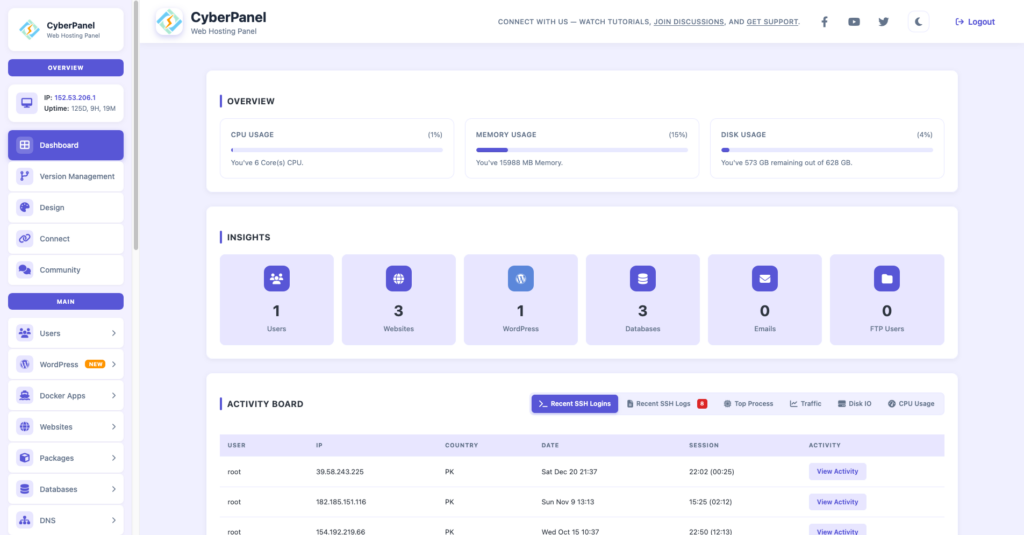
CyberPanel is a web hosting control panel powered by OpenLiteSpeed. It users manage servers, websites, and configuration files. This is where Gedit for Linux becomes very handy.
- You may be editing server configs
- You may be modifying virtual host files
- You may be updating scripts
- You may be adjusting environment variables
- You may be changing website code on the fly
No need to load up heavyweight editors when Gedit can be there for you to make quick changes directly on your Linux system.
CyberPanel is a server management solution, while Gedit is a quick file editing tool. They are simple and efficient together.
Useful Tips on Becoming a Pro Gedit User
With barely noticeable changes, Gedit is much more awesome.
Turn on:
- Line numbers
- Highlight current line
- Auto save
- Syntax highlighting
You may switch them on in Preferences.
Moreover, get plugins for:
- File browser
- Snippets
- Terminal integration
These features give you power without the burden of complexity.
Final Thoughts: Gedit Linux Is Small but Powerful
You don’t always need to go for a complex editor. There are times when you only need something quickly, and you can rely on it. This is just exactly what Gedit Linux offers.
Install it one time, open files in no time, and finish your work without getting distracted. Put it together with CyberPanel for server and website management, and you will have a neat, productive Linux workflow.
Simple tools often work best.
People Also Ask
Is Gedit for Linux good for coding?
Yes, for small to medium projects. It supports syntax highlighting and tabs, which are enough for basic development.
How do I open files with Gedit in Linux?
Use the command gedit filename.txt. It opens the file in a graphical window for editing.
Is Linux Gedit preinstalled?
Many GNOME-based distributions include it by default. If not, it can be installed easily through the package manager.