On this page
LiteSpeed vs Apache is a common comparison when choosing a web server for a high traffic website, WordPress site, or hosting server. Both can run PHP applications, WordPress, and other popular web platforms, but they use different architectures and offer different approaches to performance, caching, and server management.
LiteSpeed Web Server is designed as an Apache compatible replacement, while Apache uses a process or thread based architecture. LiteSpeed uses an event driven architecture and includes its own high performance cache engine. These differences can affect server resource usage, website speed, and scalability.
If you are comparing LiteSpeed vs Apache vs Nginx, the right choice depends on what you need from your server. WordPress hosting, server resources, caching, compatibility, traffic levels, and budget can all change the answer.
What Is LiteSpeed Web Server?
LiteSpeed Web Server is a commercial web server developed by LiteSpeed Technologies. It is designed to replace Apache without requiring major changes to existing Apache based websites.
LiteSpeed can read Apache configuration files and .htaccess files. This makes migration easier for websites that already depend on Apache configuration and rewrite rules.
However, LiteSpeed is not simply a modified version of Apache. It was built from scratch and uses a different architecture.
Its main features include:
- Event driven architecture
- Apache configuration compatibility
.htaccesssupport- LSAPI for PHP
- Built in caching
- HTTP/2 support
- QUIC and HTTP/3 support
- WebSocket support
- Support for popular control panels
- Compatibility with common Apache rewrite rules
LiteSpeed also includes LiteSpeed Cache, a server level caching system that can work with applications such as WordPress.
This combination is one reason LiteSpeed is often considered for WordPress and hosting environments.
What Is Apache Web Server?
Apache HTTP Server is one of the most widely used open source web servers. It has been used for decades to serve websites and web applications.
Apache supports a large ecosystem of modules and configuration options. It can run PHP and many other application technologies and is supported by most hosting environments and control panels.
One of Apache’s biggest strengths is its mature ecosystem.
Developers and server administrators can find extensive documentation, tutorials, modules, and community support for almost every common Apache configuration.
Apache also supports .htaccess, URL rewriting, SSL/TLS, virtual hosts, compression, authentication, and many other web server functions.
The main architectural difference is that Apache traditionally relies on process or thread based request handling, while LiteSpeed was designed around an event driven architecture.
LiteSpeed vs Apache: What Is the Main Difference?
The biggest difference between LiteSpeed vs Apache is how the two servers handle connections and server resources.
Apache’s traditional architecture can create additional processes or threads as connection demand increases, depending on the Multi Processing Module being used.
LiteSpeed uses an event driven architecture designed to handle many concurrent connections with lower overhead.
This does not mean every website will automatically become faster after switching servers. Real world performance depends on the application, server hardware, PHP configuration, caching, database performance, traffic, and website code.
Still, the architecture creates an important difference when a server needs to handle many simultaneous connections.
| Feature | LiteSpeed | Apache |
|---|---|---|
| Architecture | Event driven | Process/thread based |
| Open source | No for LiteSpeed Enterprise | Yes |
| Apache compatibility | Yes | Native |
.htaccess | Yes | Yes |
| Built in page cache | Yes | No equivalent built into Apache |
| PHP handling | LSAPI | PHP-FPM or other handlers |
| HTTP/2 | Yes | Yes |
| HTTP/3 | Yes | Available through supported configurations |
| WordPress cache | LSCache | Third party caching usually required |
| Control panel compatibility | High | Very high |
| Resource efficiency | Designed for low overhead | Depends heavily on configuration |
| License | Commercial for Enterprise | Free |
| Ecosystem maturity | Mature | Extremely mature |
Is LiteSpeed Faster Than Apache?
LiteSpeed is designed to deliver high performance with lower resource overhead, particularly under heavy concurrency.
LiteSpeed’s architecture uses an event driven model and includes its own server level cache. Its official documentation states that LiteSpeed can handle large numbers of concurrent connections with relatively low memory usage.
LiteSpeed also publishes benchmark tests comparing its server with Apache and Nginx.
For example, one LiteSpeed HTTP/2 benchmark tested small static files on LiteSpeed, Nginx, and Apache. In that specific test environment, LiteSpeed handled more requests per second than both servers. However, this was a controlled benchmark using specific server versions and hardware, so the numbers should not be treated as universal real world results.
Your actual performance can change based on:
- CPU
- RAM
- Storage
- PHP version
- Database performance
- WordPress plugins
- Theme complexity
- Caching
- Network latency
- Traffic patterns
- Server configuration
So the more useful question is not simply whether LiteSpeed is faster.
The better question is whether its architecture and built in features fit your workload.
How Does LiteSpeed Handle PHP Differently?
PHP performance is important because many websites, especially WordPress websites, rely heavily on PHP.
LiteSpeed uses LiteSpeed Server Application Programming Interface, commonly called LSAPI, for PHP processing.
This is designed specifically for LiteSpeed and can reduce some of the overhead involved in processing PHP requests.
Apache can also deliver excellent PHP performance when configured correctly. PHP-FPM is a common setup for Apache and Nginx.
The important difference is that LiteSpeed integrates its PHP handling into its own server architecture.
For a PHP heavy application, this can become more significant when traffic increases.
What About LiteSpeed vs Apache for WordPress?
For WordPress, the comparison becomes more interesting because caching plays a major role.
A WordPress request can involve:
- Web server processing
- PHP execution
- WordPress code
- Database queries
- Plugin processing
- Theme processing
- HTML generation
A page cache can prevent much of this work from happening for every visitor.
LiteSpeed has a major advantage here because LiteSpeed Cache can operate at the server level.
The LiteSpeed Cache for WordPress plugin connects WordPress with the LiteSpeed caching system and provides controls for page caching and other performance features.
Apache does not include an equivalent built in WordPress specific cache system.
An Apache WordPress site can still be extremely fast, but it generally relies on additional caching technologies or plugins.
What Is the Difference Between LSCache and Apache Caching?
This is an important distinction.
A WordPress caching plugin can cache generated pages. But LiteSpeed Cache is integrated into the LiteSpeed server itself.
This means the cache can be handled before the request reaches the full WordPress and PHP processing stack.
For a WordPress website, the basic flow can look like this:
Visitor → LiteSpeed → LSCache → Cached page
If the page is not cached, the request can continue through the application stack.
With Apache, a common setup may involve:
Visitor → Apache → PHP → WordPress → Database
A separate caching layer can be added to improve this process.
This does not make Apache incapable of high performance. It means that LiteSpeed provides more of the caching stack as part of its own ecosystem.
LiteSpeed vs Apache vs Nginx: What Is the Difference?
If you are comparing LiteSpeed vs Apache vs Nginx, architecture becomes even more important.
Nginx is also based on an event driven architecture. This means LiteSpeed and Nginx share an important architectural concept that differs from traditional Apache processing models.
However, LiteSpeed was specifically designed to combine event driven performance with Apache compatibility.
| Feature | LiteSpeed | Apache | Nginx |
|---|---|---|---|
| Architecture | Event driven | Process/thread based | Event driven |
| Apache compatibility | High | Native | Limited |
.htaccess | Yes | Yes | No |
| Built in cache | Yes | No equivalent built in | FastCGI and proxy caching |
| PHP | LSAPI | PHP-FPM and others | PHP-FPM |
| HTTP/2 | Yes | Yes | Yes |
| HTTP/3 | Yes | Supported | Depends on build/configuration |
| WordPress LSCache | Yes | No | No |
| Open source | Enterprise version is commercial | Yes | Yes |
| Migration from Apache | Relatively easy | Native | Requires configuration changes |
| Configuration style | Apache compatible | Apache | Nginx syntax |
| Common use | Hosting, WordPress, high traffic sites | General purpose hosting | High traffic, reverse proxy, web apps |
Nginx is also highly efficient for handling concurrent connections. LiteSpeed’s difference is that it combines an event driven architecture with Apache compatibility and its own caching ecosystem.
LiteSpeed vs Apache vs Nginx: Which Uses Fewer Resources?
Resource usage depends on configuration and workload, so there is no universal RAM or CPU number that applies to every server.
However, their architectures are different.
LiteSpeed and Nginx use event driven designs that are well suited to handling large numbers of concurrent connections.
Apache can also handle large traffic volumes, but the selected Multi Processing Module and server configuration have a major effect on resource consumption.
For shared hosting or a server running many websites, resource efficiency can matter because every saved CPU cycle or megabyte of RAM can be used by other applications.
This is one reason LiteSpeed is commonly considered for hosting environments where many concurrent requests need to be handled.
Which Is Better for WordPress: LiteSpeed, Apache, or Nginx?
For WordPress, all three can work well.
The difference comes down to the surrounding stack.
A WordPress installation running on Apache can use a caching plugin and optimized PHP configuration.
A WordPress installation running on Nginx can use FastCGI caching and PHP-FPM.
A WordPress installation running on LiteSpeed can use LSCache and LiteSpeed’s server level caching.
That gives LiteSpeed a particularly integrated setup for WordPress.
LiteSpeed’s own WordPress benchmark compares LiteSpeed with LSCache, Nginx with FastCGI Cache, and Apache with W3 Total Cache. In its published HTTP/2 test, LiteSpeed produced higher request throughput in that specific test environment. These results demonstrate the tested configurations rather than guaranteeing the same performance on every WordPress website.
Does LiteSpeed Work With Apache .htaccess?
Yes.
This is one of LiteSpeed’s biggest compatibility advantages.
LiteSpeed Web Server can read Apache configuration files and .htaccess files. It also supports common Apache rewrite rules and several commonly used Apache features.
This makes migration easier.
For example, an existing WordPress website may already have rules in its .htaccess file for:
- Permalinks
- Redirects
- Security
- Browser caching
- Compression
- Access control
Moving from Apache to LiteSpeed does not normally require rewriting all of those rules into a completely different syntax.
However, Apache compatibility does not mean that every Apache module works identically.
LiteSpeed’s documentation specifically notes that it does not support Apache modules written for Apache’s own architecture, although many commonly used Apache module features have LiteSpeed equivalents.
What About LiteSpeed and CyberPanel?
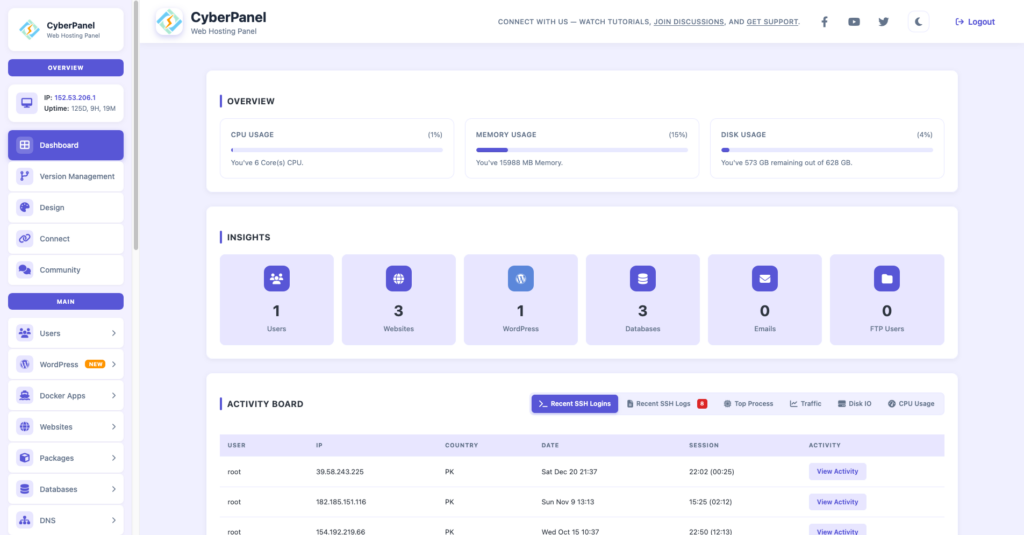
LiteSpeed is especially relevant if you are using CyberPanel.
CyberPanel is a free and open-source web hosting control panel. It is built around OpenLiteSpeed, and it can also be used with LiteSpeed Enterprise. LiteSpeed’s own product documentation lists CyberPanel among the control panels compatible with LiteSpeed Enterprise.
For WordPress users, this combination can provide a straightforward stack:
CyberPanel → OpenLiteSpeed/LiteSpeed → WordPress → LSCache
This is useful when you want server management, WordPress management, and LiteSpeed caching in the same hosting environment.
If your main reason for considering LiteSpeed is WordPress performance, CyberPanel can therefore be part of the overall hosting setup rather than something separate from the web server discussion.
Is LiteSpeed More Expensive Than Apache?
This is one area where the two servers are clearly different.
Apache is open source and can be used without purchasing a commercial server license.
LiteSpeed Enterprise is a commercial product, although LiteSpeed offers different licensing options and a free tier for some use cases.
That means you should include licensing in your hosting decision.
But price should not be viewed separately from server resources.
If a web server can handle more traffic with the same hardware, the total cost of hosting can change.
The right calculation is therefore:
Software cost + server cost + administration cost + performance requirements
rather than simply comparing the license price.
Is LiteSpeed More Secure Than Apache?
Security depends heavily on configuration, updates, application security, and server administration.
A secure web server does not make an insecure WordPress installation safe.
You still need to maintain:
- WordPress
- Plugins
- Themes
- PHP
- Server software
- Firewall rules
- User permissions
- SSL/TLS
- Authentication
- Backups
LiteSpeed supports security technologies such as ModSecurity and includes security features at the server level. Its architecture also provides several controls for handling connections and traffic.
Apache also has a mature security ecosystem and supports ModSecurity and many other security tools.
The important point is that security should be evaluated based on the complete server stack, not just the web server name.
What About HTTP/2 and HTTP/3?
Modern web servers need to support current HTTP protocols.
LiteSpeed supports HTTP/2 and HTTP/3 through QUIC. LiteSpeed documentation confirms that current LSWS versions support QUIC and HTTP/3.
Apache and Nginx also support modern HTTP protocols, although the exact support depends on the server version, build, and configuration.
For most modern websites, HTTP/3 support is useful, but it should not be treated as the only measurement of web server performance.
Your website still needs:
- Fast PHP processing
- Good caching
- Optimized assets
- Efficient database queries
- Proper server configuration
- A reliable network
LiteSpeed vs Apache Server: Which Should You Choose?
The answer depends on what you are building.
Choose LiteSpeed when:
- You run WordPress and want integrated LSCache.
- You want Apache compatibility with an event driven architecture.
- You manage many websites on a hosting server.
- You want built in server level caching.
- You want HTTP/3 and QUIC support.
- You want to reduce the number of separate caching layers.
- You are comfortable with a commercial server product.
Choose Apache when:
- You want a fully open source web server.
- Your applications depend heavily on Apache modules.
- You already have a stable Apache setup.
- Your team has strong Apache experience.
- You do not need LiteSpeed’s integrated caching ecosystem.
- Your current performance is already sufficient.
Choose Nginx when:
- You prefer an event driven web server.
- You need a high performance reverse proxy.
- Your stack is already designed around Nginx.
- You are comfortable managing Nginx configuration.
- You want an open source alternative to commercial LiteSpeed.
The choice should match your workload rather than a generic performance claim.
Apache vs Nginx vs LiteSpeed: Quick Comparison
| Requirement | LiteSpeed | Apache | Nginx |
|---|---|---|---|
| WordPress | Excellent fit | Excellent | Excellent |
| Built in WordPress cache ecosystem | LSCache | Requires additional solution | Requires additional solution |
| Apache compatibility | Excellent | Native | Limited |
.htaccess | Supported | Supported | Not supported |
| High concurrency | Strong | Strong with proper configuration | Strong |
| Ease of Apache migration | High | Not applicable | Lower |
| Open source | OpenLiteSpeed is open source; Enterprise is commercial | Yes | Yes |
| Built in cache | Yes | No equivalent built in | No equivalent to LSCache |
| Server level WordPress cache | Yes with LSCache | No | No |
| HTTP/3 | Yes | Configuration dependent | Configuration dependent |
| Hosting use | Strong | Very common | Strong |
| Cost | Depends on edition/license | Free | Free |
Is LiteSpeed Worth Switching From Apache?
If your Apache server already performs well, there is no reason to switch simply because another web server has a better benchmark.
A migration makes more sense when you have a specific problem to solve.
For example:
- High server load
- Too many PHP processes
- Slow WordPress response times
- Heavy traffic spikes
- Need for integrated page caching
- Desire for simpler caching architecture
- Growing hosting workload
LiteSpeed’s Apache compatibility can also make the migration less disruptive than moving to a server with a completely different configuration system.
Before migrating a production website, test your actual workload.
Measure:
- Requests per second
- CPU usage
- RAM usage
- PHP response time
- TTFB
- Cache hit rate
- Database load
- Peak traffic behavior
This gives you a much more useful comparison than a generic benchmark.
How Do You Migrate From Apache to LiteSpeed?
LiteSpeed is designed to make Apache migration relatively straightforward.
The basic process is:
- Back up your server and websites.
- Check application compatibility.
- Check Apache modules and custom configurations.
- Install LiteSpeed.
- Configure PHP and LSAPI.
- Test existing
.htaccessrules. - Verify SSL certificates.
- Test WordPress and other applications.
- Configure LiteSpeed Cache where appropriate.
- Monitor CPU, RAM, response time, and errors.
Do not migrate a busy production server without testing.
An application can depend on a specific Apache module even if the website itself looks simple.
LiteSpeed provides migration documentation specifically for checking Apache configurations and compatibility before switching.
Frequently Asked Questions
Is LiteSpeed faster than Apache?
LiteSpeed is designed for high performance and efficient concurrent request handling. Published LiteSpeed benchmarks show higher throughput than Apache in specific test environments, but real world performance depends on hardware, configuration, workload, and caching.
What is the difference between LiteSpeed and Apache?
The main differences are architecture, caching, PHP handling, licensing, and Apache compatibility. LiteSpeed uses an event driven architecture and LSAPI, while Apache uses its own Multi Processing Module architecture and broader open source module ecosystem.
Should I switch from Apache to LiteSpeed?
Consider switching when you have a specific performance, caching, scalability, or management requirement that LiteSpeed can address. Test your actual website workload before making the decision.
Is Apache still good for WordPress?
Yes. Apache remains a capable WordPress web server. A properly configured Apache server with good PHP, database, and caching configuration can deliver excellent WordPress performance.
Final Thoughts
The LiteSpeed vs Apache comparison is not simply about which server has the highest benchmark number.
Apache offers a mature open source ecosystem, broad compatibility, and extensive documentation. LiteSpeed combines an event driven architecture with strong Apache compatibility and an integrated caching system. Nginx offers another event driven approach and is widely used for high concurrency workloads and reverse proxy setups.
For WordPress, LiteSpeed becomes particularly interesting because LSCache operates at the server level and integrates directly with WordPress through the LiteSpeed Cache plugin.
For Apache users, there is no automatic reason to migrate if the existing setup already meets the site’s requirements.
The better choice depends on your workload, hosting environment, technical requirements, budget, and the amount of caching and server optimization you need.
Compare the complete hosting stack, not just the web server, before making the switch.