On this page
Scientific Linux was once a Linux distribution optimized for research centers, labs, universities, and scientific computing. This OS was famous for its reliable Enterprise Linux platform with software and tools tailored to specific scientific needs.
But if you are thinking of installing Scientific Linux OS for your server or VPS, there is rather sad news for you. Scientific Linux was discontinued with version 7 on June 30, 2024.
Therefore, Scientific Linux is an intriguing system to learn about, but it is not a good idea to use it for your server OS.
What Is Scientific Linux?
Scientific Linux is an enterprise-class Linux OS based on the source code of Red Hat Enterprise Linux. It was primarily maintained by Fermilab and other research facilities and supported by CERN.
Its purpose was to provide a stable Linux platform for scientific, research, and enterprise-level computing, and it was intended to supplement the needs of large-scale research, software, servers, and lab computers.
It is not a Linux distribution designed to install on regular computers. And unlike popular Linux OSes, Scientific Linux is focused almost exclusively on servers and scientific maintenance.
Its ecosystem was based around the familiar Enterprise Linux model:
Red Hat Enterprise Linux
↓
Enterprise Linux base
↓
Scientific Linux
↓
Research + Scientific Computing
This made it attractive to organizations that needed stability and compatibility more than the newest desktop features.
What Was Scientific Linux OS Used For?
The Scientific Linux OS was used in many environments where predictable software and long-term stability mattered.
Common use cases included:
- Scientific research
- University computing
- Physics laboratories
- Research servers
- High-performance computing
- Computing clusters
- Data analysis
- Laboratory infrastructure
- Enterprise applications
- Scientific software development
Its association with major research organizations helped establish its reputation as a serious operating system for scientific workloads.
For researchers, the operating system was often less important than the software environment built on top of it. Keeping that environment stable could save considerable time when applications depended on specific libraries, compilers, or system packages.
Scientific Linux addressed that need with a stable platform.
Why Was Scientific Linux Popular?
The scientific Linux was popular because it provided a common framework that combined the enterprise-level operating system with scientific research environments.
Scientific Enterprise Software
Scientific Linux incorporated the enterprise-level operating system known as the Enterprise Linux which was dependable.
Scientific Linux came with the use of scientific software making it ideal for the scientific community. This included the enterprise repositories and packages that were beneficial in meeting the demands of scientific research.
Familiarity
Like other enterprise platforms, scientific Linux was based on the reliable and familiar RPM-based package management.
Scientific Linux was backed up by institutional support which helped it to gain popularity and trust from researchers.
Long-term environment
Mostly in research settings, there are always some long-running environments. Due to this, there are many challenges involved when it comes to rolling out updates and upgrades to all the applications and servers after every six months or even less. This was the main reason why the scientific Linux was popular among researchers because it offered a reliable platform for sustaining such environments.
Scientific Linux Versions
Scientific Linux went through several major releases before reaching its final version.
| Version | General era | Status |
| Scientific Linux 4 | Earlier generation | End of life |
| Scientific Linux 5 | Enterprise Linux 5 era | End of life |
| Scientific Linux 6 | Enterprise Linux 6 era | End of life |
| Scientific Linux 7 | Enterprise Linux 7 era | Final release |
| Scientific Linux 7.9 | Final point release | End of life |
Scientific Linux 7.9 was the final release of the distribution.
There was no Scientific Linux 8 or Scientific Linux 9.
Instead, the project eventually came to an end as organizations moved toward other Enterprise Linux alternatives.
Is Scientific Linux Discontinued?
Yes. Scientific Linux is discontinued.
Scientific Linux 7 reached end of life on June 30, 2024. After that date, the project stopped publishing new security updates for the distribution.
This is the most important thing to understand if you are considering Scientific Linux today.
An old ISO or package repository may still exist, but availability does not mean active support.
There is a major difference between:
“I can download it.”
and:
“I should deploy it.”
Scientific Linux falls into the first category.
Why Did Scientific Linux Stop?
Scientific Linux was discontinued in other words, the further development of this enterprise Linux variant was halted at version 7.
As the enterprise IT world evolved, many scientific Linux users opted to move towards other distributions.
The problem is that the end-of-life for Scientific Linux was not just a matter of a particular version being outdated. The discontinuation meant the entire branch was no longer supported, and no new versions were to be released. Therefore, for all existing installations, migration became the only viable option.
In particular, many companies chose to migrate to the modern Enterprise Linux platform, such as AlmaLinux, which is now the preferred fork among many scientific Linux users.
Can I Still Get Scientific Linux?
It is possible to obtain some of the old installers for Scientific Linux.
However, you must understand that these are legacy products, which serve a particular niche need.
In particular, the old Scientific Linux installation media can benefit users who want to:
- Run legacy applications
- Reconstruct historical environments
- Test migration procedures
- Work with applications requiring an obsolete OS
The point is that installing Scientific Linux is not an option for running a web server exposed to the internet. If you happen to come across a website offering .iso files for Scientific Linux, think twice before downloading them. The fact is that these downloaders do not provide the latest security updates, which are only available through Red Hat.
Is it Worthwhile to Install Scientific Linux Right Now?
Unless you have very specific needs, there is probably no need to use Scientific Linux in 2023. If you are setting up a computer, server, VPS, or even a hosting platform right now, focus on the modern and actively maintained distributions. In the case of Scientific Linux, it is better to use it in a sandboxed environment, such as a virtual machine, when you have to support legacy applications or data.
Imagine you are asked to keep an old scientific Python application running because it is critical for your operations. If this program is only compatible with Scientific Linux 7, you have several options. You can migrate it to a new platform, invest a lot of time and effort into porting it, or simply put it in a virtual machine along with the old Linux distribution. This way, it will run in isolation and will not harm the rest of your system if something goes wrong. Obviously, such a scenario is much better than trying to use Scientific Linux for a mission-critical server application.
What Is a Scientific Linux VPS?
A Scientific Linux VPS is a virtual private server running Scientific Linux as its operating system.
A VPS provides virtualized resources such as:
- CPU
- RAM
- Storage
- Network access
- Root access
- An operating system
Historically, a Scientific Linux VPS could be useful for research applications, scientific software, development environments, or organizations that wanted to reproduce their existing Scientific Linux infrastructure in a virtual environment.
The problem today is the operating system’s lifecycle.
A VPS does not make an unsupported operating system supported.
If you deploy Scientific Linux 7 on a new VPS, you still have an operating system that no longer receives normal security updates.
Is Scientific Linux VPS Still a Good Choice?
For a new production VPS, Scientific Linux is not recommended.
| Requirement | Scientific Linux VPS |
| Legacy scientific software | Possible |
| Testing old applications | Useful |
| Historical environment | Useful |
| New development server | Not recommended |
| Public web server | Not recommended |
| Production hosting | Not recommended |
| New CyberPanel server | Not recommended |
| Security-sensitive workload | Not recommended |
The virtualization layer does not change the operating system’s support status.
If you need a VPS for modern workloads, choose a supported Linux distribution.
What Should You Use Instead of Scientific Linux?
There is no single replacement for every workload, but several modern Enterprise Linux distributions can fill the role Scientific Linux once occupied.
AlmaLinux
AlmaLinux is one of the strongest choices for users looking for a modern Enterprise Linux environment.
It is especially interesting for organizations migrating from older RHEL-compatible distributions.
Rocky Linux
Rocky Linux is another popular Enterprise Linux option and is widely used for servers and hosting.
Red Hat Enterprise Linux
Organizations that need commercial support can choose RHEL directly.
CentOS Stream
CentOS Stream is another option within the broader Enterprise Linux ecosystem, although its development model differs from the traditional Scientific Linux approach.
For many Scientific Linux users, AlmaLinux is the most natural starting point for migration research.
Scientific Linux vs AlmaLinux
If you are deciding whether to keep an old Scientific Linux environment or migrate, the difference is significant.
| Feature | Scientific Linux | AlmaLinux |
| Current development | No | Yes |
| Security updates | No | Yes |
| Enterprise Linux ecosystem | Yes | Yes |
| Suitable for new VPS | No | Yes |
| Production deployment | Not recommended | Yes |
| Legacy compatibility | Excellent for old SL software | Requires testing |
| Modern software | Limited | Better |
| Long-term use | No | Yes |
The biggest advantage of AlmaLinux is not simply compatibility.
It is the fact that you are moving to an actively maintained platform.
Can Scientific Linux Run on a VPS?
Technically, yes.
A virtualization platform can run an old Scientific Linux installation if it supports the required architecture and virtualization environment.
But technical possibility is not the same as practical recommendation.
You might run Scientific Linux in a VPS when you need to reproduce an old environment.
For example:
Modern VPS
↓
Virtual Machine
↓
Scientific Linux 7
↓
Legacy Research Application
This can be useful for controlled testing.
But putting that same environment directly on the public Internet creates unnecessary security risk.
Can You Use Scientific Linux for Web Hosting?
You technically could host websites on an old Scientific Linux installation, but it is not a sensible choice for a new hosting environment.
Modern hosting requires an operating system that continues receiving:
- Security patches
- Package updates
- Library updates
- Kernel updates
- Compatibility fixes
Scientific Linux no longer provides that lifecycle.
For a new web hosting server, choose a supported Linux distribution instead.
Can You Install CyberPanel on Scientific Linux?
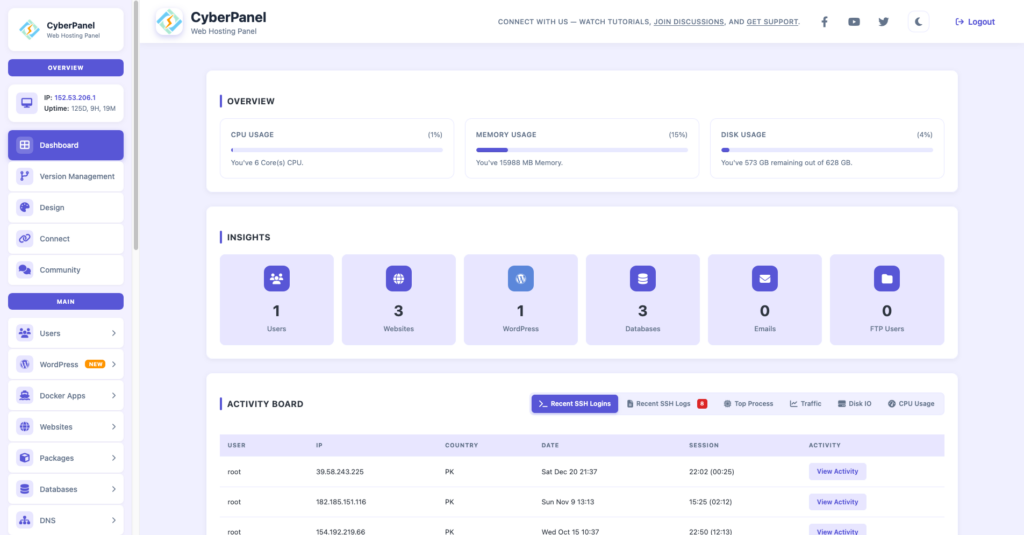
This is especially important if you are searching for a Scientific Linux VPS because you want to host websites.
Scientific Linux should not be your choice for a new CyberPanel deployment.
CyberPanel is a free and open-source web hosting control panel. It is designed to run on supported operating systems. An obsolete distribution creates unnecessary dependencies and compatibility problems.
A better setup is:
VPS
↓
Supported Linux Distribution
↓
CyberPanel
↓
OpenLiteSpeed
↓
Websites
Instead of:
VPS
↓
Scientific Linux 7
↓
CyberPanel
If your goal is to build a modern VPS hosting environment, start with a supported OS and then install CyberPanel on top of it.
CyberPanel can be particularly useful when you want to manage websites, databases, SSL, DNS, PHP, email-related services, and server resources from a web-based control panel.
Why Does the OS Matter for a VPS?
A VPS gives you the server resources, but the operating system determines much of the software environment running on those resources.
Your OS affects:
- Security
- Package availability
- Kernel support
- Software compatibility
- Control-panel compatibility
- Performance
- Maintenance
- Long-term reliability
This is why choosing a VPS should not be based only on RAM, CPU, or storage.
A powerful VPS running an obsolete operating system is still a poor production server.
Scientific Linux for Scientific Computing
Scientific Linux earned its reputation because it solved a real problem.
Scientific environments often contain software that is difficult to replace.
Imagine a research project with:
- Hundreds of servers
- Custom scientific applications
- Specialized libraries
- Research scripts
- Automated workflows
- Years of stored data
Changing the operating system can affect all of these components.
That is why stable Linux distributions have always been valuable in scientific computing.
The end of Scientific Linux does not change that need.
It simply means modern research environments need to use actively maintained alternatives.
What Happens to Old Scientific Linux Applications?
You do not necessarily have to throw away old software when migrating.
A better strategy is to separate the application from the old operating system.
For example:
Old Scientific Linux Application
↓
Test dependencies
↓
Build new environment
↓
Test application
↓
Migrate to modern OS
If migration is difficult, virtualization or containers can temporarily preserve the old environment.
This approach is much safer than keeping an obsolete server permanently exposed to the Internet.
Scientific Linux Review: Is It Worth Using?
Scientific Linux deserves credit for what it achieved.
It provided a stable Enterprise Linux platform for scientific institutions and became closely associated with serious research environments.
Its biggest strengths were:
- Stability
- Enterprise compatibility
- Scientific focus
- Institutional adoption
- Familiar Linux administration
- Long-term software environments
But a review written today must also consider its lifecycle.
The biggest weakness is simple:
Scientific Linux is no longer maintained.
So the answer depends on what you want to do.
| Use case | Verdict |
| Learn Linux history | Good |
| Study old scientific environments | Good |
| Run legacy software | Possible |
| Reproduce an old research environment | Useful |
| New desktop installation | No |
| New VPS | No |
| Production website | No |
| Modern hosting | No |
| CyberPanel deployment | No |
Scientific Linux vs Modern Linux
Scientific Linux was built around a different era of Linux administration.
Modern server users usually expect:
- Current security updates
- Modern kernels
- Container support
- Cloud compatibility
- Automated deployment
- Current programming languages
- Active repositories
- Modern control panels
Scientific Linux cannot provide that as a current distribution.
That does not make it a bad operating system.
It makes it an obsolete operating system.
That distinction matters.
Frequently Asked Questions
Is Scientific Linux the same as Ubuntu?
No. Scientific Linux was an Enterprise Linux distribution based on RHEL, while Ubuntu belongs to the Debian family. They use different package ecosystems and have different histories and administration models.
Does Scientific Linux have a newer version after 7.9?
No. Scientific Linux 7.9 was the final point release. There is no Scientific Linux 8 or Scientific Linux 9.
Can Scientific Linux be useful for old scientific software?
Yes. If an application was designed around Scientific Linux dependencies, preserving the old environment can make sense for compatibility or reproducibility. It should ideally be isolated from unnecessary network exposure.
Final Verdict
Scientific Linux was an important Linux distribution for scientific and research computing, but it is no longer a suitable choice for most new systems.
Its Enterprise Linux foundation, scientific focus, and adoption by research organizations made it valuable for laboratories and institutions that needed stable computing environments.
Today, however, Scientific Linux has reached the end of its lifecycle. Scientific Linux 7 was the final release, and its security support ended on June 30, 2024.
If you are maintaining an existing Scientific Linux machine, migration should be part of your long-term plan. If you need the old environment for scientific software, virtualization or containers can help preserve it while you modernize the underlying infrastructure.
If you are specifically looking for a Scientific Linux VPS, do not choose an obsolete VPS image simply because a provider still offers it. Start with an actively maintained Enterprise Linux distribution such as AlmaLinux or Rocky Linux.
And if your goal is CyberPanel hosting, choose a supported operating system first and build your CyberPanel server on top of it.
The practical takeaway is simple: keep Scientific Linux where legacy compatibility genuinely requires it, but use a supported Enterprise Linux distribution for every new production VPS, server, and hosting deployment.