On this page
BackBox Linux is a lightweight Ubuntu-based Linux distribution focused on penetration testing, security auditing, network analysis, vulnerability assessment, and digital forensics. This operating system is ideal for security specialists, students, researchers, and system administrators who want to use the selected tools for penetration testing and networking.
Unlike the standard Linux desktop, BackBox Linux is developed with a unique set of tools for cybersecurity testing. The tools are organized in the system to allow their regular use. Thanks to the lightweight XFCE interface and a set of useful tools, BackBox Linux can be used both as a standard computer for everyday use and for testing networks and systems in a specialized cyber security laboratory. When you are looking for the BackBox Linux download page, it is also worth comparing which Linux OS is better in the comparison of BackBox vs Kali Linux vs Parrot OS.
What is BackBox Linux?
BackBox Linux is an Ubuntu-based OS focused on security testing and analysis. It includes a set of tools for:
- penetration testing
- network analysis
- vulnerability assessment
- web application testing
- digital forensics
- wireless security testing
- information gathering
- password auditing
- security research
The OS uses the XFCE desktop environment, ensuring the reliability and lightness of the system.
The basic idea is simple:
Ubuntu Base
↓
BackBox Linux
↓
Security-Focused Desktop
↓
Testing and Analysis Tools
↓
Cybersecurity Workflows
This approach saves users from installing and configuring every security tool manually on a standard Linux installation.
Why Was BackBox Linux Created?
Security professionals often need many different tools during an assessment.
One application may be useful for network discovery, another for web testing, another for packet analysis, and another for vulnerability research.
Installing everything manually can take time.
BackBox brings many of these tools into one environment.
Instead of building a security workstation from scratch, you can install BackBox and start configuring your testing environment around your specific needs.
This makes it useful for both professional assessments and cybersecurity education.
What Is BackBox Linux Used For?
BackBox Linux can be used for many legitimate cybersecurity tasks.
Penetration Testing
Security professionals can use BackBox to assess systems and applications for weaknesses.
Network Security
Network administrators can use its tools to inspect traffic, analyze network services, and investigate security issues.
Web Security
BackBox can provide tools for testing web applications in authorized environments.
Vulnerability Assessment
Security teams can use vulnerability assessment tools to identify weaknesses before attackers find them.
Digital Forensics
Some tools can help investigators analyze systems and digital evidence.
Cybersecurity Education
Students can use BackBox in isolated laboratories to learn practical security concepts.
The important distinction is authorization. Security tools should only be used against systems you own or have explicit permission to test.
What Makes BackBox Linux Different?
BackBox does not try to be a general-purpose Linux distribution with every possible application.
Its focus is cybersecurity.
The project follows a relatively curated approach to security tools instead of simply filling the operating system with hundreds of applications.
This can make the environment easier to navigate.
| Feature | BackBox Linux |
| Base distribution | Ubuntu |
| Desktop environment | XFCE |
| Main focus | Cybersecurity |
| Architecture | 64-bit |
| Security tools | Yes |
| Penetration testing | Yes |
| Network analysis | Yes |
| Digital forensics | Yes |
| Virtual machine use | Yes |
| General desktop use | Possible |
Why Does BackBox Linux Use XFCE?
BackBox uses XFCE because a security workstation benefits from a lightweight desktop.
Security testing can involve several applications at the same time.
You might have:
- Multiple terminal windows
- A web browser
- Network monitoring tools
- A code editor
- Documentation
- A virtual machine
- Security applications
A heavy desktop environment can consume resources that could otherwise be used by these applications.
XFCE keeps the desktop relatively lightweight while still providing the graphical features most users expect.
This is one reason BackBox can work well on older or modest hardware.
What Tools Are Available in BackBox Linux?
BackBox includes tools covering several security categories.
Depending on the release and installed packages, you can work with tools related to:
| Category | Typical purpose |
| Information gathering | Collecting information about authorized targets |
| Network analysis | Examining networks and traffic |
| Vulnerability assessment | Finding potential weaknesses |
| Web application security | Testing websites and applications |
| Exploitation | Validating vulnerabilities in controlled environments |
| Wireless security | Assessing authorized wireless networks |
| Password auditing | Testing password security |
| Digital forensics | Investigating digital evidence |
| Sniffing | Analyzing network traffic |
| Stress testing | Testing system resilience |
The goal is not to use every tool simply because it is available.
A better approach is to understand the security problem first and then choose the appropriate tool.
Is BackBox Linux Based on Ubuntu?
Yes, it is.
The operating system is based on the popular Ubuntu platform. This means that the user gets the familiar Ubuntu environment with the added benefit of the security-centric tools and environment that BackBox provides.
The fact that BackBox is based on such a recognizable OS also means that learning to use it is not that difficult, especially for someone who is already familiar with the command line, apt-get, apt, repositories, and other Ubuntu-specific features.
For instance, many tasks in BackBox Linux are similar to the ones in Ubuntu, such as the following commands:
sudo apt updateAnd
sudo apt upgradeWhat Is the Latest BackBox Linux Version?
- The latest version of BackBox Linux is BackBox Linux 9.
- The OS is based on Ubuntu 24.04 LTS and the Linux 6.8 kernel.
- The tools and the desktop environment were also updated.
- The update is important for the security-focused OS, as it allows the developers to provide users with the latest security technologies.
Without constant updating, the tools within a security operating system would quickly become obsolete and ineffective.
What Are the BackBox Linux System Requirements?
BackBox is designed to be relatively lightweight.
The published minimum requirements for BackBox Linux 9 include:
| Requirement | Minimum |
| CPU architecture | 64-bit |
| RAM | 1 GB |
| Storage | 30 GB |
| Display | 800 × 600 |
These are minimum requirements, not necessarily ideal specifications.
If you plan to run virtual machines, browsers, large security applications, or multiple tools simultaneously, 8 GB or more RAM will provide a much more comfortable experience.
For serious lab work, additional storage is also useful.
How Do You Install BackBox Linux?
Installing BackBox Linux is similar to installing other Ubuntu-based distributions.
The general process is:
- Download the BackBox ISO.
- Create a bootable USB drive.
- Restart your computer.
- Boot from the USB device.
- Start the installer.
- Select your language and keyboard.
- Configure your disk.
- Create your user account.
- Complete the installation.
- Restart the computer.
If you are new to Linux security distributions, do not immediately replace your main operating system.
A virtual machine is usually a better starting point.
Can You Run BackBox Linux in a Virtual Machine?
Yes, and this is one of the best ways to learn BackBox.
You can run it using virtualization software and create a private security laboratory.
For example:
Your Computer
|
+—- BackBox Linux
|
+—- Test Linux VM
|
+—- Vulnerable Web Application
|
+—- Isolated Network
This gives you a safe environment where you can learn how security tools work without accidentally interacting with systems on the public Internet.
You can also create snapshots before experiments and restore them when something goes wrong.
Is BackBox Linux Good for Beginners?
BackBox itself is reasonably approachable for Linux users because it is based on Ubuntu and uses a familiar desktop environment.
Cybersecurity is the difficult part.
Someone who has never worked with Linux, networking, HTTP, DNS, TCP/IP, or system permissions may find the security tools confusing.
A better learning sequence is:
Linux Fundamentals
↓
Command Line
↓
Networking
↓
Web Technologies
↓
Security Fundamentals
↓
BackBox Linux
↓
Controlled Security Labs
Do not learn security by blindly running commands.
Understand what the command does, what information it produces, and why you are using it.
BackBox Linux vs Kali Linux
BackBox Linux and Kali Linux are often compared because both target cybersecurity users.
However, they have different approaches.
| Feature | BackBox Linux | Kali Linux |
| Base | Ubuntu | Debian |
| Main purpose | Security assessment | Penetration testing |
| Desktop | XFCE | Multiple desktop options |
| Approach | Curated security environment | Extensive security ecosystem |
| Resource usage | Lightweight | Depends on configuration |
| Beginner accessibility | Relatively friendly | Requires Linux/security knowledge |
| Security tools | Selected collection | Very extensive collection |
Neither distribution is automatically better.
If you prefer an Ubuntu-based, lightweight environment, BackBox can be a good choice.
If you want a very extensive penetration-testing ecosystem with broad community adoption, Kali Linux may be more suitable.
BackBox Linux vs Parrot OS
Parrot OS is another popular security-focused Linux distribution.
BackBox focuses heavily on maintaining a lightweight security workstation, while Parrot provides security, privacy, development, and everyday desktop functionality through different editions.
Your choice should depend on what you actually need.
| Use case | Suitable choice |
| Lightweight security workstation | BackBox |
| Large penetration-testing ecosystem | Kali |
| Security + privacy + daily use | Parrot |
| General Linux desktop | Ubuntu or Linux Mint |
Where Is the BackBox Linux Official Site?
If you are searching for the BackBox Linux official site, use the project’s own website rather than downloading an ISO from an unknown third-party source.
The official website is:
BackBox Linux Official Site: https://linux.backbox.org/
From there, you can find information about the distribution, releases, documentation, downloads, and project updates.
When downloading an operating system, using the project’s official distribution channel is especially important for security.
Avoid downloading security-focused Linux images from random file-sharing websites.
Is BackBox Linux Free?
Yes.
BackBox Linux is an open-source distribution and can be used without purchasing a traditional operating-system license.
You can install it on compatible hardware or use it in a virtual machine without paying for the operating system itself.
You may still have costs for:
- Hardware
- VPS resources
- Cloud infrastructure
- Commercial security services
- Training
- Enterprise software
The operating system itself does not require a standard commercial license.
Can BackBox Linux Be Used as a Daily Operating System?
Yes, technically.
BackBox can perform normal desktop tasks such as:
- Web browsing
- Programming
- File management
- Document editing
- Terminal work
- Media playback
However, you should ask whether you actually need a security distribution as your primary operating system.
If you only want a fast Linux desktop, Linux Mint or Ubuntu may be a better choice.
If cybersecurity is part of your daily workflow, BackBox becomes much more useful.
Can BackBox Linux Run on a VPS?
BackBox can technically be used in virtualized environments, but it is primarily designed as a security-focused desktop environment rather than a conventional server operating system.
For a normal VPS, distributions such as Ubuntu, Debian, AlmaLinux, or Rocky Linux are generally more appropriate.
A good architecture for authorized security testing might look like:
Security Workstation
↓
BackBox Linux
↓
VPN / Private Network
↓
Authorized Test Environment
Rather than exposing a security-testing workstation directly to the public Internet.
If you use a VPS for security testing, always check your provider’s acceptable-use policy and ensure your testing targets are authorized.
Can You Use BackBox Linux With CyberPanel?
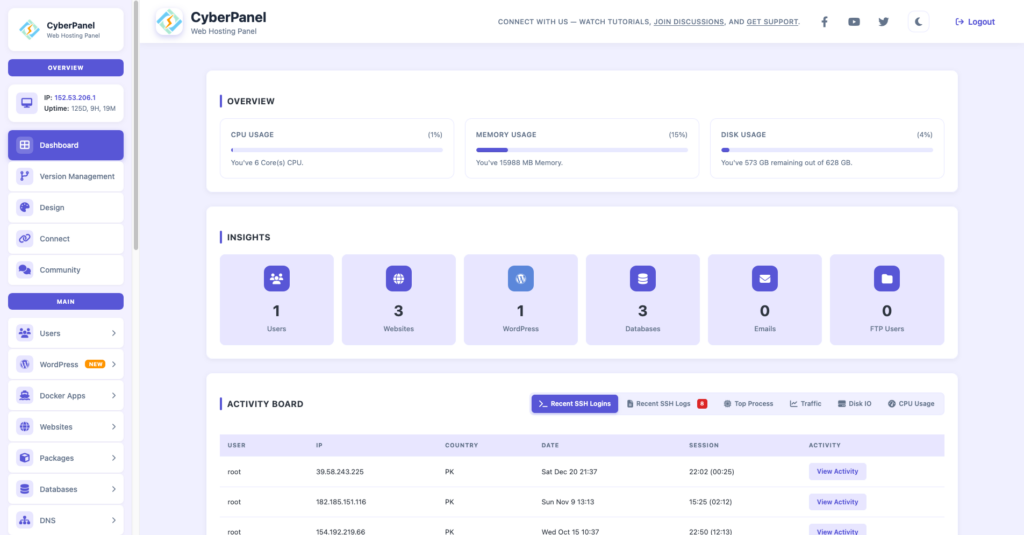
BackBox Linux and CyberPanel serve different purposes.
BackBox is designed for security assessment.
CyberPanel is a web hosting control panel.
A better setup is to use them separately:
CyberPanel VPS
↓
Websites
↓
Applications
↓
Production Hosting
BackBox Linux
↓
Security Testing
↓
Authorized Assessment
You can use BackBox to perform authorized security assessments against websites hosted on a CyberPanel server.
However, BackBox should not be selected as the operating system for a new CyberPanel production server simply because both are Linux-based.
For CyberPanel, choose an operating system supported by the panel and intended for server workloads.
What Are the Advantages of BackBox Linux?
BackBox has several strengths that make it attractive to security users.
Lightweight
The XFCE desktop keeps resource usage relatively low.
Ubuntu foundation
Users familiar with Ubuntu can adapt quickly.
Security-focused
The distribution is designed around cybersecurity tasks.
Curated tools
You do not have to manually build an entire security environment from scratch.
Virtual machine friendly
It works well as part of an isolated security laboratory.
Open source
The operating system is available without a commercial operating-system license.
What Are the Disadvantages of BackBox Linux?
BackBox is not perfect for every user.
Not necessary for ordinary desktop users
If you simply need a Linux desktop, a general-purpose distribution may be better.
Security tools require knowledge
Having a tool installed does not mean you understand how to use it safely.
Smaller ecosystem than some competitors
Kali Linux has a particularly large penetration-testing community and ecosystem.
Can be overwhelming
New users may see many unfamiliar security applications.
Not a typical server OS
BackBox is primarily designed around a security workstation rather than conventional production hosting.
Is BackBox Linux Safe?
BackBox Linux itself is a legitimate security distribution.
The bigger issue is how you use its tools.
Security-testing software can interact with networks, services, applications, and systems in ways that may be disruptive when used incorrectly.
For learning, create a controlled environment.
For professional work, obtain written authorization before testing.
A good lab might contain intentionally vulnerable machines that you own and can reset whenever necessary.
This allows you to learn without putting real systems or other users at risk.
Is BackBox Linux Worth Using?
If your goal is cybersecurity, yes.
BackBox provides a useful combination of:
- Ubuntu compatibility
- Lightweight desktop design
- Security tools
- Security-focused configuration
- Virtualization support
- A relatively clean interface
It is particularly attractive if you want a dedicated security workstation without building everything manually.
However, you should not install BackBox simply because it contains hacking tools.
The real value comes from understanding the technologies behind those tools.
Frequently Asked Questions
Can BackBox Linux run Windows applications?
Some Windows applications can run through compatibility layers such as Wine, but compatibility varies between applications. BackBox is not designed specifically to provide a Windows application environment.
Does BackBox Linux need an Internet connection?
You can use an installed BackBox system offline for many tasks. However, Internet access is useful for updating packages, downloading tools, accessing documentation, and working with legitimate remote testing environments.
Does BackBox Linux include every penetration-testing tool?
No. It provides a curated collection rather than every security application available for Linux. You can install additional software when required.
Final Verdict
BackBox Linux is a lightweight, Ubuntu-based cybersecurity distribution designed for penetration testing, security assessment, network analysis, vulnerability research, and digital forensics.
Its biggest strength is its focused approach. Instead of being a normal Linux desktop with security tools added afterward, BackBox is designed around security work from the beginning.
The XFCE desktop keeps the system lightweight, while its curated collection of tools gives security professionals and students a practical environment for authorized testing.
If you are new to BackBox, start with a virtual machine and build an isolated laboratory. Learn Linux, networking, web technologies, and security fundamentals before relying on advanced tools.
And if you were specifically searching for the BackBox Linux official site, use the project’s official website to obtain the distribution and check current project information.
For CyberPanel users, keep the two roles separate. Use CyberPanel on a supported server operating system for production hosting, and use BackBox as a dedicated security-testing environment.
The best way to get value from BackBox Linux is not to collect security tools. It is to understand what each tool does, test it in an authorized environment, and use the results to make systems more secure.