On this page
Regardless of being a home PC or a production server, every Linux machine at some point faces the inner hard drive storage shortage issues. Large logs, multiple backups, application data, and duplicated user files can take significant portions of the storage space, and it can be hard to guess what is taking the space without proper analysis. Thus, WinDirStat Linux was introduced!
The Windows counterpart of WinDirStat is one of the apps that can help you analyze the disk space, and many Linux users try to find “WinDirStat Linux” in hopes of finding an official port of the utility.
However, the reality is that WinDirStat only works on Windows, and while some tools may try to offer a solution via Wine, most Linux users will benefit from a variety of native Linux counterparts to WinDirStat.
If you are a Linux user thinking of using WinDirStat but unsure what to do since it is not available for Linux, then this guide is for you.
In this guide, I will first explain why you should not try to use WinDirStat on Linux and give you an overview of why there is no official Linux version of the utility.
After that, I will provide you with detailed information regarding the native Linux applications that act as substitutes for WinDirStat and help you choose the one that will suit you the most.
What Is WinDirStat Linux and Does It Exist?
Not really. While some unofficial ports may work, WinDirStat only officially supports Microsoft Windows. Furthermore, many Linux distributions do not offer Wine as a default utility, and running it requires additional configuration.
Linux has other tools that are perfectly suited for analyzing disk space consumption in Linux environments, and those tools are better in terms of both performance and usability than relying on the Windows binary.
Why Should You Use a Disk Usage Utility?
Disk space tends to fill up faster than you would expect. Multiple applications, ranging from web browsers to databases, require gigabytes of storage, while VMs, backups, containers, and logs eat up hundreds of gigabytes effortlessly. A tool like WinDirStat can help you with analyzing which of the files stored on your computer are taking up space, allowing you to:
- Easily delete the files that you do not need any longer
- Identify applications that have too much data
- Free up the disk space that was occupied by the unnecessary files
- Remove logs
- Delete backups that are no longer needed
- Delete old or useless data
- Manage your storage and disks more efficiently and effectively
In case you have a home computer or a server, the ability to keep track of your system storage consumption is a must-have.
Best Linux WinDirStat Alternatives
| Tool | Interface | Best For |
|---|---|---|
| Baobab (Disk Usage Analyzer) | GUI | GNOME desktops |
| Filelight | GUI | KDE Plasma users |
| QDirStat | GUI | Users wanting a WinDirStat-like experience |
| ncdu | Terminal | SSH and remote servers |
| Dust | Terminal | Modern command-line usage |
QDirStat
QDirStat is one of the closest alternatives to WinDirStat.
The software has a similar look to Windows applications and allows you to view the information about the largest folders in the system in the form of a graph.
Some of the best features include:
- Interactive treemap
- File cleanup
- Statistics about each directory
- Quick scan
- Multiple views of storage data
I think QDirStat is the most intuitive option for those who are used to working with Windows.
Baobab
This disk analyzer comes as a default solution in many Linux distributions that use the GNOME desktop environment.
The application only provides basic functionality but does it exceptionally well.
Some of the key features include:
- Easy navigation through a tree of directories
- Disk usage visualization in the form of a ring chart
- Directory scanning
- Quick navigation and folder cleanup
It is my favorite tool among the rest since it is intuitive enough for a Linux beginner.
Filelight
Filelight is a disk usage utility designed specifically for the KDE Plasma desktop environment.
The program visualizes the data in colorful radial charts. Unlike other tools listed above, Filelight does not utilize a treemap layout but offers a unique and bright alternative.
ncdu
Not every Linux system includes a graphical desktop.
Server administrators often connect through SSH, making graphical tools impossible to use.
In these situations, ncdu becomes one of the best choices.
Install it with:
sudo apt install ncduRun:
ncdu /After scanning, ncdu displays an interactive list of directories sorted by size.
You can navigate using your keyboard and immediately identify storage problems without opening a graphical application.
Comparing GUI and Terminal Tools
| Feature | GUI Tools | Terminal Tools |
|---|---|---|
| Easy for beginners | ✔ | Limited |
| Works over SSH | ✘ | ✔ |
| Graphical visualization | ✔ | ✘ |
| Low resource usage | Moderate | ✔ |
| Suitable for servers | Limited | ✔ |
Tips for Managing Disk Space on Linux
Finding large files on your system is one thing – the next challenge is deciding what to do with them, so that your valuable disk space is not wasted on unneeded stuff. Here are some tips for managing disk space:
- Delete old downloads to free up space
- remove unused packages and package caches
- archive old log files to prevent them from devouring your disks
- delete old Docker images
- clean up temporary files
- review your backup retention policy
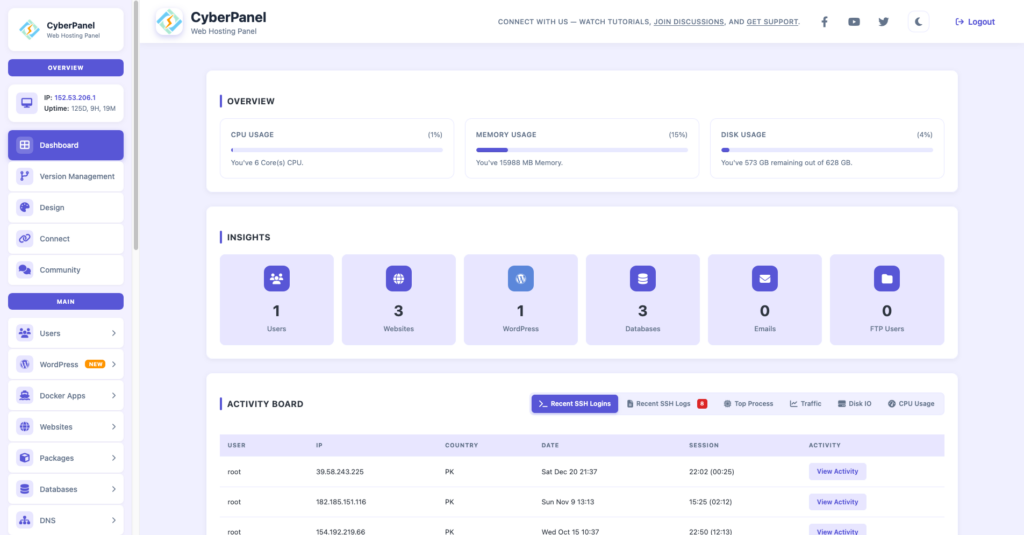
A little bit of regular maintenance will prevent your disks from getting overwhelmed. If your Linux system is not your personal computer, but a server, storage management tools might be even more crucial in keeping your system stable and efficient. CyberPanel is a web hosting control panel that allows you to manage your sites, databases, backups, and files – which means that it has some tools for storage management as well. While utilities like ncdude are great, they usually have to be launched from the command line – while CyberPanel provides a convenient GUI, which lets you manage not only your website but your server as well.
Which Tool to Choose?
It depends on your needs and your desktop environment. If you are looking for something similar to WinDirStat, QDirStat is probably the best choice, as it is actively developed and has a comparable UI.
If you are using GNOME, you might want to check out its built-in utility, Baobab. It is not as powerful, but it is intuitive and easy to use. Users of KDE should probably go with Filelight.
If you are managing a remote server, you might want to consider ncdude – it is very lightweight and simple to use, especially if you are already comfortable with the command line. Overall, I would recommend avoiding WinDirStat and going with native Linux utilities, which are usually optimized for the specific desktop environments.
Final Thoughts!
While Linux users will not be able to use WinDirStat, the good news is that there are many other options available. They might offer a similar experience, similar to the Windows utility, or they might require you to get comfortable with the command line. Either way, it is very important to make sure that your disks are not getting filled with unnecessary stuff, which will ultimately slow down your computer and/or cause system instability. So, pick your favorite disk usage analyzer for Linux and keep an eye on your storage consumption!
What disk usage analyzer do you use on Linux? Let us know in the comments below!
People Also Ask
Can I install WinDirStat directly on Linux?
No. WinDirStat is a Windows-only application. Native Linux alternatives provide better compatibility and performance.
Is ncdu suitable for beginners?
Yes. Although it runs in the terminal, its keyboard-based interface is simple to learn and works well on remote systems.
How often should I check disk usage on Linux?
For personal systems, checking every few weeks is usually sufficient. On production servers, monitoring storage regularly helps prevent unexpected outages.
Which tool is most similar to WinDirStat for Linux?
QDirStat is generally considered the closest alternative because of its similar interface and treemap visualization.