On this page
Multiple applications can be easily run in Docker; however, managing access to each of these applications is not so easy. We are going to learn how to create Traefik Docker Compose file?
For example, you may have one application running on port 3000, another on port 8080, and yet another on port 5000, and you soon start to feel like your server is messy because ports are exposed, SSL certificates are missing, and overall, it feels like the security is weak.
This is where Traefik Docker completely changes the game.
Traefik is a modern reverse proxy built specifically for running inside containers. Traefik will automatically detect Docker services and route traffic to them accordingly. With an appropriate Traefik Docker Compose setup, you will simplify domain routing, HTTPS certificate management, and routing rules all into a single tidy architecture.
If you are looking for help on how to create a Traefik Docker Compose file, then this page will take you carefully through each subject step-by-step in simple-to-follow terms.
Let’s go!
What is Traefik?
Traefik is a modern reverse proxy designed for cloud-native environments.
In layman’s terms, Traefik:
- Routes traffic to the correct container
- Manage HTTPS certificates automatically
- Load balances traffic across services
- Interacts directly with Docker
Instead of manually creating and configuring Nginx or Apache, Traefik will auto-discover Docker containers and route traffic to them based on labels.
What are the Benefits of Using Traefik and Docker?
Using Traefik with Docker provides the following benefits:
- Automatic discovery of services
- Let’s Encrypt integrated SSL support
- No manual virtual host configs
- Scale-up easily
- Use the same clean routing rules
If you have multiple Docker Applications running, an application using Traefik is essential.
How to Create Traefik Docker Compose File (Step By Step Concise Overview)
The main components of a Traefik Docker Compose file will consist of:
- Setting up the Traefik Service
- Setting up the Network Config
- Creating a Volume for Certificates
- Docker Socket Access
- Port Mapping
Here is the basic structure for you:
services:
  traefik:
    image: traefik:v2.10
    command:
      - "--api.dashboard=true"
      - "--providers.docker=true"
      - "--entrypoints.web.address=:80"
      - "--entrypoints.websecure.address=:443"
    ports:
      - "80:80"
      - "443:443"
    volumes:
      - "/var/run/docker.sock:/var/run/docker.sock:ro"
This enables Traefik to:
- listen on ports 80 and 443
- detect Docker containers
- route traffic automatically
How Traefik Docker Compose Works?
You will get controlled routing using lables inside each service with Traefik Docker Compose:
For example:
This enables Traefik to:

listen on ports 80 and 443

detect Docker containers

route traffic automatically
This tells Traefik:
- enable routing for this container
- use domain example.com
- route via HTTPS
You do not manually configure reverse proxy files. Traefik reads labels automatically.
Setup Traefik Docker Compose and Adding SSL Support
Automatic HTTPS with Let’s Encrypt makes Traefik a powerful tool for many uses.
When configuring Traefik in a Docker-compose scenario for SSL, the following items should be done:
- Enable the ACME configuration.
- Specify the email address for notification of the certificates.
- Mount a location for persistent certificate storage.
- Expose port 443.
Once all of that is done, Traefik will automatically:
- Request the appropriate certificates.
- Renew them automatically.
- Store them securely.
There is no need to manually install SSL.
Deployment Structure
You should follow this clean directory structure:
project/
│
├── docker-compose.yml
├── traefik.yml
└── acme.json
When is Traefik Needed?
Multiple Application Hosting
Different domains point to different Docker containers
Cloud VPS (Virtual Private Servers)
HTTPS certificates are provisioned automatically for app security
Microservices
Load-balancing incoming requests to microservices
SaaS (Software as a Service) projects
Easily manage creating subdomains
Great for environments where multiple services exist.
Common Misconfigurations When Configuring Docker Traefik
- Not properly mounting the Docker socket
- Exposing the Traefik dashboard publicly
- Forgetting to configure persistent certificate storage
- Improper label syntax on Docker containers
- Not configuring firewall settings
Small configuration mistakes can lead to routing not working properly.
What is CyberPanel’s Role with Traefik in Docker?
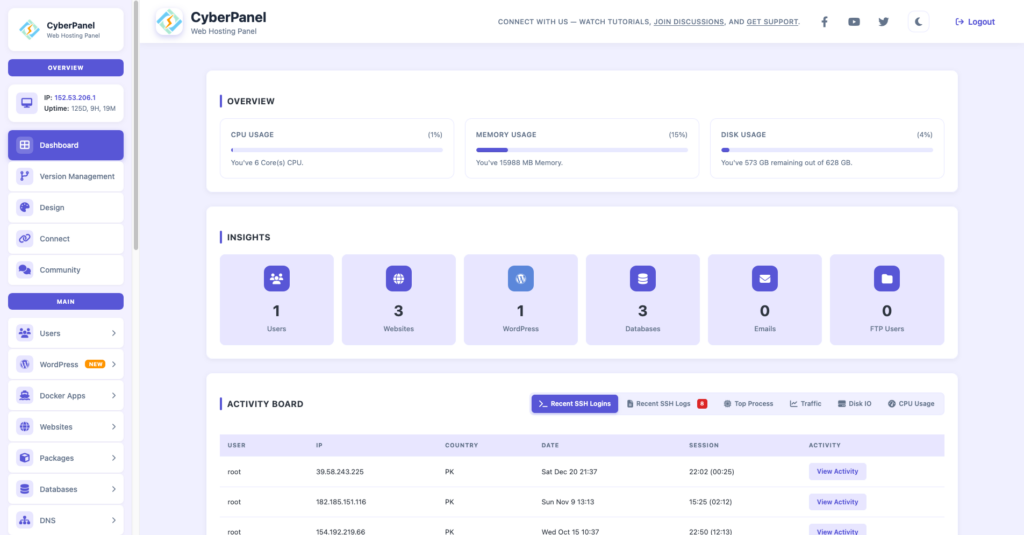
CyberPanel is free and open-source web hosting control panel. For VPS users deploying Traefik, CyberPanel is there to assist.
CyberPanel provides:
- DNS record management
- Firewall rules configuration
- Server performance monitoring
- System-level SSL management (if required)
- Domain infrastructure organization
While Traefik deals with routing containers, CyberPanel manages the entire server environment.
Together, CyberPanel and Traefik provide a secure and organized way to host your application.
Security Best Practices
- Secure the Traefik Dashboard
- Do not expose internal services to the public
- Implement strong firewall rules
- Restrict access to the Docker socket
- Regularly review your logs
Remember that reverse proxies are public entry points — handle them with care.
Traefik vs Traditional Reverse Proxy
| Feature | Traditional Proxy | Traefik Docker |
|---|---|---|
| Manual Config | Yes | No |
| Auto Discovery | No | Yes |
| Built-in SSL | Limited | Yes |
| Container Friendly | Low | High |
| Scaling | Manual | Automatic |
Final Thoughts!
To wrap it up, creating a Traefik Docker Compose file for running Docker Apps is an excellent infrastructure upgrade that will give you many benefits including but not limited to: automatic routing with Traefik, much simpler HTTPS set-up process, and much easier scaling of your apps.
Traefik will take away the need to manually manage ports for your Docker apps by doing it all for you; plus, when you add CyberPanel, it will provide you with a secured and professionally managed hosting environment.
So get started creating your Traefik Docker Compose file now! Start with just one test domain to enable HTTPS and secure your dashboard; after that you can migrate your other Docker apps (one-at-a-time) to behind Traefik to create a secure and scalable host.
People Also Ask
Can Traefik Docker work with Kubernetes?
Yes. Traefik supports Kubernetes as an ingress controller, making it suitable for container orchestration beyond Docker Compose.
Is Traefik suitable for high-traffic production environments?
Yes. It is designed for cloud-native workloads and supports load balancing and scalability features.
Can I use Traefik without Docker?
Yes. Traefik supports other providers like Kubernetes, file-based configs, and more, but it is most popular with Docker.