On this page
Are you still writing numerous Kubernetes YAML files and dealing with minor errors that end up breaking your entire deployment? That kind of frustration is the very reason why developers are moving towards Pulumi Kubernetes. Instead of simple, static, and cumbersome YAML, Pulumi allows you to manage your infrastructure as code. What it implies is that you can have loop conditions and components that can be reused, and cleaner logic.
Say goodbye to the copy-paste mess and the guessing game of what went wrong. Whether you are setting up your first Pulumi Kubernetes deployment, using a Pulumi Kubernetes custom resource, or finding real-world scenarios from Pulumi Kubernetes GitHub, this method will offer you a level of flexibility that YAML just cannot provide. If your goal is quicker deployments, neater organization, and greater control in your Kubernetes environment, this tutorial will lead you step-by-step to achieve that.
What Is Pulumi Kubernetes?
Pulumi is a modern infrastructure as Code tool. Kubernetes manages containerized applications. Pulumi Kubernetes means to use Pulumi to define and deploy Kubernetes resources using code like JS, Python, or Go.
It is important because:
- no more large YAML files
- use real programming logic
- reusable components
- better maintainability
Kubernetes Pulumi vs YAML
| Feature | YAML | Pulumi |
|---|---|---|
| Readability | Medium | High |
| Reusability | Low | High |
| Logic Support | None | Full |
| Debugging | Hard | Easier |
Example of Pulumi Kubernetes Deployment
Now, let’s have a simple example of how to deploy Pulumi Kubernetes using JavaScript:
const k8s = require("@pulumi/kubernetes");

const app = new k8s.apps.v1.Deployment("nginx", {
  spec: {
    selector: { matchLabels: { app: "nginx" } },
    replicas: 2,
    template: {
      metadata: { labels: { app: "nginx" } },
      spec: {
        containers: [{
          name: "nginx",
          image: "nginx",
          ports: [{ containerPort: 80 }]
        }]
      }
    }
  }
});Output:
- deployment created in cluster
- 2 replicas running
- nginx accessible internally
Pulumi Kubernetes Custom Resource
It allows you to manage CRDs, i.e., Custom Resource Definitions. Here is an example:
const crd = new k8s.apiextensions.CustomResource("example", {
  apiVersion: "example.com/v1",
  kind: "MyResource",
  metadata: { name: "test-resource" },
  spec: { key: "value" }
});You should use it to manage custom Kubernetes APIs. It can extend cluster functionality and integrate advanced tools.
Pulumi Kubernetes GitHub Projects
Many developers explore GitHub repositories to learn real implementations.
What You’ll Find
- ready-to-use templates
- deployment examples
- automation workflows
- reusable modules
Typical Workflow
- clone repository
- install dependencies
- run deployment
pulumi upCommon Mistakes to Avoid
Now, let’s discuss what mistakes to avoid:
Mixing YAML and Pulumi Poorly
Keep a clear structure.
Ignoring State Management
Pulumi keeps track of the state, so do not disrupt it.
Hardcoding Values
Make use of configuration files or environment variables.
Skipping Testing
Always test before deploying.
Role of CyberPanel in Modern Deployments
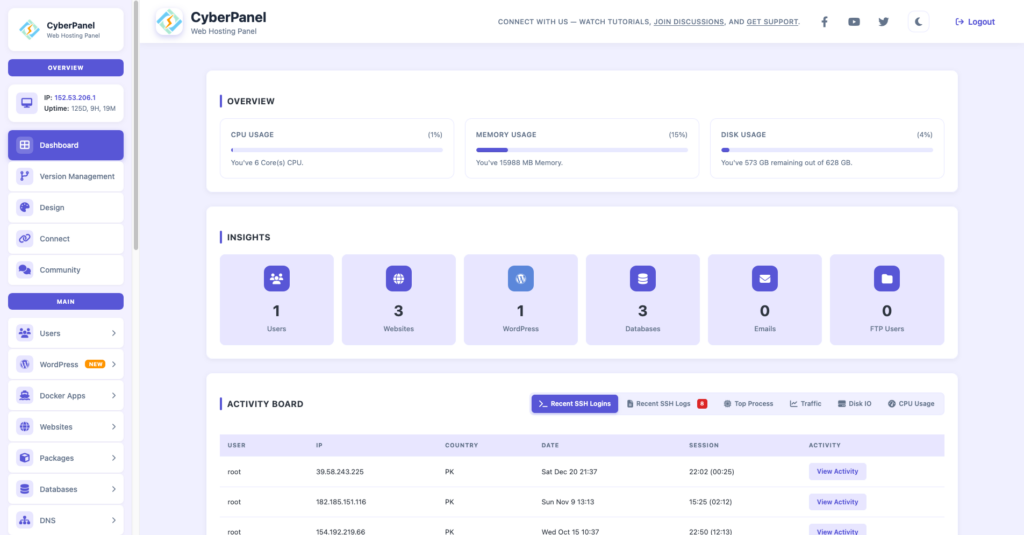
CyberPanel is your free and open-source web hosting control panel. It can be a great addition to Kubernetes environments that are being managed by Pulumi.
It assists with:
- domain management
- SSL configuration
- hosting applications
- monitoring
While Pulumi takes care of your infrastructure, Kubernetes runs your apps, and CyberPanel manages your hosting.
Benefits of Using Pulumi with Kubernetes
There are many reasons why using Pulumi with Kubernetes can be beneficial.
Real Programming Languages
Rather than learning a new domain-specific language or writing YAML files, you can write your infrastructure code in JavaScript, Python, or Go.
Reusable Code
You can package your infrastructure logic as components and reuse those components.
Better Debugging
You can leverage logs and standard tools.
Strong Automation
It can easily integrate with CI/CD pipelines.
When to Use Kubernetes Pulumi?
You should use it when:
- you are managing a large infrastructure
- you need reusable configurations
- you are working in DevOps teams
- you are automating deployments
You should not use it for very small projects where YAML is enough.
Final Thoughts!
Kubernetes management purely through YAML is somewhat manageable at smaller scales. But it gets quite challenging at larger scales. Pulumi Kubernetes presents you with a fresh choice where you can work in your favorite general-purpose language for your infrastructure.
Whether it is a basic Kubernetes deployment or highly detailed Kubernetes custom resource operations, Pulumi offers the features you need for flexibility, capability, and control.
Checking out Pulumi Kubernetes GitHub repositories is a good idea if you want to get up to speed quickly and also pick up the best ways to work in real scenarios.
Start your first Pulumi Kubernetes project today, replace repetitive YAML with clean code, and build scalable infrastructure that is easier to manage and reuse!
FAQs
Can Pulumi be used in CI/CD pipelines?
Yes. It integrates well with CI/CD tools for automated deployments.
Is Pulumi better than Terraform for Kubernetes?
Pulumi is preferred when you want to use programming languages instead of HCL, especially for complex logic.
Which programming languages can I use with Pulumi?
You can use JavaScript, TypeScript, Python, Go, and C#.