On this page
Do you think Kubernetes is hard and makes you fail at it? The good news is you can ace it. However, it depends on the system you choose. It happens that you install something quickly, and it works for the demo. But after that, everything starts breaking when you try to scale. And you start to feel that Kubernetes is cumbersome as you get everything messed up. Introducing Charmed Kubernetes to change the game.
Charmed Kubernetes lets you be free. It gives you an automated and production-ready system powered by smart orchestration. In this article, we are going to learn about it and also know how it is different from MicroK8s.
Ready to know what actually matters when you are building real systems? Let’s learn together!
What is Charmed Kubernetes?
Charmed Kubernetes is a fully automated Kubernetes distribution. It is designed for production environments. It has an operator-based model to deploy and manage every part of your cluster. It means you define what you need. The system is here to handle how it runs. Here is how it makes a difference:
- It offers automated deployment of cluster components.
- It possesses built-in lifecycle management.
- It provides consistent configuration across nodes.
- It offers easy scaling without manual fixes.
Working of Canonical Charmed Kubernetes
Canonical built Charmed Kubernetes on a model-driven approach. It avoids static configuration files. It controls everything through relationships between services. It means you don’t manage servers but relationships. Here is an example flow for you to know why it is often used in production systems:
- Define cluster model
- Deploy services using operators
- System auto-connects components
- Cluster runs with minimal manual input
Juju Charmed Kubernetes: The Brain Behind It
Juju uses charms, i.e., operators, to manage services. It powers Charmed Kubernetes. Here is what Juju actually does:
- It deploys Kubernetes components
- It connects services automatically
- It manages updates and scaling
- It handles failures intelligently
MicroK8s vs Charmed Kubernetes
| Feature | MicroK8s | Charmed Kubernetes |
|---|---|---|
| Purpose | Local & edge | Production |
| Setup Time | Minutes | Structured setup |
| Automation | Basic | Advanced |
| Scaling | Limited | High |
| Maintenance | Manual | Automated |
This table confirms that MicroK8s is for quick start and testing. On the other hand, Charmed Kubernetes is for long-term production stability.
When To Use Charmed Kubernetes?
You should use Charmed Kubernetes when:
- You are deploying production applications
- You need high availability
- You want automated updates
- You manage multiple services or clusters
You should not use it if:
- You need a quick local setup
- You are learning Kubernetes basics
How to Deploy Charmed Kubernetes?
Charmed Kubernetes deployment uses Juju to automate cluster setup. You don’t need to deploy manually. You just define and deploy using commands. Here are the steps to follow:
Step 1: Install Juju
sudo snap install juju --classicStep 2: Bootstrap Environment
juju bootstrap localhost my-controllerStep 3: Create a Model
juju add-model k8s-modelStep 4: Deploy Charmed Kubernetes
juju deploy charmed-kubernetesStep 5: Check Deployment Status
juju statusStep 6: Access Kubernetes Cluster
juju scp kubernetes-master/0:config ~/.kube/configNow test:
kubectl get nodesConfiguration of Charmed Kubernetes
After deployment, proper configuration makes your cluster production-ready. Here is how to configure:
1. Set Node Scaling
juju add-unit kubernetes-worker -n 22. Configure Networking
juju config kubernetes-master network-plugin=calico3. Enable Storage
juju deploy ceph-mon
juju deploy ceph-osd4. Configure Authentication
juju config kubernetes-master enable-dashboard-auth=true5. Enable Monitoring
juju deploy prometheus
juju deploy grafanaAdvantages of Charmed Kubernetes
Here are its benefits:
1. Automation That Saves Time
No need to configure each component manually.
2. Reliable Scaling
Add nodes without breaking your setup.
3. Consistent Environments
Same behavior across dev, staging, and production.
4. Built-in Lifecycle Management
Upgrades and patches are controlled and safer.
Common Mistakes to Avoid
These are the mistakes that can cost you later:
Treating It Like Basic Kubernetes
This system is model-driven. You need to think differently.
Ignoring Juju Concepts
Without understanding Juju, you lose its real power.
Overengineering Small Projects
Not every project needs this level of setup.
Skipping Architecture Planning
Automation does not replace good design.
Role of CyberPanel
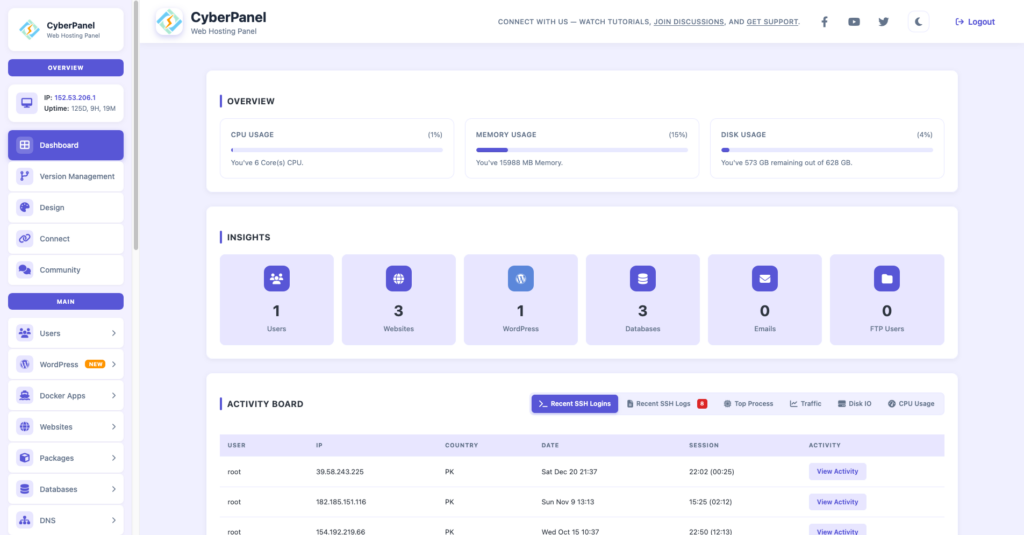
CyberPanel is your free and open-source web hosting control panel. It fits well when you host web applications alongside Kubernetes. Here is how it can help:
- You can manage domains and DNS
- You can configure SSL easily
- You can handle web hosting tasks
- You can also monitor application performance
Final Thoughts!
Kubernetes alone is very powerful. But the key is how you deploy it.
For example, if you pick something super fast like MicroK8s for a production workload, then you might be limited by the software. On the other hand, if you select something highly organized like Charmed Kubernetes, then you get automation, stability, and long-term control.
If you are working on a serious project, don’t just go with quick setups. Deploy a small Charmed Kubernetes cluster, look at Juju charms, and see for yourself how creating automated infrastructure really feels!
FAQs
How steep is the learning curve for Juju?
It has a learning curve, but once understood, it reduces long-term complexity significantly.
Can Charmed Kubernetes handle zero-downtime deployments?
Yes. With proper configuration, it supports rolling updates and high availability setups.
Does Charmed Kubernetes support GPU workloads?
Yes. It can be configured to support GPU-based workloads for AI and compute-heavy applications.