On this page
Open source AI tools for enterprises provide more control over deployment, but self-hosting is not a single technical decision. An enterprise may keep the application on its own infrastructure while still sending prompts to an external model provider. It may run model weights locally but export traces to a hosted monitoring service. It may also control every component and still lack the approvals, records and operating procedures needed for regulated work.
Instead of asking, “Can we install it ourselves?”, the better question is: “Which part of the AI system does this tool control, and what must our team still operate around it?”
The eight tools listed meet a higher standard than source-code availability alone. Each has an active project, a documented self-hosting path and a credible role in an enterprise architecture. They cover local and production model serving, governed AI agents, provider routing, retrieval, privacy, model lifecycle management and LLM observability.
They are not eight products that every company needs to install. Some are alternatives. Others become optional when a broader platform already includes the same function.
This guide reflects official project documentation available in September 2026.
On this page
- Ollama for controlled local model use
- vLLM for production model inference
- Polyant for governed enterprise AI agents
- LiteLLM for shared model-provider routing
- Qdrant for specialized vector retrieval
- Presidio for PII detection and anonymization
- MLflow for model and application lifecycle management
- Langfuse for LLM tracing and evaluation
A quick decision path
| If you need to… | Start with… | What it does not replace |
|---|---|---|
| Run open-weight models on controlled local infrastructure | Ollama | Shared enterprise governance and high-throughput cluster operations |
| Serve open-weight models with high throughput | vLLM | Cluster operations, agent governance and business workflows |
| Build and operate governed agents in enterprise processes | Polyant | Model weights, GPU infrastructure or a full ML training platform |
| Give many applications one gateway to model providers | LiteLLM | Agent orchestration, memory and process governance |
| Run large or specialized semantic-search workloads | Qdrant | Source permissions, document quality and the agent runtime |
| Detect and redact personal data | Presidio | Security policy, identity controls or legal review |
| Track models, experiments, evaluations and production traces | MLflow | The serving cluster or business application |
| Debug prompts, traces and LLM-specific quality | Langfuse | Enterprise policy enforcement and model serving |
One more distinction matters. Llama, Mistral and gpt-oss are models, not operating platforms. Some publish weights under licenses that permit commercial use, but an enterprise still needs a serving engine, access controls, monitoring, patching and a governed application around them. “Open-weight” and “open source” are not always legally or technically interchangeable.
What changed since 2025
By 2026, three patterns define the self-hosted enterprise AI stack. OpenAI-compatible APIs connect local runners, production inference engines, gateways and application platforms with less custom integration. GenAI tracing and evaluation are now established capabilities in products such as MLflow and Langfuse, not standalone experiments. At the same time, self-hosting has become a data-boundary question rather than a binary label, because a locally deployed application may still call hosted models, embedding services or telemetry endpoints.
The sequence below follows that division of responsibility. It starts with model serving, moves to the layer that turns model calls into governed work, then covers specialized data controls and evidence systems. The products do not all connect out of the box; the list is a decision map for enterprises evaluating open-source, self-hostable AI tools.
Layer 1: from a local model to a shared inference service
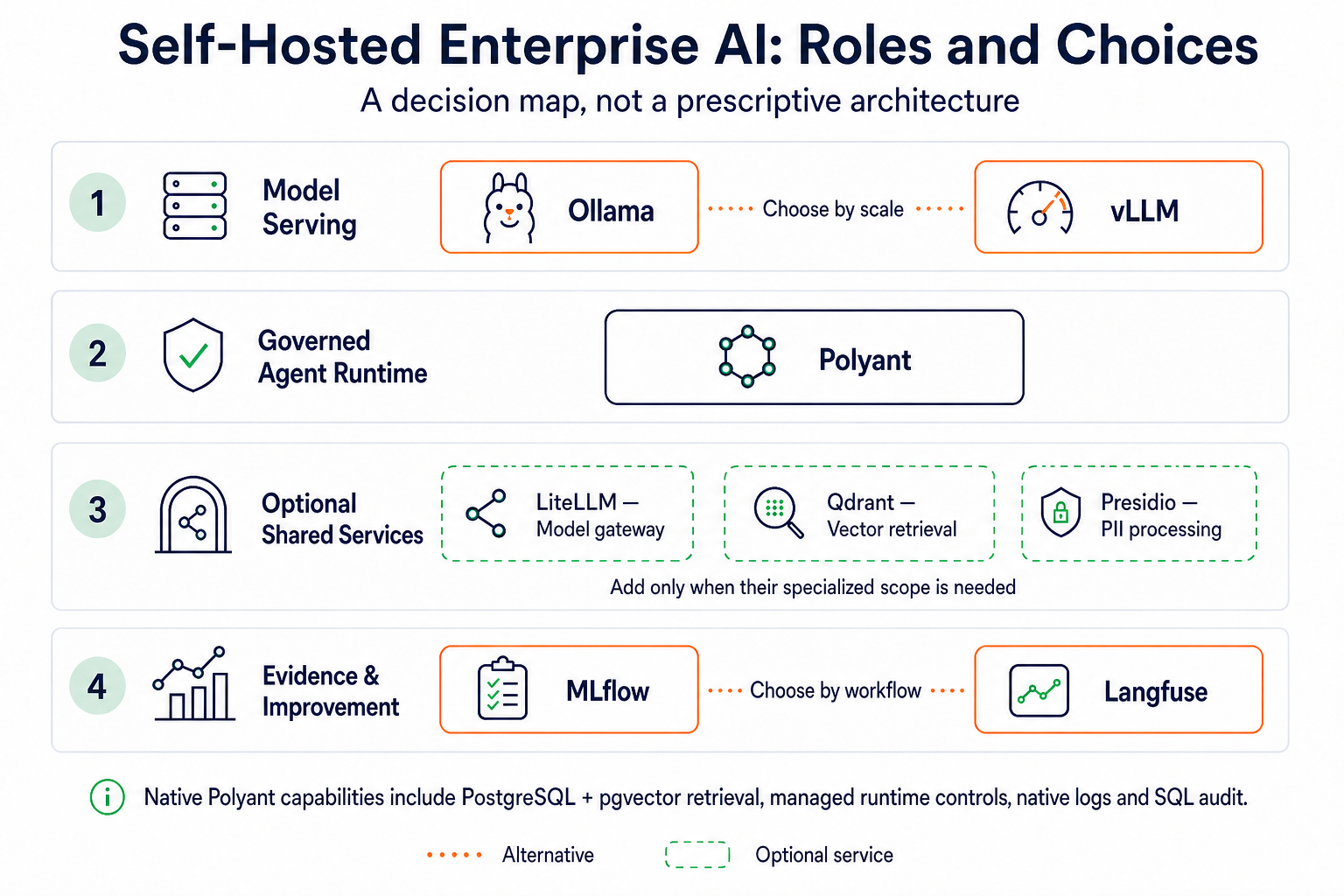
The first layer answers a narrow question: where does the model run, and how do applications call it? Ollama and vLLM solve this at different levels of scale.
1. Ollama: controlled local model use
Ollama is an MIT-licensed runtime for downloading and running open-weight models behind a local API. It works on developer machines, Linux servers and Docker, and it supports an OpenAI-compatible interface for tools that expect that API format.
Its enterprise role is specific rather than universal. Ollama gives developers and individual teams a simple way to evaluate models without sending every prompt to an external API. It can also support small internal services and isolated environments where ease of deployment matters more than cluster-wide scheduling.
Best fit: controlled development, confidential code assistance, local evaluation and small departmental workloads.
Closest alternative: vLLM. Choose Ollama for portability and a short path from download to first request. Choose vLLM when concurrent production traffic and GPU utilization matter more than local simplicity.
Operational trade-off: Ollama is not, by itself, a complete multi-tenant enterprise model platform. Identity, high availability, capacity scheduling, policy enforcement and centralized audit still need to come from the surrounding architecture. Its optional cloud models also change the data-flow boundary, so a local client does not always mean local inference.
2. vLLM: production model inference
vLLM is an Apache 2.0-licensed inference and serving engine for large language models. It exposes an OpenAI-compatible API and is designed for high-throughput workloads, including deployments that span more than one GPU or node.
Its role is narrow and important: vLLM turns model weights into a service that applications can call. It does not decide what an agent may do, maintain business memory, manage human approvals or produce compliance evidence.
Best fit: enterprises with an existing platform team that need to serve open-weight models at production traffic levels.
Closest alternative: Ollama. Ollama is simpler for local development and small internal deployments. vLLM is the stronger choice when concurrent traffic, GPU utilization and integration with a cluster control plane matter more than desktop simplicity. Enterprises already using Kubernetes can add a control plane such as KServe for declarative deployment, autoscaling and rollout management.
Operational trade-off: the license is free, but the GPUs, model storage, scaling policy, security updates and on-call ownership are not. The model also needs its own evaluation and approval process.
At this point the enterprise has a model endpoint. It does not yet have an agent that understands a role, uses approved tools, remembers business context, pauses for people or leaves a record of its decisions. That is the next layer.
Layer 2: from model calls to governed enterprise agents
3. Polyant: a governed enterprise AI agent platform
Polyant is a self-hosted enterprise AI agent platform for building and operating agents inside business processes. It can run on the customer’s own systems, including on-premises, in the customer’s cloud account or on infrastructure managed by Exelab in the EU. Its AGPLv3 core is public, while managed profiles add runtime governance controls and operational support.
Polyant operates at the agent and application layer. It combines agent configuration, tools, channels, persistent memory, knowledge retrieval and a provider-aware AI gateway. Its currently documented model providers are OpenAI, Anthropic, AWS Bedrock and Nebius. Interactions, tool calls, model usage, costs and decisions are captured in a queryable audit registry, giving compliance teams direct evidence without relying on proprietary exports.
For regulated deployments, the useful distinction is between infrastructure control and complete data isolation. Self-hosting Polyant determines where the runtime, configuration, memory and audit records live. The chosen model and embedding providers still determine whether prompts or derived data leave that environment. That makes provider selection part of the same data-residency and digital-sovereignty decision.
Polyant’s integrated memory and retrieval layer reduces the need to deploy and govern a separate vector database. The managed profiles add controls for prompt injection, external domains, rate limits, credentials and personal data. The built-in PII gate can detect configured structured patterns and block or redact matching output. It is narrower than a general privacy-processing service, but it covers a common runtime requirement without adding another component. These capabilities can support AI Act documentation and review.
Best fit: Enterprises that need to retain control over how their AI agents are deployed and governed, avoid lock-in to a single model provider, and operate in regulated sectors or jurisdictions subject to stringent rules such as the EU AI Act and GDPR.
Closest alternative: assembling an agent framework, provider gateway, memory store, policy layer and tracing system as separate components. The deciding factor is whether the company wants maximum component-level choice or one operating layer with fewer integrations to own.
Operational trade-off: Polyant reduces the number of separate agent-layer components, but enterprises must still decide where the platform runs, which model providers process their data, and which operational responsibilities remain with their internal team or are assigned to Exelab.
Polyant already provides model selection and routing for the agents it runs. A separate gateway becomes useful only when model access must also serve other applications, teams and platforms. In that case, the gateway becomes shared infrastructure rather than a feature of one product.
4. LiteLLM: one gateway for many model providers
LiteLLM provides a shared interface to more than 100 LLM providers through an OpenAI-compatible API. Its gateway can centralize virtual keys, authentication, routing, retries, rate limits and spend tracking for many applications and teams.
This is useful when model access is an enterprise service in its own right. Applications call LiteLLM instead of implementing separate integrations for OpenAI, Anthropic, Bedrock, Azure, Google and self-hosted endpoints.
Best fit: a platform team that must govern model access across several unrelated AI applications.
Closest alternative: the provider gateway already built into an agent or AI application platform. If every workload runs through one platform that already handles provider choice, adding LiteLLM may create a second routing and policy layer without solving a new problem.
Operational trade-off: centralization creates a high-value control point and a high-value failure point. In March 2026, two malicious PyPI releases were published after a compromise in LiteLLM’s release process. The official proxy Docker image was not affected, and the project removed the affected packages and published remediation guidance within 40 minutes. An enterprise deployment should pin tested versions and immutable image digests, scan artifacts before deployment and keep gateway administration isolated.
Once the model and agent layers are in place, the next risk is the data they can retrieve and expose. Retrieval quality and privacy belong in the same architectural conversation: one decides what the agent can find, the other what it may pass on.
Layer 3: control what agents know and what they expose
5. Qdrant: specialized vector retrieval
Qdrant is an Apache 2.0 vector database and search engine written in Rust. It supports dense and sparse vectors, metadata filtering and hybrid retrieval, making it a candidate for retrieval-augmented generation systems with large or specialized knowledge collections.
Qdrant becomes valuable when retrieval is a distinct platform concern. It can serve several applications, support complex filtering and scale independently from the transactional database.
Best fit: enterprises with large RAG workloads, multiple embedding-driven applications or retrieval requirements that exceed an application’s built-in memory and search layer.
Closest alternative: PostgreSQL with pgvector. Pgvector usually means fewer moving parts when vectors belong to the same application data and the scale is moderate. Qdrant is a better fit when vector search needs its own performance profile, filtering model and operating lifecycle.
Operational trade-off: a vector database does not fix poor source material or missing access rules. Teams still need document ownership, permission-aware ingestion, deletion workflows, embedding-version management and tests that measure retrieval quality.
6. Presidio: PII detection and anonymization
Presidio is an MIT-licensed framework for detecting, masking, redacting and anonymizing personally identifiable information in text, images and structured data. It combines NLP, pattern matching and checksums, and it supports custom recognizers for internal identifiers such as customer or account numbers.
Presidio can run before a model request, before data is written to a trace, or as part of the ingestion pipeline. That makes it useful when privacy controls must apply across more than one AI application, across images and structured data, or require custom recognizers beyond an application’s built-in patterns.
Best fit: organizations that need a shared, customizable PII-processing service across languages, data types and applications. Enterprises running multilingual agent deployments often pair Presidio with a separate open source localization platform to manage translated prompts, UI strings and agent-facing documentation, since PII detection and content localization are distinct problems that happen to share the same multilingual surface area.
Closest alternative: PII controls built into the application platform or an existing enterprise data-loss-prevention service. Presidio is more flexible when the team needs custom recognizers and control of the processing pipeline.
Operational trade-off: Presidio’s own documentation warns that automated detection cannot guarantee that every sensitive value will be found. Its API also needs to be placed behind the organization’s authentication, network and rate-limiting controls. It should reduce exposure, not replace threat modelling or human review.
An agent can now run, retrieve approved knowledge and reduce the risk of exposing personal data. The final responsibility is evidence: which model and prompt were used, what happened inside the request, what changed between versions and whether quality improved. Polyant already provides native operational logs and an audit trail, alongside documented per-instance LangSmith tracing. MLflow and Langfuse are presented below as independent alternatives when an organization wants a broader or separately operated evidence system, not as native Polyant integrations.
Layer 4: create an evidence and improvement loop
7. MLflow: model and AI application lifecycle management
MLflow is an Apache 2.0 platform for tracking experiments, managing model versions and evaluating AI applications. Its current GenAI features capture complete traces, including retrieval and tool steps, and can score production traces for quality, latency, safety and cost. MLflow reports more than 30 million monthly downloads (MLflow’s own materials cite figures as high as 60 million as of mid-2026), a useful signal that it is already embedded in many data and ML workflows.
Best fit: enterprises that need one system of record across traditional machine learning, foundation models and agent applications.
Closest alternative: a purpose-built LLM observability product such as Langfuse. MLflow is the stronger choice when model registry, experiments and the wider ML lifecycle matter alongside prompts and traces.
Operational trade-off: useful evidence is not automatic evidence. Teams must define evaluation datasets, approval states, owners and retention rules. A model registry can record a decision, but it cannot decide whether the model is acceptable for a regulated use case.
8. Langfuse: LLM tracing and evaluation
Langfuse is an LLM engineering platform for traces, evaluations, prompt management, datasets and metrics. The core is MIT-licensed, with separate enterprise features. Docker Compose is intended for testing and low-scale deployments; production-scale options include Kubernetes and official Terraform templates for AWS, Azure and GCP.
Langfuse records prompts, responses, retrieval steps, tool calls, latency, token usage and evaluation scores. This narrower LLM focus can make debugging agent behavior faster than retrofitting a general application-monitoring system.
Best fit: teams whose main problem is improving the behavior, cost and reliability of LLM applications rather than managing a broad model-training lifecycle.
Closest alternative: MLflow. Choose Langfuse for LLM-specific traces, prompt workflows and evaluations. Choose MLflow when those records must sit beside experiments, model versions and traditional ML assets.
Operational trade-off: self-hosting adds ClickHouse, object storage, upgrades, backups and retention planning to the team’s responsibilities. The open-source deployment also sends anonymized usage telemetry by default, although the project documents how to disable it. Review the open-source and licensed feature boundary before setting the enterprise architecture.
Build the smallest stack that meets the control objective
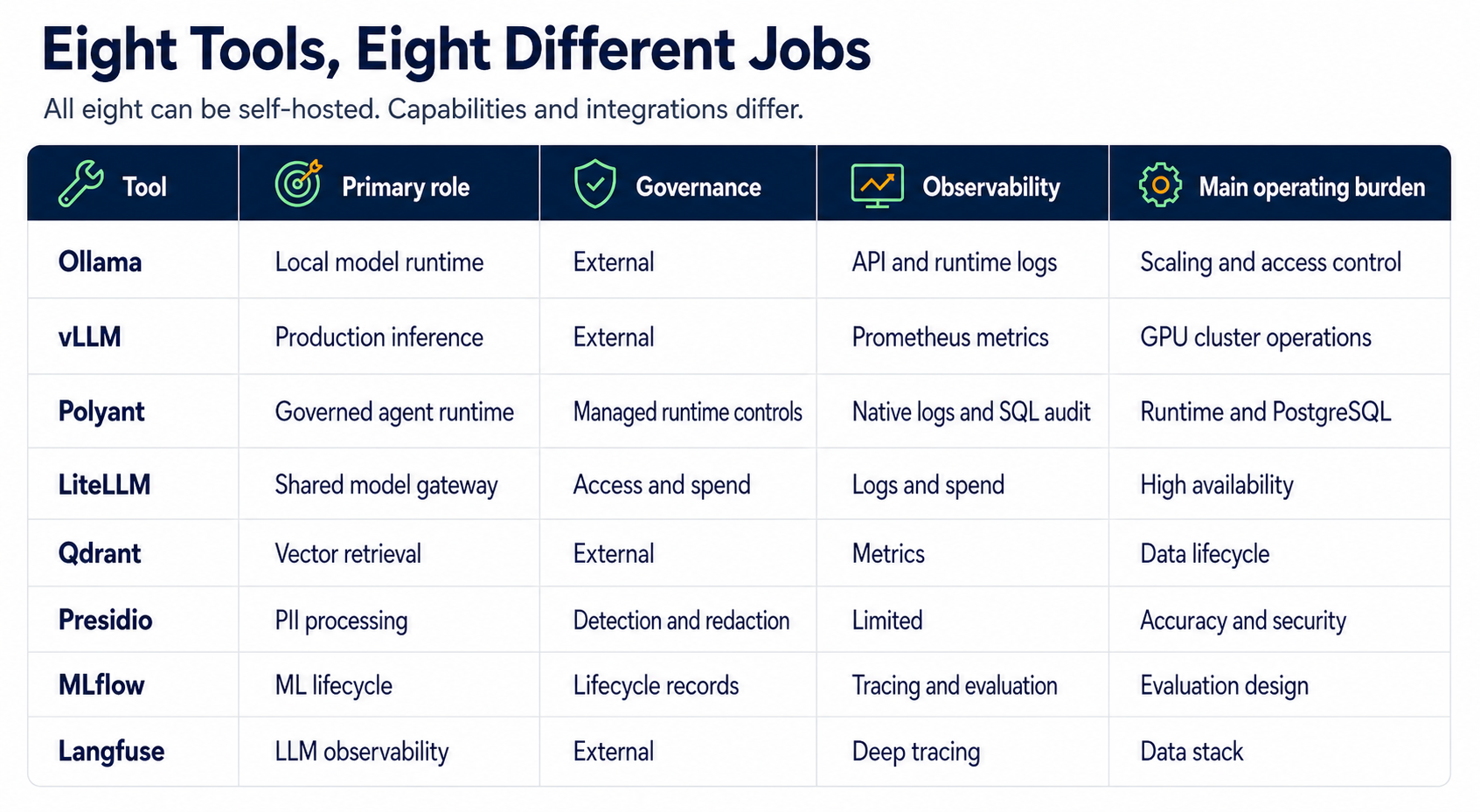
An enterprise stack does not become safer because it contains more open-source products. Every extra service adds identities, secrets, upgrades, logs, backups and failure modes.
Start with the control objective. Ollama can cover local evaluation and smaller controlled workloads. If the company must operate its own model weights at scale, vLLM can provide the inference service, with KServe as an optional Kubernetes control plane. If it needs agents that work inside governed processes, Polyant provides the application and operating layer through its documented model-provider integrations. Connecting a separate local inference service still needs an explicit, supported integration path. LiteLLM, Qdrant, Presidio, MLflow and Langfuse should be added only when their specialized capability is broader or deeper than what the chosen platform already provides.
Self-hosting creates options. Enterprise readiness comes from knowing who operates each option, what data crosses each boundary and which evidence remains available when an internal auditor or regulator asks how the system behaved.
Frequently asked questions
Does self-hosting guarantee data sovereignty?
No. It controls where the installed component runs. Data may still leave through model APIs, embedding services, telemetry, tracing exports, object storage or support processes. Map each data flow, not just each server.
Does an enterprise need all eight tools?
No. Ollama and vLLM usually address different deployment scales, while other components overlap. An integrated agent platform may already include routing, memory, retrieval, audit and basic observability. Add a specialized tool only when it meets a defined requirement that the current stack cannot meet.
What does open-source AI cost to operate?
The software license may cost nothing, but production ownership includes compute, storage, security patching, identity integration, backups, monitoring, incident response, evaluation and compliance work. Compare total operating responsibility, not only license fees.