
On this page
Have you ever thought about how DevOps teams generate clean and dynamic configs without repeating the same lines again? That’s where Ansible Jinja comes in. It mixes automation precision with template logic to build smart and repeatable setup scripts. Variables, loops, and conditions let systems generate files automatically instead of relying on fixed values.
Static setups rarely last in real work; server addresses shift. Environments evolve, while trying to write a new config every time causes delays and mistakes. Jinja-powered templates solve this by letting one define once and tweak across settings – cutting errors, speeding up delivery, and cleaning up the workflow.
Maintenance grows harder without responsive tools, although Ansible handles basic config tasks well, adding Jinja gives dynamic decision-making inside playbooks. Deployments become sharper, scaling becomes simpler, and changes stay predictable.
The guide walks through how loops, conditionals, and defaults function in practice. Real-world cases show how they’re applied directly in projects. Every example delivers clear outcomes so teams can plug them into daily operations right away.
What is Ansible Jinja?
Ansible Jinja is a templating system used in Ansible to create dynamic files. It uses Jinja2 syntax. It is there to insert a variable, apply logic, and generate output.
It is mainly used inside:
- Template files (
.j2) - Playbooks
- Variable transformations
Here is an example for you:
Template file (config.j2)
ServerName {{ server_name }}
Port {{ port }}Playbook:
- hosts: localhost
  vars:
    server_name: example.com
    port: 80
  tasks:
    - template:
        src: config.j2
dest: /tmp/config.confOutput:
ServerName example.com
Port 80How Does Jinja Ansible Templating Work?
It works by replacing variables and executing logic inside double curly braces or control blocks.
| Syntax Type | Example | Purpose |
|---|---|---|
| Variable | {{ var }} | Print value |
| Loop | {% for item in list %} | Iterate |
| Condition | {% if condition %} | Apply logic |
| Filter | `{{ var | upper }}` |
How to Use Ansible for Loop Jinja?
It allows you to iterate over lists or dictionaries. Here is an example:
Loop through users
{% for user in users %}
User: {{ user }}
{% endfor %}Playbook variables:
users:
  - Ali
  - Ahmed
- SaraOutput:
User: Ali
User: Ahmed
User: SaraHow to Apply Ansible Jinja Conditional Logic?
It allows decision-making inside templates. Here is an example:
{% if env == "production" %}
Debug False
{% else %}
Debug True
{% endif %}Variables:
env: productionOutput:
Debug FalseMultiple Conditions:
{% if user == "admin" %}
Full Access
{% elif user == "editor" %}
Limited Access
{% else %}
Guest Access
{% endif %}How to Use Ansible Jinja Default Filter?
The Ansible Jinja Default filter sets fallback values if a variable is missing. Here is an example:
{{ username | default('guest') }}If the username is not defined, the output would be:
guestCombining Loops, Conditionals, And Defaults
{% for user in users %}
{% if user.role == "admin" %}
Admin: {{ user.name }}
{% else %}
User: {{ user.name | default('unknown') }}
{% endif %}
{% endfor %}Variables:
users:
  - name: Ali
    role: admin
- role: userOutput:
Admin: Ali
User: unknownPractical Example: Dynamic Nginx Config
{% for site in sites %}
server {
    listen {{ site.port | default(80) }};
    server_name {{ site.name }};

    {% if site.ssl %}
    listen 443 ssl;
    ssl_certificate {{ site.ssl_cert }};
    {% endif %}
}
{% endfor %}Common Jinja Filters in Ansible
| Filter | Example | Output |
|---|---|---|
| upper | `{{ name | upper }}` |
| lower | `{{ name | lower }}` |
| default | `{{ var | default(‘x’) }}` |
| length | `{{ list | length }}` |
Best Practices for Ansible Jinja
Here are some best practices for you to follow:
- Design templates in such a way that they are easy to go through and understand
- Do not allow the complexity of conditions to result in extremely nested layers
- Come up with variable names that correspond to the content
- If there is a possibility of no value for the variable, it would be nice to provide a default so that the task won’t fail
- Logic and data must be kept separate as far as possible
What Does CyberPanel Contribute to Automation Workflows?
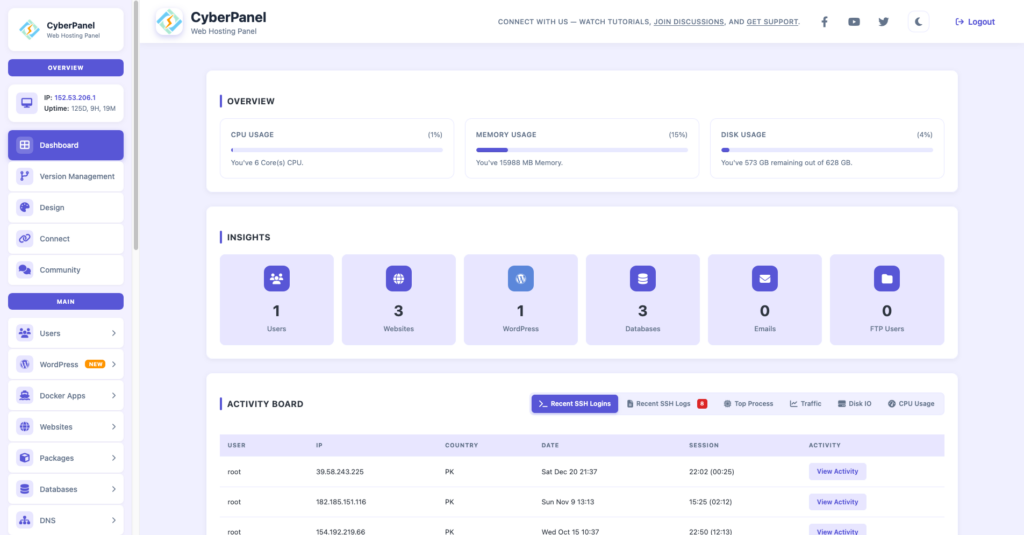
Efficiency in server management is a key concern that needs to be addressed when one gets involved in automations like Ansible.
CyberPanel can provide help in this area quite neatly.
CyberPanel is a free and open-source web hosting control panel based on the OpenLiteSpeed server engine.
It allows one to manage a server easily without compromising on the performance aspect.
Here is why you should use CyberPanel with Ansible:
- Automate website deployments using Ansible playbooks
- Manage domains, SSL, and databases easily
- Combine Jinja templates to generate configs dynamically
- Reduce manual server setup time
WorkFlow Example
- Make use of Ansible and Jinja templates to prepare configuration files
- Transfer them to a remote host
- CyberPanel takes over the hosting and performance management part
- This together will provide you with output:
- Fast execution
- Full oversight
Final Thoughts!
Templates get more powerful when Jinja handles loops and conditions. Real-world DevOps tasks like variable defaults and environment checks become smoother as a result. The result is less code, fewer errors, and cleaner control over changing infrastructures.
Begin with basic structures – simple variables and a few if statements. After that, layer in complexity using loops and nested logic. With CyberPanel alongside, it will have a setup that works both fast and reliably.
Speed comes from practice, not theory. The quicker one applies Jinja rules in actual playbooks, the sooner the automation feels professional.
Grab a starter template now and plug it directly into the Ansible workflow!
FAQs
What is the difference between Jinja and Ansible?
Jinja is a templating engine. Ansible is an automation tool. Jinja works inside Ansible to generate dynamic content.
Can I use Python logic in Jinja?
Jinja supports limited Python-like syntax but not full Python execution.
How do I debug Jinja templates?
Use ansible-playbook --check and debug module to inspect variables.
Is Jinja only used in Ansible?
No. Jinja is also used in Flask, Django, and other Python frameworks.